
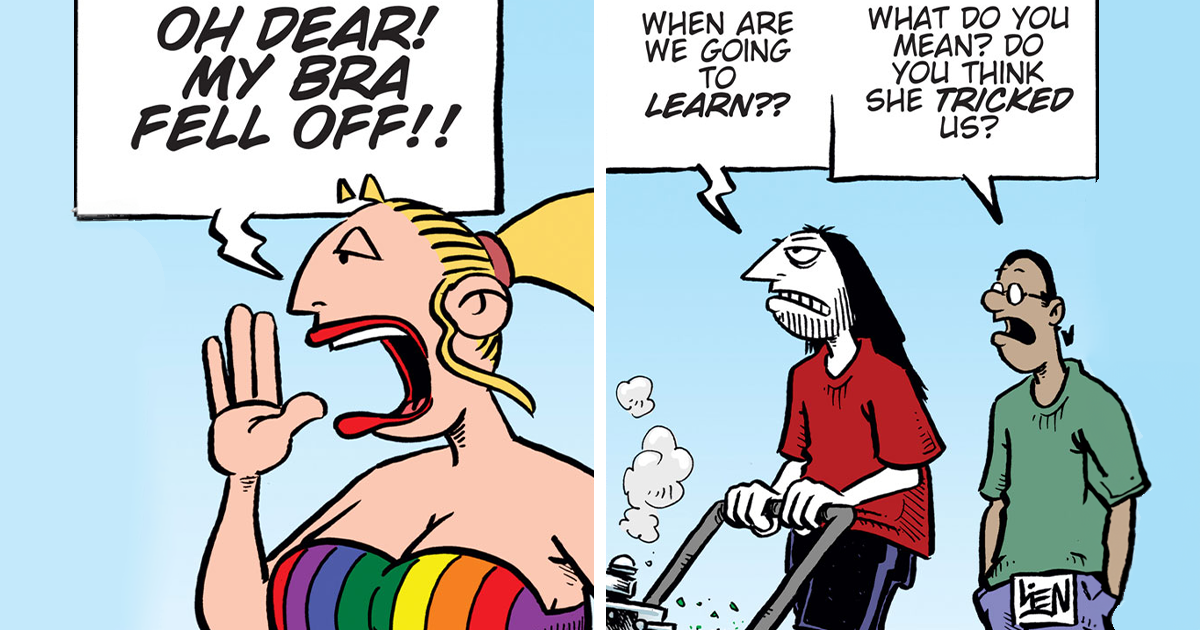
Life rarely collapses with cinematic elegance. More often, it unravels because someone misunderstood the assignment, trusted a suspicious recipe, spent the vacation budget before the honeymoon, or discovered that “a quick household chore” is a phrase invented by liars. Norwegian cartoonist Torbjørn Lien understands this quieter form of catastrophe exceptionally well.
Through Chez Cuckoo, the English-language version of his long-running Norwegian comic Kollektivet, Lien turns ordinary mistakes into compact stories packed with expressive characters, social friction, and wonderfully inconvenient consequences. His subjects range from relationships and parenting to religion, gender, money, alcohol, music, and the strange decisions people make when confidence arrives several minutes before common sense.
These 25 hilarious comics do more than deliver punchlines. They create a colorful portrait of imperfect people improvising their way through adulthoodand frequently improvising in the wrong direction.
Who Is Torbjørn Lien?
From Kollektivet to Chez Cuckoo
Torbjørn Lien is a Norwegian comics creator best known for Kollektivet, a humorous strip that debuted in 2000. The series originally centered on the clashing personalities living in a shared household. Over time, its world expanded to include families, romances, workplaces, children, musicians, former partners, and acquaintances who should probably never be left alone with either money or power tools.
The comic has appeared in newspapers, magazines, albums, collected books, holiday publications, and its own monthly magazine. Lien later introduced an English-language version under the name Chez Cuckoo, giving international readers access to the series’ distinctive mixture of Scandinavian humor, social satire, and domestic confusion.
A Cast Built for Comic Trouble
The strip’s longevity owes much to its ensemble cast. Ronny is a black-metal musician whose enthusiasm regularly exceeds his judgment. His son, Balder, possesses a vivid imagination and an admiration for his father that can make responsible adults nervous. Other recurring characters bring different beliefs, identities, romantic histories, ambitions, and insecurities into the same unpredictable orbit.
Lien has allowed these characters to develop beyond their original archetypes. That growth matters: a joke lands differently when readers understand who is being foolish, what that person wants, and why the approaching disaster feels inevitable.
25 Everyday Screw-Ups Given the Chez Cuckoo Treatment
1. Treating an Old Comic Book Like Disposable Clutter
One strip plays with the danger of underestimating an old comic book. To one person, it is a worn object taking up space. To another, it may be a treasured collectible. The setup captures a universal household mistake: throwing something away moments before learning it was valuable.
2. Discovering That “Classical” Is a Flexible Label
Lien enjoys collisions between generations and musical tastes. A conversation about classical music becomes fertile ground for misunderstanding when everyone uses the same term but imagines a different era. Yesterday’s rebellious soundtrack eventually becomes respectable culture, whether its original fans are emotionally prepared for that development or not.
3. Bringing Far Too Much Stage Gear
Musicians know that a supposedly simple performance can involve enough equipment to invade a small country. The comic about stage gear exaggerates that familiar urge to prepare for everything. Practicality quietly leaves the building while amplifiers, cables, instruments, and artistic confidence continue arriving.
4. Attempting to Fit Into a Wedding Dress
Wedding planning often combines optimism, deadlines, money, and clothing that refuses to negotiate. Lien turns the pressure surrounding a wedding dress into visual comedy, poking fun at unrealistic expectations without pretending that formalwear has ever respected human comfort.
5. Making Identity More Complicated Than It Needs to Be
When the comics address sexuality, the humor frequently comes from confused assumptions rather than identity itself. A seemingly straightforward conversation can expose how desperately people want human attraction to fit into tidy boxes. The joke reminds readers that labels may clarify experience, but other people can still misunderstand them with spectacular efficiency.
6. Being Poor With Impressive Creativity
Financial trouble is rarely glamorous, yet it produces remarkably inventive coping strategies. Lien’s treatment of being broke finds humor in the distance between what characters want and what their wallets permit. The result feels painfully familiar to anyone who has inspected a bank balance and immediately lowered their weekend standards.
7. Trying to Win an Argument at Any Cost
Arguments are often less about solving a problem than achieving the sacred status of “technically correct.” Lien captures the moment when logic becomes a blunt instrument and both participants forget why the disagreement started. Victory may be achieved, but peace has already packed a bag and moved out.
8. Overestimating One’s Skateboarding Ability
Skateboarding looks effortless when performed by someone who has practiced for years. This creates dangerous confidence in observers whose last athletic achievement was finding the remote without standing up. The comedy lies in the gap between the heroic move imagined and the medical questionnaire that reality may soon provide.
9. Outsourcing the Lawn in Questionable Ways
Mowing the lawn is simple until a clever person decides to make it easier. Then it becomes an engineering project involving persuasion, shortcuts, or a conveniently gullible helper. Lien treats laziness not as inactivity but as an intense creative discipline dedicated to avoiding 30 minutes of ordinary work.
10. Helping With Homework Without Actually Helping
Parents sometimes approach homework with great confidence, only to discover that school methods have changed or their memories have quietly resigned. A child asks for guidance; an adult provides confusion with authority. Few experiences expose the limits of grown-up competence faster than elementary-school math.
11. Turning Bisexuality Into a Logic Puzzle
Another identity-focused comic examines the assumptions surrounding bisexuality. The humor works by letting a character’s reasoning wander into absurd territory. Rather than delivering a lecture, Lien uses misunderstanding to show how strange social expectations appear when followed to their illogical conclusion.
12. Planning a Night Out That Becomes an Expedition
“Going out” can mean one quiet drink, three venues, an emotional confession, a missing jacket, and breakfast at an hour when responsible citizens are walking their dogs. Lien understands how quickly a modest social plan can collect complications until returning home feels like completing an international rescue mission.
13. Pretending to Understand a Painting
Art invites interpretation, but it also invites bluffing. Faced with a painting, people may confidently discover symbolism the artist never intendedor decide its primary function is matching the sofa. The comic finds the sweet spot between artistic seriousness and the blunt domestic question: where does this thing go?
14. Pursuing Delicious Chicken With Dangerous Commitment
Food can override caution, dignity, and occasionally basic social awareness. Lien’s chicken-related humor recognizes that a delicious meal can transform an otherwise reasonable person into a creature governed entirely by appetite. Civilization is sturdy, but apparently not when the seasoning is excellent.
15. Assuming Marriage Will Create a New Personality
Weddings change legal status, not factory settings. A partner who was disorganized, impulsive, or gloriously peculiar before the ceremony will probably remain so afterward. Lien’s relationship humor thrives on the optimistic belief that marriage includes a complimentary personality upgrade.
16. Seeing Things That May Not Be There
A suggestive shadow, an unusual shape, or an overactive imagination can turn an ordinary scene into something alarming. This comic uses visual uncertainty to pull the reader into the mistake. Once the mind recognizes a face or figure, it can become surprisingly difficult to persuade the brain to calm down.
17. Searching for a New Place to Live
Housing searches inspire a special vocabulary in which “cozy” means tiny and “full of character” means the plumbing has opinions. Lien pushes the stress of finding a home toward absurd escalation. The characters want shelter; the process offers financial panic, incompatible priorities, and surprises behind every door.
18. Cooking Without Respecting the Recipe
Recipes are instructions, but confident cooks sometimes treat them as unsolicited suggestions. One substitution leads to another until the final dish has only a distant genealogical connection to the original. Asking what went wrong is easy. The honest answer is usually “everything after the first paragraph.”
19. Going Broke on the Honeymoon
A honeymoon promises romance, scenery, and opportunities to forget how currency conversion works. Lien finds comedy in vacation spending, where every purchase seems reasonable in isolation. Only later does the couple discover that cocktails, souvenirs, and “once-in-a-lifetime” upgrades have formed a highly organized financial ambush.
20. Believing Wine Will Improve the Situation
Wine appears throughout adult social life as a celebration, consolation prize, and temporary answer to questions nobody wants to address. The comic plays with that reputation. The drink may soften the evening, but it can also encourage honesty to arrive without its usual supervision.
21. Designing a Bar Specifically for Women
A bar marketed toward women sounds straightforward until assumptions about gender begin shaping every detail. Lien uses the concept to expose stereotypes, relationship habits, and the strange confidence with which businesses imagine an entire demographic wants exactly the same experience.
22. Letting a Wedding Plan Drift Off Course
Weddings are carefully choreographed events performed by emotional human beings, so flawless execution is statistically ambitious. Lien’s wedding humor embraces the disruptions: mismatched expectations, uncomfortable traditions, questionable decisions, and relatives who treat the reception as an audition for their own reality show.
23. Invoking Elvis Presley as a Solution
Elvis remains a cultural shortcut for glamour, rebellion, Las Vegas, and decisions made while wearing unusually ambitious clothing. Introducing him into an everyday problem instantly raises the absurdity level. It is rarely the sensible solution, which is precisely why it belongs in a comic.
24. Returning From the Honeymoon to Ordinary Life
Coming home can be more revealing than leaving. The vacation glow fades, the bills arrive, and domestic routines resume before the suitcases are unpacked. Lien mines humor from the adjustment between romantic fantasy and everyday partnership, where affection must coexist with laundry and differing interpretations of “clean.”
25. Reading Something Better Left Unexplained
The final reading-themed comic demonstrates how words can cause trouble long after they are printed. A reader encounters unfamiliar language or material that demands an awkward explanation. Curiosity opens the door, embarrassment walks through it, and every adult nearby suddenly wishes literacy came with parental controls.
Why Torbjørn Lien’s Relatable Comics Work
Small Mistakes Carry Big Emotional Stakes
Lien rarely needs an apocalypse. A ruined dinner, failed argument, impulsive purchase, or romantic misunderstanding supplies enough pressure. Readers recognize the emotional stakes because they have experienced similar moments. The details may be exaggerated, but the embarrassment underneath them is genuine.
The Punchlines Grow From Character
The strongest Chez Cuckoo jokes do not feel interchangeable. Ronny’s response to a crisis differs from that of a practical parent, imaginative child, exhausted partner, or nervous friend. Familiar personalities help readers anticipate trouble while leaving room for the final panel to bend those expectations.
Absurdity Makes Difficult Subjects Approachable
Gender, religion, sexuality, money, family pressure, and social prejudice can produce tense discussions. Comedy creates enough distance to examine these issues without turning every conversation into a courtroom. Lien’s approach can be provocative, but it usually directs attention toward human inconsistency and poorly examined assumptions.
Experiences That Make These Everyday Screw-Ups Feel So Familiar
Reading these comics can feel like discovering that a cartoonist has been quietly checking everyone’s search history, family group chat, and kitchen trash can. The situations differ, yet the emotional sequence is remarkably consistent: confidence, decision, consequence, denial, andif personal growth is feeling energeticacceptance.
Consider the familiar experience of assembling furniture without reading the instructions. At first, the project appears insulting in its simplicity. There are four boards, several screws, and one tiny tool designed to punish the human wrist. Twenty minutes later, a shelf is backward, two mysterious parts remain, and the builder insists the wobble is an intentional Scandinavian feature. That is a Chez Cuckoo story waiting to happen.
Cooking offers another rich source of everyday failure. Nearly everyone has started a recipe before confirming that all the ingredients were available. This leads to substitutions made with the optimism of a game-show contestant. Yogurt replaces cream, crackers replace breadcrumbs, and an herb selected by color replaces one chosen for flavor. The meal eventually reaches the table, where everyone becomes extremely polite.
Social mistakes may be even more universal. A joke lands badly. A private message goes to the group. Someone waves enthusiastically at a stranger who was greeting the person behind them. The body may leave the scene, but the brain preserves the incident in high definition and schedules surprise screenings at 2 a.m.
Relationships produce screw-ups because two people can hear the same sentence and receive entirely different messages. “Do whatever you want” may sound like permission to one person and an approaching thunderstorm to another. Lien’s couples often make this communication gap visible, exaggerating it just enough to transform discomfort into laughter.
Money mistakes are similarly recognizable. A person may save carefully for weeks and then erase the achievement with one late-night purchase justified as an “investment.” Vacations intensify the effect because ordinary financial judgment struggles against scenic views and tiny decorative objects. At home, the souvenir becomes evidence in a case brought by the credit-card statement.
What makes these experiences funny later is perspective. During the disaster, nobody is composing a clever caption. They are searching for a missing screw, opening windows to release smoke, or wondering whether deleting a message can also erase it from another person’s memory. Time reduces the danger while preserving the absurdity.
That transformation is one of relatable comedy’s best tricks. It converts private embarrassment into shared recognition. Instead of thinking, “I am the only person incompetent enough to do this,” readers realize that mistakes are communal property. Everyone has misjudged an outfit, misunderstood instructions, overspent, overpromised, or attempted a physical activity based on memories from a younger spine.
Lien’s comics offer permission to acknowledge these failures without treating them as permanent character verdicts. The lesson is not that mistakes do not matter. It is that imperfection is often survivable, frequently instructive, and occasionally excellent material.
Conclusion: A Cheerful Tribute to Human Error
Torbjørn Lien’s 25 hilarious comics succeed because they recognize a basic truth: people are funniest when they are trying very hard to appear competent. Chez Cuckoo fills ordinary life with sharp observations, eccentric personalities, awkward conversations, and consequences that arrive at exactly the wrong moment.
Behind the black-metal jokes, relationship chaos, questionable cooking, financial regrets, and wedding disasters lies an unexpectedly warm idea. Screw-ups connect us. A person may live in Norway, the United States, or anywhere else, but the experience of confidently making a bad decision requires almost no translation.
Note: This article provides original commentary and thematic descriptions of the featured comics. Publishers should obtain permission from Torbjørn Lien or the appropriate rights holder before reproducing or embedding any Chez Cuckoo artwork.














