
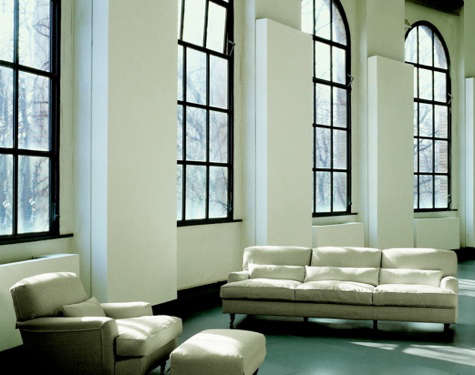
Some furniture enters a room and politely asks where it should sit. Furniture by Vico Magistretti for De Padova walks in, makes friends with the architecture, improves the lighting, and somehow convinces your coffee table to stand up straighter. That is the quiet magic of this collaboration: it does not shout, sparkle, or perform circus tricks. It simply works beautifully, year after year, while lesser pieces retire to the basement next to the broken printer.
Vico Magistretti, one of the great masters of Italian modern design, brought to De Padova a rare combination of architectural intelligence, everyday practicality, and dry Milanese wit. His furniture was never about decoration for decoration’s sake. A chair had to sit well. A table had to make sense. A bookcase had to hold books without behaving like a sculpture that resented literature. In the De Padova universe, Magistretti’s pieces became modern classics because they understood the home as a living place, not a showroom frozen in fear of fingerprints.
The phrase “Vico Magistretti for Studio De Padova” usually points to a rich period of collaboration between the designer and the De Padova brand, especially from the late 1970s through the 1990s. During this time, Magistretti created furniture that helped define the company’s visual language: elegant, useful, understated, and unmistakably Italian without needing to wave a tiny tricolor flag.
The Meeting of Two Design Minds
To understand why this collaboration mattered, it helps to understand De Padova itself. Founded by Fernando and Maddalena De Padova, the company began by importing Scandinavian furniture into Italy during the 1950s. That sounds normal today, but at the time it was a small revolution. Italian homes were being introduced to a lighter, cleaner, more democratic way of living: pale woods, honest forms, functional pieces, and a refreshing lack of visual shouting.
Maddalena De Padova had a sharp eye for design that was not merely fashionable but culturally useful. She understood that furniture could change how people behaved at home and at work. Her company later became known for bringing together international influences, Italian craftsmanship, and a refined editorial sense. Think of De Padova less as a furniture company and more as a highly opinionated host who knows exactly where every chair should go.
Vico Magistretti entered this world with perfect timing. Born in Milan in 1920 and trained as an architect, he had already become a major figure in Italian design through work for brands such as Cassina, Artemide, Oluce, Flou, Kartell, and others. His career moved easily between architecture, furniture, and lighting because he saw them as parts of the same conversation. A lamp, a room, a chair, and a city street all needed proportion, purpose, and human warmth.
Magistretti’s Design Philosophy: Simple, But Not Boring
Magistretti’s best furniture has a wonderful habit of looking simple at first glance and increasingly clever the longer you live with it. This is the difference between minimalism with brains and minimalism that merely forgot to eat breakfast. His pieces are reduced, yes, but never empty. They carry references to craft, architecture, travel, and daily life.
He loved essential forms, but he was not allergic to comfort. His work often began with a familiar object or practical observation: a classic chair proportion, a saddle curve, a screw, a modular shelf, a market basket. From that ordinary spark, he created something refined enough for a design collector yet useful enough for a busy family, a home office, or a dining room where spaghetti sauce occasionally behaves like abstract expressionism.
This is why Magistretti’s furniture for De Padova still feels current. It does not chase trends. It solves problems with grace. The pieces are quiet, but they are not timid. They are functional, but never dull. They look as if they have nothing to prove, which is usually the sign of something very well designed.
Vidun: The Table With a Giant Wooden Idea
Among Magistretti’s most recognizable De Padova designs, the Vidun table stands proudly at the center of the conversation. Designed in 1987, Vidun is a glass dining table with a sculptural wooden base. Its name comes from Milanese dialect and refers to a large screw. The concept is delightfully direct: the base resembles an oversized screw mechanism, transforming a technical detail into the emotional focus of the piece.
The transparent glass top is essential because it allows the base to remain visible. Without the glass, the table would lose its joke, its engineering, and its little wink to anyone who enjoys furniture with a brain. The base has been produced in natural beech, painted finishes, and walnut variations, with color combinations that add personality without turning the table into a carnival ride.
Vidun works because it makes structure visible. Many tables hide their engineering like a magician hiding the rabbit. Vidun does the opposite. It says, “Look, this is how I stand.” That honesty gives the design its charm. It is playful, but disciplined; sculptural, but useful; memorable, but not needy. In a dining room, it can anchor the space without making every dinner guest talk about furniture for three hoursunless, of course, you invite design people, in which case all bets are off.
Silver: The Modern Chair That Refuses to Age
The Silver chair, designed for De Padova in 1989, is another major chapter in the Magistretti story. Inspired by classic chair proportions and reimagined in aluminum and polypropylene, Silver is lightweight, durable, versatile, and unusually adaptable. It can work around a dining table, in an office, in a studio, or in public seating configurations. It is the rare chair that seems equally comfortable beside a laptop, a wine glass, or a mildly chaotic stack of mail.
Silver is not just one chair but a seating system, with versions including armchairs, armless chairs, stools, beam seating, and outdoor models. This flexibility is part of its genius. Magistretti understood that modern life does not keep furniture in fixed categories. Dining rooms become workspaces. Offices become homes. Balconies become cafés for one person and a suspiciously spoiled dog. Silver moves easily among those roles.
The chair’s materials also matter. Aluminum gives it lightness and structure; polypropylene adds practicality and resilience. The result is modern without being cold. It has enough visual restraint to blend into many interiors, yet enough identity to avoid becoming anonymous. That is a difficult balance. Many chairs either demand attention or disappear completely. Silver does neither. It stays present, useful, and calm.
Marocca: A Chair With Craft in Its Bones
Marocca, designed in 1987, shows another side of Magistretti’s De Padova work: his respect for traditional construction. Built in solid beech and often seen in a black painted finish, Marocca is a dining chair with arms that balances simple lines with careful craftsmanship. It has the confidence of a chair that knows exactly what it is doing.
The beauty of Marocca lies in its restraint. It does not rely on exaggerated curves or theatrical upholstery. Instead, it focuses on proportion, joinery, and presence. Around a large dining table, Marocca creates a sense of order and hospitality. It feels formal enough for a proper dinner and relaxed enough for someone to lean back after dessert and say, “Maybe just one more espresso.”
In SEO terms, one might call Marocca a “modern Italian dining chair,” a “wooden designer chair,” or a “Vico Magistretti De Padova classic.” In human terms, it is simply a very good chair: elegant, stable, and unlikely to embarrass you in front of your architect friends.
Raffles: Comfort With a Tailored Suit
Raffles, introduced in 1988, brings softness into the De Padova and Magistretti story. The upholstered armchair features a deep, inviting seat, relaxed lines, turned wooden feet on castors, and goose-down cushions. Pair it with the matching footstool and suddenly your living room has developed a strong opinion about afternoon reading.
What makes Raffles special is its balance of informality and elegance. It is comfortable, but it does not slump. It is generous, but not bulky. It has the air of a classic club chair translated through Italian modernism: less cigar smoke, more architectural intelligence. The castors add a small practical detail that keeps the piece from feeling static. Magistretti often knew when a small functional gesture could make a design more alive.
Raffles also demonstrates how De Padova furniture can be luxurious without becoming flashy. The luxury is in the proportions, materials, and relaxed confidence. It does not need shiny hardware or dramatic angles. It knows that true comfort is already dramatic enough after a long day.
Tani Moto and Shigeto: Storage That Behaves Beautifully
Magistretti’s work for De Padova was not limited to seating and tables. The Tani Moto modular bookcase, designed in 1991, reflects his talent for creating flexible systems. It can be assembled in different configurations, extended unit by unit, and used in living rooms or offices. With adjustable shelves and minimal lines, it turns storage into a quiet architectural element.
Tani Moto is especially relevant today because modern interiors demand adaptability. People move, downsize, expand, work from home, collect too many books, pretend they will stop collecting too many books, and then buy more books. A modular bookcase understands this human weakness and responds kindly.
Shigeto, designed in 1989, is a low sideboard in solid natural oak with chrome-plated castors. It is linear, compact, sturdy, and practical for organizing glassware, crockery, or objects. Like Tani Moto, Shigeto does not treat storage as an afterthought. It makes organization part of the room’s visual rhythm.
Both pieces show Magistretti’s architectural roots. He did not design furniture as isolated objects. He designed pieces that could participate in space. A bookcase becomes a wall. A sideboard becomes a horizon line. Storage becomes atmosphere. That is a very Milanese kind of poetry: elegant, useful, and probably wearing excellent shoes.
Incisa and Louisiana: The Saddle Becomes a Seat
Incisa, designed in 1992, is a swivel office chair with leather upholstery that recalls a horse saddle. Its hand-stitching highlights Italian craft traditions, while its curved back and sides create a comfortable, enveloping profile. Available with fixed or swivel bases, Incisa is a home office chair for people who want practicality without surrendering to the plastic throne of corporate despair.
Louisiana, designed in 1993, develops a related language in lounge-chair form. Its leather, stitching, removable inner lining, and optional footstool create a relaxation corner that feels crafted rather than manufactured. The saddle reference gives the chair a tactile richness. It suggests movement, body, and usenot just display.
These designs are particularly interesting because they connect modern furniture with older material traditions. Leather, stitching, saddlery, and curved support are not new ideas. Magistretti’s skill was to edit them into clean contemporary forms. He did not copy tradition. He translated it.
Why These Designs Still Matter
Furniture by Vico Magistretti for De Padova remains relevant because it solves a problem many modern interiors still face: how to be elegant without becoming stiff, and how to be comfortable without looking careless. His pieces are refined, but they invite use. They fit into contemporary homes because they were never trapped in a narrow visual trend.
For collectors, these pieces represent an important chapter in Italian modern furniture. For homeowners, they offer practical beauty. For designers, they are lessons in proportion, material honesty, and restraint. For everyone else, they are proof that a chair can be smart without making you feel underdressed.
The collaboration also matters because it reflects the best of De Padova’s identity. The brand has long been associated with a thoughtful mix of international influence, Italian production, domestic comfort, and modern clarity. Magistretti brought a deeply compatible voice to that identity. His furniture did not merely fill the catalog; it helped define the tone.
How to Use Vico Magistretti De Padova Furniture Today
In contemporary interiors, Magistretti’s De Padova pieces work best when allowed to breathe. Vidun, for example, deserves enough space for its sculptural base to be visible. Pair it with restrained dining chairs if you want the table to remain the star, or mix it with classics for a layered design conversation.
Silver chairs are excellent for flexible spaces. Use them in a dining area that doubles as a work zone, or choose the outdoor version for a terrace that needs design credibility without becoming precious. Marocca works beautifully in warmer rooms with wood, books, art, and soft lighting. Raffles belongs anywhere someone might realistically sit for longer than five minutes, which automatically makes it more useful than half the accent chairs on the internet.
Tani Moto and Shigeto are ideal for interiors that value order but dislike sterility. They can hold books, ceramics, glassware, or daily objects while keeping the room visually calm. Incisa and Louisiana bring leather and craft into home offices and reading corners, adding character without turning the space into a theme restaurant called “The Fancy Saddle.”
Buying and Collecting Tips
If you are considering vintage or contemporary De Padova furniture by Vico Magistretti, pay attention to condition, provenance, materials, and proportions. Authentic pieces should show the quality of construction associated with De Padova. For vintage examples, inspect joints, upholstery, castors, metal finishes, and any labels or documentation. A little patina can be charming; structural damage is less charming, especially when gravity gets involved.
Measure carefully before buying. Vidun, for instance, is visually light because of its glass top, but its base has presence. Raffles and Louisiana need room for their relaxed forms. Bookcases and sideboards should be planned around both storage needs and circulation. Great furniture becomes less great when everyone has to walk sideways around it like they are escaping a museum laser grid.
Also consider how the piece will interact with the rest of your home. Magistretti’s designs pair well with Scandinavian furniture, Italian modern classics, contemporary art, natural textiles, and architectural lighting. They do not require a full design shrine. In fact, they often look best when mixed with lived-in elements: books, ceramics, family objects, and the occasional blanket that refuses to fold attractively.
Experiences With Vico Magistretti for De Padova
Living with furniture inspired by Vico Magistretti’s De Padova work is less like owning a dramatic design object and more like having a highly competent roommate who never leaves dishes in the sink. The pieces are calm, intelligent, and quietly supportive. They do not dominate daily life; they improve it in small ways.
Imagine a Vidun table in a compact apartment. At first, the glass top makes the room feel open. Then guests notice the wooden screw-like base and lean closer. Someone asks if it adjusts. Someone else runs a hand along the wood. The table becomes a conversation starter without resorting to gimmicks. It has that rare quality of being both practical and memorable. Breakfast feels casual; dinner feels intentional. Even a laptop and a cold cup of coffee look slightly more cultured on it.
A Silver chair offers a different kind of experience. You appreciate it gradually. The first impression is lightness. Then you notice how easily it moves from desk to dining table. Then you realize it stacks, adapts, and survives daily use without making a fuss. In a home where rooms perform multiple jobs, that flexibility is gold. It is the chair equivalent of a friend who can cook, drive, fix Wi-Fi, and still arrive on time.
Raffles changes the pace of a room. Place it near a window, add a footstool, and suddenly the corner has a purpose. It invites reading, resting, and the noble domestic sport of pretending to read while actually taking a nap. The deep seat and soft cushions make it comfortable, but the tailoring keeps it elegant. It does not collapse into casualness; it relaxes with dignity.
Incisa and Louisiana add a more tactile experience. The saddle-like curves and visible stitching give the user a sense of contact with craft. These are pieces you notice with your hands as much as your eyes. Over time, leather develops character, and the furniture becomes more personal. That aging process is part of the pleasure. A perfect showroom surface can be impressive, but a well-used leather chair has stories. It knows who works late, who reads slowly, and who always says they will sit for “just five minutes.”
Tani Moto and Shigeto offer the experience of visual calm. They organize the objects of daily life without making the room feel rigid. A modular bookcase can grow with a collection. A low sideboard can hold practical things while maintaining a clean horizontal line. These pieces are especially valuable in homes where beauty and storage must negotiate a peace treaty.
The real experience of Magistretti for De Padova is not about owning famous names. It is about living with furniture that understands proportion, use, and atmosphere. These designs do not demand that you behave like a curator. They allow normal life to happen around them: meals, work, reading, conversation, clutter, cleaning, rearranging, and all the ordinary rituals that make a house feel human.
That may be the most important lesson. Great furniture does not need to freeze a room in perfection. It should help the room live better. Vico Magistretti’s work for De Padova does exactly that. It gives everyday life a clearer shape, a better seat, and occasionally a very handsome wooden screw.
Conclusion
Vico Magistretti’s furniture for De Padova remains a benchmark in modern Italian design because it combines intelligence, elegance, comfort, and practicality. Pieces such as Vidun, Silver, Marocca, Raffles, Tani Moto, Shigeto, Incisa, and Louisiana show how a designer can transform ordinary needs into enduring forms. A table becomes a sculptural idea. A chair becomes a flexible system. A lounge seat becomes a study in craft. A bookcase becomes architecture for daily life.
For anyone interested in modern furniture, Italian design, or timeless interiors, this collaboration is worth studying and, if possible, experiencing firsthand. Magistretti and De Padova shared a belief that good design should be useful, clear, human, and quietly beautiful. Decades later, that belief still feels fresh. Trends come and go, but a well-designed chair remains a very persuasive argument.













