
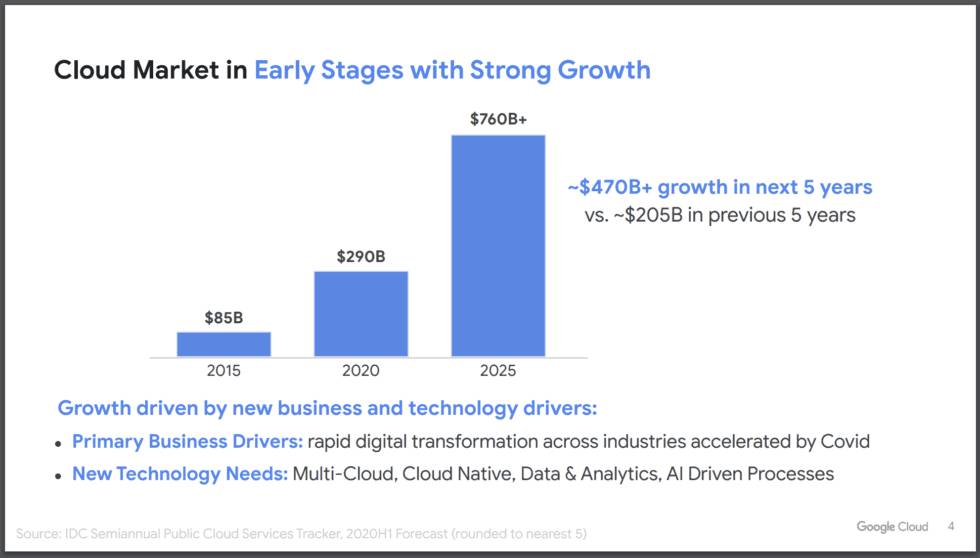
The word “cloud” used to sound like a fluffy, optional accessorylike whipped cream on a latte. Now it’s the cup, the coffee, and the barista. And according to a widely circulated Google Cloud projection (based on market research), we’re not near the end of this story: the cloud economy could triple again over a five-year stretch.
If that sounds like tech-hype, it’s worth slowing down and doing what adults do when faced with big numbers: take a breath, check the math, and ask what this would actually mean for businesses, budgets, security, and the people who get paged at 2 a.m.
What Google Means by “Cloud Will Triple Again”
The “triple again” idea traces back to Google Cloud sharing (and commentators repeating) an IDC-based view of cloud growthroughly $290B in 2020 scaling to around $760B by 2025a near-3× jump over about five years. The exact numbers depend on what’s counted as “cloud” (public cloud services, SaaS, infrastructure, hosted private cloud, and so on), but the headline is the same: the market’s growth is big enough to feel unreal.
Here’s the important nuance: “cloud” isn’t one thing. It’s a stack of things: infrastructure (compute/storage/network), platforms (databases, analytics, AI tooling), and software (applications delivered as services). So a “triple” can be about total spending, total workloads, total revenue, or even total “cloud-shaped problems” (like identity sprawl and cost creep).
Still, independent forecasts land in the same neighborhood. Gartner, for example, projected worldwide public cloud end-user spending at about $723B in 2025, up from roughly $596B in 2024. That’s not “triple in one year,” obviouslybut it does show a market still expanding at a pace that would have sounded ridiculous a decade ago.
Why This Forecast Doesn’t Sound as Wild as It Looks
1) AI is pouring rocket fuel on cloud demand
The cloud boom used to be about flexibility: “We need servers, but we don’t want to buy servers.” Now it’s about capability: “We need GPUs, high-throughput storage, fast networking, and an AI platformyesterday.”
Google’s own recent results underline how closely cloud growth is tied to AI demand. In early 2026, Google reported Cloud accelerating sharply, reaching an annual revenue run rate above $70B, with backlog rising to $240Bmomentum it attributed in large part to demand for AI products. That’s not a small signal; it’s a billboard.
2) “Hybrid and multicloud” isn’t a trend anymoreit’s normal
For many companies, the cloud journey didn’t end with “move everything.” It ended with “move what makes sense,” while keeping some systems on-premises for latency, regulation, or plain old practicality.
Gartner has projected that the vast majority of organizations will adopt hybrid approaches in the coming years. Meanwhile, industry surveys commonly show that most organizations now use multiple public cloud providers. Translation: cloud growth isn’t just new adoptersit’s existing adopters expanding, optimizing, and spreading across providers and services.
3) The cloud market is already enormousand still growing 20%+ in key segments
One reason “triple” feels dramatic is that it’s being said about a market that’s already huge. Synergy Research has estimated quarterly cloud infrastructure services revenue (IaaS/PaaS plus hosted private cloud) at roughly $107B in Q3 with trailing twelve-month revenue around $390B. When growth compounds on top of that base, the numbers get big fast.
In other words: we’re not watching a small pond become a lake. We’re watching a lake become an oceanwhile everyone is also trying to launch boats and teach dolphins to do accounting.
What’s Actually Driving Cloud to “Triple Again”
AI workloads shift from experiments to production
Lots of organizations have already done the “pilot project” phase: a chatbot, a document summarizer, a recommendation model, a fraud detector. The growth wave comes when AI moves into production systems: customer support workflows, sales enablement, developer tooling, supply chain planning, and security operations.
Production AI typically needs higher reliability, stronger governance, better monitoring, and tighter security. That pushes companies toward managed servicesdatabases, orchestration, observability, model hosting, data pipelineswhich increases cloud consumption well beyond raw compute.
Data gravity keeps pulling more work into cloud platforms
Modern businesses generate data everywhere: apps, devices, retail, factories, websites, call centers. Once data is centralized (or at least consistently accessible) in cloud storage and analytics, the rest of the organization starts building around it. That’s the quiet part of cloud growth: not the migration headline, but the “now we can finally do X” momentum that follows.
A retailer might start with cloud-based inventory analytics, then add demand forecasting, then add real-time personalization, then add an AI agent that helps store managers reorder and reduce waste. Each step is modest; together they create a compounding curve.
Networking and security become cloud products, not just IT chores
Cloud isn’t only about compute anymoreit’s the network, the security layer, and the control plane. Google, for example, has been positioning its global network as a business offering through its Cloud WAN announcements, aiming for faster performance and lower total cost of ownership for enterprise networking.
Meanwhile, security is becoming more integrated and AI-assisted. “Zero Trust” architecturetreating every request as untrusted until verified has become a standard design direction in modern security guidance. That pushes companies toward identity-first controls, continuous verification, and better segmentation across hybrid and multicloud footprints.
Regulation and “sovereign cloud” increase complexity (and spending)
As data residency rules and sector regulations grow stricter, many organizations need more granular control over where data lives, who can access it, and how it’s monitored. That frequently leads to more specialized cloud architectures: region-specific deployments, dedicated environments, encryption key ownership models, and deeper auditing.
Complexity isn’t free. But it is often cheaper and faster than building the equivalent controls alone in private infrastructure.
What Google’s Own Numbers Suggest About the Next Five Years
Forecasts are forecasts. The more useful question is: what are the biggest cloud providers doing with their money and their roadmaps? One clear sign is infrastructure investment. When hyperscalers plan dramatically higher capital expenditures, it’s usually because demand is real and capacity is constrainedespecially in AI.
In early 2026, Alphabet signaled a major step-up in spending for infrastructure, alongside strong Cloud growth. Whether you interpret that as “confidence” or “arms race,” it’s hard to interpret it as “cloud demand is slowing down.”
Another sign is backlogfuture contracted revenue not yet recognized. Large and growing backlog suggests customers are signing bigger, longer commitments, often to secure capacity for AI and critical workloads. That behavior fits the “next wave” narrative: cloud is no longer optional modernization; it’s becoming core operating infrastructure for the AI era.
What This Means for Businesses (Beyond the Buzzword Bingo)
1) Cloud strategy becomes business strategy
If cloud spending continues expanding at these rates, it won’t live quietly under “IT.” It will show up in product timelines, customer experience, security posture, hiring plans, and profit margins. Leaders who treat cloud like “just hosting” will eventually be surprised by how much it shapes operational capability.
2) The winners won’t be the companies that “move fastest,” but the ones that govern best
Cloud can scale beautifullyright up until it scales your mistakes. That’s why strong identity practices, policy automation, tagging standards, and cost allocation matter early. Security and cost management have become design requirements, not cleanup tasks.
Government and standards bodies have been emphasizing structured approaches to cloud security (including shared responsibility models and technical reference architectures). The takeaway for teams: the cloud provider can secure the platform, but you still own your configuration, identity, and data decisions.
3) FinOps becomes a core competency (because your CFO doesn’t accept “cloud did it” as an explanation)
As cloud grows, financial operations for cloud (“FinOps”) becomes essential. In the FinOps Foundation’s State of FinOps 2025 report, large cloud spenders described expanding the scope of FinOps beyond public cloud into a “Cloud+” worldSaaS, licensing, and increasingly AI spend. Notably, AI spend management jumped sharply year over year in that survey.
Practically, this means teams need better forecasting, unit economics, and accountability. If cloud is tripling, so is the cost of not knowing where your cloud money is going.
4) The “default architecture” becomes hybrid, multicloud, and edge-aware
Many organizations are settling into a reality where workloads live across environments: on-prem systems that aren’t moving soon, cloud platforms that provide scalability and managed services, and edge deployments for latency-sensitive work. The architectural question shifts from “Which cloud?” to “Which workload belongs where, and how do we manage it consistently?”
So… Will the Cloud Really Triple Again?
It’s impossible to promise a neat 3× outcomemarkets don’t care about round numbers. But the underlying drivers are real: AI productionization, data platform expansion, security modernization, and multicloud operational reality.
And when independent market forecasts still show strong double-digit growth, when hyperscalers are increasing infrastructure investment, and when cloud backlogs and run rates keep climbing, the “triple again” narrative starts to feel less like hype and more like a rough description of what compounding growth looks like in a massive market.
The best mindset is this: don’t bet your roadmap on a slogan, but do plan like cloud capacity, skills, and governance will matter morenot less over the next five years. Because even if it doesn’t triple, it’s clearly not shrinking into a cute little cumulus.
Experiences From the Field: What Teams Learn When Cloud Growth Accelerates (Extra )
When people talk about “the cloud tripling,” they usually picture bigger data centers and more AI chips. In day-to-day work, the experience is more human (and sometimes more comedic): it’s the scramble to standardize, the surprise bills, the security reviews, and the victory dance when a long-stuck project finally ships.
1) The first surprise is rarely performanceit’s the bill
Many teams begin their cloud journey thrilled that they can spin up environments in minutes. Then the finance team discovers the other magic trick: those environments can also spin up costs in minutes. A common pattern is “pilot sprawl”test clusters, forgotten storage buckets, and always-on resources that were meant to be temporary. When cloud demand rises (especially with AI experiments), that sprawl grows faster than anyone expects.
What works in practice is simple but unglamorous: naming standards, mandatory tags, budgets and alerts, and a habit of asking “what’s the unit cost per customer / per transaction / per model run?” before the system becomes mission-critical. The teams that do this early don’t just save money; they ship faster because fewer decisions get stuck in budget panic.
2) “Lift-and-shift” is a phase, not a destination
A lot of organizations start by moving existing workloads as-is, mostly to exit a data center contract or reduce hardware headaches. That can be a valid first stepbut the biggest gains usually arrive later, when teams modernize around managed services, automation, and better data pipelines. The “triple again” growth story depends on this second phase: it’s not only more workloads, it’s more capability layered onto each workload.
The practical lesson: build a migration plan that includes optimization milestones. Otherwise, the cloud becomes an expensive version of the old worldsame architecture, just with a nicer login page.
3) Security maturity becomes the difference between speed and stress
As cloud footprints expand, identity becomes the real perimeter. Teams often learn this after an audit or a near-miss: too many privileged accounts, unclear ownership, inconsistent policies across environments, and a growing list of third-party integrations. A Zero Trust mindset helps hereverify continuously, minimize implicit trust, and design access like every system is exposed.
The teams that scale calmly tend to automate guardrails: least-privilege roles, policy-as-code, standardized logging, and incident playbooks that assume cloud-native complexity. When growth accelerates, the calm teams don’t magically have fewer problems; they just detect and fix them before they become headlines.
4) AI changes the rhythm of cloud operations
AI workloads introduce new operational behaviors: bursty GPU demand, heavy data movement, and a need for strong observability. Teams often discover that the hardest part isn’t training a modelit’s keeping the pipeline reliable, controlling data access, monitoring quality drift, and explaining costs in a way that product leaders can understand.
A useful experience-based rule is: treat AI like a product, not a project. That means setting SLOs, designing rollback plans, tracking cost per outcome, and putting real owners on data and models. As more organizations do this, cloud usage becomes more durable, not just more experimentalwhich is exactly how markets “triple” over time.
5) The “best cloud” is the one your team can run well
In multicloud reality, the goal isn’t to collect providers like trading cards. The goal is clarity: which workloads go where, how identity and networking are handled, how data is governed, and how cost is measured. Many teams report that standardizing the operating modelmonitoring, policy, CI/CD, incident responsematters more than chasing the newest feature.
If the cloud really does triple again, the competitive advantage won’t simply be “being on cloud.” It will be being on cloud with control: predictable costs, strong security, fast delivery, and architectures that improve over time. That’s the difference between riding the wave and swallowing seawater.













