
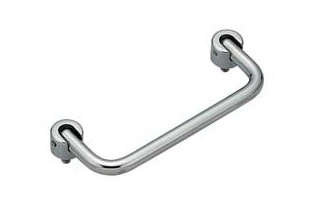
Some hardware wants to be noticed. It arrives in brushed brass, oversized proportions, or a finish with a name like “smoked champagne.” The Sugatsune folding pull handle takes a different route. It does its job, folds away, and leaves the surrounding design alone. In a world where even cabinet knobs occasionally behave like jewelry with a publicist, that restraint is refreshing.
Sugatsune’s HK folding handle is a deceptively simple piece of Japanese-designed hardware: a stainless-steel pull that rotates through 90 degrees and clicks into both its open and folded positions. The result is a useful grip when you need one and a low-profile surface when you do not. That combination makes the handle interesting not only for cabinets and furniture but also for equipment panels, storage compartments, utility installations, workshops, compact interiors, and other places where a permanently projecting handle would simply be in the way.
Its appeal is less about decoration than intelligent movement. Yet the polished stainless steel, compact geometry, and mechanical neatness give it a distinctive architectural character. This is practical hardware that somehow manages to look rather pleased with itselfand, honestly, it has earned the right.
What Is the Sugatsune Folding Pull Handle?
The best-known version associated with the Sugatsune folding pull handle name is the HK series. Unlike a fixed cabinet pull, the grip pivots at its mounting points. Pull it outward and it becomes a conventional handle. Fold it down and the grip sits much closer to the mounting surface.
The mechanism provides defined open and closed positions rather than allowing the handle to flop around freely. That detail matters. Folding hardware can become annoying very quickly if it rattles, swings unexpectedly, or drops against a panel every time a door moves. The HK design uses a clicking action to hold the handle in its working and stored positions.
Current HK-series specifications include 304 stainless steel, a mirror finish, a 90-degree folding action, and an oval-profile grip intended to feel comfortable in the hand. The series is available in multiple sizes, including versions with approximately 80 mm, 100 mm, and 120 mm mounting pitch. Sugatsune also offers related folding-handle designs, including front-mounted HKM models for applications where access to the back of the mounting surface may be limited.
A Small Mechanism With a Clear Purpose
The fundamental advantage is obvious the first time you imagine a fixed pull installed in a narrow passage. A conventional bar handle is always there, proudly waiting to catch a sleeve, hip, tote bag, power cord, or whatever else happens to pass by. A folding pull can provide nearly the same basic gripping function while reducing projection when the handle is not being used.
That makes this style of hardware especially useful on:
- Storage cabinets in narrow rooms or hallways
- Workshop drawers and mobile tool cabinets
- Equipment enclosures and access panels
- Marine-inspired or utility-focused interiors
- Compact kitchens and multipurpose furniture
- Cases, trunks, carts, and movable storage units
The concept is hardly unique to Sugatsune. Industrial hardware manufacturers offer many folding, recessed, spring-loaded, and low-profile handles. What distinguishes the Sugatsune version is the combination of restrained form, stainless-steel construction, defined movement, and an appearance refined enough for architectural interiors.
Why the Folding Design Matters
It Reduces Unnecessary Projection
A standard pull creates a permanent bump on a cabinet, panel, or drawer. In a large kitchen, that may be irrelevant. On a compact cabinet beside a walkway, a rolling equipment cart, or a storage unit under a workbench, every protruding inch becomes more noticeable.
The folding handle solves this problem without requiring the deeper cutout associated with many recessed pulls. A recessed handle can create an exceptionally flush appearance, but installation may require routing or cutting a pocket into the door or panel. A surface-mounted folding handle is often mechanically simpler while still reducing the amount of hardware sticking into the surrounding space.
Think of it as the difference between putting your chair under the table and leaving it permanently in the middle of the kitchen. Both chairs work. One is simply less likely to attack your shin at 2 a.m.
It Changes From Hardware to Handhold Only When Needed
A fixed handle always reads visually as a handle. A folding pull can become more discreet when closed. That can be valuable in minimalist interiors, where designers often try to reduce visual clutter without sacrificing function.
The polished stainless-steel finish still catches light, so the HK is not invisible. Nor is it pretending to be. Instead, it has an engineered quality that works particularly well with stainless countertops, metal cabinetry, painted millwork, plywood casework, laboratory-style interiors, and industrial-modern spaces.
The Click Positions Make It Feel Deliberate
The ability to hold the grip in its open and closed positions is a small feature with an outsized effect on user experience. Hardware that moves should feel controlled. A drawer slide that grinds, a hinge that drops, or a handle that rattles may technically function, but none of them feels finished.
With a folding pull, the transition itself becomes part of the experience. Lift, click, pull. Release, fold, click. There is a pleasing logic to the sequence, particularly in places where the handle is used frequently.
Materials and Finish: Why Stainless Steel Makes Sense
The HK series uses 304 stainless steel, one of the most widely used stainless-steel grades for architectural, household, commercial, and industrial applications. For a frequently touched component, stainless steel offers a practical combination of strength, corrosion resistance, cleanability, and visual neutrality.
The mirror finish gives the Sugatsune handle a brighter and more polished appearance than a brushed or satin pull. That can make it suitable for crisp contemporary interiors, although it also means fingerprints may be more visible. Such is the timeless bargain of polished metal: it looks beautiful until a human being encounters it.
Routine care is straightforward. A soft cloth and mild cleaner are generally preferable to aggressive abrasives, which can scratch a polished finish. In demanding environments, cleaning methods should always be matched to the actual contaminants, surrounding materials, and manufacturer guidance.
What About Heavy Loads?
Published Sugatsune catalog information for HK-series handles has listed a load capacity around 110 pounds for the handle assembly under specified conditions. That figure should not be interpreted as permission to use the pull as a safety grab bar, climbing point, personnel support, or lifting device without proper engineering review.
Load capacity is only one part of the system. The strength of the door, panel, fasteners, backing material, mounting pattern, and installation method all matter. A heroic handle attached to a flimsy panel is still attached to a flimsy panel.
HK Versus HKM: Similar Idea, Different Mounting Approach
People researching a Sugatsune folding handle may encounter both HK and HKM designations. They share the same general goalproviding a 90-degree folding gripbut the mounting configuration differs.
The classic HK design uses a compact back-mount arrangement. Related HKM models are designed for front screw mounting, making them useful where installers need to fasten the handle from the accessible face of the panel. Current HKM technical information also describes versions suitable for installation on aluminum framing.
This distinction is important when choosing hardware. The most beautiful handle in the catalog becomes considerably less charming when the installer discovers that the required side of the panel is inaccessible.
Where the Sugatsune Folding Pull Handle Works Best
Minimalist Kitchens
The folding pull has long appealed to designers interested in clean, utility-driven kitchens. On a pantry door, island cabinet, or specialty storage compartment, it can introduce a subtle industrial detail without turning every cabinet front into a field of projecting bars.
It is particularly effective when used selectively. Installing folding handles on every drawer in a conventional kitchen may be unnecessary, but using one on a large utility cabinet or unusual pull-out element can make excellent functional sense.
Workshops and Utility Spaces
This may be the handle’s natural habitat. Workshop cabinets, carts, equipment boxes, and storage compartments often benefit from hardware that provides a substantial grip but stays out of the way between uses.
A folding pull is also easier to live with on mobile equipment. Fixed handles can collide with nearby objects during storage or transportation. Reducing the profile helps create a cleaner exterior and fewer accidental snag points.
Compact Rooms and Narrow Circulation Areas
In a tight laundry room, galley kitchen, mudroom, or hallway, conventional hardware can become surprisingly noticeable. A pull that projects only a little too far has a mysterious ability to find belt loops with military precision.
A folding design helps preserve circulation space while maintaining a proper handhold when the cabinet or panel needs to be opened.
Furniture With an Industrial or Marine Influence
Folding and recessed pulls have deep associations with trunks, equipment cases, boats, machinery, and transport hardware. Bringing that vocabulary into residential furniture can create a subtle utilitarian character.
On plywood cabinetry, a painted storage chest, or a stainless-accented sideboard, the Sugatsune handle can look less like conventional decorative hardware and more like a purposeful mechanical component. For some interiors, that is precisely the point.
Installation: Measure First, Celebrate Later
Installing pull hardware appears simple because the finished result is simple. Two mounting points, a couple of screws, job doneuntil one hole is 1/8 inch off and the handle sits at an angle suggesting the cabinet was installed aboard a sinking ship.
The first step is to confirm the exact model number and technical dimensions. Do not assume that two similarly named folding handles share the same hole spacing, screw size, mounting method, or clearance requirements.
Check the Center-to-Center Measurement
For any multi-point pull, the critical dimension is the distance between mounting centers. Mark carefully and verify the measurement against the actual hardware or current technical drawing before drilling.
A drilling jig or template can improve repeatability when installing several handles. Cabinet-hardware installation guides commonly recommend careful marking, square alignment, and test fitting before final tightening. On a one-off specialty installation, making a simple scrap-wood template can save both time and colorful vocabulary.
Confirm Panel Strength and Fastener Compatibility
The handle may be stainless steel, but the mounting surface could be thin sheet metal, hardwood, plywood, MDF, aluminum extrusion, or another material entirely. The correct fastener and backing strategy depend on that substrate.
For heavier pulling loads, reinforcement may be necessary. A thin decorative panel should not be expected to perform like structural metal merely because the handle attached to it looks impressively serious.
Allow Space for the Folding Motion
Before drilling, move the handle through its full operating arc and consider nearby trim, panel edges, drawer fronts, and adjacent hardware. A folding handle needs enough space to open comfortably and close without striking surrounding components.
Also consider hand clearance. The handle should not only fit the panel; it should fit the person using it.
How It Compares With Other Low-Profile Pulls
The Sugatsune folding pull sits between a conventional surface-mounted bar and a fully recessed handle.
A fixed pull is the simplest option and is always ready to grab, but it permanently projects from the surface. A recessed pull can provide an exceptionally clean profile but often requires a larger cutout and more involved installation. A folding pull provides a full grip when open while reducing projection when stored.
There are also spring-loaded folding handles and friction-controlled industrial models designed to resist rattling or remain at various angles. Those can be excellent choices for vibrating machinery and specialized equipment. The Sugatsune HK approach is visually cleaner and particularly attractive when architectural appearance matters alongside mechanical function.
Is the Sugatsune Folding Pull Handle Worth Choosing?
For an ordinary kitchen drawer with plenty of surrounding space, a folding handle may be more mechanism than necessary. A simple fixed pull can do the job for less effort and, depending on the product, less money.
But when space is tight, projection matters, or the hardware itself is meant to express a precise industrial character, the Sugatsune folding pull becomes much more compelling. Its appeal lies in solving a specific problem elegantly: providing a substantial handhold without demanding permanent ownership of the surrounding airspace.
That is the larger lesson of good hardware. The best component is not always the one with the longest feature list. Sometimes it is the one that appears exactly when needed and quietly gets out of the way afterward.
Conclusion: A Clever Detail That Earns Its Place
The Sugatsune Folding Pull Handle is a small piece of hardware with a surprisingly broad range of applications. Its 90-degree folding movement, defined open and closed positions, stainless-steel construction, and compact stored profile make it useful in kitchens, workshops, furniture, equipment enclosures, and other space-conscious installations.
More importantly, it illustrates why thoughtful hardware deserves attention. Doors and drawers are touched constantly. The quality of that interactionthe grip, movement, sound, resistance, and final resting positioncan influence how an entire piece of furniture or cabinetry feels.
The Sugatsune handle does not transform a mediocre cabinet into a masterpiece through magic. Hardware remains stubbornly unwilling to perform miracles. But on the right project, this folding pull can be the detail that makes the design feel more considered, more compact, and simply better resolved.
Extended Experience Notes: What Living With a Folding Pull Is Really Like
The most useful way to evaluate a folding handle is not by staring at it in a product photograph but by imagining the repeated sequence of daily use. A fixed pull requires no thought: reach, grab, pull. A folding handle introduces one small extra action. You lift the grip, feel it settle into position, use it, and fold it back when finished.
At first, that extra movement can seem unnecessary. After all, humanity successfully opened drawers for a very long time without giving the handle its own choreography. Yet in the right location, the folding action quickly makes sense. On a cabinet beside a narrow walkway, the difference is immediate. The handle is there when needed but is not constantly occupying space or catching clothing.
The experience is particularly satisfying on utility furniture. Imagine a large rolling storage cabinet in a workshop. A fixed pull on the side can interfere when the cabinet is parked beside another unit. A folding handle allows the cabinet to be moved with a comfortable grip and then returned to a cleaner, more compact profile. The mechanism feels less like decoration and more like part of the equipment.
Another noticeable quality is the tactile feedback. Hardware with a positive open and closed position generally feels more intentional than a loose swinging bail handle. The click tells the user that the movement is complete. That feedback is subtle, but repeated interactions with well-controlled hardware can make an object feel more precise and durable.
The polished stainless finish creates a different experience from warm brass, matte black, or wood. It feels crisp, cool, and unapologetically mechanical. In a soft traditional kitchen, that may be too industrial. Against painted cabinetry, stainless counters, sealed plywood, or metal panels, however, it can be exactly right. The handle looks especially convincing when the rest of the project shares its straightforward material language.
Installation experience is where enthusiasm should temporarily make room for patience. Folding handles have moving parts and specific clearances, so positioning them by eye is a poor strategy. A mock-up is worth the few minutes it takes. Tape the handle in place, operate it, stand where the user will stand, and check whether the hand naturally reaches it. Confirm that the folded grip does not collide with trim and that the open handle leaves enough room for fingers.
For multiple installations, consistency becomes even more important. A template or drilling jig prevents tiny variations from becoming visually obvious across a bank of cabinets. The hardware itself may be precisely manufactured; it would be unfair to reward that precision with holes measured during a caffeine emergency.
Maintenance is similarly uncomplicated but worth considering. Polished stainless steel rewards occasional wiping, especially in kitchens and other high-touch areas. Fingerprints will appear. This is not a design flaw so much as evidence that people have hands. A soft cloth and appropriate mild cleaner usually preserve the clean appearance without unnecessarily scratching the finish.
The strongest overall impression is that a Sugatsune folding pull works best when chosen for a reason. It is not merely a novel alternative to a cabinet handle. Its value appears when a project genuinely benefits from reduced projection, controlled movement, a strong grip, or an industrial architectural detail. In those situations, the folding mechanism stops feeling like an extra step and starts feeling like the obvious solution.
Note: Specifications, mounting methods, dimensions, certifications, and load ratings vary among Sugatsune HK, HKM, and other folding-handle models. Verify the exact part number and current manufacturer technical drawing before drilling, ordering fasteners, or using the handle in a load-critical application.













