
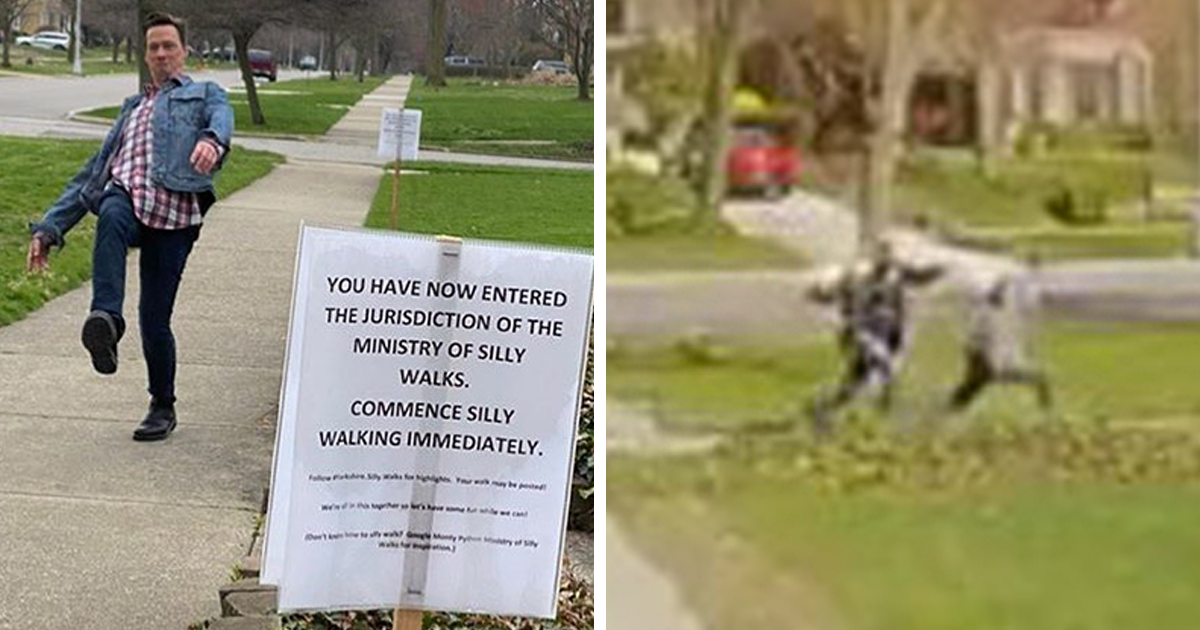
Most sidewalk signs tell us what not to do. Do not park. Do not enter. Keep off the grass, even though the grass looks suspiciously comfortable. But one neighborhood sign took a refreshingly different approach: it ordered pedestrians to abandon ordinary walking and “commence silly walking immediately.”
The unusual command appeared outside a family home in Grosse Pointe Park, Michigan, during the early months of the COVID-19 pandemic. Instead of ignoring it, many passersby accepted the challenge. They kicked, hopped, shuffled, spun, moonwalked, marched, and occasionally involved confused dogs who had clearly not reviewed the Ministry’s official regulations.
Doorbell-camera footage of the performances became the foundation of Yorkshire Silly Walks, a social media project inspired by Monty Python’s legendary “Ministry of Silly Walks” sketch. What started as a small attempt to entertain one neighborhood quickly became a viral reminder that people rarely need much encouragement to be wonderfully ridiculous.
How a Michigan Sidewalk Became a Silly Walking Zone
The Idea Arrived During an Ordinary Family Walk
Liz Koto reportedly came up with the idea while walking with her husband as their children rode bicycles ahead of them. Neighborhood walks had become one of the few accessible activities available during quarantine, but the routes were beginning to feel repetitive. A little Monty Python-inspired nonsense seemed like the perfect upgrade.
The family placed a sign near the sidewalk announcing that pedestrians had entered the “jurisdiction of silly walks.” A second message explained that performances might be recorded and shared through the Yorkshire Silly Walks social media account. Anyone unfamiliar with the reference was encouraged to look up Monty Python for inspiration.
The instructions were formal enough to sound official and absurd enough to be irresistible. Pedestrians would approach at a normal pace, read the sign, pause for a moment, and then transform into malfunctioning flamingos, overexcited marching-band leaders, or people attempting to escape an invisible swamp.
A Classic Comedy Sketch Found a New Purpose
Monty Python’s original “Ministry of Silly Walks” sketch first aired in 1970. John Cleese portrayed a bowler-hatted civil servant whose wildly inefficient gait was treated as serious government business. Beneath the acrobatics, the sketch satirized bureaucracy, public spending, and the ability of official institutions to discuss complete nonsense with impressively straight faces.
The scene remained recognizable decades later because its humor was largely physical. Viewers did not need to memorize complicated dialogue. One exaggerated knee lift could communicate the entire joke. When the neighborhood sign revived that idea, anyone could participate, regardless of age, language, or familiarity with British comedy.
30 Reactions That Prove People Were Ready to Get Silly
The performances ranged from carefully choreographed routines to spontaneous movements invented approximately half a second after reading the sign. Across the original collection and similar silly-walk zones that appeared around the country, several unforgettable reaction styles emerged.
Reactions 1–10: High Steps, Family Teams, and Fearless Beginners
- The zero-stage-fright entrance: One participant appeared ready before reaching the sign, launching into an enthusiastic routine without the slightest hesitation. Some people need rehearsal. Others have apparently been training their entire lives for an unexpected sidewalk audition.
- The “Walk Like an Egyptian” family: A group coordinated angular arms and side-facing movements, turning a residential sidewalk into a low-budget but highly committed music video.
- The imaginary lava crossing: A pair reacted as though the pavement had suddenly become molten rock. One used towering high steps while the other bent deeply at the knees, proving that fictional geological emergencies bring out very different survival strategies.
- The long-legged dog walker: A pedestrian performed huge, stretched-out steps while holding a leash. The dog continued forward with the weary patience of an animal accustomed to human embarrassment.
- The grateful performer: One walker reportedly followed the silliness with a thank-you note. The gesture showed that the sign was more than a joke; it gave people a brief, welcome interruption during a stressful period.
- The giant-step specialist: Some walkers relied on one dependable technique: lift the knees as high as physically possible and trust the artistic process.
- The heroic leaper: A participant used enormous jumps in a performance dedicated to health care workers. It was part comedy routine, part tribute, and part accidental leg workout.
- The bendy youth delegation: Younger walkers approached the challenge with loose limbs, bouncing shoulders, and the energy of a marching band that had misplaced all its instruments.
- The minister and apprentice: An adult-and-child pairing showed how quickly silliness can be passed between generations. The younger participant did not merely copy the routine; the child appeared ready to take over the entire department.
- The sidewalk fashion show: A family combined running, spinning, flowing clothes, and dramatic turns. For several glorious seconds, suburban Michigan hosted its own extremely unofficial fashion week.
Reactions 11–20: Moonwalks, Backward Steps, and Competitive Creativity
- The hands-in-pockets professional: One man performed springy, exaggerated steps while keeping his hands casually tucked away. His expression suggested that spectacular footwork was simply part of his normal commute.
- The backward-walking duo: One person moved in reverse while a companion added jumps. Walking forward was apparently considered too conventional for Ministry approval.
- The big-step minimalist: Not every performance required complicated choreography. A few enormous strides, delivered with confidence, were enough to turn an ordinary pedestrian into a neighborhood celebrity.
- The reluctant recruit: Children persuaded an innocent passerby to participate. This is how silly-walk movements expand: not through advertising campaigns, but through cheerful peer pressure from tiny people.
- The full-body improvisor: Some walkers used arms, shoulders, hips, and knees simultaneously, creating routines that could not be classified as walking, dancing, or emergency signaling.
- The synchronized pair: Two relatives performed together with enough coordination to suggest previous practiceor the kind of unspoken communication that develops after years of embarrassing each other.
- The family procession: A father and daughter moved backward while another family member floated behind with a lighter, more dance-like style. Everyone interpreted the assignment differently, which made the group performance even better.
- The surprise moonwalker: One participant abandoned forward motion and glided backward in a tribute to a completely different pop-culture icon. The Ministry apparently accepts cross-departmental cooperation.
- The Olympic scissor walk: A walker paired a stiff-kneed scissor motion with long bounds. It looked inefficient, difficult, and entirely deserving of government funding.
- The repeat visitor: Local reports indicated that some people returned to the sidewalk more than once. A silly walk is fun; a developing repertoire of silly walks is a lifestyle.
Reactions 21–30: Dogs, Popcorn Dancing, and the Fastest Escape Possible
- The rapid-footwork routine: One walker used tiny, speedy steps, moving as though the sidewalk were a piano keyboard and every paving stone needed to be played.
- The running interruption: Joggers briefly stopped their serious exercise, inserted a few absurd movements, and then continued running. Even disciplined athletes can spare three seconds for nonsense.
- The double performance: Two people delivered complementary routines, each making the other look sillier. Cooperative absurdity is often more powerful than individual effort.
- The hopping group: A small crowd crossed with skips, jumps, and bouncing movements. Their formation resembled a flock of cheerful birds that had recently discovered sneakers.
- The popcorn dance: One participant repeatedly popped upward with sudden bursts of movement, as though an invisible microwave had reached the exciting part of the cycle.
- The encore performance: Some routines appeared more than once in shared collections, which only strengthened the sense that the neighborhood had developed recurring characters and unofficial local stars.
- The sidewalk swimmer: A performer used arm motions associated with swimming while traveling on dry land. It was not the fastest route through the zone, but speed has never been the Ministry’s main concern.
- The thoughtful dog-walking pair: Two pedestrians paused, considered their options, and then committed to the performance. Their dog served as an unimpressed but essential supporting actor.
- The stealth silly walkers: One pair hurried through the zone while performing minimal movements, as though embarrassment could be avoided by completing the assignment before anyone noticed. Unfortunately, the camera noticed.
- The “fine, we’ll do it” finish: Some walkers began with visible uncertainty but eventually joined in. Their reluctant participation was especially funny because the transformation from sensible adult to flailing pedestrian happened in real time.
Why the Silly Walking Sign Worked So Well
It Gave Adults Permission to Play
Children rarely need formal authorization to walk like dinosaurs. Adults are different. We become highly aware of strangers, cameras, social expectations, and the possibility that someone from work might see us pretending to be a startled crane.
The sign removed that barrier. It did not merely suggest silliness; it presented silliness as a rule. For a few yards, ordinary walking became the incorrect option. The joke gave participants permission to perform without needing to explain themselves.
The Prompt Was Simple but Open-Ended
“Do a silly walk” is easy to understand, but there is no correct response. One person might moonwalk. Another might imitate a chicken. A child might cartwheel, while a parent attempts ballroom dancing with a stroller.
That balance is important. The sign provided enough structure to inspire action without controlling the result. Every new pedestrian became both a participant and a creator, which kept the videos unpredictable.
Shared Laughter Created a Neighborhood Connection
Research summarized by the American Psychological Association has suggested that humorous pandemic-related content helped some viewers cope with stress. Cleveland Clinic specialists also note that laughter can interrupt the stress response and strengthen social bonds. Studies discussed by the Greater Good Science Center similarly connect shared laughter with feelings of closeness and positive social interaction.
The silly-walk project created those benefits without requiring a crowded event. Residents could participate individually or with their households, while neighbors watched from windows or enjoyed the recordings online. It transformed a familiar strip of pavement into a shared community experience.
How Silly Walk Zones Spread Across the United States
Once the Michigan videos circulated online, similar signs appeared in other communities. Families did not need expensive equipment or official permits to adapt the idea. A printed sign, a visible section of sidewalk, and a camera were usually enough.
In San Luis Obispo, California, Maureen and Aaron Salmon created a silly-walking area outside their home and captured neighbors running, dancing, performing high kicks, doing cartwheels, and even ballroom dancing. Their postal worker contributed a moonwalk, demonstrating admirable commitment to both mail delivery and public entertainment.
Residents in Eau Claire, Wisconsin, established another “department of silly walks,” welcoming performances from toddlers through older adults. An East Lansing version inspired crab walks, stroller twirls, spins, tiptoe runs, and moves reminiscent of the “YMCA” dance. In Elkins Park, Pennsylvania, a similar project helped neighbors who had previously known one another only from a distance begin interacting more personally.
Each location developed its own performers and local flavor, but the basic formula remained the same: place a playful invitation in an ordinary public setting and give people room to surprise one another.
Related Experiences: What It Feels Like to Enter the Jurisdiction of Silly Walks
Picture an ordinary afternoon walk. You are thinking about groceries, work emails, or whether the dog has eaten something mysterious again. Then you notice a sign ahead. At first, it appears official, so your responsible-adult instincts tell you to read it.
You discover that you have entered the jurisdiction of silly walks.
Your first reaction is probably a smile. Your second is to look around. Is anyone watching? Of course someone is watching. The sign practically guarantees it. There may be a doorbell camera, a family near a window, or another pedestrian approaching from behind with the inconvenient timing of a live studio audience.
You now face a decision. You can continue walking normally and spend the rest of the block knowing that you rejected a harmless invitation to be ridiculous. Or you can perform a silly walk and accept that your knees are about to become freelance entertainers.
Most people begin cautiously. Perhaps you lift one foot slightly higher than usual. That feels insufficient. You try again, this time raising your knee toward your chest. Your arms begin moving because they have misunderstood the assignment and think they are helping.
Then something changes. Once you have crossed the line from normal walking to obvious nonsense, embarrassment becomes less powerful. You add a sideways hop. You rotate your shoulders. You attempt a moonwalk, remember that you cannot moonwalk, and convert the failure into a new movement called “the confused carpet cleaner.”
If you are walking with another person, the experience becomes competitive. Your companion tries a duck walk, so you respond with enormous strides. They spin. You pretend to climb invisible stairs. Within seconds, two respectable adults have transformed into rejected characters from a musical about malfunctioning robots.
Children usually require less preparation. They may run directly into the zone, jump, crawl, flap their arms, or perform cartwheels without consulting anyone. Dogs, meanwhile, remain the most honest participants. Some trot along without concern. Others stare at their owners with the unmistakable expression of an animal reconsidering the relationship.
The most enjoyable part often comes after the performance. You straighten your clothes, return to an ordinary pace, and laugh with the people around you. A stranger on the opposite sidewalk may applaud. Someone waiting near the sign may feel encouraged to participate because you went first.
That is how a playful public prompt becomes contagious. It does not demand talent, perfect timing, or confidence. The awkwardness is the point. Every participant lowers the social risk for the next person, gradually turning a neighborhood into a temporary stage.
The experience also changes the way people remember the walk. A routine trip around the block becomes the afternoon Dad attempted ballet in hiking boots, Grandma invented the turbo shuffle, or the mail carrier moonwalked past the recycling bins. These moments are small, but their smallness makes them repeatable. Anyone can create a similar invitation, and nearly anyone can participate.
Long after the original quarantine conditions faded, the idea remained appealing because daily life still contains stress, repetition, and too many serious signs. A silly-walking zone interrupts that routine without requiring a ticket, reservation, or special occasion. It simply asks people to notice where they are, interact with the moment, and risk looking ridiculous for a few seconds.
That is not wasted time. It is a tiny act of neighborhood storytellingperformed one awkward step at a time.
Conclusion: Sometimes the Best Community Ideas Are Delightfully Unnecessary
The “commence silly walking” sign succeeded because it asked almost nothing from participants while offering something everyone needed: a moment of play. The resulting high steps, moonwalks, spins, leaps, backward shuffles, and bewildered dogs turned a plain sidewalk into a community attraction.
It also demonstrated that humor does not always need a stage, professional comedian, or complicated setup. Sometimes it needs only a sign, a camera, and one brave pedestrian willing to lift a knee far higher than the situation requires.
The next time a neighborhood feels quiet, repetitive, or overly serious, the solution may not require a committee meeting. A piece of cardboard and an imaginary Ministry could be enough. Just remember to stretch first. The Department of Unnecessarily Dramatic Hamstring Injuries is notoriously slow with paperwork.
Note: The descriptions above are an original synthesis of documented Yorkshire Silly Walks performances, interviews with participating families, reports about similar American neighborhood projects, and research discussing humor, stress relief, and social connection.














