
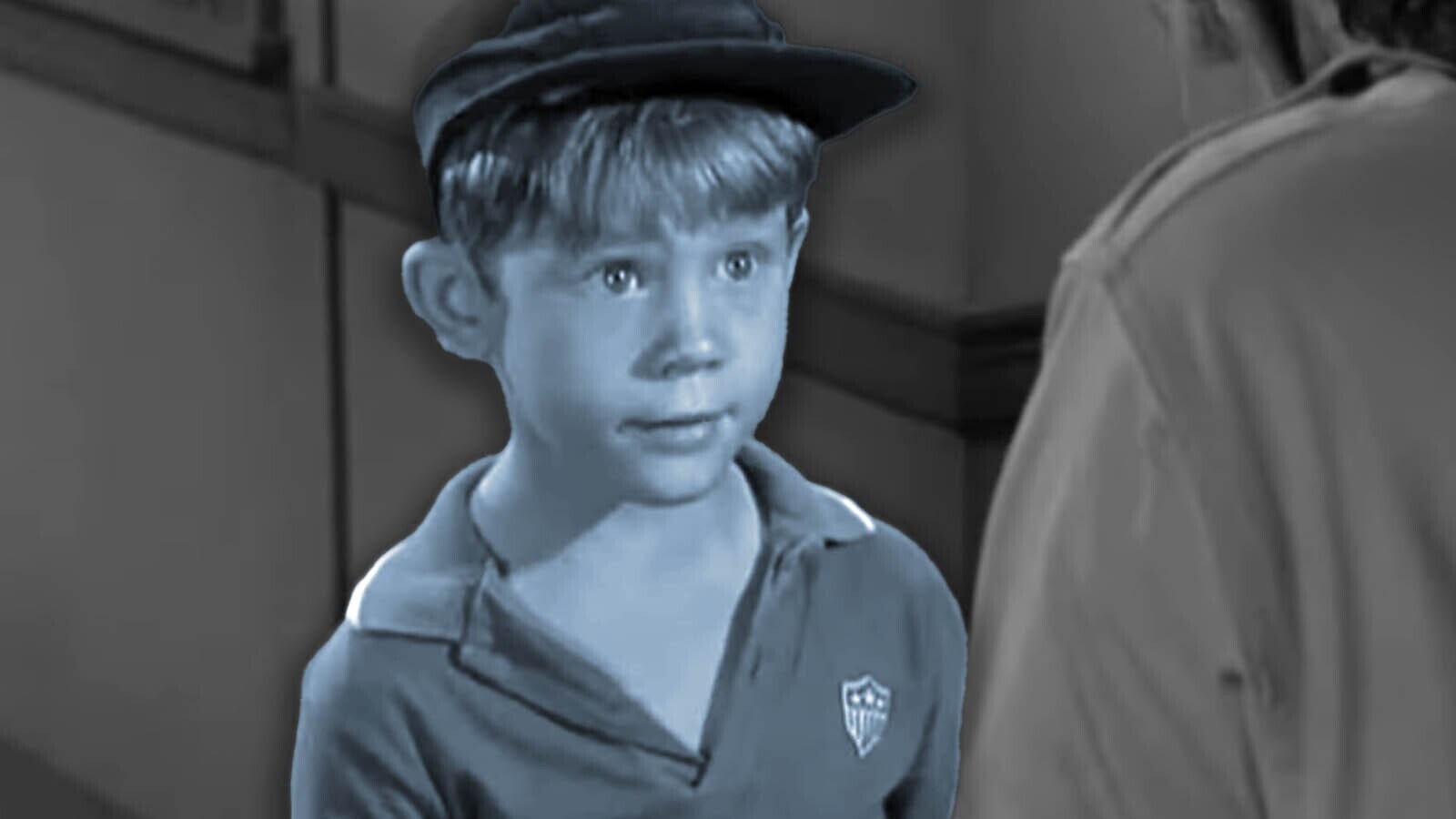
There are celebrity stories that sound like they must involve a feud, a secret rule, or at least one dramatic Hollywood door being slammed in slow motion. Then there is the charmingly simple reason Ron Howard was not allowed to watch The Andy Griffith Show when he first appeared on it: he was a little kid, and his bedtime arrived before Mayberry did.
Yes, the future Oscar-winning director, the boy America knew as Opie Taylor, was starring in one of television’s warmest and most enduring sitcoms before he was even old enough to stay up and watch himself. While millions of families gathered around their living-room televisions to see Sheriff Andy Taylor, Barney Fife, Aunt Bee, and young Opie navigate life in Mayberry, Ron Howard was likely doing something far less glamorous: brushing his teeth, putting on pajamas, and being sent to bed like any other first-grader.
That tiny detail says a lot about why Howard’s child-star story turned out so differently from many Hollywood cautionary tales. His parents, Rance Howard and Jean Speegle Howard, were actors, but they were also parents first. They treated acting as work, not as a golden ticket to ego inflation. Ron may have been famous to viewers, but at home he was still a child who needed sleep. In other words, Opie had a bedtime, and Ron Howard did too.
The Real Reason Ron Howard Couldn’t Watch Himself on TV
Ron Howard has explained that when he first worked on The Andy Griffith Show, he had not really seen himself on television because the programs aired after his bedtime. The reason was not mysterious, punitive, or strange. He was simply too young to be sitting up late watching prime-time television. For a child actor, that may sound ironic. For a parent, it sounds wonderfully normal.
The Andy Griffith Show premiered on CBS on October 3, 1960. Howard, born in 1954, was six years old when the series reached American homes. He had already done acting work before Mayberry, including appearances on shows such as Dennis the Menace and The Twilight Zone, but playing Opie Taylor made him a familiar face to millions. Still, familiar face or not, a six-year-old is a six-year-old. If bedtime comes before the credits roll, fame has to wait until morning.
Howard later said he eventually was allowed to stay up and watch The Andy Griffith Show, which he remembered as airing around 8:30. That little upgrade must have felt like a promotion: from “off to bed” to “fine, you may watch yourself be adorable on national television.” But even then, he did not fully understand the cultural impact of the show until much later. To him, it was not yet “classic television.” It was his workplace, his childhood, and the place where grown-ups with scripts made scenes work.
Why That Bedtime Rule Matters More Than It Seems
The bedtime story is funny because it flips the usual image of child stardom. We often imagine famous kids as miniature adults, surrounded by attention, exceptions, applause, and maybe a tiny director’s chair with their name on it. Howard’s experience was different. His parents kept his life grounded. He worked, but he also went to bed. He performed, but he did not become the center of the universe.
That balance may help explain why Howard has spoken with such affection about his years on the show. He has described The Andy Griffith Show as part of his childhood, not as something that stole his childhood. There is a difference. The set was creative, busy, and professional, but it was also shaped by adults who understood tone, discipline, and kindness. Andy Griffith was not just the star; he helped set the atmosphere.
For SEO-friendly clarity, the phrase “Ron Howard wasn’t allowed to watch The Andy Griffith Show” can sound like clickbait. The truth is better. He was not banned from watching because of content, conflict, or some secret behind-the-scenes rule. He was not allowed because he was young, and his parents maintained ordinary household boundaries. The most wholesome show on television had the most wholesome viewing restriction imaginable: go to sleep, Ronny.
How Ron Howard Became Opie Taylor
Ron Howard played Opie Taylor, the red-haired son of widowed Sheriff Andy Taylor, portrayed by Andy Griffith. Set in the fictional town of Mayberry, North Carolina, The Andy Griffith Show followed small-town misunderstandings, moral lessons, and community comedy. It ran from 1960 to 1968 and became one of the defining American sitcoms of the era.
Opie was not just a cute kid added to soften the show. He gave the series emotional weight. Through Opie, viewers saw Andy as a father, not only as a sheriff. Some of the show’s most memorable moments came from the quiet conversations between Andy and Opie, where lessons were not shouted, preached, or wrapped in syrup. They were delivered with calm humor, patience, and that Mayberry rhythm that made even a front-porch pause feel like storytelling.
Howard’s natural performance helped Opie feel like a real child rather than a punchline machine. That was no accident. One important behind-the-scenes influence came from Ron’s father, Rance Howard, who was also an actor. According to Ron, Rance noticed early that Opie could easily become the typical sitcom kid: sarcastic, smarter than the adults, and always ready with a wisecrack. Rance suggested something more sincere. What if Opie actually respected his father?
Rance Howard’s Quiet Impact on Mayberry
That suggestion helped shape the emotional center of The Andy Griffith Show. Instead of making Opie a miniature insult comic, the series allowed him to be curious, flawed, loving, and respectful. He could make mistakes, but he did not treat Andy like a fool. That one creative choice helped turn Andy Taylor into one of television’s most beloved father figures.
Rance Howard’s advice also protected Ron as a young actor. Playing a child who constantly outsmarts or mocks adults can be funny in short bursts, but it can also teach a young performer to chase laughs in artificial ways. Rance seemed to understand that truth was stronger than easy punchlines. Ron has reflected that his father may have been teaching him a simple version of truthful acting: find the reality of the moment instead of forcing the joke.
This matters because The Andy Griffith Show was not a loud sitcom. It did not depend on chaos every five seconds. Its comedy often came from character, timing, and restraint. Barney Fife could explode into nervous energy, but Andy Taylor usually stayed grounded. Opie’s sincerity gave the show another layer of warmth. A boy who respected his father made the father worth respecting.
Andy Griffith’s Role in the Show’s Gentle Genius
Andy Griffith’s influence on the show was enormous. Though the series had writers, directors, producers, and a gifted cast, Griffith’s sensibility shaped the tone. He understood that rural humor did not need to be cruel or cartoonish. Mayberry could be funny without making its people look stupid. The South, as Howard has recalled Griffith believing, was already funny enough on its own.
That approach gave the show its staying power. Barney Fife was ridiculous, but he was loved. Aunt Bee could be fussy, but she was never disposable. Opie could be mischievous, but he was not cynical. Andy could be wise, but he was not smug. The characters had comic flaws, yet the show rarely humiliated them. It laughed with Mayberry more than it laughed at Mayberry.
Howard later observed that the show looked simple, but its simplicity required precision. Scenes had to be funny, truthful, and timed just right. That is a valuable lesson for anyone studying television writing: easy-looking comedy is usually the result of very hard work. Mayberry’s calm surface hid a lot of careful craft.
Why Viewers Still Care About This Story
The reason this Ron Howard story continues to attract attention is not only nostalgia. It reveals something people miss about older television and about childhood itself. Here was a boy starring in a hit show, yet he was still protected from the adult machinery around him. His parents did not let fame rewrite every rule. They gave him structure.
In today’s world of streaming, social media clips, instant reactions, and children becoming public figures overnight, the idea that a child actor could be on television but not stay up to watch himself feels almost impossible. Today, a six-year-old might see their performance replayed on phones before the episode even ends. In Howard’s case, the boundary was simple: television was work, home was home, and bedtime was bedtime.
That separation likely helped Howard build a healthier relationship with entertainment. He did not grow up merely worshiping the screen. He grew up watching the process behind the screen. Directors, writers, actors, and crew members solved problems together. Scenes improved through collaboration. Jokes were adjusted. Emotions were calibrated. For a future filmmaker, this was a remarkable education.
From Opie Taylor to Oscar-Winning Director
Ron Howard’s career after Mayberry is one of Hollywood’s great transitions. Many child actors struggle to escape the role that made them famous. Howard moved from Opie Taylor to Richie Cunningham on Happy Days, then shifted behind the camera and became one of America’s most successful directors. His filmography includes crowd-pleasers, dramas, documentaries, and major studio hits.
He directed films such as Splash, Cocoon, Apollo 13, How the Grinch Stole Christmas, and A Beautiful Mind. The last of those earned major Academy Award recognition and confirmed Howard as far more than a former child actor with a second career. He became a filmmaker known for clarity, emotional accessibility, and strong storytelling instincts.
It is tempting to draw a straight line from Mayberry to his directing style. That would be too neat, but not entirely wrong. The values he saw on The Andy Griffith Showtone, sincerity, collaboration, and respect for the audienceappear again and again in his later work. Howard learned early that entertainment does not have to be cynical to be smart. It can be generous and still be expertly made.
The Bigger Meaning Behind “Not Allowed to Watch”
So, why was Ron Howard not allowed to watch The Andy Griffith Show? Because he was a child, and the adults in his life treated him like one. That may be the least scandalous answer in television history, but it is also the most revealing.
The story reminds us that healthy boundaries can exist even inside show business. It also explains why Howard’s memories of the series sound so grounded. He was not raised to believe that being on TV made him superior to other kids. He was raised to work hard, listen, learn, and still go to bed on time. Somewhere, Aunt Bee is nodding approvingly.
There is also a sweet irony here. Millions of children were allowed to stay up and watch Opie learn lessons from Andy Taylor, while the real boy playing Opie sometimes had to miss those lessons because his own parents were teaching him one: sleep matters. That is Mayberry-level parenting at its finest.
Experiences Related to Watching Ron Howard and ‘The Andy Griffith Show’
For many viewers, discovering that Ron Howard could not initially watch The Andy Griffith Show because of bedtime brings back memories of their own childhood television rules. Before streaming made every show available at any hour, television had a schedule, and families had rules. You either watched when the program aired, or you missed it. There was no “just one more episode” button glowing like a tiny bad decision in the corner of the room.
That is part of why the story feels so relatable. A child might not understand ratings, syndication, or cultural legacy, but every child understands the injustice of being sent to bed when something interesting is happening in the living room. Imagine being Ron Howard: you spent the day acting with Andy Griffith and Don Knotts, then the episode airs, and your reward is pajamas. It is both hilarious and oddly perfect.
Many fans who grew up with the show remember watching it as a family ritual. The humor was gentle enough for children, smart enough for adults, and warm enough that grandparents could approve without issuing a committee statement. Parents trusted Mayberry. It was a place where mistakes had consequences, but people were rarely beyond forgiveness. Opie might misunderstand something, Barney might overreact, and Aunt Bee might worry herself into a casserole crisis, but by the end, the town usually found its balance again.
The bedtime angle also makes modern viewers think about how children experience fame today. A child actor now might see comments, memes, edits, praise, and criticism almost instantly. Howard’s early experience was slower and more protected. He did the work, went home, and lived a life that still had ordinary limits. That distance may have helped him avoid confusing public attention with personal identity.
There is a lesson here for parents, teachers, young performers, and anyone raising a child with a talent. Encouragement is important, but so are boundaries. A gifted child still needs rest, chores, school, correction, and boring normal things. Especially boring normal things. Normal life is the ballast that keeps talent from floating away like a balloon at a county fair.
Watching The Andy Griffith Show today can feel like opening a time capsule, but not because everything in it is perfect. It reflects a particular era, with its own limits and assumptions. Yet the emotional core still works because it is built on recognizable relationships: a father trying to raise his son well, friends trying to help each other, a community making room for oddballs, and a child learning that love and discipline can exist in the same sentence.
Ron Howard’s story adds another layer to that experience. When we watch Opie, we are not just watching a character. We are watching a young performer whose own parents were carefully guiding him through a strange profession. We are watching the result of Rance Howard’s thoughtful advice, Andy Griffith’s tonal instincts, and a set culture that allowed a child to learn without being swallowed by fame.
That is why this small bedtime confession has become such a charming piece of television history. It is not shocking. It is better than shocking. It is human. The boy who helped make Mayberry feel real was, in his own home, still being protected by the simplest rule in the parenting handbook: famous or not, lights out means lights out.
Conclusion
Ron Howard was not allowed to watch The Andy Griffith Show at first for the most ordinary reason imaginable: his bedtime came before the show aired. But that ordinary reason opens the door to a much richer story about childhood, parenting, television craft, and the values that made Mayberry last. Howard’s parents kept him grounded, Rance Howard helped shape Opie into a respectful and believable child, and Andy Griffith created a show where truthfulness mattered as much as timing.
In the end, the story is not about a child star being denied his big moment. It is about a child being allowed to remain a child, even while millions of people watched him grow up on television. That may be one of the quiet reasons Ron Howard moved so gracefully from Opie Taylor to one of Hollywood’s most respected directors.













