
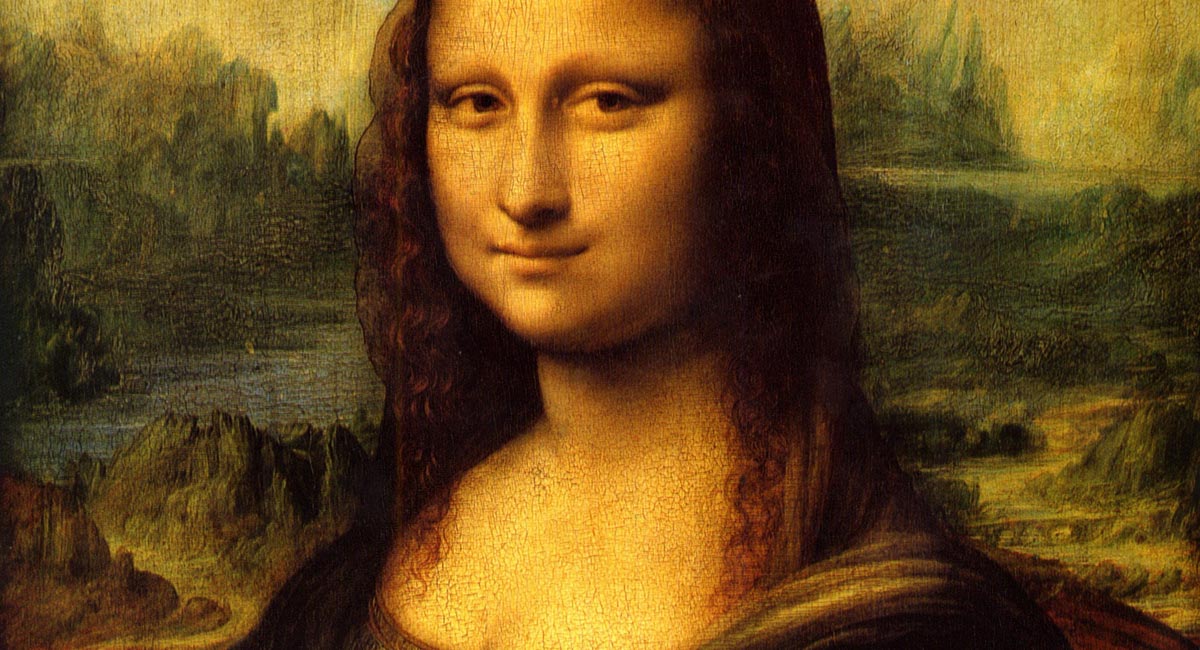
Let’s get one thing out of the way before anyone faints into a velvet chaise lounge: Leonardo da Vinci did not literally invent reality television, contour kits, or Kris Jenner’s management style. He did, however, help build the visual logic that makes modern celebrity culture possible. That is the real trick hiding inside this gloriously ridiculous title. The Mona Lisa did not give birth to the Kardashians in a family-tree sense. She gave birth to them in a cultural sense.
She taught the modern world how to worship a face.
Long before ring lights, Instagram Stories, paparazzi lenses, and billion-dollar shapewear brands, there was a woman in a dark dress, seated before a dreamlike landscape, wearing the most famous almost-smile in history. The painting became more than art. It became a public event, a brand, a meme before memes, and eventually a symbol of the strange power that images can hold over mass audiences. If the Mona Lisa is the grandmother of visual obsession, the Kardashians are her most successful digital descendants: masters of the public face, curators of mystique, and experts at turning visibility into value.
This is the story of how a Renaissance portrait helped create the celebrity economy that families like the Kardashians now dominate. It is also the story of how beauty, fame, image control, and public curiosity evolved from oil paint to phone screens. In other words, this is a history of the internet told through one mysterious smile and one very photogenic family.
The Mona Lisa Wasn’t Just a Painting. She Became a Public Personality.
Today, people speak about the Mona Lisa as if she arrived on Earth already famous, like a celestial influencer with a perfect launch strategy. But her worldwide celebrity did not spring up overnight. Her rise was built over time through criticism, reproduction, media attention, and one blockbuster theft that turbocharged her fame. Once that machine got moving, the painting stopped being just a portrait and became something closer to a permanent public figure.
That transformation matters. A famous artwork is no longer only viewed; it is consumed, discussed, reproduced, parodied, protected, photographed, merchandised, and argued over. Sound familiar? It should. That is exactly how modern celebrity works.
The Mona Lisa became irresistible partly because she seems to withhold as much as she reveals. Her expression is unreadable but inviting. Her gaze feels intimate yet unreachable. She appears calm, self-contained, and faintly aware that everyone in the room is trying a little too hard. The portrait offers what celebrity culture always offers: access wrapped in distance. You feel close, but never close enough.
That mix of intimacy and mystery is not a bug. It is the entire business model.
The Original Image Economy Started With the Face
Portraiture has always been about more than likeness. It is about power, status, memory, aspiration, and control. A portrait tells viewers not just what someone looked like, but how they should be seen. That idea runs straight from old master painting to glossy magazine covers to impeccably lit Instagram grids.
In earlier portrait traditions, a sitter’s face and gaze were carefully designed to communicate character. Minimal backgrounds, direct eye contact, restrained gestures, and deliberate styling all helped turn a person into a public image. Renaissance and post-Renaissance portraiture understood something that social media later industrialized: people do not simply appear in images. They perform in them.
The Mona Lisa is especially powerful because she feels uncannily alive. She is not frozen like an icon on a coin. She seems to be in the middle of thinking something. Viewers project onto her because she leaves room for projection. That is one of the oldest tricks in fame. The less the image explains itself, the more the audience fills in the blanks.
Modern celebrity still depends on this same mechanism. We stare, speculate, zoom in, debate, imitate, and assign meaning. The audience becomes part of the production. Fame is not just created by the subject. It is co-authored by the crowd.
Then Came Mass Reproduction, and the Smile Went Viral Before Viral Was a Thing
If portraiture provided the blueprint, mass reproduction provided the rocket fuel. Once images can travel, fame can multiply. Prints, newspapers, posters, magazine spreads, television, and now algorithmic feeds all do the same basic thing: they turn a face into portable attention.
The Mona Lisa became one of the earliest global examples of this phenomenon. Reproductions made her recognizable far beyond the museum. The 1911 theft made her an international sensation. Suddenly, people who had never seen the painting in person knew the story, knew the face, and knew that this one image mattered. Not because everyone had studied art history, but because media had decided that this woman in a portrait was now news.
That leap from object to spectacle is exactly the leap modern celebrities make. Once the public no longer experiences a person directly, but through circulating images and stories, fame begins to live in the copy as much as in the original. The image becomes more famous than the underlying reality.
And what are the Kardashians, if not virtuosos of life as a circulating image?
The Kardashians Perfected What the Mona Lisa Started
The Kardashian empire did not rise simply because the family was visible. Lots of people are visible online. The family rose because it understood how to turn visibility into narrative, narrative into aspiration, and aspiration into commerce. That is not random fame. That is image strategy.
Kim Kardashian in particular learned how to occupy the strange modern zone between intimacy and performance. She shares enough to feel knowable, but not enough to become ordinary. She can appear in a raw family moment, then pivot seamlessly into a luxury campaign, a legal advocacy interview, a beauty launch, or a high-fashion appearance. The effect is the same one viewers feel before the Mona Lisa: closeness mixed with control.
The Kardashians did not invent self-branding, but they scaled it with industrial efficiency. Their faces are not just faces. They are platforms. Their bodies are not just bodies. They are marketing surfaces, debate magnets, trend engines, and commercial ecosystems. Every photo can sell. Every outfit can signal. Every appearance can be monetized. Their public image is not a side effect of success. It is the engine of success.
That is where the line back to the Mona Lisa becomes sharp. The most famous painting in the world showed that one face, properly circulated, could hold the attention of millions. The Kardashians showed that in the digital age, one family can turn that principle into a lifestyle empire.
From Museum Crowds to Scroll Culture
Go to the Louvre and you will see a modern ritual that feels almost suspiciously online. People crowd into a room, hold up their phones, push toward the image, and often leave with a photograph of themselves having been near the photograph. The experience is not only about contemplation. It is about proof of proximity. “I was here. I saw the famous face. Please validate my existence accordingly.”
That impulse is not silly so much as deeply modern. We no longer just want to see the iconic image; we want to insert ourselves into its orbit. The audience wants a relationship with fame, even if that relationship lasts six seconds and includes three elbows to the rib cage.
Social media takes that museum behavior and puts it on a 24-hour loop. The scroll is a hallway of portraits. We move from face to face, reading beauty, status, mood, desirability, wealth, coolness, taste, and relevance in fractions of a second. It is portraiture with caffeine. It is art history with a notification badge.
The Kardashians thrive in this environment because they understand that being looked at is no longer enough. The image must be optimized for circulation, reaction, imitation, and shopping. The old masterpiece asked for attention. The new celebrity image asks for attention, engagement, and conversion.
Beauty Standards, Filters, and the Commercial Face
Here is where things get more complicated. The journey from the Mona Lisa to the Kardashians is not only about fame. It is also about beauty standards. Cultural ideals of femininity have always been shaped by images, but digital platforms speed that process up until it starts smoking.
The Kardashians became central to 21st-century beauty culture because they did more than wear trends. They helped systematize them. Contour-heavy makeup, hyper-curated glamour, sculpted silhouettes, image retouching, and the blending of aspirational luxury with casual accessibility all became hallmarks of a broader visual era. Their look traveled everywhere, from red carpets to mall brands to teen phone screens.
At the same time, that influence sparked major criticism. The family’s image culture has been accused of promoting unrealistic standards, intensifying comparison, and helping normalize filters and heavily managed appearances as everyday expectations. In digital beauty culture, the face becomes a project. Then it becomes a product. Then, if we are not careful, it becomes a problem.
That tension also has roots in portrait history. Images have always idealized. They flatter, edit, elevate, and frame. But the scale is different now. A painted portrait once lived in a palace, collection, or museum. Today, aesthetic pressure rides around in your pocket, pings you during lunch, and asks whether your pores have considered rebranding.
The Kardashians as the Final Form of the “It Girl” Tradition
American culture has long turned women into archetypes. The Gibson Girl became an early “it girl” figure who helped shape beauty and fashion ideals. Hollywood stars later inherited that role. Magazine models, supermodels, pop stars, and reality stars each took a turn. The Kardashians did not come from nowhere. They arrived at the end of a very long runway.
What makes them different is that they fused nearly every previous stage of fame into one machine. They borrow from portraiture, magazine culture, tabloid culture, reality television, influencer marketing, luxury branding, and direct-to-consumer retail. They are not just celebrities in the old sense. They are media systems.
And unlike classic movie stars, they operate in public continuously. There is no clean divide between the role and the person, the ad and the life, the family scene and the brand strategy. That blur is the point. It gives the illusion of authenticity while preserving the architecture of spectacle.
If the Mona Lisa was the woman whose image conquered the world, the Kardashians are the family who learned how to conquer the world through image.
Why This Connection Still Matters
It is tempting to laugh off the comparison between Leonardo’s masterpiece and a reality-TV dynasty. Honestly, the comparison is funny. It sounds like the opening line of a college lecture taught by someone wearing designer sneakers and carrying too many tabs open. But it also reveals something serious about how culture works.
We tend to separate “high art” from “pop culture” as if one belongs to museums and the other belongs to group chats. In reality, both are systems for creating attention and meaning around images. Both teach us how to look. Both shape desire. Both influence what becomes memorable, admirable, aspirational, or imitable.
The Mona Lisa helped prove that a face could become a global obsession. The modern media age then layered on reproduction, publicity, fashion, commerce, and algorithmic distribution. The Kardashians did not invent the worship of image, but they mastered its latest software update.
So when we ask how the Mona Lisa gave birth to the Kardashians, the answer is not that Renaissance art somehow predicted Hulu. It is that the structures of modern fame were already present in the long history of portraiture: the curated face, the intriguing gaze, the controlled mystery, the public fixation, the endless reproduction, and the commercial afterlife of being seen.
The smile came first. The empire came later.
Experiences From Inside the Image Machine
To really understand this connection, it helps to think less like a historian and more like an ordinary person moving through modern life. Imagine standing in front of the Mona Lisa. The room is packed. You are not alone with the painting in a quiet, candlelit state of spiritual refinement. You are shoulder to shoulder with tourists, security barriers, raised phones, and a low electric hum of people trying to collect proof that they encountered something iconic. You look at the painting, but you also look at everyone else looking at the painting. Fame works like that. It is contagious because other people’s attention tells you where to direct your own.
Now imagine opening Instagram, TikTok, or any other image-first platform. You are again standing in a crowd, except this time the crowd fits in your hand. Face after face appears. Some are polished. Some are “casual” in the highly suspicious way that takes excellent lighting and three drafts. Some are selling products. Some are selling a mood. Some are selling a body, a routine, a fantasy, or the illusion that a better version of your life is one lip liner away. The feeling is not that different from the museum, except the velvet rope is gone and the gift shop has merged with the artwork.
That is where the Kardashians become so relevant as a lived experience, not just a media case study. They are part of the visual weather. Even people who do not follow them have lived in a culture shaped by them. You can see it in beauty tutorials, shapewear language, red-carpet posing, filtered selfies, luxury minimalism, and the broader expectation that a person should be camera-ready not just for events, but for breakfast.
There is also a psychological experience attached to all this. Looking at famous images often creates a cocktail of emotions: fascination, admiration, envy, boredom, inspiration, amusement, skepticism, and the occasional desire to throw your phone into a lake and start a simpler life involving tomatoes. The strange thing is that the contradiction is the point. Celebrity images are powerful because they keep us toggling between attraction and resistance. We want to look, and we want to complain about looking, and then we look again.
In that sense, the road from the Mona Lisa to the Kardashians is also the road from passive viewing to participatory viewing. We do not simply receive images anymore. We answer them with our own. We pose, filter, crop, caption, archive, and compare. We become both audience and amateur publicist, museum visitor and mini-brand manager. The modern experience of identity is shaped by this constant awareness of being potentially visible.
And maybe that is the most important legacy of all. The Mona Lisa helped create a world in which a face could carry mystery, prestige, and public obsession across centuries. The Kardashians live in the version of that world where the face never stops circulating and where personal image is tied to money, influence, and self-worth. For better or worse, most of us now live there too. We are all, in some small way, negotiating with portraits all day long.
So yes, the title is absurd. But like the best absurd things, it tells the truth sideways. The Mona Lisa gave birth to the Kardashians by helping invent the culture that made them possible: a culture that stares at faces, builds myths around them, copies them, commodifies them, and keeps coming back for one more look. Preferably with the front-facing camera on.
Conclusion
The Mona Lisa and the Kardashians belong to different centuries, different technologies, and very different gift shops. Yet they are connected by the same cultural current: the transformation of the human image into a site of fascination, aspiration, and power. Leonardo’s portrait showed how a face could hold the world still. Modern media showed how that face could be reproduced endlessly. The Kardashians showed how endless reproduction could become a business model, a beauty standard, and a defining feature of contemporary celebrity culture.
That does not mean the comparison is neat or flattering. It means it is revealing. The history of portraiture did not end in museums. It spilled into magazines, television, feeds, ads, selfies, and influencer branding. The result is a culture in which being seen can be as valuable as being brilliant, and where image management often shapes public reality. The smile in the Louvre and the selfie on your phone are not identical. But they are part of the same long story about how pictures teach us what matters.













