
Research synthesis: University of Wisconsin–Madison Extension, University of Florida IFAS Extension, University of Georgia, University of Minnesota Extension, Penn State Extension, University of Illinois Extension, Mississippi State University Extension, Iowa State University Extension, Texas A&M AgriLife Extension, Oklahoma State University Extension, Missouri Department of Conservation, Smithsonian Gardens, and the USDA Forest Service.
Finding a black swallowtail caterpillar on your parsley can create two immediate thoughts: “What a beautiful little creature,” followed closely by, “Hey, that was supposed to be dinner.” Fortunately, you can protect the caterpillar without surrendering your entire herb garden to a striped eating machine.
The black swallowtail, scientifically known as Papilio polyxenes, commonly lays its eggs on plants in the parsley family. Its caterpillars eat dill, parsley, fennel, carrots, parsnips, celery, golden Alexanders, and several related wild plants. Young larvae look dark, spiny, and suspiciously similar to bird droppings. Older caterpillars develop the familiar green body, black bands, and yellow-orange spots.
Caring for one is relatively simple, but success depends on fresh pesticide-free food, good ventilation, daily cleaning, minimal handling, and enough space for pupation and adult emergence. The following 14 steps take you through the process from hungry caterpillar to healthy butterfly.
Identification, host plants, developmental timing, and appearance:
Before You Begin: Understand the Black Swallowtail Life Cycle
A black swallowtail passes through four major life stages: egg, larva, pupa, and adult. Eggs generally hatch within several days, although development varies with temperature. The caterpillar then grows through five larval stages called instars, molting between each one.
The larval period commonly lasts from about 10 days to a month. After reaching full size, the caterpillar wanders away from its food, attaches itself to a secure surface, and forms a chrysalis. A summer chrysalis may produce a butterfly within a few weeks. A late-season chrysalis may remain dormant throughout winter.
These timeframes are estimates, not appointments. Your caterpillar has not misplaced its calendar merely because it takes longer than an online chart predicted.
Life-cycle timing and overwintering:
How to Care for a Black Swallowtail Caterpillar in 14 Steps
-
Confirm That It Is a Black Swallowtail Caterpillar
Start by identifying the caterpillar correctly. Mature black swallowtail caterpillars have green bodies crossed by black bands containing yellow or orange dots. Unlike monarch caterpillars, they do not have long black filaments projecting from both ends of the body.
Check the plant on which you found it. A striped caterpillar eating parsley, dill, fennel, carrot foliage, celery, or parsnip is likely a black swallowtail. A similar-looking caterpillar eating milkweed is more likely a monarch.
Young black swallowtails can look entirely different. They are usually dark, somewhat spiny, and marked with a pale saddle across the middle. Do not dismiss one as a mystery bug simply because it has not yet changed into its fashionable striped outfit.
-
Decide Whether Captive Care Is Necessary
A caterpillar does not automatically need to be brought indoors. Leaving it on a healthy host plant allows it to participate naturally in the surrounding ecosystem. Birds, predatory insects, and parasitoids are part of that ecosystem, even when their dining habits are less charming than a butterfly garden brochure suggests.
Temporary captive care may be appropriate for education, observation, protection from yard maintenance, or rescue from a plant that must be removed. Raise only as many caterpillars as you can feed and clean up after properly. Habitat gardening usually provides greater long-term value than collecting large numbers of wild caterpillars.
-
Prepare a Well-Ventilated Enclosure
Use a mesh butterfly cage, screened container, pop-up insect enclosure, or roomy container fitted with substantial ventilation. The enclosure must prevent escapes while allowing air to circulate. Avoid tightly sealed jars and containers that remain damp inside.
Line the bottom with plain paper towels or unprinted paper. This liner catches frassthe polite scientific term for caterpillar poopand makes daily cleaning easier. Do not use loose fabric with loops that may catch tiny feet.
Place the enclosure in bright indirect light. Direct sunlight can quickly overheat a small container, turning your butterfly nursery into a botanical pressure cooker.
-
Provide the Same Kind of Host Plant
Offer the same plant species on which the caterpillar was found whenever possible. A caterpillar collected from dill should initially receive dill; one found on parsley should receive parsley. Although black swallowtails use several related plants, a sudden menu change may cause a young larva to wander or refuse food temporarily.
Reliable host plants include flat-leaf or curly parsley, dill, fennel, carrot tops, parsnips, celery foliage, golden Alexanders, and certain other members of the carrot family. Rue may also be used by black swallowtails in some areas.
Never substitute lettuce, spinach, milkweed, or random garden leaves. Caterpillars are specialists, not adventurous salad-bar customers.
-
Use Only Pesticide-Free Foliage
Food safety is one of the most important parts of black swallowtail caterpillar care. Use plants you grew without insecticides or plants obtained from a trusted pesticide-free source. Avoid foliage from roadsides, sprayed landscapes, or recently purchased ornamental plants unless you know how they were treated.
Systemic insecticides can remain inside plant tissues and cannot necessarily be removed by rinsing. Biological caterpillar-control products containing Bacillus thuringiensis, commonly called Bt, can also kill butterfly larvae.
Inspect every cutting for spiders, ants, predatory bugs, and other hitchhikers. Rinse safe foliage gently with cool water and allow it to dry before placing it in the enclosure.
Enclosure airflow, sanitation, fresh food, and pesticide avoidance:
-
Keep Cuttings Fresh Without Creating a Drowning Hazard
Place host-plant stems in a narrow-necked floral tube or small jar of water. Caterpillars receive most of the moisture they need from fresh foliage, so keeping the plant hydrated is more useful than adding a water bowl.
Seal the opening around the stems with foil, plastic wrap, a fitted lid, or tightly packed paper towel. A caterpillar can crawl down a stem, fall into an open container, and drown. Covering the water also prevents frass from turning the jar into an unpleasant green soup.
Replace limp or drying foliage promptly. Young caterpillars are especially vulnerable when their leaf dries before they successfully transfer to fresh food.
-
Supply More Food Than You Think You Need
A nearly full-grown black swallowtail caterpillar can consume an impressive amount of foliage. Check the enclosure at least twice daily and add fresh food before the existing supply is reduced to bare stems.
Planting extra dill, parsley, or fennel is the easiest solution. A potted host plant can also be placed directly inside a large mesh enclosure. Keep several backup plants growing because mature caterpillars have a talent for finishing the last parsley leaf shortly after every garden center has closed.
Do not overcrowd the cage. Multiple large caterpillars require considerably more foliage, ventilation, cleaning, and pupation space than several tiny larvae.
-
Clean the Enclosure Every Day
Remove frass, dead leaves, wilted stems, and excess moisture daily. Replace the paper liner and wipe contaminated surfaces with clean water. Allow reusable containers to dry before returning the caterpillar.
Move the caterpillar by transferring the leaf or stem on which it is resting. There is usually no reason to peel it from a surface with your fingers. Regular cleaning reduces mold and limits the buildup of waste that may contribute to unhealthy rearing conditions.
Wash your hands before and after tending the enclosure, especially when caring for more than one cage. Use separate tools when possible so that a problem in one enclosure is not spread to another.
Daily cleaning, fresh foliage, airflow, and uncrowded conditions:
-
Handle the Caterpillar as Little as Possible
Caterpillars are soft-bodied animals that cling firmly with tiny legs. Pulling one from a stem can injure it. When relocation is unavoidable, move the entire leaf, cut the supporting stem, or encourage the caterpillar to crawl onto a fresh piece of host plant.
Avoid touching a motionless caterpillar. Stillness often means it is preparing to molt. During this period, it may anchor itself to a silk pad, stop eating, and remain in one place for many hours. Disturbing it can interfere with the shedding process.
After molting, the caterpillar may appear pale or soft while its new outer covering hardens. It may also eat its discarded skin. This recycling behavior looks strange but does not require intervention.
-
Recognize the Caterpillar’s Defensive Display
When frightened, a black swallowtail caterpillar may rear backward and extend a bright orange, fork-shaped organ from behind its head. This organ is called an osmeterium. It releases an unpleasant odor intended to discourage predators.
The osmeterium is harmless to people, but repeatedly provoking the display stresses the caterpillar. Do not poke it for photographs or party entertainment. Observe the behavior if it happens naturally, then give the animal space to calm down.
Molting, instars, and osmeterium behavior:
-
Watch for the Pre-Pupal Wandering Stage
A mature caterpillar eventually stops eating and begins roaming around the enclosure. It may empty its digestive tract, producing a loose or greenish dropping, and then spend hours searching for a suitable pupation site.
This is usually normal behavior, not an escape attempt motivated by dissatisfaction with the parsley. Make sure the enclosure is completely closed and provide sturdy upright twigs, rough stems, cardboard strips, or mesh walls.
The chosen surface should be stable enough to remain undisturbed during pupation and strong enough to support the emerging adult later.
-
Allow the Caterpillar to Form Its Chrysalis Undisturbed
The caterpillar attaches its rear end to a silk pad and spins a supporting silk girdle around its upper body. It rests in a head-up position before shedding its final larval skin and revealing the chrysalis beneath.
Do not touch or relocate it during this process. A newly formed chrysalis is soft and vulnerable to damage. Wait at least a day or two before moving the enclosure or any removable twig to which the chrysalis is attached.
Black swallowtail chrysalides may be green, brown, grayish, or mottled. Color can be influenced by the surrounding surface and season, so a brown chrysalis is not automatically dead.
-
Care for a Summer or Overwintering Chrysalis Correctly
A summer chrysalis may produce an adult in approximately one to three weeks, depending on temperature and other conditions. Keep it ventilated, protected from direct sun, and positioned where the future butterfly will have plenty of room to emerge.
A chrysalis formed late in the season may enter diapause and remain dormant until spring. Do not keep an overwintering chrysalis in a continuously heated living room, where warmth may trigger emergence when outdoor food and suitable weather are unavailable.
Keep it in a sheltered, unheated location that experiences natural seasonal temperatures without flooding, extreme temperature swings, or direct exposure to harsh weather. Check periodically for mold, physical damage, or premature emergence.
Pupation posture, chrysalis colors, development time, and overwintering:
-
Provide Space for the Butterfly to Emerge and Hang
Shortly before emergence, the chrysalis may darken and the wing pattern may become visible through its outer covering. The adult usually emerges quickly and must immediately grip a surface and hang vertically.
Provide several inches of unobstructed space below the chrysalis. Mesh walls or rough upright material should be close enough for the butterfly to grab if it falls. While hanging, it expands its folded wings and allows them to dry and harden.
Do not handle the butterfly or attempt to open its wings. A reddish-brown liquid discharged after emergence is normal waste from the pupal stage, not necessarily blood or an injury.
-
Release the Adult in Suitable Weather
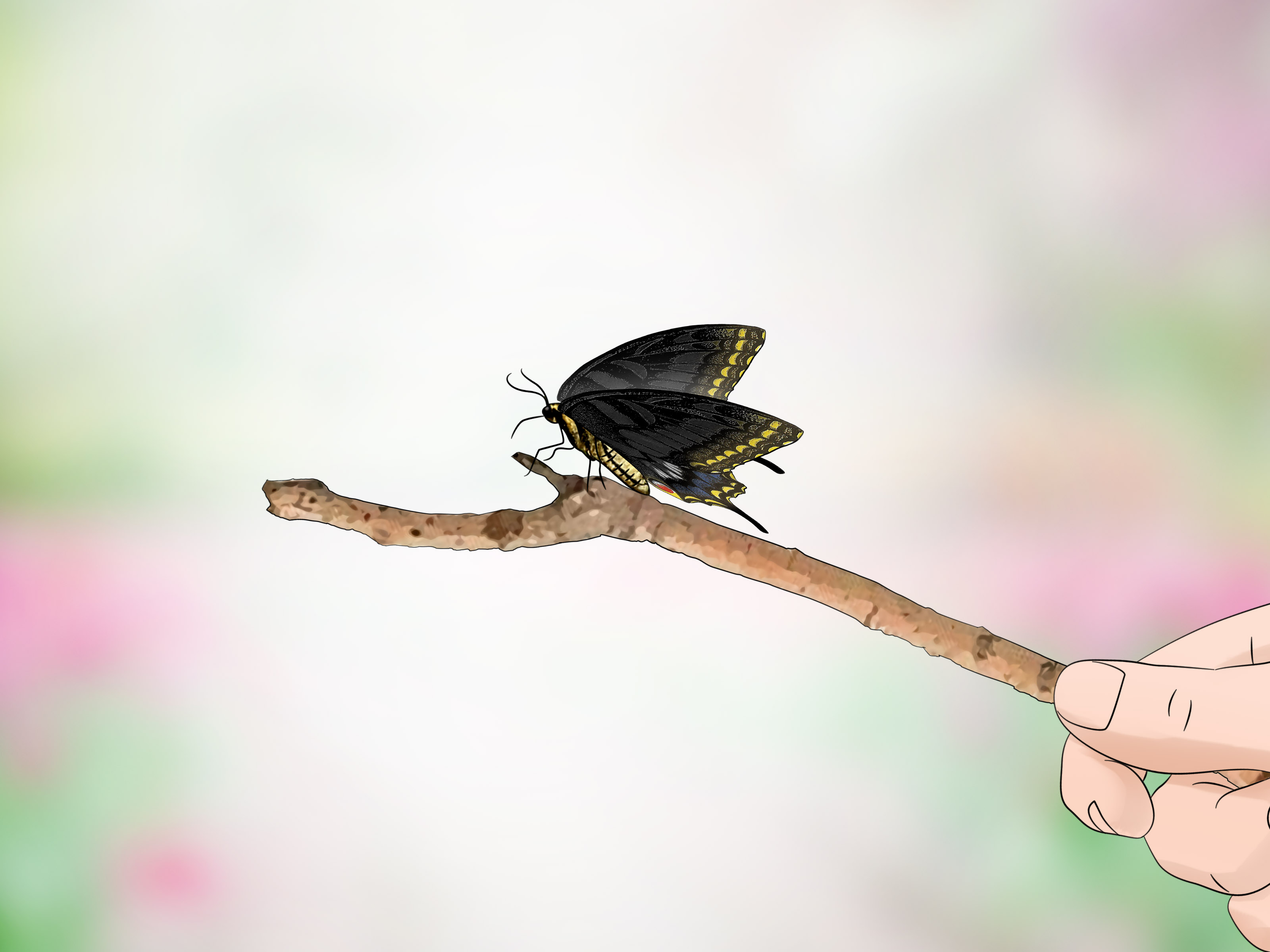
Wait until the butterfly’s wings are fully expanded, firm, and dry. Release it during daylight in calm, dry, mild weather, preferably near the area where the caterpillar was found. A garden containing nectar flowers and black swallowtail host plants provides an especially welcoming launch site.
Open the enclosure outdoors and allow the butterfly to leave on its own. It may fly immediately or rest for a while before departing. Avoid tossing it into the air, placing it on hot pavement, or releasing it during heavy rain, strong wind, or unusually cold conditions.
If poor weather temporarily delays release, keep the adult in a spacious mesh enclosure where it can hang without damaging its wings. Release it as soon as reasonable conditions return.
Adult wing expansion, post-emergence waste, and resting before flight:
Common Problems and Warning Signs
The Caterpillar Suddenly Stops Eating
A healthy caterpillar often becomes motionless before molting or pupating. Check whether it is firmly attached to silk and leave it alone. Constantly nudging it to confirm that it is alive can turn a normal molt into a genuine problem.
The Caterpillar Turns Dark or Limp
Unusual discoloration, leaking fluid, persistent limpness, foul odors, or rapid deterioration may indicate disease, pesticide exposure, physical injury, or parasitism. Isolate the affected individual from other caterpillars and thoroughly clean the enclosure.
A Wasp or Fly Emerges Instead of a Butterfly
Black swallowtails have several natural parasitoids. A caterpillar may look normal and even form a chrysalis before an adult wasp or fly eventually emerges. This is disappointing, but it is not necessarily the result of poor care. The caterpillar may have been parasitized before you found it.
The Chrysalis Does Nothing for Months
A late-season chrysalis may be overwintering. Continued firmness and normal coloration are more encouraging than a rigid deadline on a calendar. Maintain appropriate seasonal conditions and wait for spring warmth to resume development.
Natural enemies, parasitoids, and variable development:
Practical Experiences: Lessons First-Time Caregivers Commonly Learn
The first lesson many caregivers learn is that the enclosure is usually easier to obtain than the food. A tiny caterpillar may appear to require only one parsley sprig, encouraging the confident belief that supplies are under control. Several molts later, that same caterpillar is consuming leaves with the efficiency of a miniature landscaping crew. Growing extra host plants before caterpillar season prevents frantic herb shopping later.
A second surprise is how dramatically black swallowtails change. Someone who brings home a dark, spiny larva may worry when it later becomes smooth, green, and striped. The change is normal. Each instar can look different enough to seem like a new species moved into the cage overnight while everyone was asleep.
New caregivers also tend to misinterpret stillness. A caterpillar that stops eating and remains frozen on a stem often triggers emergency internet searches, flashlight examinations, and gentle but unnecessary poking. In many cases, the caterpillar is preparing to molt. The most successful response is often the least exciting one: observe from a distance and wait.
Daily cleaning quickly becomes the least glamorous but most valuable part of the routine. Small larvae produce frass that resembles black pepper. Large larvae produce pellets that are impossible to overlook and astonishingly numerous. A removable paper liner makes the job faster, while good ventilation keeps damp waste from encouraging mold.
Another practical lesson concerns cut foliage. A lush stem can wilt surprisingly quickly, particularly in a warm room. Placing stems in covered water tubes keeps the leaves fresh, but every opening must be sealed. Caregivers sometimes focus so heavily on protecting a caterpillar from predators that they accidentally create an open-water hazard inside its supposedly safe enclosure.
The wandering stage can also produce confusion. A full-grown caterpillar may leave perfectly good food and march repeatedly around the cage. Adding more parsley will not persuade it to return to lunch because eating is no longer the objective. It is searching for a pupation site. Providing stable twigs and rough vertical surfaces before this stage prevents it from attaching to a zipper, lid seam, or other inconvenient location.
Patience becomes even more important after the chrysalis forms. Summer development may proceed quickly, but an overwintering chrysalis can remain unchanged for months. Moving it into a warm house to “help” may interfere with its seasonal timing. Matching natural conditions is generally more useful than trying to accelerate the process.
Finally, not every caterpillar survives. Some have already encountered predators, pesticides, disease, or parasitoids before being collected. Responsible care improves conditions but cannot guarantee an adult butterfly. The experience is still valuable because it reveals how closely the animal depends on clean habitat, suitable host plants, seasonal weather, and a surprisingly complicated web of other organisms.
The most rewarding moment is not necessarily the emergence itself. It is opening the enclosure in good weather and watching the butterfly decide when to leave. Sometimes it launches instantly. Sometimes it rests on a hand, sleeve, flower, or cage wall before taking flight. Either response is normal. The butterfly does not owe its caregiver a cinematic departure, although it occasionally provides one anyway.
Conclusion
Successful black swallowtail caterpillar care is built on a few simple principles: correct identification, abundant pesticide-free host plants, clean and ventilated housing, minimal handling, suitable pupation surfaces, and patience during metamorphosis. The goal is not to control every moment of the process but to provide safe conditions in which the caterpillar can complete its natural development.
For lasting results, continue caring for black swallowtails after the butterfly leaves. Grow extra dill, parsley, fennel, carrots, or native golden Alexanders, avoid broad-spectrum insecticides, and provide nectar-rich flowers for adults. A healthy garden can support many generations without requiring every caterpillar to become a household guest.
Habitat planting, host plants, nectar resources, and pesticide avoidance:













