
Finding coterminal angles sounds like the kind of math task that should come with a tiny warning label: “May involve mysterious circles, Greek letters, and unexpected flashbacks to trigonometry class.” Good news: it is much easier than it looks. A coterminal angle is simply another angle that lands in the same place on the coordinate plane after making one or more full rotations.
Think of it like walking around a circular track. If you start at the same spot and stop facing the same direction, it does not matter whether you walked one lap, two laps, or backed up a lap while pretending to be dramatic. Your final direction is the same. Coterminal angles work the same way. They may have different measurements, but they share the same initial side and terminal side.
In this guide, you will learn how to find coterminal angles in 3 easy steps using degrees and radians. We will cover the formula, common mistakes, examples, shortcuts, and practical experience-based tips that make this concept less “math fog” and more “oh, that actually makes sense.”
What Are Coterminal Angles?
Coterminal angles are angles drawn in standard position that end at the same terminal side. In standard position, an angle begins on the positive x-axis. Positive angles rotate counterclockwise, while negative angles rotate clockwise.
For example, 45° and 405° are coterminal angles. Why? Because 405° is just 45° plus one full 360° rotation. The terminal side lands in the same exact place. Likewise, 45° and -315° are also coterminal because -315° rotates clockwise and stops at the same terminal side as 45°.
The Simple Definition
A coterminal angle is an angle that shares the same ending side with another angle after adding or subtracting full rotations.
In degrees, one full rotation is 360°. In radians, one full rotation is 2π. That is the secret sauce. Once you know the unit, you know what number to add or subtract.
Why Coterminal Angles Matter
Coterminal angles are not just a classroom trick invented to make calculators nervous. They are useful in trigonometry, unit circle problems, graphing sine and cosine, solving trigonometric equations, and understanding periodic functions.
Because trigonometric functions repeat after full rotations, coterminal angles often have the same sine, cosine, and tangent values. For instance, sin(30°) and sin(390°) are equal because 390° is coterminal with 30°. That repeating behavior is the heartbeat of trig graphs.
How to Find Coterminal Angles in 3 Easy Steps
Here is the main process. It works whether your angle is positive, negative, very large, awkward-looking, or wearing a tiny disguise as a fraction of pi.
Step 1: Identify Whether the Angle Is in Degrees or Radians
Before adding or subtracting anything, check the unit. If the angle has a degree symbol, such as 725°, you are working in degrees. If the angle includes π, such as 19π/4, or is written as a radian measure, you are working in radians.
This step matters because the full-rotation value changes:
- Degrees: Add or subtract 360°.
- Radians: Add or subtract 2π.
If you mix the two, the answer will wander off like a student who accidentally entered the wrong classroom.
Step 2: Add or Subtract a Full Rotation
To find coterminal angles, add or subtract the full rotation value. In degrees, use this formula:
θ + 360°n
Here, θ is the original angle and n is any integer, such as -2, -1, 0, 1, or 2. This means an angle has infinitely many coterminal angles.
In radians, use this formula:
θ + 2πn
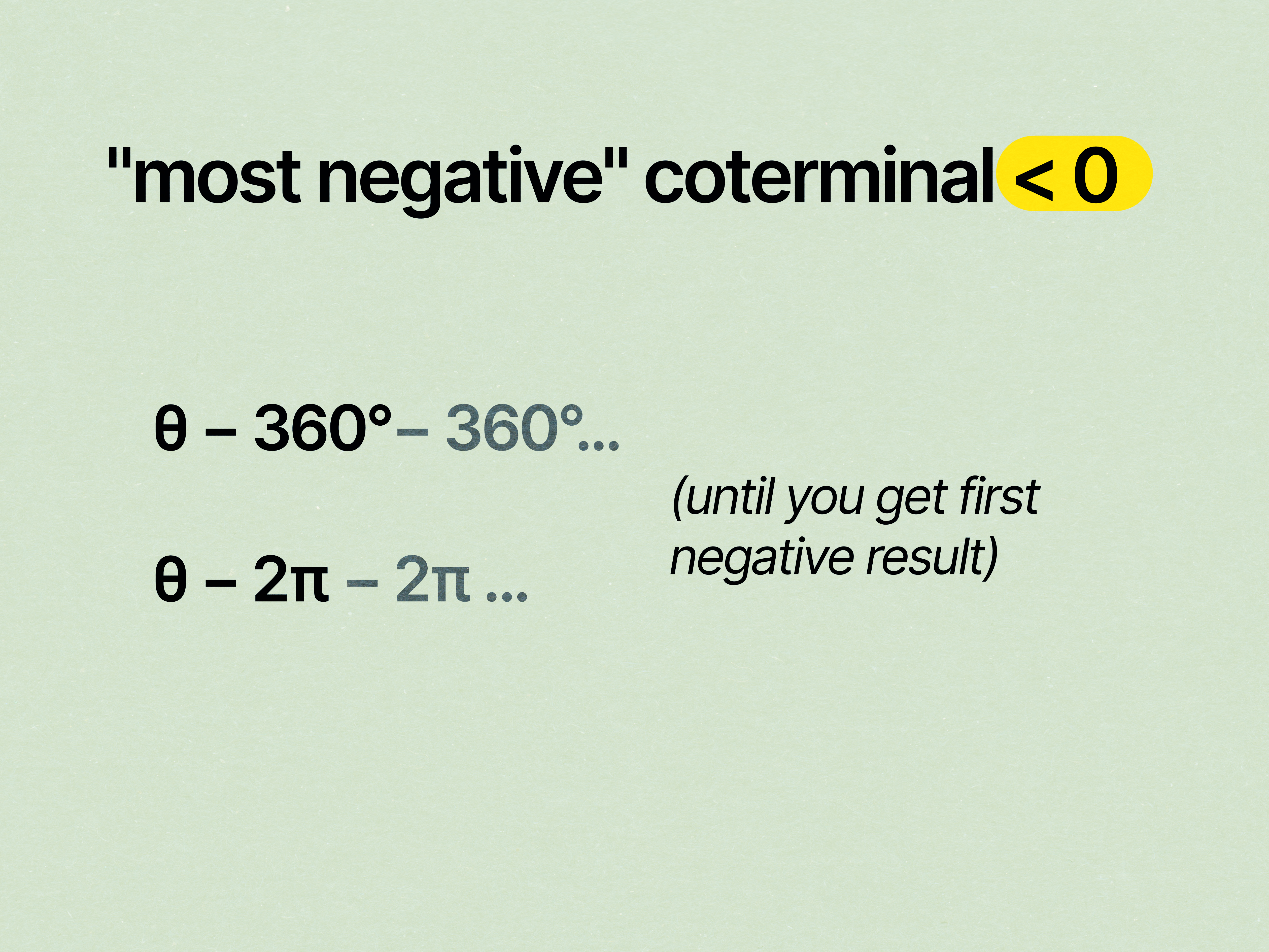
Again, n can be any integer. Add a full rotation to find a larger coterminal angle. Subtract a full rotation to find a smaller one.
Step 3: Keep Going Until the Angle Fits the Requested Range
Many problems ask for a coterminal angle between 0° and 360°, or between 0 and 2π. If your result is still too large or too small, keep adding or subtracting full rotations until it lands in the requested interval.
For example, if you are given 800° and asked to find a coterminal angle between 0° and 360°, subtract 360°:
800° – 360° = 440°
That is still greater than 360°, so subtract again:
440° – 360° = 80°
So, 80° is coterminal with 800°.
Coterminal Angle Formula
The formula is beautifully short. You may even want to put it on a sticky note, assuming your sticky notes have not already been claimed by grocery lists and suspicious reminders like “buy more batteries.”
Formula for Degrees
Coterminal angles = θ + 360°n
Use this formula when the original angle is measured in degrees.
Formula for Radians
Coterminal angles = θ + 2πn
Use this formula when the original angle is measured in radians.
The variable n represents any integer. That is why every angle has infinitely many coterminal angles. You can keep spinning around the circle forever, although your math teacher may eventually ask you to sit down.
Example 1: Find a Positive Coterminal Angle
Problem: Find a positive coterminal angle for 120°.
Solution: Add 360°.
120° + 360° = 480°
Answer: 480° is a positive coterminal angle with 120°.
You could also add another 360° and get 840°. Both are correct. Coterminal angles are generous like that.
Example 2: Find a Negative Coterminal Angle
Problem: Find a negative coterminal angle for 60°.
Solution: Subtract 360°.
60° – 360° = -300°
Answer: -300° is coterminal with 60°.
This tells us that rotating 60° counterclockwise lands in the same position as rotating 300° clockwise.
Example 3: Find an Angle Between 0° and 360°
Problem: Find an angle between 0° and 360° that is coterminal with 725°.
Solution: Since 725° is larger than 360°, subtract 360°.
725° – 360° = 365°
365° is still larger than 360°, so subtract 360° again.
365° – 360° = 5°
Answer: 5° is coterminal with 725°.
Example 4: Find a Coterminal Angle for a Negative Angle
Problem: Find a coterminal angle between 0° and 360° for -150°.
Solution: Since the angle is negative, add 360°.
-150° + 360° = 210°
Answer: 210° is coterminal with -150°.
This is a common type of question because many trig problems prefer angles written inside one standard rotation.
How to Find Coterminal Angles in Radians
Radians use the same idea, but instead of adding or subtracting 360°, you add or subtract 2π. Since 2π represents one complete trip around the circle, it creates a coterminal angle just like 360° does in degree measure.
Example 5: Radian Coterminal Angle
Problem: Find a coterminal angle for π/3.
Solution: Add 2π.
π/3 + 2π = π/3 + 6π/3 = 7π/3
Answer: 7π/3 is coterminal with π/3.
Example 6: Find a Radian Angle Between 0 and 2π
Problem: Find an angle between 0 and 2π that is coterminal with 19π/4.
Solution: Subtract 2π. To combine fractions, rewrite 2π as 8π/4.
19π/4 – 8π/4 = 11π/4
11π/4 is still greater than 2π, so subtract 8π/4 again.
11π/4 – 8π/4 = 3π/4
Answer: 3π/4 is coterminal with 19π/4.
Shortcut Method: Use Division or Remainders
When angles are large, repeated subtraction works, but it can feel like cleaning a room one dust particle at a time. A faster method is to divide by the full rotation and use the remainder.
For degrees, divide by 360. For radians, think in terms of multiples of 2π.
Degree Shortcut Example
Problem: Find a coterminal angle between 0° and 360° for 1,450°.
Subtract 360° as many times as needed:
1,450° – 360° = 1,090°
1,090° – 360° = 730°
730° – 360° = 370°
370° – 360° = 10°
Answer: 10°
A calculator shortcut would be to compute the remainder after dividing 1,450 by 360. The remainder is 10, so the coterminal angle is 10°.
Common Mistakes to Avoid
Mistake 1: Adding 180° Instead of 360°
Adding 180° creates an angle on the opposite side of the circle, not a coterminal angle. A full rotation is 360°, not 180°. Half a pizza is wonderful at lunch, but it is not a full rotation.
Mistake 2: Mixing Degrees and Radians
If your angle is in radians, do not add 360. If your angle is in degrees, do not add 2π. Keep the units consistent from start to finish.
Mistake 3: Stopping Outside the Required Range
If the problem asks for an angle between 0° and 360°, your final answer must fit inside that range. An answer like 420° may be coterminal, but it does not satisfy the requested interval.
Mistake 4: Forgetting That Negative Angles Can Be Correct
Negative coterminal angles are valid. A negative angle simply rotates clockwise. If the problem asks for any coterminal angle, a negative answer may be perfectly fine.
How Coterminal Angles Connect to the Unit Circle
The unit circle is where coterminal angles become especially useful. On the unit circle, angles correspond to points, and coterminal angles share the same point. That means they also share the same sine and cosine values.
For example, 30°, 390°, and -330° all land at the same terminal side. Their sine and cosine values are identical. This is why coterminal angles show up so often in trigonometric identities, graphing, and equation solving.
How to Check Your Answer
You can check coterminal angles by subtracting one angle from the other. If the difference is a multiple of 360° or 2π, the angles are coterminal.
Check in Degrees
Are 40° and 760° coterminal?
760° – 40° = 720°
Since 720° is 2 times 360°, the angles are coterminal.
Check in Radians
Are π/6 and 13π/6 coterminal?
13π/6 – π/6 = 12π/6 = 2π
Since the difference is 2π, the angles are coterminal.
Practice Problems
Problem 1
Find a positive coterminal angle for 75°.
Answer: 435°, because 75° + 360° = 435°.
Problem 2
Find a negative coterminal angle for 210°.
Answer: -150°, because 210° – 360° = -150°.
Problem 3
Find an angle between 0° and 360° coterminal with 1,020°.
Answer: 300°, because 1,020° – 360° – 360° = 300°.
Problem 4
Find an angle between 0 and 2π coterminal with 15π/4.
Answer: 7π/4, because 15π/4 – 8π/4 = 7π/4.
Quick Reference Table
| Original Angle | Operation | Coterminal Angle |
|---|---|---|
| 45° | 45° + 360° | 405° |
| 120° | 120° – 360° | -240° |
| -90° | -90° + 360° | 270° |
| π/2 | π/2 + 2π | 5π/2 |
| 11π/6 | 11π/6 – 2π | -π/6 |
Experience-Based Tips for Learning Coterminal Angles
From experience, the easiest way to understand coterminal angles is to stop treating them as a memorization problem and start treating them as a movement problem. Picture yourself standing at the center of a clock, facing 3 o’clock. That direction is the positive x-axis. Now imagine rotating counterclockwise for positive angles and clockwise for negative angles. Suddenly, angles are not just numbers floating around on a worksheet. They become directions.
One helpful classroom trick is to use a pencil as the terminal side. Place the eraser at the origin of a coordinate plane and point the pencil along the positive x-axis. Rotate it 90°, then rotate it another 360°. The pencil ends in the same direction, even though the total angle has changed. That physical motion makes the idea of coterminal angles much easier to remember.
Another useful habit is to always ask, “What is one full turn in this unit?” If the problem is in degrees, one full turn is 360°. If the problem is in radians, one full turn is 2π. This one question prevents most mistakes. Many students lose points not because they misunderstand coterminal angles, but because they accidentally use the wrong full-rotation value.
When working with large positive degree measures, repeated subtraction is reliable. For example, with 1,275°, subtract 360° until the number falls between 0° and 360°. It may feel repetitive, but repetition is not always bad. It builds confidence. Once the process feels familiar, you can switch to using division and remainders for speed.
For negative angles, remember that adding 360° moves the angle counterclockwise by one full rotation. If the answer is still negative, add another 360°. For example, -725° + 360° = -365°, and -365° + 360° = -5°. That is still negative, so add 360° again to get 355°. The angle 355° is coterminal with -725°.
Radians often seem more intimidating because fractions of pi look fancy. But the same logic applies. If you see 17π/3, subtract 2π. To make subtraction easier, rewrite 2π with the same denominator. Since 2π = 6π/3, you get 17π/3 – 6π/3 = 11π/3. Still too large? Subtract 6π/3 again to get 5π/3. That final answer is between 0 and 2π.
One final experience-based tip: always check your answer by subtracting the two angles. If the difference is a full rotation or a multiple of full rotations, your answer is correct. For degrees, the difference should be a multiple of 360°. For radians, it should be a multiple of 2π. This check takes only a few seconds and can save you from sneaky arithmetic errors.
The more you practice coterminal angles, the more you will notice that they are not a separate topic floating alone in trigonometry. They connect to the unit circle, reference angles, graphing, periodic functions, and trig equations. Once this idea clicks, many later trig concepts become far less mysterious.
Conclusion
Learning how to find coterminal angles in 3 easy steps comes down to one simple idea: full rotations do not change where an angle ends. In degrees, add or subtract 360°. In radians, add or subtract 2π. Then continue until your angle fits the required range.
Coterminal angles are useful because they help simplify trigonometric problems, identify unit circle positions, and understand why sine, cosine, and tangent repeat. Whether you are working with 725°, -150°, 19π/4, or another angle that looks like it came dressed for a math costume party, the method stays the same.
Note: This article is written for educational use and is based on standard American trigonometry concepts commonly taught in algebra, precalculus, and unit circle lessons.













