
Some math problems look innocent until they hit you with a twist. “Here’s the surface area of a cube. Now find the volume.” Excuse me, geometry, but why are we being mysterious today?
The good news is that this is much easier than it sounds. Once you know the relationship between a cube’s surface area and its side length, the rest is basically a short walk to the answer. No dramatic soundtrack required. If you can divide, take a square root, and cube a number, you can solve this problem confidently.
In this guide, you’ll learn exactly how to find the volume of a cube from its surface area in 7 clear steps. We’ll also cover the formula, explain why it works, show examples, point out common mistakes, and give you some real-world ways to think about the math. By the end, cube problems should feel a lot less like traps and a lot more like easy points on a homework set or test.
The Quick Answer
To find the volume of a cube from its surface area, use this process:
Step 1: Use the surface area formula for a cube: S = 6s2
Step 2: Solve for the side length: s = √(S ÷ 6)
Step 3: Plug that side length into the volume formula: V = s3
You can also combine those steps into one formula:
V = (S ÷ 6)3/2
That’s the whole trick. The rest of this article makes it feel easy, logical, and hard to forget.
Why This Works
A cube has 6 identical square faces. If each side of the cube is s, then the area of one face is s2. Since there are 6 faces, the total surface area is:
S = 6s2
The volume of a cube is found by multiplying the side length three times:
V = s × s × s = s3
So if the problem gives you the surface area instead of the side length, your job is simple: work backward to find s, then cube it. Think of surface area as the cube’s “outside wrapping” and volume as the “space inside.” Surface area helps you discover the side length, and the side length unlocks the volume.
How to Find the Volume of a Cube from Its Surface Area: 7 Steps
Step 1: Write down the given surface area
Start with the number the problem gives you. This will usually be written in square units, such as square inches, square feet, or square centimeters.
For example, let’s say the surface area is 150 cm2.
Write it clearly so you don’t accidentally confuse it with volume later. Surface area uses square units. Volume uses cubic units. Those are not interchangeable, and math teachers notice everything.
Step 2: Use the surface area formula for a cube
The surface area formula for a cube is:
S = 6s2
In this formula:
S = surface area
s = side length of the cube
If the problem says the surface area is 150 cm2, then substitute that value into the formula:
150 = 6s2
Step 3: Divide the surface area by 6
Because a cube has six equal faces, divide both sides of the equation by 6:
150 ÷ 6 = s2
25 = s2
This step gives you the area of one face of the cube. That’s a big deal, because once you know the area of one square face, you’re one square root away from the side length.
Step 4: Take the square root to find the side length
Now solve for s:
s = √25 = 5
So the side length of the cube is 5 cm.
This is the step students sometimes rush through, but it matters a lot. Since you had s2, you need the square root, not the cube root. The cube root comes up in other problems, but not here. This is a classic place where small mistakes turn into big wrong answers with great confidence.
Step 5: Write the volume formula
Now that you know the side length, switch to the volume formula for a cube:
V = s3
Since s = 5, substitute it in:
V = 53
Step 6: Calculate the volume
Now cube the side length:
V = 5 × 5 × 5 = 125
So the volume is:
125 cm3
That’s your answer. You started with the outside of the cube and ended with the amount of space inside it. Geometry can be surprisingly polite when it wants to be.
Step 7: Check your answer
Always do a quick reasonableness check:
- If the side length is 5 cm, then one face has area 25 cm2.
- Six faces would give a surface area of 150 cm2.
- The volume would be 5 × 5 × 5 = 125 cm3.
Everything matches, so your answer is correct.
That check takes less than a minute and can save you from avoidable mistakes, especially on quizzes and tests.
A Faster Formula You Can Use
If you want to go straight from surface area to volume without pausing to write every step, you can combine the formulas.
Start with:
S = 6s2
Solve for s:
s = √(S ÷ 6)
Now plug that into V = s3:
V = (√(S ÷ 6))3
This simplifies to:
V = (S ÷ 6)3/2
This shortcut is useful if you’re comfortable with exponents. But if you’re learning the concept for the first time, the step-by-step method is usually easier and less error-prone.
Example Problems
Example 1: Surface area is 96 in2
Use the formula:
96 = 6s2
Divide by 6:
16 = s2
Take the square root:
s = 4
Find the volume:
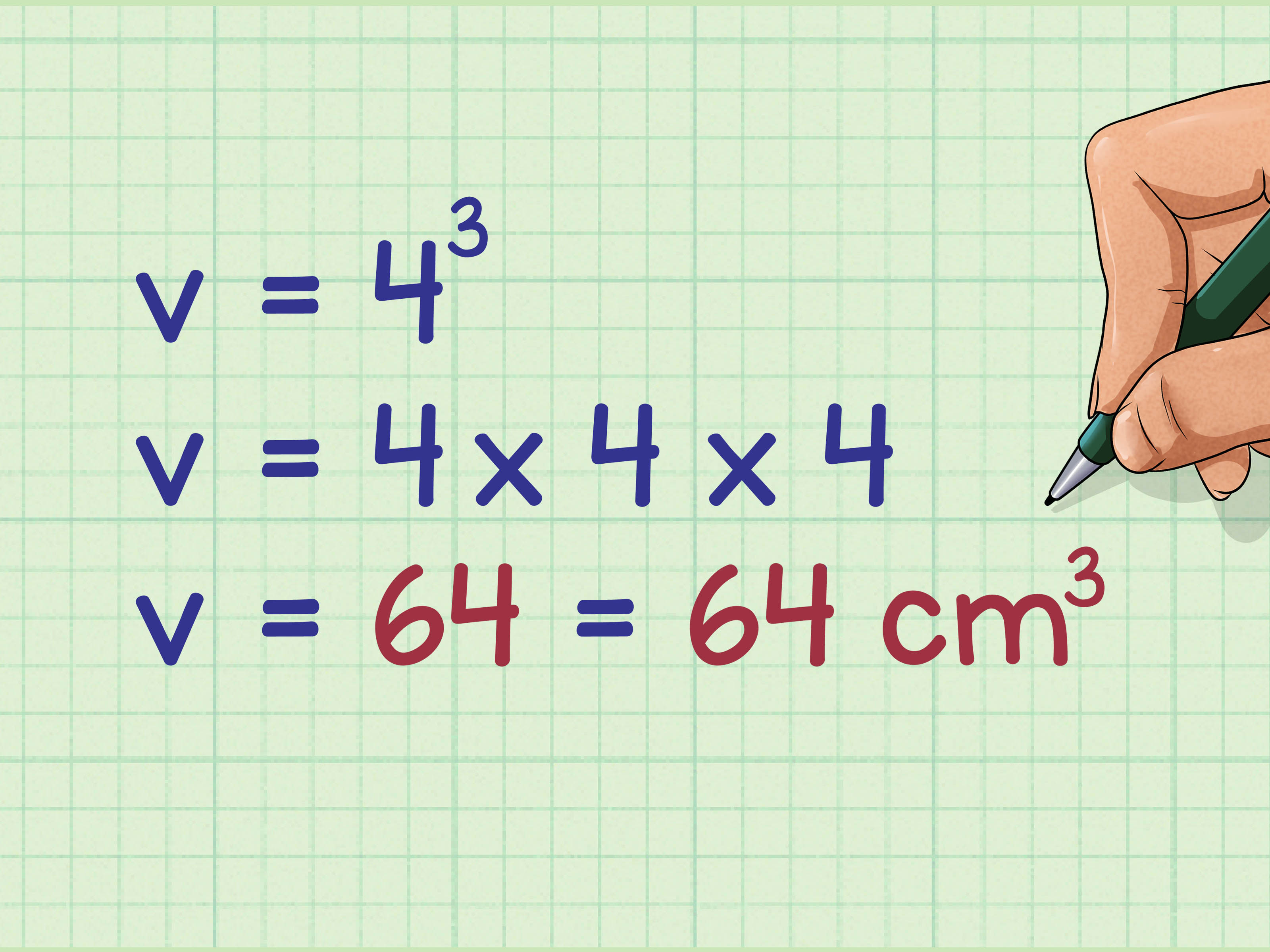
V = 43 = 64 in3
Example 2: Surface area is 294 ft2
294 = 6s2
49 = s2
s = 7
V = 73 = 343 ft3
Example 3: Surface area is 24 m2
24 = 6s2
4 = s2
s = 2
V = 23 = 8 m3
Once you’ve done two or three of these, the pattern becomes very familiar: divide by 6, square root, cube. That’s the rhythm.
Common Mistakes to Avoid
Mixing up square units and cubic units
Surface area is measured in square units. Volume is measured in cubic units. If your final answer for volume ends in cm2 or ft2, something went wrong.
Using the cube root too early
From surface area, you first get s2, so you need a square root to find the side length. The cube root does not belong in this step.
Forgetting to divide by 6
The surface area covers all six faces. If you skip dividing by 6, you’re treating the whole outside of the cube like one face, which is not how cubes work and not how math forgives.
Stopping after finding the side length
Sometimes students correctly find s and then forget the question asked for volume. If the problem asks for volume, you are not done until you compute s3.
Real-World Uses of This Idea
This may feel like textbook math, but the relationship between surface area and volume of a cube comes up in real life more than you might expect.
If you’re designing a cube-shaped box, you may know how much material covers the outside and want to estimate how much space is inside. If you’re working with storage containers, gift boxes, dice, shipping cubes, or even cube-shaped art installations, this relationship helps connect the outside dimensions to the inside capacity.
In science, surface area and volume matter when comparing how objects interact with heat, air, liquids, or coatings. In manufacturing, the amount of outer material and inner capacity can affect cost, weight, efficiency, and design choices. Even if you never grow up to become a professional cube enthusiast, understanding this connection makes you better at visualizing three-dimensional problems.
FAQ
Can you find the volume of a cube if you only know the surface area?
Yes. Use the surface area formula S = 6s2 to find the side length, then plug that side length into V = s3.
What is the formula for the volume of a cube from surface area?
The direct formula is V = (S ÷ 6)3/2.
Why do you divide by 6?
Because a cube has six equal square faces. Dividing the total surface area by 6 gives you the area of one face.
Why do you use a square root?
Because the area of one face is s2. To solve for s, you take the square root.
What if the surface area is not a perfect square after dividing by 6?
Then your side length may be a decimal or radical. That’s perfectly fine. Just use the exact value or round carefully, depending on the instructions.
Experiences and Learning Moments Related to Finding the Volume of a Cube from Its Surface Area
One of the most common experiences students have with this topic is realizing that the problem is not actually hard, just unfamiliar. At first glance, being given surface area and asked for volume feels backward. Most beginners expect math problems to hand them the side length directly, almost like the worksheet is being polite. But once they see the pattern, many students say the problem suddenly feels satisfying. It becomes one of those “Oh, that’s all?” moments that makes geometry less intimidating.
Another very relatable experience is making the exact same mistake almost everyone makes once: using the wrong root. A student divides by 6 correctly, stares at the result, and then confidently takes the cube root because the question mentions volume. It feels logical for about five seconds. Then the answer comes out weird, the units look suspicious, and the student has to retrace the steps. Oddly enough, that mistake often helps the lesson stick better. After that, many learners remember that surface area leads to a square, so the next move is a square root, not a cube root.
Teachers also see an interesting pattern with visual learners. When students draw a cube and label its six faces, the formula S = 6s2 suddenly makes more sense. Without the picture, the formula can feel like a random rule dropped from the sky. With the picture, it becomes obvious: one square face has area s2, and there are six of them. This tiny visualization often turns a memorized formula into something the student actually understands. And once that happens, the rest of the problem gets much easier.
There’s also a confidence-building side to these problems. Students who struggle with long word problems often do well here because the process is so structured. Divide by 6. Take the square root. Cube the answer. That kind of consistency is reassuring. It gives learners a repeatable method they can trust, which is especially helpful in a test setting where panic likes to show up uninvited.
In tutoring sessions, this topic often becomes a great lesson in mathematical translation. Students learn that geometry problems are really asking, “Can you move from one formula to another without getting lost?” That’s a powerful skill. It shows up later in algebra, physics, and many real-world measurements. So while the problem is about a cube, the experience is bigger than the cube. It teaches how to reverse a formula, isolate a variable, and interpret units correctly.
And finally, there is the strangely enjoyable moment when the numbers work out perfectly. You divide the surface area by 6, get a clean square number, find a neat whole-number side length, and end with a tidy cube for the volume. It feels like the universe briefly decided to cooperate. Those moments make math feel less like punishment and more like solving a puzzle that actually wants to be solved.
Conclusion
If you need to find the volume of a cube from its surface area, the method is straightforward once you know the connection between the formulas. Start with S = 6s2, divide by 6, take the square root to get the side length, and then use V = s3. That’s it.
The 7-step approach works because it breaks the problem into simple moves you can repeat every time. Whether you’re studying for a geometry quiz, helping with homework, or brushing up on basic math skills, this is one of those useful formulas that becomes easy once you understand the logic behind it.
And honestly, that’s the best kind of math: the kind that looks complicated for a minute, then turns out to be surprisingly manageable.














