
Note: This folding trick creates an accidental visual resemblance from parts of the White House engraving on a $20 bill. It is not evidence of a prediction, coded message, or government foreknowledge of the September 11 attacks. Because the resemblance is connected to a real tragedy, demonstrate it thoughtfully and avoid treating the victims or events as a punchline.
A $20 bill is usually expected to do one of three things: pay for lunch, disappear at a gas station, or hide in a jacket pocket until laundry day. With a few careful folds, however, the back of the note can also form an image that some viewers compare to the burning Twin Towers.
The effect became a widely shared curiosity after September 11, 2001. People passed folded bills around offices, classrooms, restaurants, and early internet forums, often reacting with the same mixture of surprise and suspicion. Yet the explanation is far less mysterious than the finished image appears. The folds simply reposition symmetrical portions of the White House illustration, nearby trees, shading, and decorative engraving. Human pattern recognition does the rest.
This guide explains how to fold a $20 bill into the well-known Twin Towers-like image, how to improve the alignment, why the illusion works, and how to discuss it without drifting into unsupported conspiracy claims.
What Does the Folded $20 Bill Actually Show?
The reverse of a modern U.S. $20 note contains an engraving of the White House surrounded by trees, architectural details, lettering, borders, and dense shaded lines. When the bill is folded lengthwise and its ends are raised diagonally, separate parts of that engraving meet near the center.
The resulting symmetrical form may resemble two dark buildings with clouds of smoke rising between or above them. On the opposite side, some viewers claim another arrangement resembles damage to the Pentagon. These interpretations are subjective. The bill does not contain literal drawings of either attack site.
Think of it as visual remixing. The artwork is being cropped, mirrored, and rearranged by the folds. It is a little like spotting a face in a power outlet or a dragon in a cloud, except this cloud costs twenty dollars and can still buy several tacos afterward.
What You Need
- One genuine U.S. $20 bill
- A clean, dry, flat surface
- Clean hands
- Good lighting
- A few minutes of patience
A relatively crisp note produces the cleanest result because its edges remain straight and the diagonal creases stay symmetrical. A worn bill can still work, but old folds may interfere with the final alignment. Avoid using a rare collectible note, a valuable star note, or currency you would be heartbroken to wrinkle.
How to Fold a $20 Bill Into the Twin Towers Image
Step 1: Place the Bill With the White House Side Facing Up
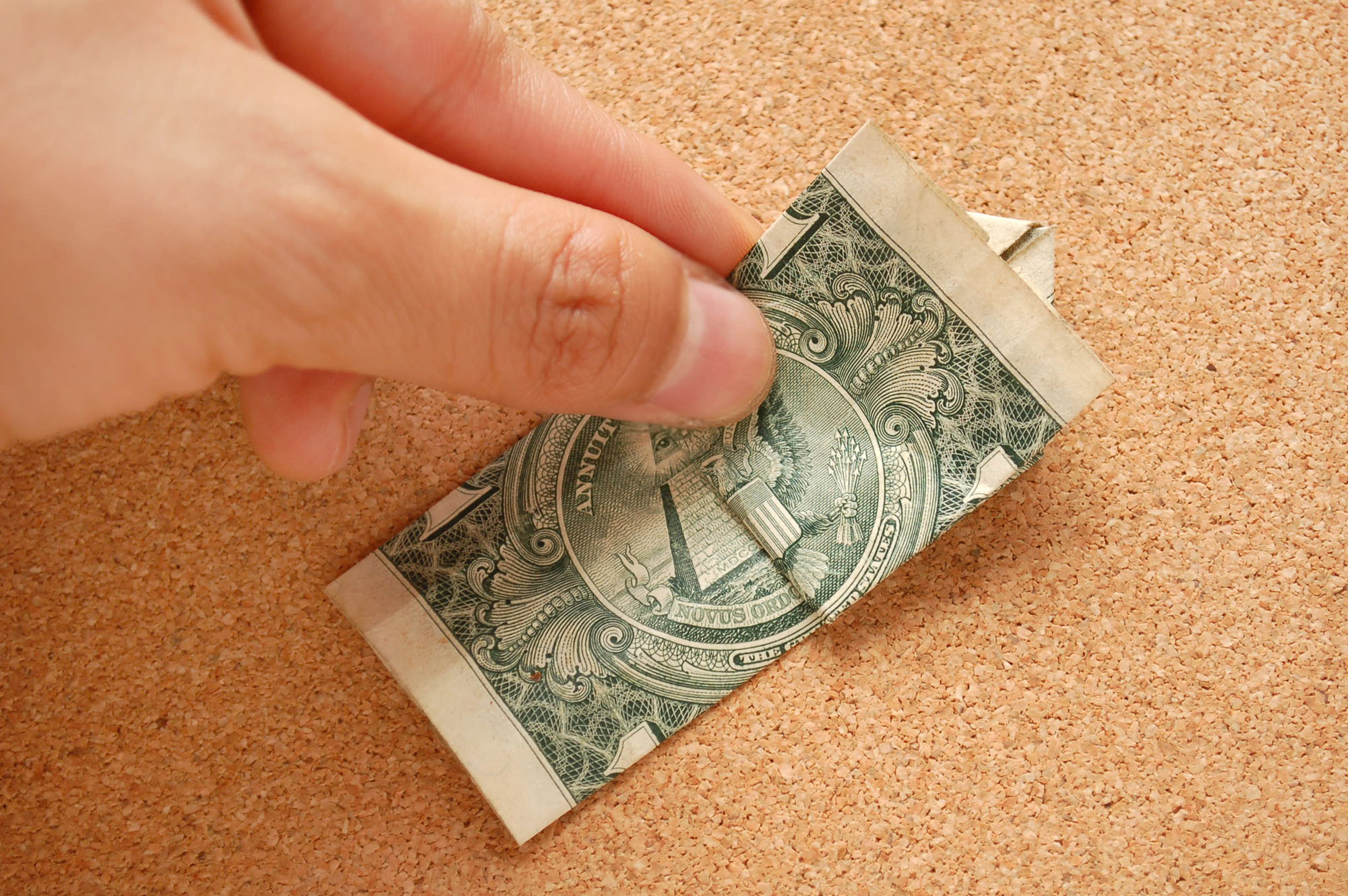
Lay the note horizontally on a flat surface. The reverse side, which displays the White House, should face you. Smooth the bill gently with your fingertips so the borders and center are easy to see.
Before folding, identify the horizontal midpoint running from the left edge to the right edge. You do not need a ruler. The printed border provides a convenient visual guide.
Step 2: Fold the Bill in Half Lengthwise
Bring one long edge toward the other, folding the bill horizontally through its length. Arrange the fold so the reverse design remains on the outside and the upper portion of the White House side is visible.
Align the long edges before pressing the crease. Start at the center and move outward with a fingertip. Use firm but moderate pressure. You are making a temporary craft fold, not trying to engrave a second Grand Canyon into the note.
Step 3: Locate the Center of the Folded Edge
Find the midpoint of the long folded bill. Lightly pinch or mark the location with your fingertips without making an additional vertical crease. This midpoint will serve as the starting position for both diagonal folds.
The closer both folds begin to the same central point, the more balanced the final image will appear.
Step 4: Fold the Left End Diagonally
Starting near the center point, bend the left side backward and upward at an angle. The left portion should resemble one raised wing of a paper airplane. Press the diagonal crease only after the edge looks straight.
Do not obsess over an exact angle on the first attempt. A fold of roughly 40 to 50 degrees usually provides a useful starting point. The printed artwork varies slightly among different series, and tiny adjustments can change the illusion significantly.
Step 5: Mirror the Fold on the Right Side
Fold the right end backward and upward from the same central area. Match the angle of the left fold as closely as possible. The folded bill should now form a shallow arrowhead or airplane-like shape with two raised sides.
Check the symmetry before sharpening the crease. If one side rises higher than the other, reopen it and try again. Even a small mismatch can turn the expected skyline into something resembling two shrubs arguing over a parking space.
Step 6: Turn the Folded Bill Over
Flip the bill to view the opposite surface of the folded arrangement. Portions of the White House engraving, surrounding foliage, roof details, and shaded background should meet near the center.
At this point, many viewers see a form resembling the Twin Towers with smoke or flames above them. The exact appearance depends on the bill’s series, condition, fold angles, and the viewer’s expectations.
Step 7: Adjust the Diagonal Creases
If the resemblance is weak, do not immediately declare the entire internet a liar. Open the diagonal folds slightly and reposition them by a fraction of an inch. Try making both sides steeper, then flatter, while keeping them symmetrical.
The illusion usually becomes more recognizable when the dark areas of the White House design meet evenly. Once you find the best position, press the two diagonal creases more firmly.
Step 8: Unfold the Bill Carefully
After demonstrating the effect, open the bill in reverse order. Smooth it gently rather than pulling sharply on the corners. The note will retain temporary creases, but it should remain usable as long as it has not been cut, torn, taped, glued, or otherwise seriously damaged.
Troubleshooting Common Folding Problems
The Image Looks Uneven
Uneven diagonal folds are the most common problem. Return to the lengthwise fold, confirm the center point, and make the left and right sides mirror each other. Use the printed border as a reference.
I See Trees, Not Towers
That is not necessarily a mistake. The image is built from trees and architectural shading in the original engraving. People who already know what they are supposed to see often recognize the resemblance more quickly than someone viewing the folded bill without a suggestion.
The Bill Keeps Opening
Very new notes can be springy, while heavily circulated notes may contain competing creases. Hold each new fold for several seconds. Running a clean fingernail lightly along the crease can help, but avoid using sharp tools.
The Effect Looks Different From Online Photos
Lighting, camera angle, image contrast, shadows, and digital editing can make online examples appear more dramatic. Some photos are tightly cropped or photographed under harsh light. Judge the physical bill from several angles rather than expecting it to match a highly processed image.
An Older $20 Bill Produces a Different Result
The $20 note has appeared in multiple designs. Notes issued before and after major redesigns do not place every line, tree, border, and background element in precisely the same location. The famous folding effect is most often associated with late-20th-century and early-21st-century designs featuring the White House on the reverse.
Why Does the Fold Create Such a Convincing Image?
Symmetry Makes Random Details Feel Intentional
Human vision pays close attention to balanced forms. When similar dark shapes appear on both sides of a central gap, the brain tends to group them into a single meaningful object. Symmetrical folds intensify that effect by placing unrelated portions of the engraving next to each other.
The Engraving Contains Dense Visual Information
U.S. currency uses intricate lines, shading, buildings, plants, borders, numerals, and lettering. Folding such a detailed design can create many unexpected combinations. With enough possible folds, it would be more surprising if nobody ever found a recognizable shape.
Pareidolia Helps the Brain Complete the Picture
Pareidolia is the tendency to perceive a familiar object in an ambiguous pattern. It explains why people see faces in clouds, animals in rock formations, or a surprised expression on the front of a car.
The folded bill does not need to reproduce the Twin Towers accurately. It only needs to provide several suggestive features: two vertical dark areas, approximate symmetry, and irregular shapes that can be interpreted as smoke. The viewer’s memory supplies the missing detail.
Knowing the Claim Changes What You See
Expectation is powerful. Tell someone that a folded bill contains an image of two towers, and the person begins searching for two towers. Present the same shape without explanation, and the viewer may report seeing buildings, trees, wings, flames, or nothing recognizable at all.
This does not mean the resemblance is imaginary in the sense of being dishonest. It means visual interpretation is influenced by context.
Was the Image Deliberately Hidden in the $20 Bill?
There is no credible evidence that currency designers intentionally concealed a depiction of the September 11 attacks. The relevant imagery comes from an engraving of the White House and surrounding landscape, not from a secret illustration added after the attacks.
The folding claim spread widely in 2002 through word of mouth, websites, forwarded emails, and news coverage. Different audiences interpreted it as coincidence, prophecy, conspiracy, dark humor, or an example of America’s unlimited ability to become distracted while waiting for coffee.
Claims about secret symbols in money have existed for generations. Detailed artwork offers abundant raw material for creative folding, selective cropping, rotation, and interpretation. Finding a recognizable shape after manipulating a design does not prove that the shape was deliberately placed there.
Is Folding a $20 Bill Legal?
Federal law addresses mutilating, cutting, defacing, perforating, gluing, or otherwise altering a banknote with the intent to make it unfit for reissue. Temporarily folding a bill for a demonstration does not ordinarily render it unusable. People routinely fold currency to place it in wallets, pockets, cards, and money-origami gifts.
However, do not cut the bill, remove pieces, burn it, permanently glue sections together, or intentionally damage it so severely that it cannot circulate. This article is general information rather than legal advice.
A simple rule works well: fold it, show it, unfold it, and keep it spendable.
What Is Really Printed on a Modern $20 Note?
The front of the current-design $20 note features a portrait of Andrew Jackson. The reverse displays the White House. Modern notes also include anti-counterfeiting features such as a portrait watermark, an embedded security thread, color-shifting ink, fine-line printing, and subtle background colors.
These features have practical purposes. They help cash handlers and consumers authenticate currency. None is connected to the folded Twin Towers claim.
Older-design Federal Reserve notes remain legal tender in the United States, although the precise appearance and placement of design elements differ among series.
How to Demonstrate the Fold Respectfully
The September 11 attacks caused an enormous loss of life and affected victims’ families, survivors, first responders, and communities throughout the United States and beyond. The National September 11 Memorial honors the 2,977 people killed in the 2001 attacks, as well as the six victims of the 1993 World Trade Center bombing.
For that reason, introduce the fold as a lesson in visual perception, internet folklore, or currency design rather than as a party gag about the attacks. Avoid presenting the resemblance as proof of a plot. It is also wise to consider the audience; someone with a personal connection to 9/11 may not welcome an unexpected demonstration.
A respectful explanation can be simple: “This is a well-known accidental image created by folding the White House design. It shows how easily our brains recognize meaningful patterns.”
Frequently Asked Questions
Does the Fold Work With Every $20 Bill?
It works best with designs that position the relevant portions of the White House engraving in familiar locations. Different series, wear patterns, and fold angles may produce weaker or slightly different images.
Can Other Denominations Create Similar Images?
People have made related claims about $5, $10, $50, and $100 notes. Because each denomination contains detailed, symmetrical artwork, folding can produce many shapes that viewers interpret as buildings, smoke, faces, words, or symbols.
Does the Opposite Side Show the Pentagon?
Some viewers interpret the reversed folded shape that way. As with the Twin Towers image, it is an ambiguous resemblance rather than an accurate illustration.
Should I Use a Printed Copy Instead of Real Money?
A clearly marked educational reproduction can be useful for repeated demonstrations, provided it complies with applicable rules for reproducing currency images. For a casual one-time fold, an ordinary circulated note is simpler.
Will a Store Accept the Bill Afterward?
A bill with ordinary creases remains legal tender. Smooth it before spending it, and avoid handing a cashier something that still resembles a tiny paper airplane during the evening rush.
Conclusion
Learning how to fold a $20 bill into a picture of the Twin Towers requires only three essential actions: fold the note lengthwise, raise both ends diagonally from the center, and turn the result over. Achieving a recognizable image depends on symmetry and small adjustments rather than complicated origami skills.
The finished form is visually striking, but its meaning should not be exaggerated. It is an accidental combination of printed details reinforced by pareidolia, expectation, and historical memory. Used thoughtfully, the demonstration can open a useful conversation about currency artwork, human perception, viral folklore, misinformation, and the importance of checking extraordinary claims.
What the Folding Experience Is Really Like
A typical first attempt begins with confidence. The instructions sound almost suspiciously easy: one horizontal fold, two diagonal folds, flip. How difficult could it be? Then the bill is turned over and reveals something closer to a crooked mountain range than a famous skyline.
This is where the experience becomes more interesting than the trick itself. Most people begin making tiny adjustments. One diagonal fold moves upward. The other shifts inward. The bill is flipped again. Suddenly, the separate patches of ink appear more balanced, and the resemblance becomes easier to recognize.
The most noticeable part of a group demonstration is that people rarely react at the same moment. One person sees two towers immediately. Another sees only smoke. Someone else rotates the bill, squints, and announces that it looks like an angry owl. All three viewers are examining the same piece of paper, yet each brain organizes the visual information differently.
Try showing the folded note to one person while naming the expected image and to another person without offering a clue. The first viewer is likely to locate the towers quickly because the description directs attention toward vertical structures and dark central shading. The second may need more time or may identify a completely different form. That small experiment demonstrates how suggestion influences perception.
The physical condition of the money also changes the experience. A crisp bill creates sharp edges but may resist staying folded. A soft, circulated note cooperates more readily but can sag or follow old wallet creases. A note that has survived several years of pockets, vending machines, and suspiciously humid cash drawers may behave as though it has its own artistic agenda.
Lighting matters more than most beginners expect. Under direct overhead light, the dark engraved areas look stronger and the fold casts narrow shadows that can intensify the apparent smoke. Under soft light, the same arrangement may appear less dramatic. Phone cameras can further increase contrast automatically, which helps explain why online photographs sometimes look clearer than the bill held in your hand.
Another worthwhile experience is unfolding the note and examining the original design. The supposed towers dissolve back into trees, rooflines, border elements, and engraved shadows around the White House. Nothing resembling a complete attack scene exists on the flat bill. Only the folding process selects and combines the fragments.
That before-and-after comparison is an effective lesson in evaluating viral claims. A dramatic result may seem designed when presented without its construction process. Once the transformations are understood, the mystery becomes a study in geometry and perception rather than evidence of a concealed message.
The exercise can also lead to a broader challenge: take another detailed image, fold it repeatedly, and search for familiar objects. Magazine pages, maps, decorative packaging, and other banknotes can produce surprising combinations. Given enough lines and enough folds, faces, animals, letters, and buildings begin appearing everywhere.
The best way to end the experience is to restore the bill, smooth the creases, and place the result in context. The fold is memorable because it connects an ordinary object to an emotionally powerful historical image. Treating that connection carefully allows curiosity and critical thinking to coexist. Then the $20 bill can return to its normal dutiesmost likely vanishing during the next trip to the grocery store.










