
Note: This article is synthesized from reputable U.S. energy, engineering, transportation, construction, and safety sources. Source links are intentionally omitted for clean web publication.
Introduction: Moving a Giant Without Angering the Mountain
Getting a wind turbine up a mountain sounds like the setup for a very expensive joke: “A 200-foot blade, a crawler crane, and a civil engineer walk into a switchback…” But in real life, this is one of the most impressive logistical puzzles in renewable energy. A modern land-based wind turbine is not one object. It is a carefully choreographed parade of tower sections, blades, nacelles, hubs, transformers, cranes, concrete trucks, escort vehicles, survey crews, and people with clipboards who suddenly become everyone’s best friend.
The reason mountain wind projects exist is simple: ridgelines often have stronger, steadier wind. Wind moving over elevated terrain can create excellent energy potential, and that makes a mountain site attractive for developers. The hard part is getting the equipment there without turning the access road into spaghetti, the forest into a parking lot, or the project budget into confetti.
To understand how to get a wind turbine up a mountain, you need to think less like a tourist and more like a logistics commander. The job begins years before the first blade appears on the highway. Engineers study wind resources, road geometry, soil strength, environmental limits, transmission access, local permits, crane pad requirements, and weather patterns. Then they design a route that can handle enormous components that do not bend, do not appreciate potholes, and definitely do not enjoy surprise hairpin turns.
What Actually Has to Go Up the Mountain?
A utility-scale wind turbine is usually divided into several major components: the foundation, tower sections, nacelle, hub, rotor blades, electrical equipment, and grid interconnection hardware. The foundation is built on-site, but most of the large turbine parts arrive by truck, rail, ship, or a combination of all three before they ever see the mountain road.
The blades: long, light, and dramatic
Wind turbine blades are the celebrities of the move. They are long, aerodynamic, delicate compared with their size, and impossible to ignore. Modern land-based blades can stretch well over 200 feet, and once manufactured, they cannot simply be folded like a lawn chair. That single fact controls much of the transportation plan. A blade needs enough clearance for curves, trees, utility poles, signs, bridges, guardrails, and every mailbox that ever dreamed of becoming a news story.
The nacelle: the heavyweight champion
The nacelle sits at the top of the tower and houses major mechanical and electrical equipment. It is not as long as a blade, but it can be extremely heavy. Transporting it requires heavy-haul trailers, careful weight distribution, bridge checks, grade analysis, and sometimes route reinforcement. If the blade is the diva, the nacelle is the bodybuilder: compact, powerful, and not something you casually roll over a weak culvert.
The tower: sections, not one giant straw
The tower usually travels in sections. Each cylindrical section has diameter, height, and weight constraints. Tower sections may run into bridge-clearance problems, especially when diameters grow. For mountain projects, tower delivery can require careful timing, road widening, and staging areas where trucks can pause without blocking every pickup truck in the county.
Step 1: Choose the Mountain Site Carefully
Before logistics teams ask, “How do we get there?” developers ask, “Should we even try?” A mountain ridge may have excellent wind, but a wind farm is not built on wind alone. The site must also have acceptable environmental impacts, feasible road access, geotechnical stability, safe crane working areas, and a realistic connection to the electrical grid.
Wind resource assessment usually begins with meteorological towers, lidar, long-term weather data, and modeling. Engineers want to know average wind speed, turbulence, seasonal patterns, icing risk, and extreme-weather events. Mountains can be generous with wind, but they can also be moody. A ridge that looks perfect on a sunny afternoon may become a foggy, icy, gusty obstacle course in February.
Good siting also considers nearby homes, wildlife, wetlands, cultural resources, aviation concerns, and visual impact. The best route is not always the shortest route. In mountain wind construction, the winning route is the one that balances cost, safety, permitting, environmental protection, and component passability. Translation: the road that looks easy on a map may be the one that makes truck drivers mutter ancient words into the steering wheel.
Step 2: Run a Transportation Feasibility Study
A transportation feasibility study is where the dream meets the tape measure. Specialized logistics teams analyze every mile from port, factory, rail yard, or storage area to the mountain site. They check turning radii, road width, overhead clearance, bridge capacity, pavement condition, slopes, intersections, railroad crossings, traffic signals, utility lines, and temporary removal needs.
For wind turbine transportation, “almost fits” means “does not fit.” A blade trailer cannot improvise its way around a tight switchback. Engineers often perform swept-path analysis, which simulates the exact path of a vehicle and its cargo through curves and intersections. This analysis shows whether the load will stay within the road, clip a sign, cross a ditch, or require temporary road widening.
Mountain routes are especially demanding because grades and curves appear together. A truck may have enough engine power to climb a steep road, but not enough space to turn safely while doing it. In some cases, logistics teams recommend using specialized trailers that can steer independently, extend to support long loads, or lift blades at an angle to clear obstacles.
Step 3: Secure Oversize and Overweight Permits
Wind turbine components are typically classified as oversize, overweight, or both. That means the project team must obtain permits from state and local transportation authorities. In the United States, requirements vary by state, county, bridge authority, and road jurisdiction. A route may cross several agencies, each with its own rules, time windows, escort requirements, and restrictions.
Permitting is not paperwork for paperwork’s sake. Transportation officials need to know whether the load can safely travel over bridges, under structures, around curves, and through communities. Permit conditions may control travel hours, speed, escort vehicles, police support, temporary traffic control, and weather limitations.
For mountain projects, local coordination matters even more. Narrow roads may require temporary closures. Residents need advance notice. Emergency services need to know when roads may be blocked. School bus routes, farm access, logging roads, and tourism traffic can all affect the delivery schedule. A successful wind turbine delivery is one where the blade arrives safely and the town does not feel ambushed by a fiberglass dragon at breakfast.
Step 4: Upgrade the Roads Before the Big Loads Arrive
Mountain wind projects usually require access road construction or upgrades. Existing roads may need widening, grading, drainage improvements, culvert reinforcement, vegetation clearing, slope stabilization, and stronger surfaces. In some real U.S. wind projects, dozens of miles of existing roads have been upgraded and several miles of new roads built to reach turbine locations along ridgelines.
Access roads must serve multiple purposes. They carry heavy turbine components during construction, support crane movements between pads, allow concrete and electrical work, and remain useful for maintenance after commissioning. A road that is barely good enough for delivery day may become a long-term headache when technicians need access during snow, mud season, or high-wind maintenance windows.
Road width and turning radius
Wind turbine blades require generous turning space. On mountain roads, curves may be widened temporarily using gravel pads, timber mats, or engineered fill. Sometimes crews remove signs, guardrails, fences, or small obstacles and reinstall them after delivery. The key is to make every modification intentional, permitted, and reversible where possible.
Grade and traction
Steep grades can require push trucks, pull tractors, or special traction planning. Wet weather can change everything. A route that works on dry gravel may become risky after rain. Construction teams often schedule heavy-haul deliveries during favorable weather and maintain road surfaces aggressively during the delivery campaign.
Drainage and erosion control
Mountain roads can become erosion machines if drainage is poorly designed. Ditches, culverts, sediment controls, and stabilized slopes are not decorative. They protect streams, keep roads usable, and prevent repairs from eating the schedule. On a mountain wind project, water is the quiet villain. It always finds the weak spot.
Step 5: Build Crane Pads and Laydown Areas
Getting the turbine components up the mountain is only half the adventure. Once they arrive, crews need enough room to unload, stage, assemble, and lift them. Each turbine location requires a crane pad or hardstand capable of supporting massive lifting equipment and heavy components.
Crane pads must be level, compacted, and engineered for ground-bearing pressure. The crane may need space for outriggers, counterweights, boom assembly, support cranes, trailers, blade racks, and worker access. Mountain terrain rarely offers a naturally perfect flat spot, so crews may cut, fill, stabilize, and test the pad before major lifts begin.
Laydown areas are also essential. Blades may be stored on specialized supports. Tower sections need room for staging. The hub may be assembled with blades on the ground in some installation methods, while other projects lift blades one at a time. The final approach depends on turbine model, crane capacity, pad size, wind conditions, and manufacturer procedures.
Step 6: Use the Right Transport Equipment
There is no universal “wind turbine truck.” Transport equipment is selected based on component size, route constraints, grade, turning radius, and delivery sequence.
Extendable blade trailers
Extendable trailers are common for long blades. They stretch to support the blade during transport and may include steerable rear dollies to help navigate turns. These trailers are impressive, but they still need road geometry that respects the blade’s length.
Blade lifters
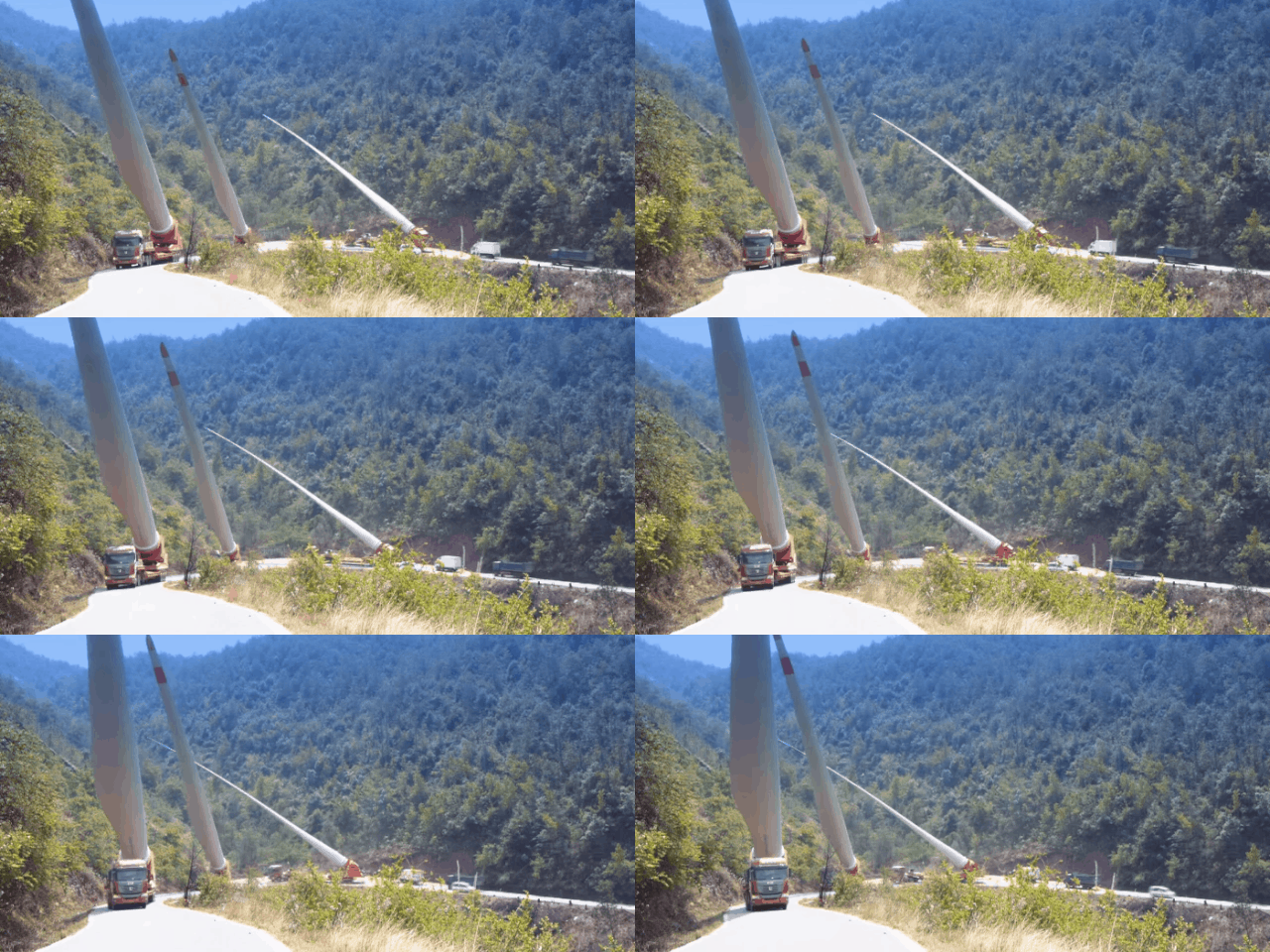
For tight mountain roads, blade lifters can be game changers. A blade lifter can raise and rotate a blade, sometimes at steep angles, allowing the transport vehicle to clear obstacles, reduce the swept path through curves, or pass through narrow sections. The trade-off is speed. Blade-lifter moves are slow, highly controlled, and sensitive to wind. They look graceful in videos, but on-site they are less ballet and more careful surgery with a very expensive feather.
Self-propelled modular transporters
Self-propelled modular transporters, often called SPMTs, can move heavy loads with precise control. They are useful in yards, ports, and certain project sites, though not every mountain road is suitable for them. Their strength is maneuverability and load distribution.
Heavy-haul trailers for nacelles and tower sections
Nacelles, hubs, tower sections, and transformers require specialized heavy-haul trailers with enough axle lines to distribute weight safely. These loads demand bridge studies, road capacity checks, and careful speed control, especially on steep grades.
Step 7: Stage Deliveries Like a Military Operation
Wind turbine delivery sequencing is precise. Components cannot simply show up whenever they feel inspired. Roads, crane pads, foundations, electrical trenches, and crews must be ready before each delivery. Too early, and the site becomes cluttered. Too late, and the crane sits idle, which is a very expensive way to admire the scenery.
Staging areas near the mountain may be used to hold components before the final climb. This allows crews to move loads during approved time windows and coordinate with escorts, police, utility crews, and site managers. A typical turbine may require multiple truckloads: blades, tower sections, hub, nacelle, drivetrain components, electrical cabinets, anchor bolts, and other hardware.
The delivery plan also includes communication protocols. Drivers, escorts, site supervisors, crane teams, and traffic-control crews need reliable radios or cellular coverage. Mountain sites often have weak signals, so backup communication plans are important. Nobody wants the phrase “Can you hear me now?” to become the project’s unofficial safety program.
Step 8: Pour the Foundation and Prepare the Turbine Pad
Before the tower rises, the foundation must be built. This usually involves excavation, reinforcing steel, anchor bolt cages, concrete placement, curing time, and quality inspections. Mountain foundations require special attention to geology. Rock type, groundwater, frost depth, slope stability, and bearing capacity all matter.
Concrete logistics can be tricky. Concrete trucks must reach the site reliably, and timing matters because large pours require continuous delivery. Some remote projects use temporary batch plants to reduce haul distance. Others rely on carefully scheduled truck rotations from existing plants. Either way, the foundation is not the place for improvisation. A turbine is tall, dynamic, and exposed to enormous loads. It deserves a foundation that is more “engineered monument” than “big patio.”
Step 9: Assemble the Crane and Lift the Turbine
Wind turbine erection usually requires a large main crane plus support cranes. The tower sections are lifted one by one and bolted together. Then the nacelle is lifted to the top of the tower. After that, crews install the hub and blades, either as a preassembled rotor or blade by blade.
Preassembling the rotor on the ground can reduce work at height, but it requires a large laydown area and favorable wind conditions for lifting the full rotor. Single-blade installation needs less ground space but involves more lifts and careful control of each blade. The best method depends on terrain, equipment, turbine design, and weather.
Wind is both the reason for the project and one of the biggest enemies during installation. High winds, gusts, rain, ice, and poor visibility can stop crane operations. Safety teams monitor weather closely, and crane operations follow manufacturer limits and site-specific lift plans. On a mountain ridge, the weather can change fast. The crew may spend the morning waiting, the afternoon lifting, and the evening explaining to a cloud that it is not helping.
Step 10: Connect, Test, and Commission
After the turbine is mechanically complete, electrical teams connect internal wiring, collection cables, transformers, communications systems, and the project substation. Commissioning includes inspections, torque checks, control-system tests, safety-system verification, blade pitch testing, yaw system checks, grid synchronization, and performance monitoring.
The turbine does not simply begin spinning at full power like a movie finale. It goes through controlled testing. Operators confirm that sensors, brakes, pitch systems, generators, converters, and communication equipment are functioning correctly. Only then does the machine become part of the wind farm’s operating fleet.
Common Problems When Moving Wind Turbines Up Mountains
Problem 1: The road is too tight
Tight curves are the classic mountain wind challenge. Solutions include temporary widening, vegetation clearing, blade lifters, alternate routes, or smaller turbine models. In extreme cases, a developer may redesign the turbine layout to avoid unreachable locations.
Problem 2: The road is too weak
Heavy components can overload weak bridges, culverts, or soft roadbeds. Engineers may reinforce structures, replace culverts, use temporary matting, distribute loads over more axles, or reroute the delivery.
Problem 3: The weather refuses to cooperate
Mountain weather creates delays through wind, fog, snow, ice, heavy rain, and lightning. Smart schedules include weather contingency. Optimistic schedules look nice in presentations and then get personally insulted by the atmosphere.
Problem 4: There is not enough crane space
Large cranes need room to assemble, move, and operate. If the turbine pad is squeezed between steep slopes, forests, wetlands, or property boundaries, the installation method may need to change. Sometimes roads and pads are designed specifically around crane movement rather than only component delivery.
Problem 5: Permits take longer than expected
Transportation permits, environmental approvals, aviation reviews, road-use agreements, and utility coordination can all affect the schedule. The earlier the project team starts, the better. Waiting until components are ready to ship is like buying hiking boots at the summit.
Specific Example: A Ridgeline Wind Project
Consider a hypothetical ridgeline project inspired by real U.S. wind development patterns. The site includes 30 to 40 turbines on a mountain ridge. The best wind resource is near the crest, but the existing logging roads are narrow and steep. Engineers identify a main access route that uses existing roads where possible, upgrades several dozen miles of roadway, and adds short new segments to reach turbine pads.
Before construction, survey crews mark sensitive areas, water crossings, and property limits. Civil crews widen curves, improve drainage, reinforce culverts, and build crane pads. Transportation specialists test the route digitally using blade-trailer simulations. A few tight turns require temporary gravel “bump-outs.” One overhead utility line must be raised for delivery week. A staging yard is built near the base of the mountain.
When deliveries begin, blades arrive one at a time with escort vehicles. Tower sections follow on separate heavy-haul trailers. The nacelle moves during a restricted travel window because of weight and traffic impacts. At the site, crews stage components, assemble the crane, lift tower sections, install the nacelle, and mount the rotor during calm wind windows. The project succeeds not because the mountain was easy, but because the planning respected how hard it was.
Why Bigger Turbines Make Mountain Logistics Harder
Wind turbines have grown larger because taller towers and longer blades can capture more energy. Bigger rotors sweep more area. Taller towers reach stronger winds. That can improve project economics, especially in lower-wind areas. But every extra foot of blade length and every additional inch of tower diameter creates transportation challenges.
Road transport constraints have pushed the wind industry toward innovation. Segmented blades, modular towers, on-site manufacturing concepts, improved trailers, advanced blade lifters, and hybrid tower designs all aim to solve the same basic problem: the best turbine for energy production is often not the easiest turbine to move.
On mountains, this tension becomes obvious. A larger turbine may produce more power, but if the blades cannot make the final turn, the design is useless for that site. Practical wind development is always a compromise between energy output, constructability, cost, safety, and environmental impact.
Environmental Care During Mountain Wind Construction
Mountain construction must be handled carefully because slopes, streams, forests, and wildlife habitat can be sensitive. Good projects minimize disturbance, use existing roads where feasible, control erosion, restore temporary work areas, and monitor construction impacts. Environmental planning may include seasonal restrictions, wildlife surveys, wetland protections, stormwater controls, and post-construction restoration.
A well-designed access road does not merely get the turbine to the top. It reduces sediment runoff, avoids unnecessary clearing, and remains stable after heavy rain. Temporary workspaces should be restored when no longer needed. In the best projects, the construction footprint is treated like borrowed land, not disposable land.
Safety: The Non-Negotiable Part
Wind turbine mountain logistics involve heavy loads, steep grades, large cranes, changing weather, and remote work locations. Safety planning covers traffic control, fall protection, lift plans, emergency response, fire prevention, equipment inspections, worker training, and communication. The remote nature of mountain sites makes emergency planning especially important.
Every critical lift needs a plan. Every road movement needs control. Every worker needs to know where to stand, where not to stand, and what to do when conditions change. The machinery may be enormous, but successful wind construction depends on disciplined human decisions.
Field Experiences and Practical Lessons From Mountain Wind Logistics
Anyone who has spent time around mountain wind construction learns quickly that the route is never just a route. It is a living part of the project. A road that looks finished on Monday may need grading again by Friday after rain, truck traffic, or freeze-thaw cycles. The best crews treat road maintenance as an ongoing operation, not a box checked at the beginning.
One common field lesson is that small obstacles become big obstacles when the cargo is enormous. A rural signpost, a leaning tree, a tight gate, or a shallow ditch may be invisible to normal traffic. Add a turbine blade longer than a commercial airplane wingspan, and suddenly that tiny obstacle gets promoted to “critical path issue.” Experienced route teams walk and drive the route repeatedly. They do not rely only on drawings. They look for real-world surprises: fresh utility work, parked equipment, soft shoulders, low branches, loose gravel, and corners where the trailer tail swing needs more room than expected.
Another lesson is that mountain communities appreciate communication. Wind turbine deliveries are fascinating, but they can also be disruptive. Residents may face temporary delays, road closures, noise, dust, or unusual nighttime traffic. Projects that explain the schedule early, provide contact information, coordinate with local officials, and respond quickly to complaints usually have fewer conflicts. People are more patient with a giant blade blocking the road when they knew it was coming and understand why it matters.
Weather teaches humility. A team can have the best crane, the best drivers, and the best schedule, and still lose a day to ridge winds. That is not failure; it is mountain reality. Smart managers build flexibility into the plan and avoid pressuring crews to lift or haul in marginal conditions. A delayed lift is frustrating. A rushed lift is dangerous. The mountain does not care about your spreadsheet.
There is also a powerful lesson in sequencing. Turbine components should arrive when the site is ready for them. Too much early delivery clogs laydown areas and increases handling risk. Too little delivery leaves cranes idle and crews waiting. The smoothest projects use detailed delivery schedules, daily coordination meetings, and contingency plans for breakdowns, weather, and permit windows.
Finally, mountain wind work rewards respect: respect for terrain, equipment limits, local roads, environmental boundaries, and the people doing the job. Getting a wind turbine up a mountain is not about brute force. It is about planning so carefully that the impossible-looking move becomes boring in the best possible way. When the blade finally rounds the last switchback and reaches the ridge, it feels like engineering has politely convinced gravity to cooperate.
Conclusion: The Mountain Is the Real Project Manager
So, how do you get a wind turbine up a mountain? You start early, measure everything, permit carefully, strengthen the roads, build crane-ready pads, choose the right transport equipment, respect the weather, and coordinate every move with obsessive attention to detail. The turbine may be the star of the show, but logistics is the director, civil engineering is the stage crew, and safety is the rulebook nobody gets to ignore.
Mountain wind projects prove that renewable energy is not just about elegant blades spinning in the sky. It is also about gravel, drainage, permits, escorts, cranes, torque checks, and patient professionals solving one hard problem after another. The result is worth it: clean electricity generated from high, windy places that were never easy to reach but were powerful enough to justify the climb.













