
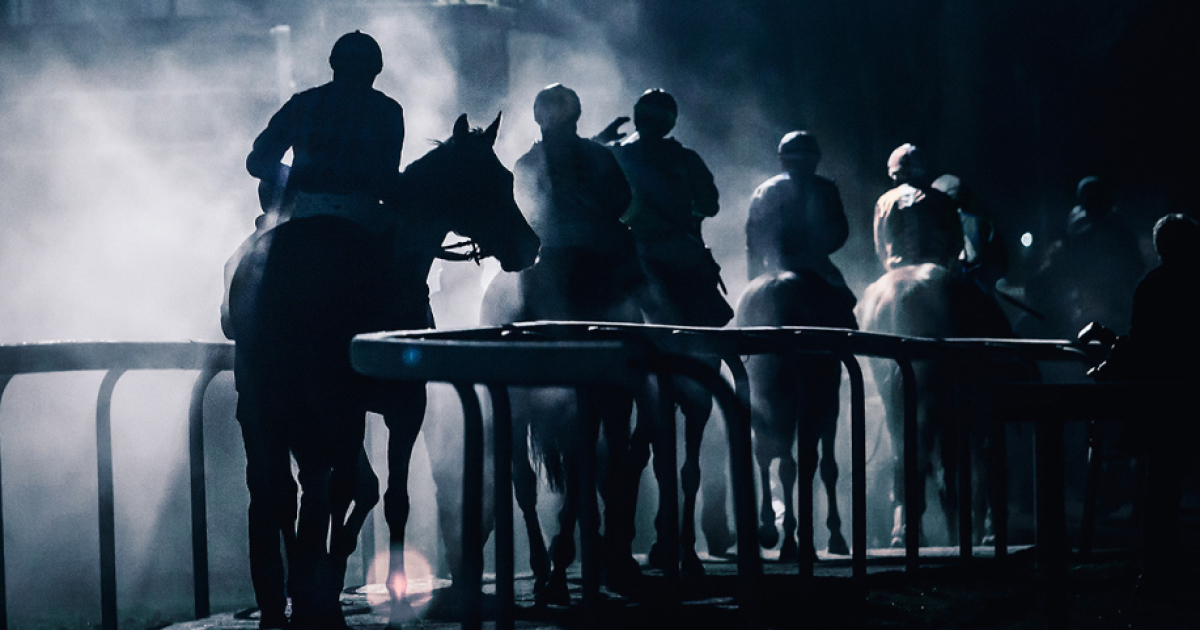
Horse racing is one of the few sports where beauty and worry arrive at full speed in the same frame. One moment, a Thoroughbred floats over the dirt like it was born from wind and muscle. The next, the lens catches the tight face of a jockey, the strain in a horse’s neck, the anxious silence before an inquiry, or the lonely walk back after a dream has gone sideways. That is why I do not photograph horse racing as if it were only hats, champagne, and the glamorous blur of the finish line. I capture horse races with all their light and dark sides because the sport is never just one thing.
It is grace and grit. Pageantry and pressure. Million-dollar bloodlines and stable workers arriving before sunrise. Thunderous applause and uncomfortable questions about equine welfare, injuries, medication rules, gambling, and what happens to racehorses after the crowd goes home. In horse racing photography, the real story is not only who wins. It is what the sport reveals when the shutter clicks between the cheers.
The Light: Why Horse Racing Looks Like Poetry in Motion
There is a reason photographers keep returning to racetracks. Few places offer such a dramatic mix of movement, emotion, color, and tradition. A race can last less than two minutes, yet inside that brief window lives a full novel: hope, strategy, risk, instinct, and sometimes a plot twist that would make a screenwriter spill coffee on a keyboard.
At major American races such as the Kentucky Derby, the visual language is almost mythic. Churchill Downs has hosted the Derby continuously since 1875, making it one of the most recognizable stages in U.S. sports. The twin spires, the roses, the mud-splashed silks, the giant hats, and the roaring grandstand give photographers a ready-made theater. But the best images are rarely just postcard-pretty. They happen when a horse’s eye catches the morning light, when a groom presses a forehead against a familiar muzzle, or when a jockey exhales after surviving the controlled chaos of the stretch run.
The Beauty of Speed
Photographing racehorses is a technical challenge wrapped in adrenaline. These animals can cover ground so quickly that hesitation becomes the enemy. A photographer must read rhythm: hoofbeats, stride length, shoulder angle, jockey posture, and the exact second when effort becomes expression. The camera is not merely recording motion; it is translating it.
A great horse racing photo can freeze what the human eye barely understands in real time. Dust hangs like smoke. Muscles ripple under a glossy coat. A jockey leans forward with the discipline of someone balancing on a rocket with opinions. Every part of the frame says motion, even though the image itself is still.
The Human Drama Around the Horses
Horse racing is never only about horses. It is also about the people who build their lives around them: trainers, hot walkers, exercise riders, veterinarians, farriers, owners, bettors, track photographers, outriders, and fans who have been coming to the same rail for decades. Some arrive in polished shoes. Others arrive in boots that have met every puddle on the backside. Both belong to the story.
Through the lens, I look for the moments that do not shout. A groom smoothing a mane before a stakes race. A trainer checking the sky as if weather can be negotiated with. A child seeing a racehorse up close for the first time. A losing jockey patting a horse’s neck because not every good run ends in a winner’s circle. These are the quiet frames that give horse racing photography its heart.
The Dark: What the Camera Cannot Pretend Away
To photograph horse racing honestly, you cannot crop out the hard parts forever. The sport has been under intense scrutiny for equine injuries, fatal breakdowns, medication controversies, whip use, and inconsistent regulation across jurisdictions. In recent years, national oversight through the Horseracing Integrity and Safety Authority has brought more uniform safety and anti-doping standards to much of U.S. Thoroughbred racing. The Jockey Club’s Equine Injury Database has also reported long-term declines in fatal injury rates since national reporting began in 2009. Those improvements matter. So does the fact that every serious injury still represents a living animal, not a statistic wearing a saddlecloth.
This is where photography becomes complicated. A camera can glamorize. It can also reveal. It can make a sport look cleaner than it is, or crueler than it is, depending on where it points and what the photographer chooses to publish. The ethical responsibility is not to turn every image into an accusation, but also not to turn every race into a shiny advertisement with hooves.
Injury, Risk, and the Fragile Athlete
Racehorses are elite athletes, and elite athletics always carry risk. The difference is that horses do not choose competition in the way humans do. That reality raises the moral stakes. When I photograph a race, I am aware that the same power that makes a Thoroughbred breathtaking can also make injury devastating. A leg extended in full stride is beautiful. It is also vulnerable.
Modern safety efforts focus on veterinary exams, track surface monitoring, medication rules, workout oversight, injury databases, and research into early warning signs. Some tracks now promote more transparent safety protocols, while veterinary organizations continue to emphasize racehorse health, welfare, and integrity. Still, the camera teaches humility: no protocol looks impressive when a horse is in distress. That is why the dark side must remain part of the public conversation, not hidden behind a fresh coat of marketing paint.
The Pressure Behind the Pageantry
The public sees the race. The backside sees the work. Long before fans place bets or sip mint juleps, stable teams have fed, walked, checked, wrapped, cooled, cleaned, and calmed horses most spectators will only see for a few seconds. Racing is an industry, and industries create pressure. There are purses to win, bills to pay, owners to satisfy, schedules to meet, and reputations to protect.
That pressure can produce excellence. It can also create temptation: to push too hard, return too soon, overlook discomfort, or treat a horse like an investment before treating it like an animal. The best racing professionals reject that mindset. The worst confirm every critic’s fear. My job as a photographer is not to pretend one side cancels out the other. It is to notice both.
The Role of the Photographer: Witness, Artist, and Occasional Mud Magnet
Horse racing photography demands more than fast autofocus and a brave relationship with flying dirt. It requires emotional balance. If I only chase beauty, I risk becoming a decorator of uncomfortable truths. If I only chase darkness, I risk missing the genuine love many racing people have for their horses. The honest image lives somewhere in the middle, where admiration and accountability can stand in the same paddock without biting each other.
What I Look For Through the Lens
I look for contrast. Morning light against wet track. A white blaze cutting through shadow. A glamorous hat beside a muddy boot. A champion surrounded by cameras, then a claiming horse waiting quietly in a stall. I look for the physical language of the horse: ears pricked, nostrils flared, neck arched, tail lifted, muscles coiled. I look for human expressions that reveal the emotional weather: confidence, worry, joy, frustration, relief.
Most of all, I look for truth. Not truth as a lecture, but truth as a layered image. A good photograph should let viewers feel the speed and then wonder about the cost. It should allow admiration without asking people to switch off their conscience. The best frame is not always the cleanest one. Sometimes it is the one with dust, sweat, imperfect light, and a story that refuses to behave.
Why the Photo Finish Still Matters
Horse racing has a deep relationship with photography because the camera has long been tied to fairness. Photo-finish technology changed the sport by giving officials a more accurate way to judge close races. Today, the phrase “photo finish” has entered everyday language because racing helped prove that a fraction of a second can rewrite history.
But beyond official results, photography gives racing memory. Without images, great finishes become rumors with better posture. With images, a nose victory, a muddy upset, or a three-horse scramble at the wire becomes part of the sport’s visual archive. Photography turns speed into evidence and emotion into something people can revisit long after the tote board changes.
The Light Side in Detail: Community, Heritage, and the Bond With Horses
For many fans, horse racing is family history. People remember going to the track with parents or grandparents, learning how to read a program, picking a horse because of its name, then celebrating as if they personally trained the winner by whispering “good luck” from the grandstand. Racing culture includes tradition, regional pride, breeding knowledge, handicapping skill, and an unmistakable sense of ceremony.
There is also a sincere bond between horses and the people closest to them. Spend time near the barns and you will see it. Horses recognize voices. Grooms know which horse wants a scratch, which one needs extra patience, and which one has the personality of a mischievous intern. This daily care rarely gets the spotlight, but it is one of the most important stories my camera can tell.
The Dark Side in Detail: Aftercare, Gambling, and Public Trust
One of the most important questions in modern horse racing is simple: what happens after the racing career ends? Thoroughbred aftercare has become a major part of the sport’s welfare conversation. Accredited organizations work to retrain, retire, and rehome former racehorses, helping them transition into second careers or safe retirement. This work deserves more attention because a horse’s value should not expire at the finish line.
Then there is gambling, the engine that has powered much of racing’s economy. Betting adds excitement, but it can also distort how people see the animals. When a horse becomes only a number, a ticket, or a bad beat, something human has gone missing. The camera can push back by restoring individuality. Every horse has a face. Every horse has a body that feels fatigue. Every horse has a life beyond a wager.
Public trust is now one of racing’s most valuable and fragile assets. Fans want excitement, but many also want assurance that horses are protected by serious rules, independent oversight, meaningful penalties, transparent data, and real aftercare. Racing cannot depend on nostalgia alone. A beautiful sport must also be a responsible one, or the beauty starts to look like stage lighting.
How I Photograph the Whole Story
When I arrive at a track, I try not to begin at the finish line. I start in the morning, when the grandstand is mostly empty and the backside is already awake. The light is softer then, and the truth is easier to hear. Hooves tap over pavement. Buckets clatter. Horses steam in the cool air after exercise. Someone laughs near a shedrow. Someone else checks a leg with quiet concern. These early hours give context to the afternoon spectacle.
During races, I shoot wide enough to show the crowd and tight enough to capture effort. I want the explosive frame, yes, but I also want the aftermath: the unsaddling, the cooling out, the water, the hands on the neck, the look between rider and horse. Winning is cinematic. Recovery is honest.
Experiences From the Rail: Capturing Horse Races With All Their Light and Dark Sides
The first thing people imagine about photographing horse races is the finish-line shot. They picture me planted in the perfect spot, camera raised, calmly capturing a heroic winner as if I were born with a telephoto lens instead of a spine. The reality is less elegant. I have been rained on, dusted like a powdered donut, elbowed by enthusiastic fans, and humbled by horses who moved faster than my supposedly very advanced equipment. Racing photography is glamorous in the same way camping is glamorous: only after you edit out the mud.
One of my strongest memories is not of a famous winner but of a nervous young horse in the paddock. The crowd was loud, the saddle towels were bright, and everything seemed designed to say, “Smile, this is entertainment.” But the horse’s eye told a different story. It was alert, uncertain, almost questioning. A groom stood close, hand steady on the lead, speaking softly. I made a frame of that small exchange. No trophy, no roses, no roaring finish. Just trust being negotiated in real time. That image stayed with me because it showed the hidden foundation of the sport: before speed comes handling, and before performance comes care.
I have also photographed the strange silence after disappointment. A horse can run bravely and still finish nowhere near the winner. The crowd moves on quickly because the next race is already forming in the program. But near the barn, the loss has texture. A trainer may replay the trip in a low voice. A jockey may explain that the horse never liked the surface. A groom may simply remove the tack and offer water. Those moments are not dramatic in the fireworks sense, but they are deeply human. They remind me that racing is not only a sport of winners; it is a sport full of effort that never makes the headline.
The darker experiences are harder to write about. Any photographer who spends enough time around racing eventually learns how quickly the mood can change. A race can move from thrilling to frightening in a breath. When concern spreads through a crowd, it has a sound: first confusion, then quiet, then the uncomfortable shuffle of people not knowing where to look. In those moments, I do not think like a content creator. I think like a witness. There are images I take carefully and images I choose not to take at all. Not every painful moment belongs to the public, and not every public moment should be turned into spectacle.
Still, I believe honest visual storytelling matters. Racing’s supporters often want photographers to show the love, labor, tradition, and athletic brilliance that outsiders miss. Critics want the camera to expose the risks, injuries, and ethical blind spots that insiders may minimize. I understand both. My experience has taught me that the camera should not work as a public relations employee for anyone. It should work as a window. Sometimes that window opens onto sunlight. Sometimes it opens onto shadow. Most days at the track, it opens onto both.
What keeps me returning is the complexity. I have seen horses treated with tenderness that would soften the most cynical heart. I have also seen enough pressure around performance to understand why reform and oversight matter. I have photographed joy so pure it made strangers hug, and worry so sharp it made the grandstand forget to breathe. That is horse racing. That is why the images matter. They help us look longer than the race lasts.
Conclusion: The Frame Must Be Honest
To capture horse races with all their light and dark sides is to respect the sport enough not to simplify it. Horse racing can be magnificent. It can also be troubling. It can showcase the deep bond between humans and horses, and it can expose what happens when money, tradition, and risk collide. The camera does not solve those contradictions, but it can keep them visible.
My favorite horse racing images are not the ones that tell viewers what to think. They are the ones that ask viewers to feel more than one thing at once. Awe and concern. Joy and responsibility. Speed and fragility. A race may be over in minutes, but a truthful photograph keeps asking questions long after the horses have left the track.














