
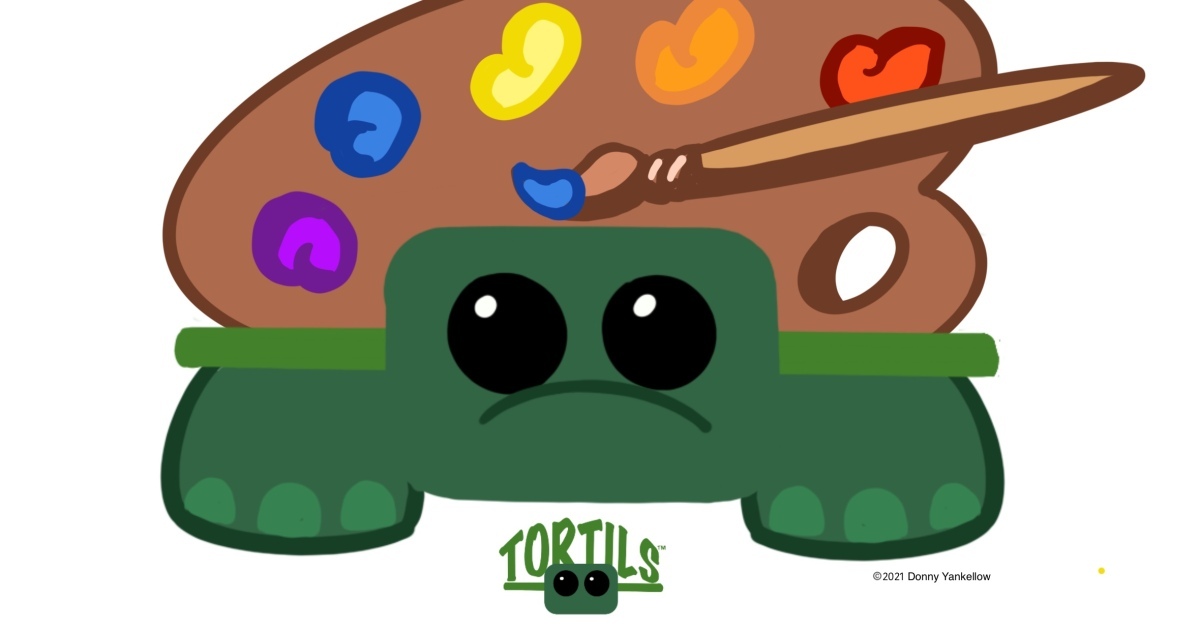
It began with a small artistic identity crisis: Had I drawn a turtle or a tortoise? The creature had a rounded shell, sturdy little feet, enormous eyes, and an expression suggesting it had just remembered an embarrassing moment from 2007. Rather than force it into a scientific category, I gave it a new one. I called it a Tortil.
One drawing soon became a growing series of turtles and tortoises with themed shells. A normal carapace might transform into an ice cream sundae, a hamburger, an apple, a snowy mountain, a ladybug, a fortune-telling crystal ball, or even an entire miniature planet. The shell stopped being background anatomy and became the main stage.
The resulting Tortils digital art series combines cute animal illustration, visual puns, imaginative character design, and short animation. Each creature keeps the same recognizable personality while carrying a completely different world on its back. Apparently, the road to artistic obsession is paved with tiny reptiles wearing tacos.
How the Tortils Art Series Began
The first Tortil was created almost accidentally. I liked the basic creature, but I was not entirely sure whether its shape belonged to a turtle, a tortoise, or some adorable third option that had wandered away from biology class. Naming it solved the problem and opened a much more interesting creative door.
Instead of repeatedly drawing realistic shell markings, I began asking a simple question: What else could that shell become? Once the shell was treated as a blank canvas, ideas arrived faster than I could sketch them. A dome could become a scoop of ice cream. A flatter shell could resemble a plate, a puzzle, or a tiny landscape. The segmented surface could hold patterns, objects, rooms, weather systems, and visual jokes.
The concept also had a useful built-in structure. Every Tortil needed a familiar body, a clear shell theme, and one memorable visual surprise. That limitation made the series easier to expand rather than more restrictive. The character remained recognizable, while each new shell delivered a fresh punch line.
Why the Name Works
“Tortil” sounds like a cheerful collision between “turtle” and “tortoise.” It is short, easy to remember, and slightly ridiculous in exactly the right way. The name gives the creatures their own identity without requiring viewers to inspect their feet and debate whether they are aquatic, terrestrial, or simply late for lunch.
Why Turtle Shells Are Perfect for Imaginative Art
Real turtle and tortoise shells already look like natural works of design. The upper portion is called the carapace, while the underside is the plastron. Many species have visible plates called scutes arranged in repeating geometric patterns. Those sections create a ready-made grid for an illustrator, almost like nature installed a set of drawing guides millions of years before tablets were invented.
A shell is not a removable house. It is an essential part of the animal’s skeleton, connected to its ribs and spine. That biological fact makes the shell even more visually fascinating. It is architecture, armor, anatomy, and identity all at once.
Tortoises generally live on land and tend to have sturdy legs and more dome-shaped shells. Many aquatic turtles have flatter, streamlined shells and webbed feet or flippers. Nature enjoys exceptions, of course, because nature apparently dislikes neat filing systems. Pancake tortoises, softshell turtles, box turtles, and leatherback sea turtles all demonstrate how dramatically shell shape and structure can vary.
For the Tortils series, scientific accuracy provides inspiration rather than a cage. Rounded forms work beautifully for food, planets, snow globes, and garden scenes. Segmented shells invite mosaics, tie-dye patterns, maps, puzzles, and decorative motifs. The silhouette remains unmistakably turtle-like even when the carapace has become a cheeseburger with structural ambitions.
Exploring the Different Themed Tortils
Food-Themed Shells
Food quickly became one of the richest sources of Tortil ideas. The curved shell naturally resembles a bun, scoop, bowl, fruit, or pastry. This led to designs such as Taco Tuesday, Soft Serve, Latte, Cherry on Top, Dog on a Bun, An Apple a Day, and Burger and Cheese.
These designs work because the theme can be understood immediately. A viewer does not need an instruction manual to recognize a Tortil carrying an ice cream swirl. The comedy comes from the visual fit: the food appears as though it was always secretly designed to become a turtle shell.
Food themes also create opportunities for texture. A toasted bun needs soft shading and scattered sesame seeds. Ice cream benefits from glossy highlights and melting edges. An apple shell needs a firm shape, a stem, and enough color variation to avoid looking like a red bowling ball. Every ingredient becomes a miniature character-design problem.
Nature and Seasonal Tortils
Other shells draw from wildlife, weather, and seasonal landscapes. Ladybug transforms one familiar natural pattern into another. Save the Earth places the planet on a creature already associated with longevity and endurance. On the Slopes turns the carapace into a snowy mountain scene, while Brrrrrrrrrrr explores winter with enough cold energy to make the Tortil appear ready to request a heated rock.
Summers Day shifts the atmosphere toward warmth, while tie-dye and colorful abstract designs celebrate pattern for its own sake. These pieces show how a shell can communicate an entire mood. Color temperature, lighting, and tiny environmental details tell viewers whether the Tortil belongs beside a fireplace, on a beach, or at a music festival offering suspiciously expensive lemonade.
Art, Games, and Pop-Culture-Inspired Shells
Several Tortils are built around playful references and visual storytelling. The Claaaaaaaw suggests an arcade claw machine or a dramatic mechanical encounter. Now in 3D! plays with dimensional illusion. Artortil gives the shell an artist’s palette, turning the creature into a walking studio.
Tell My Fortune uses the rounded carapace like a crystal ball, while Solve It! turns it into a puzzle. Pop! and other graphic designs rely on bold shapes that can be understood even at thumbnail size. That matters online, where an illustration may have only a fraction of a second to convince someone to stop scrolling.
The best Tortil themes are not merely objects placed on top of a turtle. The shell and the subject should feel structurally connected. A successful idea creates the delightful sensation that the viewer has discovered an obvious joke nobody had noticed before.
Turning Static Illustrations Into Procreate Animations
The shells eventually seemed too lively to remain still, so the characters were animated in Procreate on an iPad and shared as short videos. Animation gave each design a second layer of personality. Ice cream could wobble. A claw could descend. Snow could fall. Steam could curl upward from a latte. A tiny movement made the concept feel less like an isolated drawing and more like a resident of a larger Tortils universe.
Building a Clear Character Silhouette
Before adding shell details, the underlying body must remain easy to recognize. The head, legs, eyes, and general posture act as the visual anchor. If the shell becomes extremely elaborate, a strong silhouette prevents the character from disappearing beneath its own accessories.
Choosing One Strong Visual Idea
A themed illustration becomes confusing when it tries to deliver six jokes simultaneously. The most effective Tortils usually begin with one dominant concept. Supporting details can enrich that idea, but they should not compete with it. A taco shell may need lettuce, cheese, and salsa, but it probably does not also need a ski resort and a working lighthouse. Probably.
Designing Motion Around the Theme
Animation works best when the movement belongs to the shell concept. The character does not need to perform gymnastics. A blink, a bounce, a drip, a shimmer, or a gently swaying object may be enough. Small loops are especially suitable for social platforms because viewers can understand them quickly and enjoy watching them repeat.
Why the Tortils Series Connects With Viewers
The series uses a classic creative formula: consistency plus surprise. Viewers recognize the same basic creature, but they do not know what it will be carrying next. That makes every new illustration feel both familiar and unexpected.
The Tortils also have expressive faces that contrast with their spectacular shells. A creature might be carrying an elaborate dessert, a glowing crystal ball, or an entire planet while looking mildly concerned about tomorrow’s dentist appointment. That emotional mismatch adds humor and encourages viewers to imagine a personality behind the design.
Naming each piece strengthens the effect. Titles such as “Taco Tuesday” or “Cherry on Top” function as miniature punch lines. They also make individual characters easier to remember, discuss, and collect. A themed art series becomes more engaging when every entry feels like a specific character rather than “Turtle Illustration Number 14.”
The concept is flexible enough to appeal to animal lovers, digital artists, animation fans, collectors, children, and adults who simply appreciate a respectable visual pun. It can expand into seasonal collections, educational projects, stickers, prints, greeting cards, short animations, or collaborative art prompts without losing its central identity.
Whimsical Turtle Art Can Also Encourage Conservation
Cute art does not have to become a lecture, but it can inspire curiosity about real animals. Someone who enjoys a fictional Earth-themed Tortil may begin learning about sea turtles, desert tortoises, box turtles, or freshwater species. That curiosity matters because turtles and tortoises face serious pressures from habitat loss, vehicle strikes, plastic pollution, fishing activity, illegal collection, wildlife trafficking, and changing environmental conditions.
Their shells may look indestructible, but the animals themselves are vulnerable. Some turtles must cross roads to reach nesting areas. Tortoises depend on specific landscapes and burrows. Sea turtles require healthy feeding grounds and nesting beaches. Protecting them means protecting the connected habitats that support many other species as well.
Tortils celebrate the shell without treating real wildlife as an art supply. The designs belong in digital illustrations, prints, and animationnot painted onto living animals. Imagination can decorate a fictional shell with a cheeseburger, but a real turtle deserves to keep the design nature gave it.
Creator’s Experience: What Building Tortils Taught Me
Working on a repeating character series changed the way I approached creative ideas. At first, I assumed repetition would become boring. Drawing the same body again and again sounded like the artistic equivalent of eating identical sandwiches for a month. Instead, the familiar Tortil shape became a foundation that made experimentation easier.
I no longer had to invent an entirely new universe every time I opened a blank canvas. The basic character was waiting for me. The challenge was to discover what had happened to its shell today. Was it a dessert? A landscape? A toy? A symbol? A household object that had no business being carried by a reptile but looked suspiciously perfect there?
I began noticing potential shell shapes everywhere. A hamburger bun at lunch became a sketch idea. A rounded backpack suggested another. Snow piled on a hill looked like a winter carapace. An artist’s palette practically introduced itself as Artortil before I had time to object. Creating a series trained me to look at ordinary objects through a single playful question: Could this become a shell?
Not every answer worked. Some objects looked funny in my imagination but became unreadable on the screen. Others covered too much of the character or created awkward proportions. A concept could be clever yet visually weak. Learning to abandon those ideas was difficult, especially after spending an hour adjusting tiny details that nobody had requested.
The experience taught me that simplicity is not the same as laziness. A clear Tortil may require dozens of decisions about silhouette, color, balance, texture, and expression. The final image should appear effortless even when the working file contains enough layers to qualify as digital archaeology.
Animation introduced a different kind of patience. A movement that lasted one second could require repeated adjustments. If an object bounced too far, it looked detached. If it moved too little, the animation seemed frozen. Timing became part of the joke. A delayed blink could make a character appear confused, unimpressed, or quietly aware that it was carrying a hot dog.
Sharing the Tortils also showed me that viewers bring their own memories to an illustration. One person might love a ladybug design because it reminds them of a family member. Someone else may prefer a food-themed piece because it matches an inside joke. An image begins with the artist’s idea, but its emotional meaning does not remain under the artist’s control.
Comments about the characters’ worried or sad expressions became especially memorable. I had focused so heavily on the shells that viewers began inventing stories about the faces. Why did a creature with such an impressive shell look concerned? Was the ice cream melting? Had the fortune-telling Tortil seen something alarming? Was Taco Tuesday happening on a Wednesday?
Those reactions helped the Tortils become characters rather than decorative objects. Their expressions allowed humor, sympathy, and narrative to enter the series without lengthy captions. Each shell explained what the creature was, while the face invited viewers to wonder what it was thinking.
Most importantly, the project reminded me that a small idea does not need to know its final destination. The first drawing was simply a creature I liked. I did not begin with a giant content plan, an imaginary merchandise warehouse, or a dramatic speech about building a reptile-based creative empire. I made one drawing, named it, and followed the next amusing idea.
That gradual process is part of the charm. Tortils grew because the rules were understandable, the possibilities were broad, and creating them remained fun. A successful art series does not always begin with a masterpiece. Sometimes it begins with uncertainty, a made-up word, and a turtle-shaped character patiently waiting for someone to put an apple on its back.
The continuing lesson is simple: give playful ideas room to develop. Repeat them, challenge them, animate them, and occasionally allow them to become cheeseburgers. Creativity does not always move in a straight line. Sometimes it travels slowly, carries an entire world on its shell, and answers to the name Tortil.














