
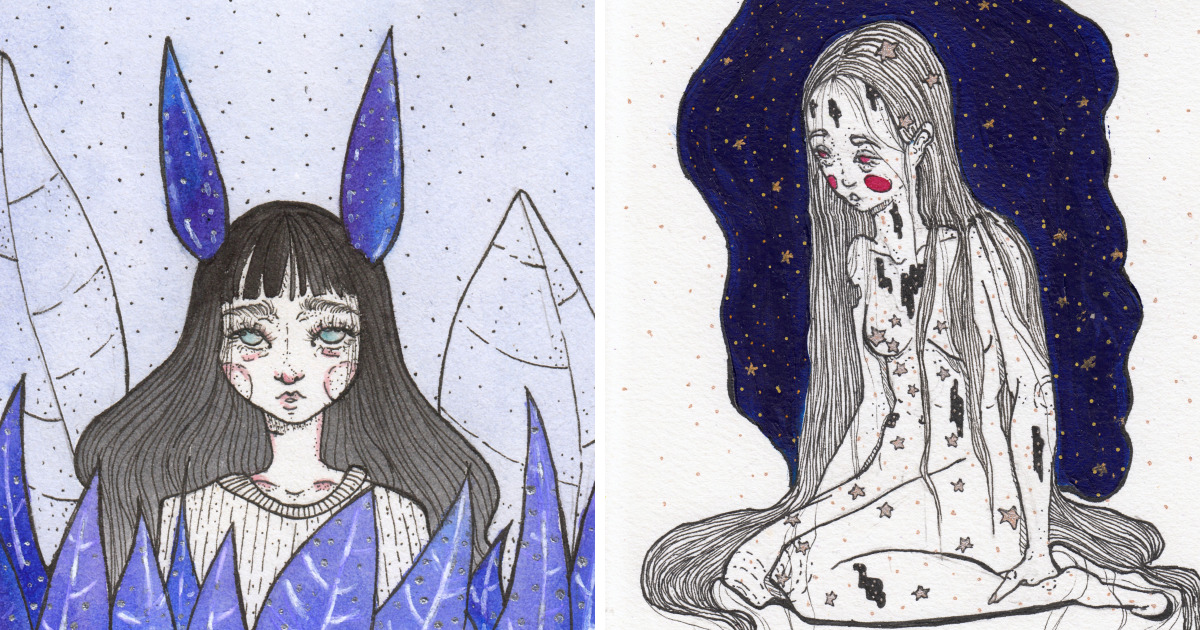
Some people journal with elegant penmanship and a candle that smells like self-awareness. I, on the other hand, started drawing imaginary characters because my moods were too dramatic to stay inside neat little sentences. A bad day did not feel like “mild frustration.” It felt like a nervous raccoon in a raincoat carrying twelve overdue thoughts. A peaceful afternoon did not feel like “contentment.” It felt like a sleepy giant made of moss, tea steam, and soft afternoon light. Once I realized my emotions had better casting ideas than I did, illustration stopped being just an art habit and became a way to understand myself.
That shift matters more than it sounds. Creative work is not only about making something pretty enough to post online and wait for the digital equivalent of polite clapping. Real art-making can also help people express emotions that are hard to verbalize, process inner experiences with a little more distance, and turn vague feelings into something visible. That was the doorway for me. I was not trying to make “perfect” characters. I was trying to make honest ones. And honesty, it turns out, is much more interesting than perfection.
Why Imaginary Characters Can Say What Plain Language Cannot
There is something almost magical about giving a feeling a face, a posture, and a wardrobe. The moment a mood becomes a character, it stops floating around like invisible weather and starts behaving like a story. Instead of saying, “I feel overwhelmed,” I can draw a tall creature with too many pockets, each one spilling lists, receipts, keys, and tiny alarms. Suddenly, the emotion has shape. It has weight. It has comic timing. Most importantly, it has enough distance for me to look at it without getting swallowed by it.
That distance is one reason this process works so well. Imaginary characters let you externalize a feeling without denying it. You are not pretending the emotion is gone. You are saying, “Fine, you can stay, but you have to sit for a portrait.” That changes the relationship. Instead of being ruled by the mood, you become its illustrator, costume designer, and occasional editor. It is difficult for panic to feel all-powerful when you have drawn it wearing striped socks and carrying a briefcase full of thunderclouds.
Characters also invite complexity. A mood is rarely just one thing. Sadness may include tenderness. Anger might be protecting hurt. Joy may arrive with nervous energy and glitter all over the floor. An imaginary character can hold those contradictions better than a label can. Through expression, gesture, color palette, and setting, one drawing can say, “This feeling is messy, layered, and very much alive.”
Illustration Turns Emotion Into Visual Storytelling
Illustration is especially good at this because it naturally combines emotion with narrative. A character does not exist alone; it belongs to a world. If I draw a lonely figure standing under a giant paper moon in an empty laundromat, the mood becomes more than a facial expression. The lighting, objects, textures, and space all help tell the emotional truth. This is where character design becomes deeply personal. The shape of the body, the slant of the shoulders, the colors chosen for the clothes, and even the kind of shoes the character wears all contribute to the feeling being translated.
That is why imaginary characters based on moods never feel random to me. They are tiny emotional ecosystems. Every design decision says something. Soft round forms can suggest safety, gentleness, or nostalgia. Sharp edges can hint at tension, defensiveness, or urgency. Muted colors may whisper. Saturated ones may shout. Even when the drawing is whimsical, the emotional logic underneath it is real.
How I Built Characters From Feelings Instead Of Reference Sheets
Usually, character design begins with a backstory, a role, or a world. My process often begins with a weather report from the inside. I ask myself a few simple questions: What is this mood doing in my body? Is it heavy, fizzy, restless, slow, prickly, warm, or foggy? Does it want to hide, sprint, perform, disappear, or build a blanket fort and ignore all incoming emails? Once I answer those, the character starts to appear.
First comes shape language. Anxiety often arrives as narrow lines, cluttered silhouettes, too many accessories, and limbs that look like they forgot where to go. Calm tends to become broader, softer forms with more breathing room in the composition. Excitement is all motion: hair floating upward, shoes barely touching the floor, a scarf acting like it is auditioning for its own action movie. Burnout, meanwhile, usually shows up as a tired knight made of cardboard, still trying very hard despite obviously needing a nap and maybe a sandwich.
Then comes color. I do not use color as a strict code, because emotions are not a traffic light. Still, color helps me amplify tone. Dusty blues and grays can give a piece emotional hush. Acid yellow can create mental static. Warm peach, moss green, and gold often bring a sense of comfort or recovery. Sometimes I deliberately choose unexpected colors, because moods can surprise you. Grief is not always black. Sometimes it is pale lavender at 6:12 p.m. while the house is too quiet.
Props and environments help seal the deal. A character carrying a ladder made of pencils suggests effort, ambition, and maybe a slightly unhealthy relationship with productivity. A creature living in a room full of floating teacups suggests fragile calm. A girl with stars tangled in her headphones suggests overstimulation dressed as inspiration. The fun part is that none of this has to be literal. Symbolism gives mood-based illustration its poetic power. You are allowed to be strange. In fact, strange is often where the truth finally gets comfortable enough to sit down.
The Moods That Became My Favorite Imaginary Characters
The Overthinker
This character began as a scribble with knees. I drew them with a coat full of notes, a tangled halo of paperclips, and eyes pointed in two different directions as if trying to predict tomorrow and re-edit yesterday at the same time. Their world was made of stacked clocks, open tabs, and little staircases that led nowhere. It was funny, but it was also accurate. The illustration captured the absurdity of mental overload better than a paragraph of self-analysis ever could.
The Quiet Giant
This one came from those rare days when peace feels large instead of small. I imagined a moss-covered giant carrying a greenhouse on its back. Birds nested in its sleeves. Nothing about the design was flashy. That was the point. The character represented steadiness, the mood I trust the least because I always expect it to leave early. Drawing it helped me recognize that calm does not have to be boring. It can be powerful, rooted, and deeply cinematic.
The Social Battery on One Percent
Everyone knows this creature, whether they admit it or not. Mine wore party shoes with no emotional support, smiled politely while dissolving into confetti, and carried a phone the size of a brick. The background was full of chat bubbles floating like balloons at a parade I was too tired to attend. Humor made this piece work. Once I laughed at the character, I felt less ashamed of the mood behind it. Comedy can be a wonderful little bridge between honesty and relief.
The Hopeful Gremlin
Not all mood characters come from struggle. Some are born from scrappy optimism. This character had giant ears, paint-stained hands, and the determined expression of someone who has absolutely no plan but excellent vibes. It represented the part of me that keeps making things even when the algorithm shrugs, the deadline creeps closer, or the sketch looks like it was drawn by a distracted potato. That character reminded me that creativity is often sustained by imperfect hope rather than grand confidence.
What This Process Taught Me About Art, Mood, and Self-Understanding
The biggest surprise was that illustration became a form of pattern recognition. After drawing enough mood-based characters, I started noticing repeated visual themes. My stressed characters were always carrying too much. My lonely characters were often placed in oversized rooms. My confident characters had stronger silhouettes and took up more space on the page. Those patterns told me things about my emotional habits before I could explain them out loud.
I also learned that not every mood wants to be “solved.” Some just want to be witnessed. That realization changed the tone of my work. Instead of using art only to fix feelings, I began using it to accompany them. A sketch can say, “I see you,” without pretending to cure everything. That is a gentler, more sustainable relationship with creativity. Art does not always need to rescue us in one dramatic cinematic montage. Sometimes it just sits nearby with a marker and lets us breathe.
Another lesson was that imagination is not an escape from reality; it is often a way of approaching reality sideways. Fictional characters can reveal truths that direct autobiography misses. When I invent a moon-faced insomniac who irons wrinkles out of the night sky, I am obviously not reporting facts. But I am telling the truth about exhaustion, tenderness, and the strange labor of trying to make life feel manageable. Imagination lets emotional truth wear better clothes.
Tips for Creating Your Own Mood-Based Illustrations
If this idea makes you want to grab a sketchbook, good. You do not need elite drawing skills, expensive software, or a suspiciously perfect desk setup with matching ceramic containers. Start with one mood and keep it simple. Ask what shape it is, what color it leans toward, how it stands, and what kind of world it belongs in. Build from sensation rather than logic. Your character does not need a polished lore bible. It just needs enough visual clues to feel emotionally true.
Let symbols do some of the heavy lifting. Maybe your anxious character has shoelaces that never stay tied. Maybe your joyful one leaves flowers in its footprints. Maybe your frustrated one has a zipper where its mouth should be. These details do more than decorate a page. They create emotional shorthand that readers immediately understand, even if they interpret it in their own way.
Most of all, do not over-police the weirdness. Mood-based illustration thrives on surprising combinations. A character can be adorable and devastated. It can be elegant and chaotic. It can look like a librarian cloud, a dragon made of receipts, or a melancholic prince who lives in a vending machine. If the image captures something honest, it is doing the job.
Additional Experiences: What Happened After I Kept Making These Characters
The longer I worked this way, the more I realized the illustrations were becoming a visual diary. I could flip through old sketches and instantly remember entire seasons of my life without reading a single caption. There was the month of all the storm-headed people, when I was trying to do too much and pretending caffeine counted as emotional development. There was the stretch of tiny glowing creatures hiding in coat pockets, which now feels like a chapter defined by cautious hope. There was even a run of smug little characters with capes, drawn during a week when I got exactly three things done and felt weirdly invincible about it.
Friends started reacting to the work in ways I did not expect. They would point to a character and say, “That is exactly what my stress feels like,” or, “I know that one. Mine looks more like a tired pigeon, but still.” That was the moment I understood mood-based illustration is personal, but it is not lonely. When emotions are translated into characters, they become easier to share. People may not use the same visual language, yet they still recognize the emotional truth inside it. A drawing can say, “You are not the only one with a dramatic internal cast.”
I also noticed that these pieces made me less afraid of inconsistency. Some days my art is detailed and polished. Other days it looks like it was created by a haunted highlighter. Mood-based work gave me permission to let style fluctuate with feeling. That freedom improved my creativity more than strict control ever did. Instead of forcing every piece to look brand-consistent, I let the emotion determine the texture, pace, and finish. A restless mood produced scratchier lines. A reflective mood created softer edges and more empty space. The art became more alive because it stopped pretending to be a machine.
Over time, the characters also helped me recover my sense of play. Adult life has a sneaky way of turning creativity into output, metrics, and the occasional identity crisis in a swivel chair. But imaginary mood characters are gloriously unprofessional in the best way. They invite experimentation. They encourage visual jokes. They remind me that wonder is not childish; it is fuel. Even when the subject is serious, the act of inventing a tiny emotional universe can make the process feel lighter and more generous.
If I had to sum up the whole experience, I would say this: making illustrations with imaginary characters based on my moods taught me that feelings do not have to remain abstract in order to be valid. They can be drawn, stylized, exaggerated, softened, and reimagined. They can become monsters, guardians, weird little roommates, or cosmic librarians. And when they do, they often become easier to understand. Not smaller, exactly. But more speakable. More visible. More workable. That is the quiet gift of this process. It turns emotion into image, and image into insight, one strange, wonderful character at a time.
Conclusion
Making illustrations from moods taught me that imagination is not a detour from emotional truth; it is one of the clearest roads to it. By turning feelings into characters, I found a way to observe them, laugh at them, and learn from them without flattening their complexity. The result was not just a collection of whimsical drawings. It was a more honest visual language for inner life. If you have ever struggled to name what you feel, try drawing who it might be instead. Your next favorite character may already be living in your sketchbook, waiting for an introduction.













