
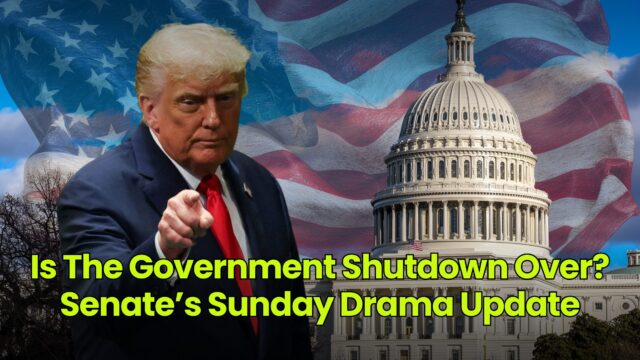
If you have been trying to keep up with the latest government shutdown headlines, first of all, congratulations on surviving a news cycle that somehow made budget procedure feel like a reality show reunion special. Second, here is the honest answer: the shutdown story is not a simple yes or no.
At the broadest level, the entire federal government is not sitting in one giant all-agencies shutdown. Congress and the White House already moved earlier this year to end a short partial shutdown and keep most of the government funded. But the more recent Senate drama has centered on a narrower, messier, and still highly consequential fight over the Department of Homeland Security, or DHS. In plain English: the giant fire was mostly put out, but one very important room was still smoking.
That is why so many headlines seem to contradict each other. One story says the Senate passed a deal. Another says the shutdown continues. Another says workers are getting paid again. All of those can be true at the same time, because Washington has once again turned a basic funding question into legislative origami.
This latest chapter matters because DHS is not some sleepy back-office agency that nobody notices until paperwork goes missing. DHS includes TSA, FEMA, the Coast Guard, cybersecurity operations, border agencies, and immigration enforcement. When that department is tangled in a funding lapse, the effects are not theoretical. Travelers feel it. Federal workers feel it. Families feel it. And yes, politicians definitely feel it when airport lines start becoming campaign material.
So, is the government shutdown over?
Mostly for the wider government, but not fully for the latest DHS-specific fight. That is the cleanest, least annoying answer.
Earlier in 2026, Congress passed a package that ended a four-day partial shutdown and restored funding for major parts of the federal government, while giving DHS only temporary breathing room. That solved the immediate crisis for most agencies, but it did not settle the underlying fight over homeland security funding. When the short-term DHS extension expired, the department fell back into a partial shutdown fight of its own.
So if you are asking whether Washington has returned to normal, the answer is no. If you are asking whether every federal office is dark and locked, also no. If you are asking whether the Senate has tried to move things forward while the House turned the process into a game of legislative hot potato, now we are getting warmer.
Why the Senate drama became the whole story
The shutdown fight became Senate drama because the Senate is where budget math goes to develop a personality disorder. In the House, a narrow majority can often muscle through a bill if leadership can keep enough members from wandering off. In the Senate, it is usually harder. Even when one party has control, it often still needs bipartisan cooperation to move a spending bill across the finish line.
That is exactly what happened here. Lawmakers could not agree on how to fund DHS, especially the parts tied most directly to immigration enforcement. Democrats demanded changes and oversight after deadly incidents involving federal agents. Republicans argued those demands would weaken enforcement and border operations. That disagreement did not just create policy tension. It jammed the appropriations process itself.
The result was classic Capitol Hill theater: public blame games, procedural votes, temporary fixes, angry floor speeches, and a growing pile of evidence that everyone involved would rather accuse the other side of chaos than admit Congress is structurally addicted to last-minute budgeting.
A quick timeline of the shutdown mess
1. Most of government got funded, but DHS was carved out
In late January, the Senate approved a funding package for much of the federal government through the end of September while temporarily separating out DHS. That move prevented a broader funding collapse, but it also guaranteed that homeland security would remain the next political battleground. Think of it as Congress tossing one leaking bag out of the boat while quietly keeping another one on board.
2. A short partial shutdown ended, but only temporarily
In early February, a spending bill was signed into law ending a four-day partial shutdown. That was the good news. The less good news was that DHS only received a short-term extension, meaning lawmakers had merely purchased time rather than peace. Washington loves to call this “avoiding a shutdown.” Normal people call it “hitting snooze on the alarm.”
3. DHS fell back into a funding fight
Once that temporary funding expired in mid-February, the DHS dispute turned into a prolonged partial shutdown. Because DHS touches airport screening, emergency management, cybersecurity readiness, the Coast Guard, and immigration-related operations, the consequences spread far beyond a standard Beltway food fight.
4. The Senate advanced a compromise, but the House dragged its feet
By late March, the Senate had moved a compromise bill that would fund most of DHS through the rest of the fiscal year while leaving some immigration-enforcement funding for a separate fight. That was the “Senate drama update” moment many readers were waiting for. The chamber had a path. The problem was that a Senate path is not the same thing as a final law.
The House was slower, more divided, and less thrilled with the Senate’s version. Some Republicans wanted a broader measure. Others wanted separate funding for immigration enforcement pushed through a different process. So even after the Senate signaled progress, the shutdown story did not end. It just changed from “Can the Senate pass something?” to “Can the House stop making this harder?”
5. Workers got financial relief before Congress fully solved the politics
As the standoff dragged on, the White House moved to restore pay or back pay for affected DHS workers, including relief measures for TSA personnel and later broader orders involving DHS employees. That eased some immediate pain, but it did not erase the deeper dysfunction. Paying workers during a shutdown helps people survive. It does not magically convert a temporary patch into stable appropriations law.
What a shutdown actually means in real life
The phrase “government shutdown” sounds dramatic, but it can also be misleading. It does not mean every federal worker goes home and every government service stops at once. Under federal shutdown rules, some employees are furloughed while others keep working because their roles are considered excepted or essential. That creates a weird and deeply frustrating split-screen version of government.
One office may go quiet while another remains fully active but understaffed, stressed, or unpaid. Workers can be told to report anyway. Managers are left triaging what can legally continue. Contractors are often stuck in an even murkier spot. Federal employees are more likely to receive back pay after the lapse ends. Contractors do not always get the same protection, which means the economic damage can ripple outward even when lawmakers later congratulate themselves for “resolving” the crisis.
That is why shutdown politics are never just about headlines. They are about paychecks delayed, projects paused, travel disrupted, reimbursements slowed, morale drained, and public trust chipped away one procedural stunt at a time.
Why this particular fight was so politically explosive
This was not a generic budget fight over line items that only appropriators can love. It was tied directly to immigration enforcement, border politics, and competing claims about oversight, accountability, and public safety. That raised the temperature immediately.
Democrats pushed for tighter constraints and more transparency after deadly incidents involving federal agents. Republicans argued that withholding or conditioning DHS funding would amount to kneecapping national security and border enforcement. Once those competing narratives hardened, the shutdown stopped being just a funding problem and became a symbolic fight over who gets to define “security” in an election-season political climate.
And because symbolism is apparently the most heavily funded program in Washington, the fight escalated fast. Senate leaders tried to separate the funding pieces. House leaders flirted with other strategies. The White House signaled support for one path, then leaned into a broader political argument. Before long, the story was no longer just “Is the shutdown over?” It became “Which side can claim victory even if nobody is actually happy?”
What happens next?
The mechanical answer is simple: for the DHS shutdown story to be truly over in a clean, boring, adult way, both chambers need to pass the same funding measure and the president needs to sign it. Until that happens, every celebration should come with a giant asterisk the size of the Capitol dome.
The political answer is trickier. Even if lawmakers finalize funding for most of DHS, the separate argument over ICE and Border Patrol funding is likely to continue. That means the shutdown itself may end before the political war ends. In Washington terms, that counts as progress. In normal-human terms, that counts as “we solved half the problem and wrote press releases about all of it.”
So yes, the Senate drama update matters. It shows there is movement. It shows there is at least a roadmap. But it does not yet prove the road has been paved, cleared, and opened to traffic.
on the real experience behind the shutdown headlines
Here is the part that often gets buried under vote counts and leadership quotes: a shutdown is experienced very differently by the people living through it than by the politicians narrating it. For lawmakers, it is leverage, messaging, procedure, and power. For workers and families, it is a calendar, a bank account, a grocery bill, and an increasingly uncomfortable text thread about whether next month’s rent will land on time.
Take airport workers and travelers. When TSA staffing becomes shaky, the shutdown stops sounding like a constitutional quarrel and starts looking like missed flights, longer security lines, and frazzled families removing shoes at dawn while wondering why Congress cannot manage the one thing it literally exists to do. For travelers, the experience is confusion. For TSA workers, the experience can be even worse: keep showing up, keep doing the job, and keep waiting for Washington to decide whether competence is worth funding this week.
For Coast Guard families and other DHS personnel, the experience is even more personal. Some employees continue working because the mission cannot simply pause. But continuing to work while funding is in limbo creates a uniquely maddening kind of pressure. The country still needs the job done. The bills still arrive. Child care still costs what it costs. Car payments do not become patriotic just because Congress missed a deadline.
Then there are the less visible disruptions. FEMA operations and reimbursements can slow. Cybersecurity teams face uncertainty while threats, of course, do not politely take a budget break. Contractors and support staff can feel especially exposed because they are often outside the political sympathy package that eventually brings back pay for federal employees. That means two people can work on the same mission and experience the shutdown very differently when payday rolls around.
There is also a psychological experience that rarely makes the chyron. Shutdowns grind down morale. People feel like pieces in a political hostage exchange. Workers are told they are essential one minute and treated as optional in the next budget showdown. The public is told to trust institutions while watching those same institutions repeatedly drift to the edge of preventable dysfunction. Even when funding is restored, the aftertaste lingers.
And for ordinary voters, the experience is a blend of anger, fatigue, and déjà vu. Most people do not spend their mornings studying cloture votes or appropriations language. They simply want air travel to work, emergency services to function, federal offices to answer questions, and the people elected to govern to act like the phrase “must-pass bill” means the bill should, in fact, pass. Instead, they get a civic lesson in brinkmanship they never asked for.
That is why the shutdown question matters beyond partisan scorekeeping. It is not just about whether one chamber won a tactical skirmish. It is about whether the basic machinery of government can operate without periodically turning federal workers, travelers, and families into unwilling extras in the longest-running drama on Capitol Hill. If there is one shared experience in every shutdown saga, it is this: the people with the least control over the crisis are usually the ones forced to absorb the most disruption.
Final takeaway
If you came here for a one-sentence answer, here it is: the government shutdown story is partly over, but the latest Senate-driven DHS chapter was still not fully resolved as of early April 2026.
Most of the federal government has funding in place, but the homeland security fight kept the shutdown conversation alive because Congress separated that issue from the broader package and then failed to close the deal quickly. The Senate showed movement. The House showed hesitation. Workers got some financial relief. The politics remained messy.
In other words, Washington did what Washington does best: it solved enough of the problem to hold a press conference, but not enough to make the headline disappear.














