
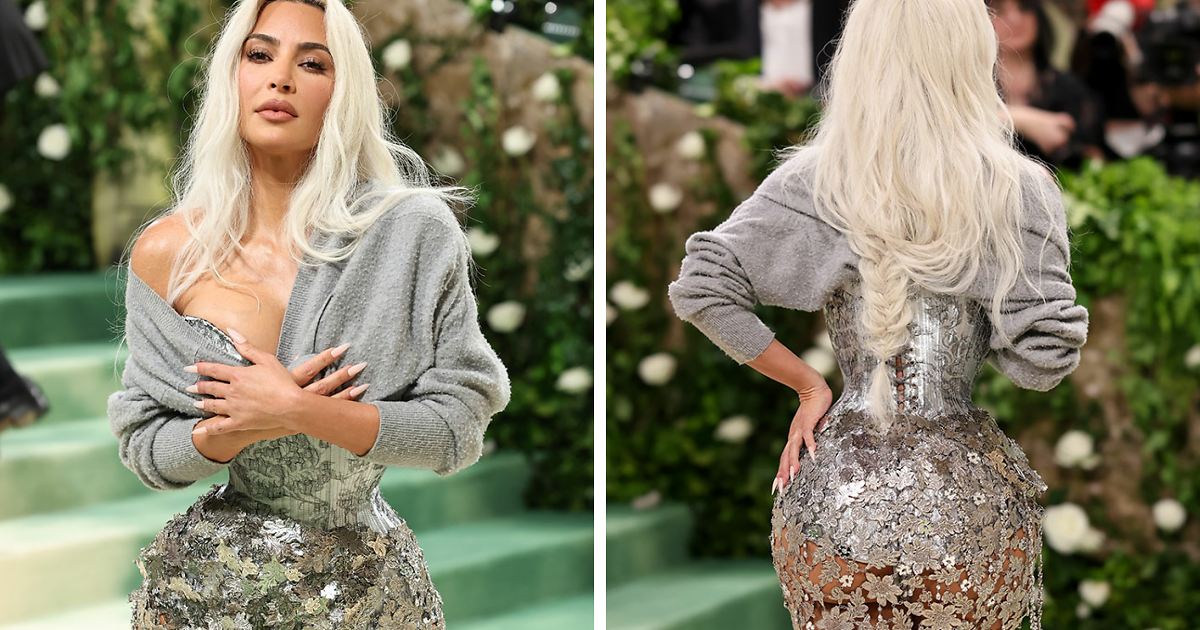
When Kim Kardashian stepped onto the Met Gala carpet in 2024, she did not merely arrive. She detonated the group chat. Again. In a silver, hyper-corseted Maison Margiela by John Galliano look, topped with a casual gray cardigan that looked like it had been borrowed from a chilly ex-boyfriend or a very stylish ghost, Kardashian managed to dominate the conversation within minutes. The internet zeroed in on one detail faster than you can say “first Monday in May”: her dramatically cinched waist.
Critics called it “unhealthy.” Others called it “non-existent.” Fans debated whether the look was fashion genius, performance art, or a visual stress test for internal organs. And because this was the Met Gala, where subtlety goes to die in couture, the controversy only grew louder once behind-the-scenes footage showed just how tightly the corset had been constructed.
This was not just another celebrity outfit recap. The 2024 Met Gala look tapped into bigger conversations about body image, extreme beauty standards, internet culture, and why Kim Kardashian remains one of pop culture’s most reliable controversy magnets. Love her, loathe her, or simply wonder how she sat down in that thing, one fact remains: the outfit worked exactly as red carpet fashion often hopes to work. It got everyone talking.
Why Kim Kardashian’s 2024 Met Gala Look Blew Up Online
The Met Gala has always rewarded visual drama, but Kardashian’s outfit hit a very specific nerve. This was not simply a glamorous dress. It was a carefully engineered spectacle. The silver corset compressed her waist to an extreme degree, while the rest of the look mixed metallic florals, chain-mail-like texture, sheer elements, and a slouchy gray cardigan that confused nearly everyone before they heard her explanation.
That contrast was part of the magic and the mess. The outfit said “fantasy couture,” while the cardigan said “I stayed out too late and grabbed knitwear on the way out.” The result was memorable, strange, theatrical, and just awkward enough to become meme bait. In internet terms, it was perfect fuel.
But the real reason the backlash took off was not the cardigan. It was the silhouette. Social media users were less interested in the outfit’s craftsmanship than in the question it raised: why are extreme waistlines still being sold as spectacle in an era that claims to be more body-positive, more media-literate, and more suspicious of impossible beauty standards?
What Kim Kardashian Actually Wore to the 2024 Met Gala
A Maison Margiela fantasy with John Galliano fingerprints all over it
Kardashian’s look was custom Maison Margiela by John Galliano, and it leaned hard into the dreamy, decaying romance that defined much of the 2024 Met Gala mood. The gala celebrated Sleeping Beauties: Reawakening Fashion, while the dress code was The Garden of Time. That meant guests were expected to flirt with themes of nature, fragility, memory, and fashion’s ability to feel both alive and haunted at the same time.
Kim’s ensemble delivered that idea in the most Kim way possible: with high drama, visible discomfort, and enough online discourse to power a small city. The dress featured silver floral and leaf-like elements, a structured bustier, and an overskirt with intricate decorative details. It had the sort of couture complexity that makes fashion editors swoon and ordinary viewers ask, “Yes, but can she breathe?”
The answer, based on the reaction online, was “probably not casually.” That concern intensified after Vogue’s behind-the-scenes footage showed Kardashian being laced into the corset and joking that breathing in it was “an art form.” A sentence like that may sound playful in a fashion video, but on social media it landed like a starter pistol for criticism.
The gray cardigan that launched a thousand think pieces
Then there was the cardigan. The cardigan! The Met Gala is many things, but cozy is not usually one of them. So when Kardashian draped a cropped gray knit over one of the year’s most high-concept looks, the internet reacted with the confusion usually reserved for surprise album drops and airline baggage fees.
Her explanation was more narrative than practical. Kardashian described the look as a fantasy of waking up in a garden after the best night of your life, grabbing your boyfriend’s sweater, and running off while your dress is half-falling apart in chic disarray. That story gave the cardigan context. It was not random. It was character work.
Whether the public bought that story is another issue. Some found it whimsical. Others thought the sweater looked like a last-minute cover-up tossed onto an otherwise severe look. Either way, it helped make the outfit more than a dress. It turned it into a scene.
Why People Called the Waist “Unhealthy” and “Non-Existent”
The criticism was not just about aesthetics. It was about what the silhouette represented. Kardashian’s waist appeared so dramatically compressed that many viewers described it as unrealistic, painful, and unsettling. In an age when audiences are increasingly skeptical of manipulated images, filtered faces, and beauty trends that flirt with bodily harm, the look touched a raw nerve.
To be fair, corsetry has always been part of fashion history. Corsets are not new, and they are not automatically sinister. They can be beautiful, historically rich, and technically fascinating. But context matters. On a modern celebrity with a massive platform, an ultra-cinched silhouette is never just a design choice. It also becomes a cultural message, whether intended or not.
That is what made the backlash so sharp. Many viewers saw the look less as couture fantasy and more as a recycled beauty ideal dressed up in silver. It felt, to some, like an old obsession wearing a new label: the tiny waist, the exaggerated hourglass, the body treated like a project rather than a person. For critics, the issue was not merely that the corset looked uncomfortable. It was that it risked normalizing discomfort as glamour.
And the phrase “non-existent waist” caught on because the visual effect really did seem to bend ordinary proportions into something more stylized than human. The internet is not known for moderation, so the jokes came quickly. But beneath the jokes was a serious concern: are we still applauding body distortion when it is packaged as luxury?
Fashion Theater vs. Health Reality
The red carpet is not real life, but audiences know images travel
One of the most important things to understand about Met Gala fashion is that it is theatrical by design. These are not outfits made for grocery runs, school pickup, or sitting comfortably through a three-hour movie with popcorn. They are costumes of status, imagination, and extreme image-making.
That is the strongest defense of Kardashian’s outfit. It was never meant to be a wellness tutorial. It was a fantasy. It was couture. It was performance. The point was to provoke, stun, and dominate headlines.
Still, audiences are not wrong to push back. Red carpet images do not stay on the carpet. They travel to TikTok, Instagram, YouTube, celebrity sites, gossip pages, and beauty conversations. They become screenshots, reaction videos, memes, fan edits, and aspiration boards. Once an image enters that ecosystem, it stops being “just fashion.” It becomes part of the larger visual culture that shapes how people think bodies are supposed to look.
That tension is exactly why this outfit became such a lightning rod. Fashion insiders may see construction, references, and craft. Regular viewers may see a celebrity presented as glamorous precisely because she appears physically compressed. Both reactions can be true at the same time.
Why the backlash felt bigger in 2024
Timing mattered. By 2024, audiences had grown more vocal about body-image pressure, cosmetic transparency, edited photos, and the comeback of ultra-thin beauty messaging in pop culture. The appetite for “impossibly tiny” as an aspirational aesthetic had already started to feel stale to many people. Kardashian’s Met Gala silhouette walked straight into that climate wearing silver armor and a controversy halo.
That is why the response was so intense. Viewers were not simply reacting to Kim Kardashian as an individual. They were reacting to a larger pattern in celebrity culture: the endless recycling of body ideals presented as fashion innovation. The dress was the spark. The cultural fatigue was the gasoline.
Kim Kardashian and the Met Gala: Controversy Is Practically a Dress Code
Kardashian’s 2024 appearance did not happen in a vacuum. Her Met Gala history is basically a museum of internet uproars. In 2013, her floral Givenchy debut was mocked so mercilessly that it became one of the defining meme moments of the event. In 2019, the Thierry Mugler “wet look” dress sparked widespread discussion because of its extreme corseted shape. In 2022, she wore Marilyn Monroe’s famous dress and touched off a very different controversy about historical garments, preservation, and celebrity entitlement.
So when she showed up in 2024 with another highly restrictive silhouette, the public already had a script. People expected a headline. They expected debate. They expected Kardashian to lean into the kind of image-making that generates both fascination and fury. And that expectation is part of her brand power.
In that sense, the 2024 Met Gala outfit was successful beyond measure. It was instantly recognizable, endlessly discussable, and almost impossible to ignore. It did what a lot of celebrity fashion tries to do and rarely achieves at this scale: it made the outfit itself the main event.
But success in attention terms is not the same as success in cultural terms. That is where the criticism sticks. If the look was designed to shock, it succeeded. If it was meant to inspire admiration without concern, it had a tougher night.
The Bigger Conversation About Beauty Standards
The most useful takeaway from the backlash is not whether Kardashian “won” the Met Gala. It is what the reaction says about public tolerance for body-focused spectacle. Many people are simply tired of seeing women’s bodies treated like architectural challenges. They are tired of discomfort being rebranded as elegance. They are tired of celebrity beauty culture pretending that impossible silhouettes are merely the product of great tailoring and good lighting.
That does not mean fashion must become boring. It does mean audiences are increasingly asking harder questions. Can a look be artistically bold without glamorizing bodily strain? Can celebrity style embrace fantasy without reviving harmful ideals? Can the industry produce drama without always returning to the same old trick of “make the waist smaller, then act surprised when people notice”?
Those are not anti-fashion questions. They are the kind of questions that appear when viewers start caring as much about the message as the material. And that may be the most interesting part of the entire episode: the backlash itself suggests the audience has evolved, even if the red carpet formula has not.
Final Thoughts
Kim Kardashian’s 2024 Met Gala outfit was never going to pass quietly. It was too sculpted, too theatrical, too strange, and too knowingly provocative for that. The Maison Margiela by John Galliano design was rich in concept and craft, but the ultra-cinched waist became the dominant story because it collided with a modern audience that is far less willing to separate image from impact.
In pure publicity terms, Kardashian did what she has done for years: she made herself the conversation. But the tone of the conversation matters. This time, the dominant reaction was not simple awe. It was discomfort, critique, and skepticism about the beauty standards still being recycled under couture lighting.
Fashion can be fantasy. The Met Gala can be theater. But when a look makes the public wonder whether glamour has crossed into self-erasure, the backlash is not exactly mysterious. It is the audience saying, loudly and with screenshots, that bodies are not trends. And no matter how expensive the corset, that message is harder to cinch away.
Experiences Related to the Topic: What Moments Like This Feel Like for Viewers
One reason this controversy hit so hard is that many people have lived through some version of the same pressure, just without a GlamBot and a couture team. You do not have to be at the Met Gala to understand the weird social script around appearance. A lot of viewers looked at Kardashian’s waist and did not just see a celebrity outfit. They saw every moment they had ever been told to suck in their stomach, choose pain over comfort, or treat beauty like a competitive sport with impossible rules.
For some people, watching the 2024 Met Gala was less about celebrity gossip and more about a familiar emotional whiplash. First comes the spectacle. Then comes the comparison. Then comes the tiny, irritating voice that says, “Should I look more like that?” even when the rational part of your brain is waving red flags and asking whether anyone in that outfit can inhale a full sentence.
That is the experience many viewers know too well. Celebrity culture often sells contradiction with remarkable confidence. It says, “Be natural,” but only in a way that takes a glam team, tailored undergarments, strategic lighting, and probably a backup plan involving tape. It says, “Be confident,” but usually after implying confidence comes from shaving inches off yourself, physically or metaphorically. It is exhausting. Also expensive. Mostly exhausting.
There is also the experience of social media overload. A moment like Kardashian’s Met Gala appearance does not remain one image. It becomes a thousand versions of the same image, all framed differently. One post calls it iconic. Another calls it dangerous. Another turns it into a joke. Another tries to sell you shapewear five minutes later, which is a very efficient summary of modern internet life. Viewers are left bouncing between glamour, criticism, satire, and marketing until the whole thing starts to feel less like fashion coverage and more like a psychological obstacle course.
For people who have spent years unlearning unhealthy appearance pressures, these celebrity moments can feel especially frustrating. Progress around body acceptance is rarely neat or permanent. It is more like cleaning your room during a windstorm. You make progress, then the culture blows in another message telling you smaller is better, tighter is better, more controlled is better. That is why reactions to Kardashian’s look were so emotional. The outfit touched a nerve that had been exposed for a long time.
At the same time, there is another experience here too: fatigue. Many viewers are simply tired of the same old formula. Tiny waist, giant headlines, online discourse, repeat. The public has seen this movie before, and while the costume budget keeps going up, the theme can feel oddly repetitive. That may be why the criticism sounded less shocked than annoyed. People were not just reacting to one look. They were reacting to the return of an entire aesthetic mindset they hoped had already been retired.
In the end, the shared experience around this moment may be surprisingly simple. Viewers want fashion to be imaginative without making discomfort look aspirational. They want spectacle without self-punishment. They want beauty without the old bargain that asks women to disappear a little in order to be seen more. That is a bigger request than one celebrity can answer, but it explains why one silver corset turned into such a loud cultural conversation.













