
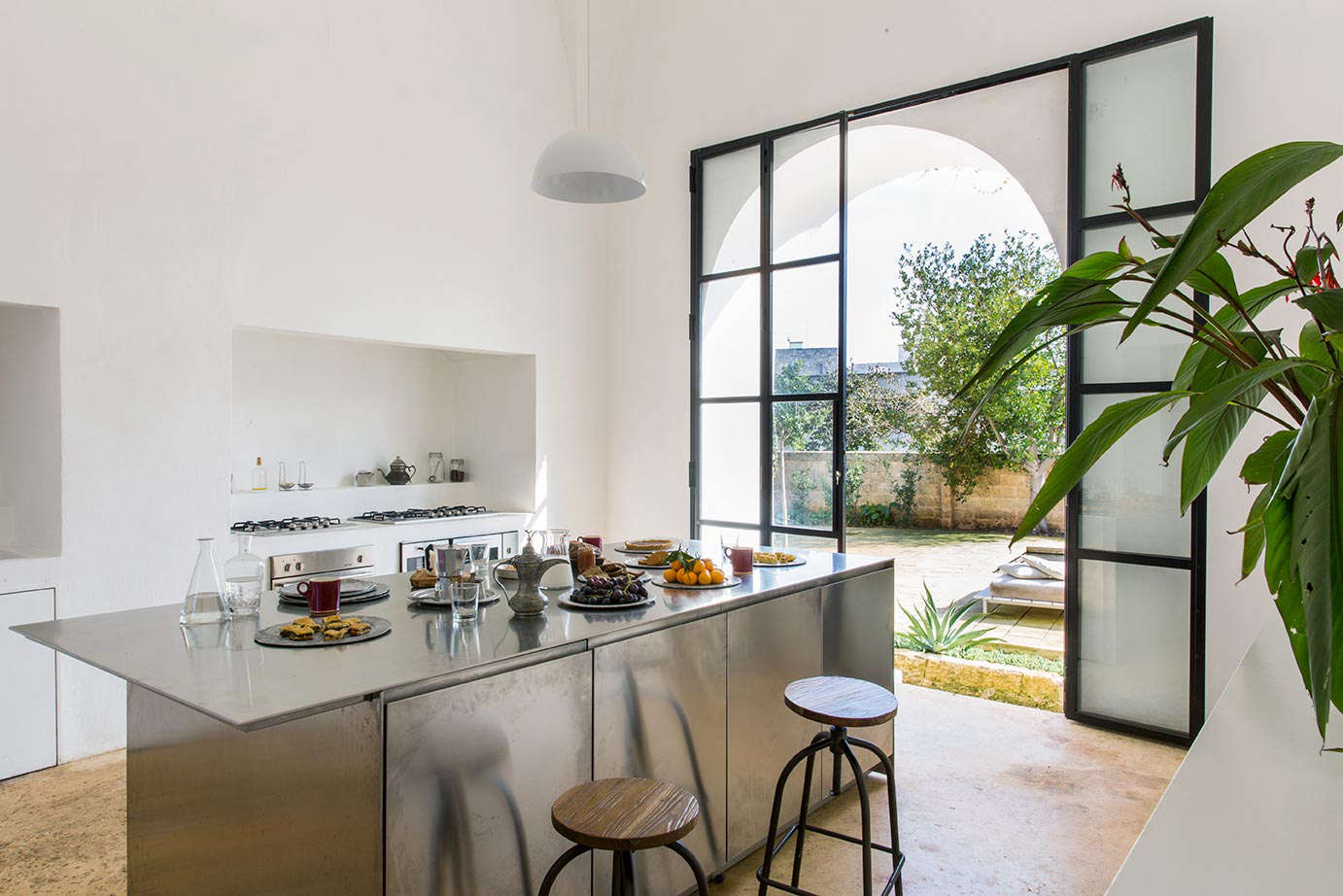
Some kitchens whisper. Some kitchens shout. And then there is the kitchen at Palazzo Daniele, the kind of place that quietly raises one perfectly arched eyebrow and makes stainless steel, ancient frescoes, and Puglian tomatoes look like they have been plotting a lifestyle revolution together.
Set in Gagliano del Capo, at the southern tip of Puglia in Italy’s heel, Palazzo Daniele is a 19th-century aristocratic residence transformed into a boutique hotel and artist guesthouse. Built in 1861, the palazzo once served as a family home. Today, it blends original mosaic floors, vaulted ceilings, bare plaster walls, contemporary art, and a culinary philosophy rooted in Salento tradition. The result is a kitchen story that feels both ancient and startlingly modern.
This is not minimalism in the cold, “where did everyone hide the chairs?” sense. It is minimalism with a pulse. Minimalism with olive oil. Minimalism that understands a tomato grown nearby can be more dramatic than a chandelier if you give it the right plate and a little respect.
A Historic Italian Villa Turned Hotel With a Kitchen at Its Heart
Palazzo Daniele is not designed to behave like a conventional luxury hotel. Its own guiding spirit is closer to “this house is not a hotel,” a phrase that captures the home-like energy of the property. Guests do not simply pass through a lobby, collect a key, and disappear into anonymous corridors. They move through courtyards, gardens, common rooms, art-filled salons, and kitchens that invite conversation.
The palazzo was revitalized by owner and art collector Francesco Petrucci, hotelier Gabriele Salini, and Milan-based designers Ludovica Serafini and Roberto Palomba of Palomba Serafini Associati. Rather than smothering the building in polished luxury, the design team stripped away excess. They let cracks remain visible, allowed frescoes to show their age, and treated old surfaces as living documents instead of problems to be painted into silence.
That restraint is what makes the kitchen so memorable. In many grand hotels, the kitchen is hidden like a backstage crew member. At Palazzo Daniele, the kitchen is part of the performance. Guests can gather near the cooking, watch local ingredients become lunch or dinner, and feel the rhythm of the house through the clink of dishes, the scent of vegetables, and the tiny panic that occurs when fresh bread enters the room and everyone suddenly becomes emotional.
Minimalism Meets Grandeur: Why the Design Works
The phrase “minimalism meets grandeur” sounds like a design contradiction until you see how Palazzo Daniele balances the two. Grandeur comes from the architecture: high ceilings, frescoed rooms, original floors, courtyards, and the natural drama of an old aristocratic palazzo. Minimalism comes from what the designers chose not to add.
The Power of Absence
The hotel’s design language is often described through the idea of absence. That does not mean empty for the sake of empty. It means every element has to earn its place. A stainless steel shelf, a tiled counter, a high table, a simple chair, or a piece of contemporary art becomes more visible because it is not competing with unnecessary decoration.
In the kitchen, this approach feels especially smart. Kitchens are naturally busy places. They collect tools, ingredients, towels, trays, bottles, and mysterious drawer objects that no one remembers buying. By keeping the architectural and decorative palette spare, the kitchen becomes functional without feeling chaotic. The room can work hard while still looking calm enough to meditate in, assuming your meditation practice allows for espresso.
Old Walls, Modern Edges
One of the strongest design ideas at Palazzo Daniele is contrast. Weathered plaster meets clean-lined metal. Frescoes meet contemporary light pieces. Mosaic floors meet bare walls. The kitchen uses that same visual tension. Stainless steel does not fight the historic setting; it sharpens it. Simple counters do not erase the old building; they give it breathing room.
This is a useful lesson for anyone designing a kitchen in an older home. You do not have to imitate the past to honor it. In fact, too much imitation can make a room feel like a theme restaurant where the theme is “grandma got a renovation budget.” A cleaner modern intervention can make original details feel more authentic because the eye can actually see them.
The Communal Kitchen: Where Hospitality Becomes Personal
The communal kitchen at Palazzo Daniele is more than a place to prepare food. It is a social center. Guests are encouraged to gather, talk, and experience meals as something closer to being welcomed into a local home than being seated in a formal restaurant.
The culinary program focuses on local cooks, seasonal ingredients, and Apulian and Salento traditions. Farmers bring ingredients to the hotel daily, and dishes are shaped around what is fresh rather than what has been forced onto a permanent menu. This makes the kitchen feel alive. The menu does not march in wearing a laminated jacket; it changes with the day.
That approach fits the design perfectly. A kitchen with minimal lines and honest materials makes sense when the food is also honest. The room does not need decorative acrobatics because the drama is already there: handmade pasta, vegetables from nearby farms, olive oil, herbs, seafood, and the kind of simple regional cooking that makes people say, “Why doesn’t my Tuesday dinner taste like this?” The answer is probably that your Tuesday dinner was assembled during a Zoom call.
The Private Kitchen: A Suite With Its Own Quiet Theater
Palazzo Daniele also offers private kitchen experiences in some accommodations, including suite-style spaces where guests can enjoy a more secluded version of the palazzo lifestyle. These kitchens are not oversized showroom kitchens designed to impress people who rarely boil water. They are intimate, practical, and atmospheric.
Tiled countertops provide usable work space, while skirted storage softens the room and adds a relaxed, almost domestic feeling. A high table becomes a natural perch for morning coffee, a late-night snack, or a dramatic stare into the middle distance while pretending you are in an Italian film. Clean lines keep the look modern, while the surrounding architecture reminds you that the building has been collecting stories since the 19th century.
This blend of private and communal cooking spaces is part of what gives the hotel its charm. Guests can choose connection or retreat. They can mingle near the main kitchen, eat in the courtyard, or enjoy the quieter pleasure of a simple breakfast in a suite. Good hospitality is not about forcing everyone into the same experience. It is about giving people enough beauty, comfort, and freedom to find their own rhythm.
Design Lessons to Steal From This Italian Villa Kitchen
You may not have a frescoed palazzo in Puglia. Annoying, but we move forward. The good news is that the kitchen design ideas at Palazzo Daniele can translate beautifully into real homes, apartments, guesthouses, and boutique hospitality spaces.
1. Let Materials Speak
The kitchen proves that materials do not have to be loud to be luxurious. Tile, steel, plaster, stone, linen, and wood can create depth without visual clutter. Choose materials with texture and honesty. A slightly imperfect surface often feels richer than something glossy enough to reflect your existential questions.
2. Edit Before You Decorate
The most important move in minimalist kitchen design is not buying more. It is removing what weakens the room. Before adding art, hardware, shelving, or new lighting, ask what can disappear. Fewer objects create more attention for the elements that remain.
3. Mix Modern Function With Historic Soul
If your kitchen has original floors, exposed beams, plaster walls, old brick, or vintage windows, do not automatically cover them. Pair them with modern appliances, simple fixtures, and clean storage. The contrast can feel more sophisticated than a perfectly matched room.
4. Design for Gathering, Not Just Cooking
The most beautiful part of the Palazzo Daniele kitchen is not just how it looks. It is how people use it. Add a stool, a small table, a long island, or a landing spot where guests can sit without getting in the cook’s way. A kitchen should welcome conversation, even if that conversation is mostly someone asking when dinner will be ready.
5. Make Locality Visible
Bowls of seasonal produce, handmade ceramics, regional textiles, and local ingredients can create a sense of place. In a home kitchen, that might mean farmers market vegetables on the counter. In a hotel, it might mean a menu built around nearby farms. Either way, locality gives a kitchen personality that no catalog can fake.
Why This Kitchen Feels So Modern Right Now
Design trends come and go, but the Palazzo Daniele kitchen feels timely because it answers a very current craving: people want spaces that feel quieter, more personal, and more connected to place. After years of over-styled interiors and algorithm-friendly sameness, rooms with patina and restraint feel refreshing.
Minimalist kitchen design is also evolving. It is no longer only about flat white cabinets and hidden appliances. The best minimalist kitchens now include texture, history, warmth, and imperfection. They are less concerned with looking untouched and more concerned with feeling intentional.
That is why Palazzo Daniele resonates. Its kitchen is not a sterile object. It is a working room inside a living building. It has enough simplicity to feel serene and enough history to feel human. It understands that grandeur does not always need more. Sometimes grandeur needs space, light, one excellent table, and someone in the kitchen who knows what to do with eggplant.
How to Recreate the Look at Home
To bring the feeling of this Italian villa kitchen into your own space, start with a restrained color palette. Warm whites, stone grays, muted creams, soft terracotta, blackened metal, and natural wood can create a similar foundation. Avoid colors that feel too shiny or synthetic. The mood should be sun-washed, not showroom-polished.
Next, focus on open surfaces and tactile finishes. A tiled countertop or backsplash can add Mediterranean character. Stainless steel shelving can introduce a practical professional edge. Linen or cotton curtains under a counter can soften storage and create a relaxed old-world note. Simple pendant lights or wall lamps can provide function without stealing attention.
Finally, make room for one or two statement details rather than many small ones. A large ceramic bowl, a sculptural stool, an antique portrait, a contemporary print, or a handmade table can do more than a dozen decorative accessories. The goal is not to copy Palazzo Daniele exactly. The goal is to borrow its confidence: keep what matters, remove what does not, and let the room breathe.
Experience Notes: What This Kitchen Teaches About Travel, Taste, and Everyday Living
Spending time with a kitchen like the one at Palazzo Daniele, even through photographs and design study, changes how you think about hospitality. The room does not try to impress in the usual glossy way. There is no parade of marble waterfalls, no lighting scheme behaving like a nightclub, no island large enough to require its own postal code. Instead, the experience is quieter and more persuasive. You start noticing how a simple surface can hold a whole mood.
The first lesson is that food tastes better when the room lets you pay attention. In an overdesigned kitchen, the eye is always bouncing from feature to feature. At Palazzo Daniele, the spareness gives focus back to the meal. The color of tomatoes matters. The shine of olive oil matters. The sound of a knife on a board matters. Even the pause before the first bite feels designed.
The second lesson is that kitchens become memorable when they encourage participation. A guest who can sit near the cook, ask a question, watch pasta take shape, or smell herbs being torn is not just consuming hospitality. They are entering a ritual. That does not mean every kitchen needs to be open to a crowd, but it does suggest that the best kitchens offer a sense of welcome. Even at home, one extra stool can turn meal prep from a lonely task into a shared event.
The third lesson is emotional: perfection is overrated. The cracks in the walls, old floors, and preserved surfaces at Palazzo Daniele remind us that beauty can come from age and use. Many homeowners panic over every scratch, stain, and ding. But rooms that are too perfect can feel nervous. A kitchen should be clean and functional, yes, but it should also be allowed to live. A wooden table with knife marks may have more charm than a flawless table nobody is allowed to touch.
The fourth lesson is about restraint. Minimalism here does not feel like deprivation. It feels like respect. Respect for the architecture, the ingredients, the cooks, the guests, and the region. That is a powerful idea for any kitchen renovation. Before adding another cabinet style, another finish, or another decorative trend, ask whether the room already has something worth listening to.
The final experience is the most practical one: grandeur can be intimate. Palazzo Daniele may have frescoes, courtyards, and aristocratic bones, but its kitchen succeeds because it feels personal. It proves that luxury does not have to mean distance. Sometimes luxury is being close enough to the kitchen to smell dinner before it arrives, hearing local stories while a meal is prepared, and realizing that the most unforgettable design feature in the room might be the feeling that you have been invited to stay a little longer.
Conclusion
The kitchen at Palazzo Daniele shows how minimalism and grandeur can coexist without awkwardly bumping elbows. Its design honors the old palazzo while making space for modern life, local food, and genuine connection. Bare walls, tiled worktops, stainless steel, contemporary art, and regional cooking come together in a way that feels both elegant and deeply human.
For homeowners, designers, and hospitality lovers, the takeaway is simple: a great kitchen does not need to shout. It needs clarity, character, and purpose. It should make the food look better, the architecture feel respected, and the people in the room want to stay. Preferably with a second helping.










