
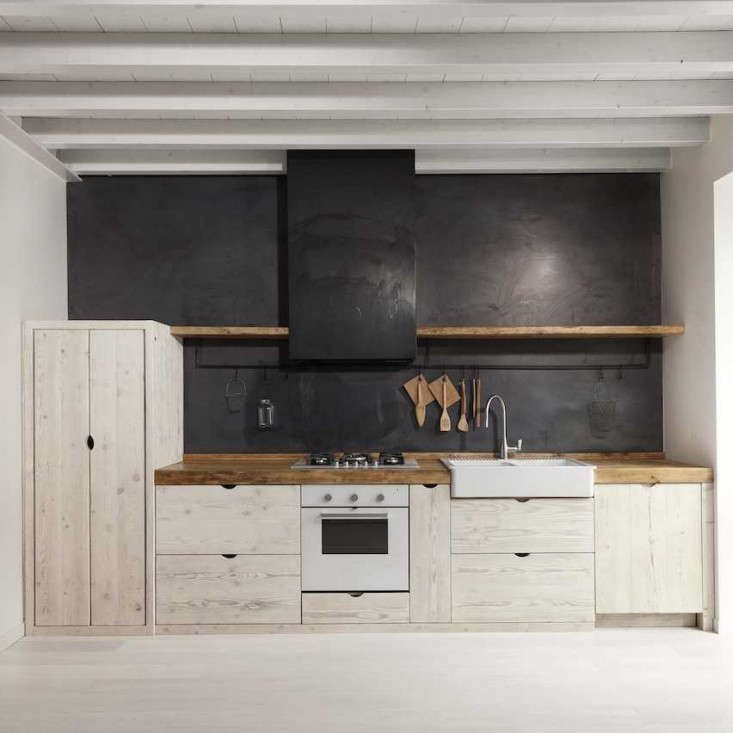
Some kitchens announce their budgets with marble waterfalls, brass fixtures, and enough integrated technology to operate a small airport. Katrin Arens’s Italian country kitchen takes a more compelling route. It quietly asks what might happen if discarded scaffolding boards, existing fixtures, blackened iron, and skilled craftsmanship were treated as valuable ingredients rather than renovation leftovers.
Designed for a young restaurateur couple in Bergamo, Italy, this compact kitchen feels rustic without becoming theatrical and modern without looking freshly unboxed. Its beauty comes from tension: rough wood meets disciplined lines, pale cabinetry meets a nearly black metal wall, and old materials are shaped into highly practical storage. Nothing appears too precious to touch, which is exactly what a working kitchen should achieve.
An Italian Country Kitchen Without the Usual Clichés
The phrase Italian country kitchen can summon a predictable catalog of decorative beams, copper pans, stone floors, and baskets of artfully disobedient lemons. Arens avoids that costume-party version of rustic design. Her kitchen is unmistakably Italian in spirit, but its character comes from local materials, honest construction, and respect for the building rather than decorative shorthand.
The project occupies an apartment in a remodeled early-19th-century house in central Bergamo. Instead of attempting to make every surface look historically original, Arens introduces a contemporary layer that still feels compatible with the architecture. The cabinetry is largely made from salvaged scaffolding wood, while blackened sheet metal forms a dramatic backsplash and wraps around the range hood. The combination is strong, simple, and slightly industrial.
That restraint matters. Reclaimed wood already contains knots, stains, nail marks, variations in grain, and evidence of earlier use. Adding ornate moldings or elaborate hardware could have turned the room into visual soup. Arens lets the material provide the decoration and keeps the cabinet forms clean.
Katrin Arens and the Art of Giving Materials a Second Life
German-born and long based in Northern Italy, Katrin Arens has built her design practice around materials that other people overlook. Old shutters, doors, balcony windows, scaffolding planks, and miscellaneous architectural castoffs become cupboards, tables, beds, shelving, and custom kitchens.
Her work is not simply about attaching fashionable reclaimed boards to conventional cabinet boxes. She develops repeatable furniture forms that can accommodate the irregularities of old wood without erasing them. That is a difficult balance. A useful cabinet must close properly, carry weight, tolerate movement, and fit within measured dimensions. At the same time, forcing every board into artificial perfection would remove the qualities that made it worth salvaging.
Arens’s solution is disciplined simplicity. Straightforward silhouettes create order, while variations in color and texture give each piece its personality. Her workshop has also experimented for years with waxes, pigments, whitewashed treatments, and other protective finishes. The result is furniture that looks relaxed but is anything but accidental.
Inside the Scrap-Wood Kitchen
Cabinetry Made From Salvaged Scaffolding
The reclaimed wood cabinets are the room’s main event, although they do not behave like showpieces. Broad boards form doors and drawer fronts, and differences in tone remain visible rather than being buried beneath an opaque factory coating. Some surfaces are pale and softly pigmented; others retain warmer natural shades.
Simple carved openings replace conventional knobs on many fronts. These integrated pulls make the cabinetry feel almost elemental. They also remove another layer of visual clutter, allowing the grain, patched holes, and imperfect edges to remain in focus.
A Blackened-Iron Wall That Grounds the Room
Behind the counters, dark sheet metal stretches across the wall and continues around the hood. The effect is far more architectural than a standard backsplash. It creates a continuous backdrop, protects the cooking zone, and gives the pale reclaimed wood a strong visual counterweight.
The black surface also keeps the rustic materials from becoming overly sweet. Without it, the whitewashed wood might drift toward cottage style. With it, the kitchen feels urban, graphic, and appropriate for clients who work in the restaurant business. It is the design equivalent of adding black pepper to a creamy sauce: suddenly everything wakes up.
A Sink and Faucet Worth Saving
The clients brought an IKEA sink and faucet from their previous home, and Arens incorporated both into the new cabinetry. Rather than treating reuse as a compromise, the design treats it as common sense. A component that is functional, attractive, and already paid for does not become useless simply because its address changes.
One upper drawer was carefully built around the sink plumbing, demonstrating that reuse works best when supported by thoughtful fabrication. Salvaging materials does not mean tolerating awkward function. It means adjusting the new design so useful existing pieces can continue doing their jobs.
Storage Hidden in Plain Sight
A narrow space beside the range contains three drawers concealed behind one tall front. Elsewhere, a slender cupboard with stacked cutout openings provides vertical storage without overwhelming the compact room. These details show that the project is not an aesthetic exercise pasted onto an ordinary kitchen. Its storage was considered down to the inconvenient leftover inches.
Why the Material Palette Works
The kitchen relies on a limited group of materials: weathered wood, pale pigment, dark iron, simple fixtures, and sealed wooden work surfaces. Because the palette is narrow, every change in texture becomes meaningful.
The reclaimed boards are irregular, but the cabinet geometry is calm. The metal is visually heavy, but its flat surface provides relief from the busy grain. The pale cabinetry reflects light, while the dark cooking wall adds depth. This push and pull prevents the kitchen from feeling either chaotic or sterile.
Modern rustic kitchens often go wrong by making every element “interesting.” Distressed cabinets sit beneath dramatic beams beside patterned tile, antique signs, stone walls, and enough vintage accessories to open a flea market. Arens makes one material the storyteller and asks the rest of the room to listen.
That approach is broadly useful. A kitchen does not need fifteen statement features. It needs one clear idea carried through with confidence.
Compact Planning for People Who Actually Cook
Because the owners were restaurateurs, the kitchen needed more than photogenic cabinet fronts. The sink, dishwasher, range, work surfaces, storage, and freestanding refrigerator had to function within a relatively small footprint.
The layout keeps major tasks close together while preserving clear countertop areas for preparation. Frequently used utensils hang from a simple iron rail against the dark backsplash. Drawers occupy narrow gaps that might otherwise have been wasted, and the cabinetry works around plumbing rather than surrendering an entire storage zone to it.
Professional kitchen-planning guidance emphasizes efficient relationships among work centers, sufficient landing space near appliances, unobstructed circulation, and storage located where items are used. Arens’s kitchen feels informal, but its compactness works because the informal appearance sits on top of careful planning.
This is an important lesson for anyone chasing a rustic kitchen look: charm cannot rescue a bad layout. Reclaimed timber may have a fascinating previous life, but it will not make a refrigerator door stop blocking the dishwasher.
Sustainable Kitchen Design Without the Lecture
The environmental value of this kitchen is woven into the project rather than added as a marketing label. Existing fixtures were retained. Discarded construction timber became cabinetry. Durable finishes were applied to extend the wood’s useful life, and local craft skills transformed inconsistent raw material into fitted furniture.
Material reuse can reduce demand for newly manufactured products while keeping usable building components out of the waste stream. It can also preserve embodied resources: the energy, labor, processing, and transportation already invested in an object. Reusing an existing sink or cabinet board is not merely a sentimental gesture; it avoids replacing something that still has practical value.
Reclaimed wood also brings qualities that newly distressed products often imitate at considerable expense. Its marks were earned honestly. That does not automatically make every salvaged board safe or appropriate, but when properly inspected and prepared, old timber can provide both environmental and aesthetic benefits.
When new wood must be introduced, responsibly sourced or independently certified material can complement reclaimed components. Sustainability is rarely an all-or-nothing purity test. A durable kitchen that combines reused, repairable, responsibly sourced, and long-lasting materials is generally more sensible than one built around a single fashionable “green” feature.
How to Re-create the Katrin Arens Kitchen Style
Choose One Reclaimed Material as the Hero
Begin with a consistent source of salvaged wood rather than collecting random boards simply because they look old. Flooring, scaffolding planks, barn boards, shutters, or deconstructed cabinetry can work, but the material should be available in sufficient quantity and suitable dimensions.
Have it checked for rot, insect damage, embedded fasteners, chemical contamination, and unstable coatings. Painted architectural salvage may require testing before sanding, especially when its age and treatment history are unknown.
Pair Texture With Restraint
Balance lively reclaimed wood with quieter materials. Blackened steel, simple plaster, plain tile, honed stone, or solid-color walls can provide visual rest. The goal is contrast, not competition.
Use Simple Cabinet Shapes
Flat doors, uncomplicated drawer fronts, and carved or minimal pulls allow irregular timber to appear intentional. Highly decorative door profiles can fight with the knots and scars already present in the wood.
Reuse What Still Works
Before demolition, inventory the sink, faucet, appliances, shelves, lighting, and hardware. Measurements and condition should determine what staysnot the assumption that a remodeled kitchen requires every object to be new.
Design Around the Salvaged Pieces Early
Existing items should be included during measurement and cabinet planning, not introduced after fabrication. A reused sink may require a custom support structure. Older appliances may need ventilation clearances or unusual openings. Designing around these realities early keeps reuse from becoming an expensive last-minute puzzle.
Protect Work Surfaces Properly
Wood counters need a finish appropriate to how they will be used. Sealed decorative counters, food-preparation surfaces, and direct cutting areas may require different treatments. Water around sinks, heat near ranges, and repeated cleaning are less romantic than reclaimed timber’s backstory, but they are much more persistent.
What to Consider Before Installing Reclaimed Wood in a Kitchen
Old wood is not automatically cheaper. Sourcing, removing nails, cleaning, drying, milling, joining, stabilizing, finishing, and custom fitting can require substantial labor. The savings often come from resourcefulness and selective reuse rather than from assuming scrap material is free.
Movement is another consideration. Wood expands and contracts as humidity changes, so cabinetmakers must account for seasonal variation. Boards that appear stable in a dry warehouse may behave differently beside a dishwasher or sink.
Maintenance depends on the finish. Some sealed wood counters resist moisture well but should not be treated as cutting boards. Oil-finished surfaces may be repairable and pleasant to touch, yet require periodic renewal. Spills should be wiped promptly, harsh abrasives avoided, and damaged areas addressed before water reaches joints or end grain.
Reclaimed surfaces also refuse to remain visually perfect. They collect additional marks, deepen in color, and develop new variations. Anyone who considers every scratch a domestic emergency may be happier with another material. This kitchen rewards people who see wear as evidence of life rather than a personal attack from the countertop.
Why This Kitchen Still Feels Relevant
Although this Bergamo project was first published years ago, its ideas feel increasingly current. Designers and homeowners continue to explore reclaimed cabinetry, salvaged architectural components, low-waste renovations, freestanding storage, and kitchens that resemble furniture rather than banks of standardized boxes.
The project also offers an antidote to disposable trend cycles. It is not dependent on a particular faucet finish or fashionable cabinet color. Its identity comes from material history, proportion, craft, and usefulness. Those qualities age more gracefully than novelty.
Recent rustic and sustainable kitchens frequently use reclaimed wood to warm painted cabinetry, introduce texture, or connect newer construction with a sense of place. Arens’s design goes further by making reuse the organizing principle of the entire room.
Real-World Experience: Living With a Scrap-Wood Kitchen
A reclaimed wood kitchen changes the homeowner’s relationship with daily wear. In a glossy showroom-style space, the first scratch can feel catastrophic. On a cabinet front already carrying saw marks, filled holes, and tonal variation, a new nick tends to join the landscape rather than ruin it. That forgiving quality is especially valuable in a busy household where chairs bump doors, grocery bags scrape corners, and someone inevitably opens a drawer with flour on both hands.
The material also feels different from uniform factory cabinetry. Each door may have a distinct grain pattern, and subtle changes in color become more apparent as daylight moves through the room. The kitchen can feel warmer in the morning, quieter on a cloudy afternoon, and richer under evening light. Instead of presenting one perfectly controlled surface, it offers a collection of small visual discoveries.
Cleaning requires a modest adjustment in expectations. Textured boards should be smooth enough to wipe down, especially near the cooking zone, but they may not behave like glossy laminate. Dust and grease can settle into deep crevices, which is why reclaimed wood intended for cabinetry should be professionally prepared rather than installed in its roughest possible state. Rustic should mean character, not splinters in the dish towel.
The most successful experience begins during sourcing. Boards from the same building or batch usually create a more coherent result than a miscellaneous collection. Photographing and labeling each board before fabrication can help determine which faces should remain visible. Particularly expressive pieces may suit tall doors, while calmer boards can serve as drawer fronts or internal shelves.
Mockups are extremely useful. A finish that looks beautifully pale on one plank may turn muddy on another species or exaggerate stains that were barely visible when dry. Testing pigments, waxes, oils, and sealers on offcuts reveals how the material will respond before the entire kitchen is committed. It also allows the homeowner to compare sheen levels under actual room lighting.
Day-to-day experience improves when vulnerable zones receive extra protection. Sink cabinets need careful sealing and ventilation. Counter edges near dishwashers should be protected from steam. Hot cookware requires trivets, and standing water should not be allowed to linger simply because the kitchen looks rugged enough to survive a medieval siege.
Repairs, however, can be refreshingly straightforward. A localized scratch may be sanded and refinished. A damaged board can sometimes be patched or replaced without remaking an entire wall of cabinetry. Integrated carved pulls avoid loose knobs, while simple construction makes future adjustment easier. Repairability is one of the quiet advantages of furniture-like kitchens built by skilled makers.
There is also a storytelling benefit. Homeowners can point to a cupboard and explain that its boards came from local scaffolding, a demolished outbuilding, or shutters saved during renovation. That story gives the room a connection to place that cannot be ordered from a standard sample catalog. Visitors may not identify every material, but they often sense that the kitchen has depth.
The final experience is less about owning a perfectly preserved design and more about participating in its next chapter. The wood arrived with a history, the craftspeople reshaped it, and daily use continues the process. In a room devoted to chopping, stirring, spilling, gathering, and feeding people, that is not a flaw. It is an unusually appropriate design philosophy.
Conclusion: A Country Kitchen Built on Resourcefulness
Katrin Arens’s scrap-wood kitchen succeeds because sustainability, craftsmanship, and function are not treated as separate categories. Salvaged scaffolding becomes fitted cabinetry. A reused sink receives custom accommodation. Blackened iron provides protection and drama. Narrow gaps become useful drawers, while variations in old timber supply a richness that manufactured distressing struggles to reproduce.
The room is rustic but disciplined, compact but practical, and environmentally thoughtful without sacrificing personality. Most importantly, it demonstrates that reuse can generate a fresh design language rather than a compromised version of something new.
For homeowners, the most transferable lesson is not to copy every board or finish. It is to examine what already exists, identify what deserves another life, and let those materials guide a clear, functional design. That approach may require more imagination than ordering a matching cabinet package, but it produces a kitchen with something a catalog cannot deliver: a memory.














