
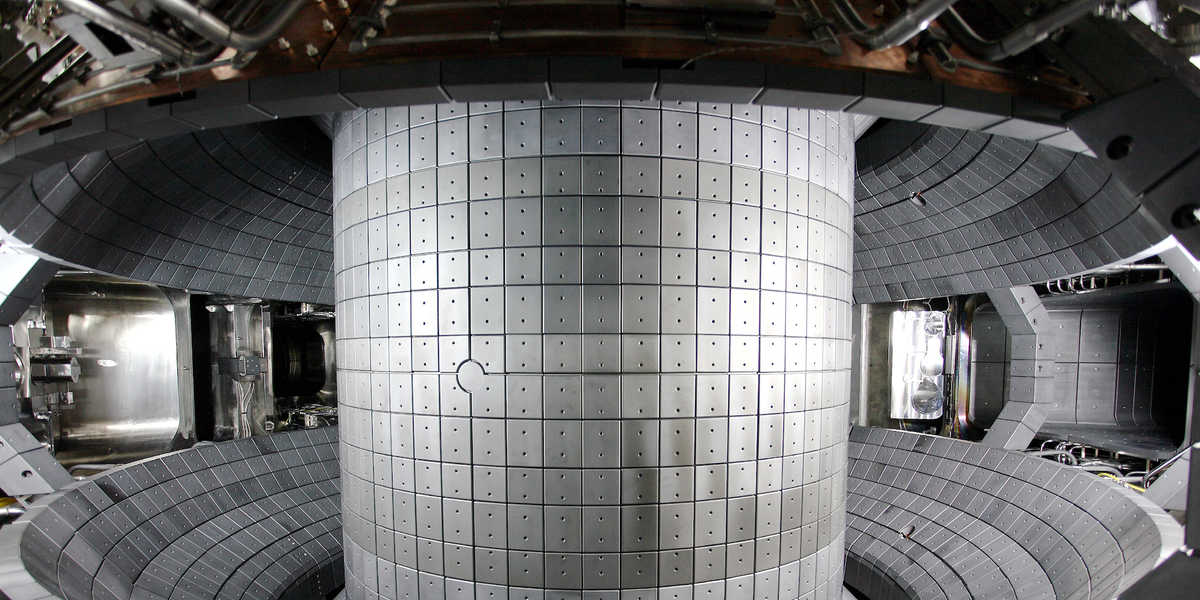
South Korea’s KSTAR fusion experiment has produced a number that sounds borrowed from science fiction: about 100 million degrees Celsius, nearly seven times the temperature at the Sun’s core. The real achievement was not merely reaching that temperature, however. KSTAR maintained the ultrahot plasma for 48 seconds, giving researchers a longer window to study how a future fusion reactor might remain stable without roasting its own components.
KSTAR stands for Korea Superconducting Tokamak Advanced Research. Often nicknamed Korea’s “artificial sun,” it is a superconducting tokamak built to confine plasma with powerful magnetic fields. It is not a commercial power plant and does not supply electricity to the grid. It is a research machine designed to solve the physics and engineering problems that must be mastered before fusion energy can become practical.
What KSTAR Actually Achieved
During an experimental campaign conducted from December 2023 through February 2024, KSTAR sustained plasma with an ion temperature of approximately 100 million degrees Celsius for 48 seconds. In the same campaign, it maintained high-confinement mode, known as H-mode, for 102 seconds. Those are two related but separate results: the widely verified 100-million-degree record lasted 48 seconds, while the 102-second figure describes the duration of H-mode operation.
The distinction matters because fusion headlines sometimes blend the two numbers into a more dramatic but less accurate claim. KSTAR’s 48-second result already surpassed its earlier high-temperature duration of roughly 30 seconds. In a machine where plasma turbulence can ruin a carefully prepared experiment almost instantly, adding seconds is serious progress.
A Tungsten Upgrade Helped Extend the Record
A major improvement was KSTAR’s new tungsten divertor. The divertor acts like the tokamak’s exhaust system, removing heat, helium ash, and stray particles from the plasma edge. Earlier components used carbon, which tolerates heat but can trap hydrogen isotopes. Tungsten has the highest melting point of any pure metal and erodes slowly, making it attractive for reactor-facing surfaces. KSTAR’s upgrade also creates conditions more relevant to ITER and future demonstration reactors.
Tungsten is not invincible. If atoms from the divertor enter the plasma core, they can radiate energy and cool the fuel. The engineering challenge is therefore delightfully unreasonable: use tungsten to survive extreme heat while preventing the tungsten from spoiling the plasma that created the heat.
Why Is KSTAR Hotter Than the Sun?
NASA places the Sun’s core temperature at about 15 million degrees Celsius. Dividing 100 million by 15 million gives approximately 6.7, commonly rounded to seven. The comparison is with the core, where solar fusion occurs, not the visible surface, which is about 5,500 degrees Celsius.
The Sun can fuse hydrogen at a lower temperature because gravity compresses its core to enormous density and pressure. A laboratory tokamak cannot place a star’s mass on top of its fuellocal zoning boards would probably objectso researchers compensate by heating a thin plasma to a much higher temperature and holding it together long enough for atomic nuclei to collide.
Most near-term reactor designs focus on deuterium and tritium, two hydrogen isotopes. When they fuse, they produce a helium nucleus and an energetic neutron. The reaction is favored because it can occur at lower temperatures than several alternative fusion fuels, although “lower” still means conditions around 100 million degrees.
How Can a Reactor Contain 100-Million-Degree Plasma?
Temperature is not the same as total heat. KSTAR’s plasma is extraordinarily hot but extremely thin, so it contains far fewer particles than an ordinary gas at atmospheric pressure. More importantly, the plasma is kept away from solid walls by magnetic fields.
The Tokamak’s Magnetic Bottle
A tokamak uses a doughnut-shaped vacuum chamber wrapped in magnetic coils. Because plasma particles carry electric charge, magnetic fields guide them along spiraling paths. KSTAR’s superconducting magnets and the electric current flowing through the plasma combine to form nested magnetic surfaces that reduce contact with the vessel.
The plasma is heated through methods including electric current, neutral beam injection, and radio-frequency waves. Strong confinement is then required to maintain temperature and density. Fusion scientists often describe the overall requirement with the “triple product”: density multiplied by temperature multiplied by energy-confinement time. A high temperature is impressive, but it is only one-third of the basic scorecard.
Why 48 Seconds Is an Important Fusion Milestone
Future fusion plants must operate for long periods, not just produce short laboratory flashes. Longer discharges let scientists observe slower problems such as impurity buildup, component heating, fuel behavior, and changes in plasma stability. They also give control systems more time to prove that they can steer the plasma rather than merely start it.
KSTAR’s result is especially useful because the machine combines superconducting magnets with a tungsten environment. Researchers can test real-time adjustments to heating, fueling, magnetic fields, and exhaust. Recent work involving KSTAR and the U.S. DIII-D tokamak has also demonstrated advanced control techniques that use optimized three-dimensional magnetic fields and machine learning to suppress damaging edge bursts while preserving plasma performance.
What the Korean Fusion Record Does Not Mean
KSTAR did not generate commercial electricity or prove that the complete facility produced more energy than it consumed. It did not solve tritium breeding, neutron damage, power conversion, remote maintenance, or plant economics. The result is a plasma-confinement milestone, not the opening of a fusion utility.
It also differs from the achievements of the U.S. National Ignition Facility. NIF uses lasers to compress tiny fuel capsules for fractions of a second and has achieved target gain, meaning fusion energy exceeded the laser energy delivered to the target. KSTAR uses magnetic confinement and pursues long-duration plasma operation. Both approaches advance fusion science, but they face different engineering problems.
The Biggest Problems Fusion Still Must Solve
Heat Exhaust and Plasma Stability
The divertor must handle intense heat without eroding or contaminating the core. Researchers are developing controlled “detachment,” which cools the plasma near the divertor while keeping the center hot. At the same time, control systems must prevent turbulence, edge-localized bursts, and major disruptions from dumping energy onto internal components.
Neutron-Resistant Materials
In deuterium-tritium fusion, energetic neutrons escape magnetic confinement and strike the surrounding blanket. A power plant would capture their energy as heat, but repeated neutron exposure can displace atoms, weaken structures, and activate materials. Reactor components must survive this punishment long enough to be economically replaceable.
Tritium Breeding
Tritium is radioactive and scarce in nature. Most power-plant concepts plan to breed it by using fusion neutrons to interact with lithium in a blanket around the plasma. A practical reactor must produce, extract, process, and recycle enough tritium to fuel itself safely.
Reliable and Affordable Operation
A commercial plant must combine superconducting magnets, vacuum systems, heating equipment, shielding, turbines, fuel processing, and robotic maintenance while achieving high uptime. A reactor can satisfy plasma physics and still disappoint the accountants, who are arguably harder to confine.
KSTAR’s Place in the Global Fusion Program
KSTAR contributes data to a worldwide effort that includes ITER, U.S. national laboratories, European tokamaks, stellarators, laser-fusion facilities, and private companies. ITER identifies KSTAR as an important superconducting research tokamak and has highlighted its tungsten upgrade and long-pulse goal. Other machines specialize in different parts of the challenge, including duration, energy yield, plasma control, materials, and magnet technology.
No single record wins the fusion race. A working plant must combine high temperature, sufficient density, long confinement, stable exhaust, durable materials, fuel self-sufficiency, and favorable economics. KSTAR advances several of those requirements, especially long-duration control in a reactor-relevant environment.
Could Fusion Become a Major Clean-Energy Source?
Fusion’s appeal is substantial. Deuterium is widely available, and lithium could support tritium breeding. The fusion reaction itself emits no carbon dioxide, and losing plasma confinement stops the reaction rather than producing a self-sustaining runaway event.
Fusion is not impact-free. Tritium requires careful handling, neutron exposure creates activated components, and plants would still use land, water, metals, concrete, and complex supply chains. A realistic goal is not “perfectly clean, limitless energy,” but firm, low-carbon power that could complement renewables, storage, transmission, and other energy sources.
Experiences and Lessons From Following the KSTAR Breakthrough
The KSTAR story offers a useful experience for anyone trying to understand a scientific breakthrough without falling into hype or reflexive cynicism. The first lesson is to look beyond the largest number. “Seven times hotter than the Sun” is a fair comparison with the solar core, but temperature alone does not reveal whether a reactor can produce useful power. Duration, density, confinement quality, repetition, material survival, and energy balance all matter.
The second lesson is that scientific progress usually arrives as a staircase. KSTAR’s team did not leap directly to 48 seconds. Researchers improved heating, diagnostics, magnetic control, plasma scenarios, and wall components over many experimental campaigns. The tungsten divertor sounds less glamorous than an artificial sun, yet that practical materials upgrade helped make the record possible. Fusion teaches humility: sometimes the hero of the story is an exhaust component.
A third lesson is to separate related records. The 48-second high-temperature result and the 102-second H-mode result came from the same campaign, so careless summaries can merge them. A better reading habit is to ask exactly what parameter was sustained, under which conditions, how it was measured, and whether a comparison uses the same definition. That habit also improves how we read battery claims, medical studies, artificial-intelligence benchmarks, and financial forecasts.
The fourth experience is learning that temperature and heat are different. KSTAR’s plasma is hotter than the Sun’s core, but it is extremely low-density and magnetically isolated. A familiar analogy is a spark: it can be very hot without containing enough energy to heat a room. The reactor’s danger and engineering burden depend on particle density, stored energy, radiation, magnetic forces, and how heat reaches the wallsnot on the temperature headline alone.
The fifth lesson is that fusion is international even when a national laboratory sets the record. Korean experiments inform ITER and future reactors; American and European laboratories contribute control methods, diagnostics, materials research, and computer models. Competition may attract funding, but collaboration prevents every team from independently learning the same expensive lesson.
A sixth lesson concerns timelines. Fusion announcements often trigger two equally unhelpful reactions: “electricity next year” and “always 30 years away.” KSTAR suggests a better approachtrack concrete milestones instead of slogans. Did confinement improve? Did components survive? Can the result be repeated? Can the machine operate with reactor-relevant materials? Each answer narrows uncertainty. Commercial schedules may still move because a power plant must integrate many systems that no experiment has yet combined, but measurable progress is more informative than either a countdown clock or a shrug.
Finally, KSTAR supports realistic optimism. The achievement does not prove that commercial fusion is imminent, yet dismissing it because it is not already a power station ignores how engineering advances occur. Forty-eight seconds gives researchers more data, more control experience, and more evidence about tungsten operation. It is not the finish line, but it is a measurable step toward a machine that must eventually run steadily, repeatedly, and economically.
Conclusion
KSTAR’s 100-million-degree, 48-second plasma record is a meaningful advance in magnetic-confinement fusion. It demonstrates better long-duration control and provides reactor-relevant experience with tungsten heat-exhaust technology. The remaining obstaclesmaterials, disruptions, tritium, maintenance, energy conversion, and costare enormous, but they are increasingly specific engineering problems rather than vague scientific wishes.
The Korean fusion reactor has not put a miniature Sun on the power grid. It has shown that scientists can hold one of the hottest laboratory plasmas on Earth for longer than before, study it, and improve the machine for the next campaign. In fusion research, that is genuine progresseven if the fusion-powered toaster remains on back order.
Editorial note: This article distinguishes KSTAR’s documented 48 seconds at approximately 100 million degrees Celsius from its separate 102-second H-mode result. It does not claim that the full 100-million-degree ion temperature was sustained for 102 seconds.













