
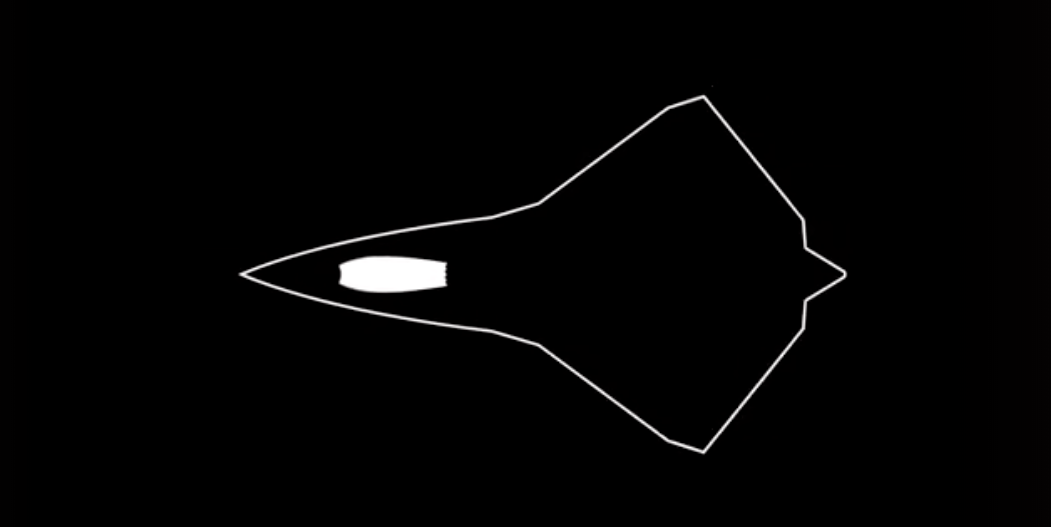
Secret aircraft programs rarely announce themselves with a cheerful press release and a tray of complimentary muffins. More often, they emerge through carefully chosen words, suspicious silhouettes, cinematic concept art, and promotional videos featuring an aircraft that nobody recognizes but everybody immediately wants to discuss.
That was exactly what happened when Lockheed Martin and Northrop Grumman released a series of intriguing social media posts and corporate videos. The images appeared to show unfamiliar stealth aircraft at a time when the United States was developing two next-generation fighter programs: the Air Force’s Next Generation Air Dominance platform and the Navy’s carrier-based F/A-XX.
The obvious question was irresistible: Were the companies merely displaying imaginary future fighters, or were they placing carefully sanitized versions of real classified aircraft in public view?
Developments since the original speculation have made the mystery even more interesting. Boeing ultimately won the Air Force contract to develop the F-47, Northrop Grumman withdrew from that particular competition as a prime contractor, and Lockheed Martin began discussing ways to transfer technology from its unsuccessful proposal into upgraded F-35 and F-22 aircraft. Meanwhile, Northrop remains involved in the Navy’s F/A-XX competition.
In other words, some of those mysterious images may not have shown a future production fighter. They still revealed plenty about how America’s largest aerospace companies imagine the next era of air combat.
Why the Mysterious Fighter Images Attracted Attention
The unusual artwork appeared during a rare moment in American military aviation. Both the Air Force and Navy were pursuing clean-sheet combat aircraft intended to operate in the 2030s and beyond. These were not ordinary upgrades involving a new radar, a larger screen, and several billion dollars in paperwork. They represented potential replacements for some of the most capable fighters ever built.
The Air Force’s program was designed to succeed the F-22 Raptor in the air-superiority role. The Navy’s separate F/A-XX effort was intended to replace the F/A-18E/F Super Hornet and potentially take over missions performed by the EA-18G Growler.
Although both efforts were frequently associated with the term NGAD, they were never simply two versions of the same airplane. The Air Force emphasized long-range operations, advanced survivability, distributed sensors, and cooperation with autonomous aircraft. The Navy needed many of those qualities while also demanding carrier suitability, corrosion resistance, manageable dimensions, rugged landing gear, and the ability to survive the uniquely enthusiastic experience of being launched from a ship by a catapult.
Interest became even more intense after Air Force officials acknowledged in 2020 that an experimental next-generation aircraft had already been designed, built, and flown. Almost no useful visual information was released. That left aviation enthusiasts examining corporate artwork with the seriousness normally reserved for satellite imagery and suspicious restaurant bills.
Lockheed Martin’s Carefully Worded Clues
The Importance of One Word
One of Lockheed Martin’s most discussed posts involved the SR-71 Blackbird and the fictional Darkstar aircraft created with assistance from the company’s Skunk Works division for Top Gun: Maverick.
The post described the SR-71 as the fastest acknowledged crewed, air-breathing jet aircraft. That single word immediately energized the black-aircraft community. Saying “acknowledged” rather than simply “fastest” seemed to leave a hangar door slightly open. It invited readers to wonder whether an unacknowledged aircraft had already exceeded the Blackbird’s performance.
There was no confirmation that the wording referred to a real secret airplane. It could have been playful marketing, a reference to decades of aviation rumors, or simply an extremely effective way to make the internet stare at one adjective for several days.
The Unknown Skunk Works Silhouette
Another clue appeared in material celebrating the history of Skunk Works. A sequence of aircraft profiles included recognizable designs such as the U-2, SR-71, F-117, F-22, F-35, and X-59. At the end appeared an unidentified aircraft.
The mystery shape had the broad appearance of a stealthy tactical aircraft. Its fuselage seemed large enough to accommodate substantial internal fuel, weapons, sensors, or cooling systems. Those characteristics would fit an aircraft designed for long-range missions against sophisticated air defenses.
However, a silhouette is not an engineering drawing. It does not reveal inlet geometry, control surfaces, exhaust treatment, sensor placement, structural layout, engine arrangement, or actual dimensions. A stealthy outline can suggest a design philosophy, but it cannot prove that the pictured aircraft exists.
Lockheed Martin also had an obvious reason to display a futuristic concept. At the time, the company was pursuing advanced fighter work and needed to communicate that Skunk Works remained more than a museum containing excellent black-and-white photographs.
Northrop Grumman’s Recurring Mystery Aircraft
Northrop Grumman took a slightly different approach. In multiple promotional videos, the company displayed a computer-generated hangar containing familiar aircraft alongside an unidentified fighter-like design.
The unknown aircraft attracted attention because it appeared more than once. Background aircraft and presentation details changed between the videos, yet the mysterious design remained remarkably consistent. Reusing the same model suggested that it was not merely a random shape created by an artist five minutes before lunch.
The aircraft appeared to have a stealth-oriented planform, reduced or absent vertical tails, and a broad blended body. Such features are often associated with low radar observability, efficient internal volume, and long-range performance. They also align with Northrop Grumman’s extensive experience with flying-wing aircraft, including the B-2 Spirit and B-21 Raider.
Northrop’s history made the images especially tempting to analyze. The company produced the YF-23 demonstrator during the Advanced Tactical Fighter competition and has remained deeply involved in stealth aircraft, sensors, electronic warfare, autonomous systems, and major structural components for other fighters.
Still, corporate artwork can be realistic without depicting a real aircraft. Aerospace companies employ engineers and technically knowledgeable artists who understand that a supposedly stealthy fighter should not look like a 1950s interceptor wearing a Halloween costume.
What “Sixth-Generation Fighter” Actually Means
The phrase sixth-generation fighter sounds simple, but it does not describe one universally agreed checklist. It is better understood as a collection of capabilities designed for operations in highly contested environments.
Greater Range
Future American fighters are expected to operate across the vast distances of the Indo-Pacific. Greater combat radius reduces dependence on vulnerable aerial tankers and allows aircraft to reach targets from bases located farther from enemy missiles.
Range requires internal fuel, and internal fuel requires volume. This helps explain why many next-generation fighter concepts look wider and larger than traditional dogfighters. The future may favor the aircraft that arrives with enough fuel, weapons, and electrical power over the aircraft that looks most dramatic while making a tight turn at an air show.
Advanced Stealth and Electronic Warfare
Low observability is likely to extend beyond shaping and radar-absorbing material. Future aircraft must manage radar, infrared, electromagnetic, and communications signatures while detecting threats across multiple frequencies.
Electronic warfare may become as important as physical maneuvering. A next-generation fighter could confuse enemy sensors, share targeting data, direct decoys, and coordinate attacks without revealing its position through careless transmissions.
Human-Machine Teaming
The Air Force does not view its next fighter as a lone heroic airplane. The F-47 is the crewed centerpiece of a broader family of systems that includes Collaborative Combat Aircraft, advanced weapons, communications networks, and offboard sensors.
Uncrewed aircraft could carry additional missiles, conduct reconnaissance, jam hostile radar, act as decoys, or enter areas considered too dangerous for a pilot. Instead of personally operating every drone, the fighter pilot may supervise mission goals while autonomous software handles formation keeping, navigation, and routine tactical decisions.
Open Architecture and Continuous Upgrades
Traditional aircraft modernization can take years because hardware and software are tightly connected to proprietary systems. Future platforms are expected to use more modular architectures, allowing sensors, weapons, processors, and software to be replaced without redesigning half the airplane.
This matters because a fighter introduced in the 2030s may remain in service for decades. Its computers will need repeated modernization unless the Pentagon plans to defend the 2060s with the processing power of an antique refrigerator.
What Concept Art Canand CannotReveal
Promotional images can offer clues about broad engineering priorities. A large blended fuselage may suggest an emphasis on range and internal payload. The absence of vertical tails may point toward stronger radar-signature reduction. Swept leading edges and carefully aligned surfaces can reflect common stealth-design principles.
Yet many plausible concepts will naturally share those features. Aircraft designers working from similar mission requirements face similar aerodynamic, thermal, structural, and signature-management problems. Two companies can independently produce comparable shapes without either image matching the final aircraft.
Concept art may also blend several programs. An image can incorporate elements from a classified demonstrator, an abandoned proposal, an internal research project, and a graphic designer’s desire to make the company logo look exciting.
The most sensitive details are usually the least visible. Engine performance, sensor capability, electronic warfare systems, software, communications, coatings, weapons, and thermal-management technology can determine an aircraft’s combat value without appearing in a silhouette.
Therefore, the safest conclusion is not that the images showed specific operational aircraft. They probably reflected technically informed ideas about what future fighters might require.
What Happened to the Air Force Competition?
On March 21, 2025, the Department of the Air Force announced that Boeing had received the engineering and manufacturing development contract for the crewed NGAD platform, officially designated the F-47. The award was valued at more than $20 billion for the development phase and positioned Boeing to return to the center of American fighter design.
The F-47 is intended to replace the F-22 and operate with autonomous teammates as part of a networked family of systems. Officials stated that experimental aircraft connected to the program had already been flying for years, although publicly released images remained heavily obscured and should not be treated as accurate blueprints.
Northrop Grumman had previously chosen not to compete for the Air Force fighter as the prime contractor. The company remained available as a supplier of mission systems and other technologies. Lockheed Martin submitted a proposal but lost to Boeing and decided not to protest the award.
Lockheed’s response demonstrated why an unsuccessful fighter proposal is not necessarily wasted work. The company said it would explore inserting technologies developed for NGAD into the F-35 and F-22. Potential areas include improved stealth, propulsion, sensors, passive detection, communications, weapons integration, and electronic warfare.
Lockheed executives described the possibility of a more capable “fifth-generation-plus” F-35 offering a significant portion of sixth-generation performance at a lower price. Whether that ambitious formula becomes an actual funded configuration remains uncertain, but the idea shows how classified research can migrate into existing aircraft.
Northrop Grumman Still Has a Fighter Opportunity
Northrop Grumman’s decision not to lead an Air Force NGAD bid did not end its next-generation fighter ambitions. The company has remained a major participant in advanced aircraft development through the B-21 Raider, autonomous-aircraft work, mission systems, radar technology, and the Navy’s F/A-XX competition.
As of June 2026, the Navy’s competition had narrowed to Boeing and Northrop Grumman, with a selection expected later in 2026. Lockheed Martin was no longer in the final competition.
F/A-XX is expected to provide greater range, survivability, networking, and integration with uncrewed aircraft than the current Super Hornet. It must also function from an aircraft carrier, where every extra pound, inch, maintenance hour, and fragile component eventually becomes somebody’s problem on a crowded flight deck.
This gives the old Northrop Grumman imagery a new interpretation. The mystery aircraft may not have represented the Air Force’s future fighter. It could have reflected internal Navy studies, a general-purpose advanced fighter concept, or simply the company’s preferred visual language for next-generation air combat.
Why Defense Contractors Tease Classified Capabilities
Aerospace companies have several reasons to release suggestive images without confirming what they represent.
First, futuristic artwork helps recruit engineers, software developers, manufacturing specialists, and security-cleared employees. “Come work on an undisclosed program in an undisclosed building” becomes more persuasive when accompanied by an airplane that looks as though it arrived from Thursday of next week.
Second, promotional material signals capability to military customers, lawmakers, investors, and potential partners. It reminds decision-makers that a company has active design teams and relevant technology, even when contract details cannot be discussed.
Third, controlled ambiguity preserves brand mystique. Skunk Works has built its reputation partly on secrecy, speed, and unexpected aircraft. Northrop Grumman has similar credibility in stealth and flying-wing design. A carefully placed silhouette can reinforce that heritage without disclosing classified information.
Finally, the image may simply be a concept. Not every shadow is a secret fighter, and not every dramatic phrase is an accidental confession. Sometimes a mysterious airplane is doing the very ordinary job of making a corporate video less boring.
Experience-Based Lessons for Reading Fighter-Jet Teasers
The most useful experience anyone can develop while following secret aviation is learning to separate possibility from evidence. New enthusiasts often begin by treating every unfamiliar outline as a photograph of a classified prototype. More experienced observers usually become cautious after watching dozens of “confirmed” aircraft disappear into the same fog from which they emerged.
Start With the Program Timeline
Before analyzing wings and exhausts, check whether the suspected program was actually mature enough to produce a demonstrator when the image appeared. An aircraft shown years before a formal competition may represent an internal study rather than the eventual proposal. Conversely, artwork released after prototype flight testing began may contain broad lessons learned from real engineering work, even when it does not depict the test vehicle.
The timeline surrounding the Lockheed and Northrop images matters. The Air Force had already acknowledged flight activity connected to next-generation technology, while the Navy was advancing its own requirements. Both companies therefore had credible reasons to possess mature concept studies. That does not mean their public artwork reproduced classified hardware.
Examine Repeated Features, Not Tiny Details
Repeated design characteristics are more informative than one mysterious pixel. If a company consistently depicts wide fuselages, tailless layouts, buried engines, and large internal volume, it may be communicating the importance of range, signature reduction, and payload.
By contrast, counting imaginary weapons-bay doors on a compressed social media image can produce more confidence than knowledge. Promotional art is often simplified, mirrored, cropped, or modified specifically to prevent technical interpretation.
Follow Corporate Decisions
Contract awards, earnings calls, supplier announcements, and executive comments often reveal more than artwork. Northrop Grumman’s withdrawal from the Air Force prime competition changed the likely meaning of its teaser. Boeing’s F-47 victory showed that the most widely discussed Lockheed and Northrop shapes were not reliable previews of the winning design.
Lockheed’s later plan to reuse NGAD-derived technologies also provided a valuable lesson: a concept can influence future aircraft even when its original proposal is rejected. Aerospace development is less like throwing away a losing lottery ticket and more like keeping a very expensive toolbox.
Expect Deliberate Misdirection
Security teams review public material connected to classified programs. If an image closely resembles a protected design, it may be altered before release. Features can be removed, proportions changed, or multiple concepts blended together.
Companies may also publish intentionally generic aircraft. A broad flying-wing shape communicates “advanced stealth” to the public without exposing inlet geometry, exhaust treatment, or control methods. The resulting image can be technically credible and operationally meaningless at the same time.
Preserve the Fun Without Promoting Fiction
Speculation is part of the appeal of advanced aviation. Examining unfamiliar designs encourages discussion of aerodynamics, stealth, propulsion, sensors, weapons, and military strategy. The problem begins only when possibility is reported as fact.
A responsible analysis uses phrases such as “may indicate,” “is consistent with,” and “cannot be confirmed.” Those phrases are not evasive. They accurately describe a subject in which the most important evidence is deliberately unavailable.
The Lockheed Martin and Northrop Grumman teasers remain fascinating precisely because they sit between engineering reality and corporate theater. They may contain fragments of genuine research, echoes of rejected proposals, hints of active programs, or all three. What they do not provide is a clean photograph with a helpful label reading, “Secret fighterplease identify responsibly.”
Conclusion
Lockheed Martin and Northrop Grumman almost certainly wanted audiences to notice their mysterious fighter concepts. The timing, repeated imagery, and technically plausible shapes made the posts more than ordinary decorative artwork. They demonstrated that both companies were thinking seriously about long-range stealth, advanced sensors, human-machine teaming, and the changing demands of air superiority.
Later events showed why caution was necessary. Boeing, not Lockheed Martin or Northrop Grumman, won the Air Force contract to develop the F-47. Northrop had already stepped away from that competition as a prime, while Lockheed redirected relevant technology toward improvements for existing fighters. Northrop, however, remained positioned for another major opportunity through the Navy’s F/A-XX program.
The public may not have seen an operational secret fighter hiding in plain sight. It may have seen something equally revealing: the visual vocabulary of sixth-generation air warfare. Wider bodies, reduced tails, long-range proportions, autonomous teammates, and networked operations are no longer science-fiction decorations. They are clues to the problems future combat aircraft must solve.
Note: This article distinguishes confirmed program developments from interpretations of promotional imagery. Public concept art should not be treated as proof of a classified aircraft’s existence, appearance, or performance. Program status is updated through June 2026.










