
Note: Body-only HTML, ready to copy for web publishing.
Some hotels try very hard to impress you. They wave chandeliers around, throw in a marble lobby the size of a small airport, and hope you confuse “large” with “luxurious.” Maison Rika in Amsterdam takes the exact opposite route. It is small, stylish, intimate, and confident enough not to shout. In a city filled with postcard canals, polished design hotels, and charming townhouses that seem almost unfairly photogenic, Maison Rika stands out by feeling less like a conventional hotel and more like a beautifully curated point of view.
Set in Amsterdam’s beloved Nine Streets district, Maison Rika captures what many travelers say they want but rarely find: a stay that feels personal, design-driven, and deeply rooted in the neighborhood around it. This is not a giant property built to please every possible guest. It is a boutique guesthouse shaped by the sensibility of Ulrika Lundgren, the Swedish-born founder of the Rika fashion label and magazine, and that creative DNA is visible in nearly every detail. The result is a place that blends fashion, interiors, retail, and hospitality into one compact but memorable experience.
For travelers who love canal views, understated luxury, and the thrill of staying somewhere that actually has character, Maison Rika is the kind of address that earns repeat mentions in stylish travel guides. Not because it tries to be trendy, but because it understands something even better: good taste ages far more gracefully than hype.
What Is Maison Rika?
Maison Rika is a tiny guesthouse in central Amsterdam, housed inside a traditional canal-side townhouse in the city’s historic core. The property is known for being exceptionally small, with just two guest rooms spread across the upper floors, which instantly changes the rhythm of a stay. There is no anonymous hallway packed with identical doors. No buffet stampede. No elevator music trying its best and failing. Instead, Maison Rika feels more like being invited into a carefully styled private home that just happens to sit in one of Europe’s most beautiful urban settings.
The ground floor functions as a lifestyle-oriented space tied to the broader Rika universe. That matters because Maison Rika is not merely “a place to sleep.” It is part guesthouse, part boutique spirit, part gallery-minded concept, and part neighborhood hideaway. The downstairs area has long been associated with curated objects, books, fashion, gifts, and pop-up energy, while the rooms upstairs offer a quieter, more private escape overlooking the canal.
That combination gives Maison Rika its identity. Plenty of boutique hotels have nice sheets and a moody lamp. Fewer manage to feel like a real extension of a founder’s creative life. Maison Rika does, and that is why it continues to attract design-conscious travelers who want more than a generic luxury stay in Amsterdam.
Why the Amsterdam Location Is a Big Part of the Magic
If boutique hospitality is all about context, Maison Rika picked an excellent one. The guesthouse sits in De 9 Straatjes, or the Nine Streets, one of Amsterdam’s most loved shopping and strolling districts. This neighborhood is famous for its independent boutiques, canal views, cozy cafés, and the kind of retail mix that makes even people who swear they are “just browsing” somehow leave with a beautifully wrapped candle, a notebook, and a sudden opinion about linen texture.
Staying here means being in the heart of old Amsterdam without feeling trapped in a tourist conveyor belt. The area rewards walking. One moment you are crossing a canal bridge with a coffee in hand, the next you are wandering into a small shop, pausing outside a gallery window, or debating whether a second pastry is really a bad idea. Answer: in Amsterdam, it is practically cultural research.
Maison Rika’s canal-facing setting also matters because it delivers the Amsterdam atmosphere travelers actually dream about. This is not an abstract city-center location used by booking platforms to flatter themselves. It is the real thing: narrow streets, layered history, water everywhere, and a sense that the city’s beauty sneaks up on you through proportion, light, and detail rather than through theatrical spectacle.
From here, guests are well placed for shopping, dining, museum visits, and long, aimless walks that somehow become the highlight of the trip. That is one of Maison Rika’s advantages over larger luxury properties: it puts you not just near Amsterdam, but inside the version of Amsterdam many people came to find.
The Design Language: Small-Scale, High-Taste, Zero Fuss
Maison Rika’s interiors are often described as Scandinavian in spirit, but that only tells part of the story. Yes, there is restraint. Yes, there is simplicity. Yes, there is an appreciation for texture, line, and calm. But the space is not cold, minimal, or clinically “designed.” It has warmth, mood, and the kind of intentional imperfection that makes a place feel lived in rather than staged for a very expensive robot.
Rooms That Feel Edited, Not Decorated
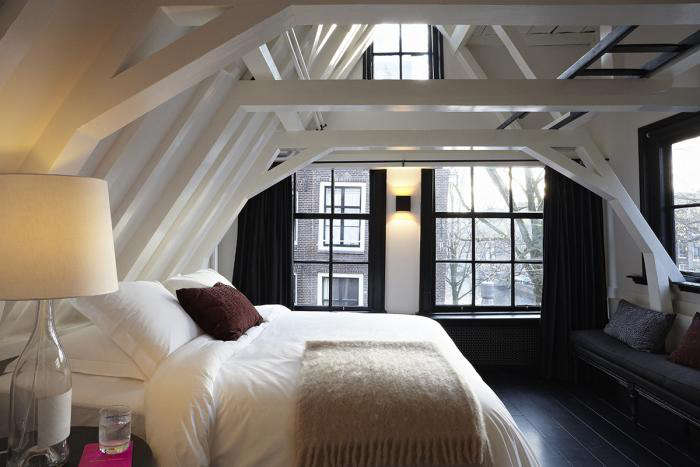
The rooms are known for features like black-painted oak floors, exposed architectural character, large windows, and custom furniture, all of which create a striking contrast between historic structure and modern styling. The palette tends to stay disciplined, allowing materials and objects to do the talking. Instead of visual noise, guests get a room that feels composed.
That restraint is important because Maison Rika understands a quiet design truth: when every object is trying to be the star, the room turns into a talent show no one asked for. Here, the effect is more elegant. Furniture, art, books, flowers, and lighting work together to create a cohesive atmosphere. The result is photogenic, of course, but more importantly, it is restful.
Canal Views That Do a Lot of Heavy Lifting
Maison Rika’s upper-floor rooms look out over the historic canal environment, and those views shape the mood of the stay. Amsterdam is a city where windows matter. Light matters. The relationship between indoors and outdoors matters. Large windows in an old townhouse do not merely frame scenery; they create a conversation between the room and the city. Morning light softens the space. Evening reflections make it feel cinematic. Rain turns the entire view into a moody Dutch painting with better shoes.
A Boutique and Guesthouse in One
Another layer of appeal comes from Maison Rika’s hybrid identity. Because the building also connects with the Rika retail world, the guesthouse gains a cultural and aesthetic dimension that many hotels never reach. This is not a random lobby with decorative objects chosen by committee. It is an extension of a brand built around fashion, publishing, travel, and creative curation.
That means guests are not just checking into a room. They are stepping into a distinct taste universe, one shaped by a founder who has spent years working across fashion and interiors. In practical terms, it gives Maison Rika a stronger personality than many boutique hotels ten times its size.
The Ulrika Lundgren Effect
It is impossible to understand Maison Rika without understanding the influence of Ulrika Lundgren. Before building the Rika brand, Lundgren worked as a stylist, and that background shows up everywhere in the guesthouse. Stylists know how to edit. They know when a room needs contrast, when it needs softness, and when it needs absolutely nothing else because adding one more object would ruin the spell.
Maison Rika feels shaped by that discipline. It does not look like a hospitality concept reverse-engineered from market research. It looks like a founder-led place created by someone with a real eye. That difference may sound subtle, but in hospitality it is enormous. Guests can feel when a property has been assembled to satisfy brand strategy, and they can also feel when it has been built around genuine personal taste.
The Rika identity itself blends a pared-down Scandinavian sensibility with a feminine, slightly rock-and-roll edge. That mix gives Maison Rika more personality than a purely minimal guesthouse would have. It is clean without being severe, elegant without being precious, and cool without trying too hard. In other words, it has the rare ability to look fashionable without becoming exhausting.
Who Maison Rika Is Best For
Maison Rika is not for everyone, and that is part of its appeal. Travelers who want a full-service mega-hotel with multiple restaurants, a spa menu longer than a novella, and enough meeting rooms to host a trade summit may want to look elsewhere. Maison Rika works best for people who value mood, location, scale, and design over endless facilities.
It is especially well suited to couples, solo travelers, design lovers, fashion-minded visitors, and return travelers who have already seen the standard version of Amsterdam and now want something more personal. It is also ideal for guests who enjoy boutique hospitality that feels connected to the city’s creative life rather than sealed off from it.
This kind of stay appeals to people who notice the details: the curve of a staircase, the quality of the light, the placement of a chair by a window, the pleasure of finding a guesthouse that feels like it knows exactly what it is. Maison Rika does not try to be a Swiss Army knife of accommodation. It tries to be itself, and that confidence is one of its strongest selling points.
Why Maison Rika Still Matters in a Crowded Boutique Hotel Scene
Amsterdam has no shortage of attractive places to stay. Canal houses have been transformed into luxury hotels. Grand properties offer polished service and historic glamour. Design hotels lean into spectacle. Yet Maison Rika still holds attention because it occupies a very specific niche: deeply personal boutique hospitality with fashion-world credibility and a neighborhood-forward sense of place.
In a market crowded with concept-heavy hotels, Maison Rika feels refreshingly human in scale. It offers a version of luxury that is less about abundance and more about editing. Less about amenities as a checklist and more about atmosphere as a memory. That approach resonates because modern travelers increasingly want places with identity, not just efficiency.
And perhaps that is Maison Rika’s greatest achievement. It proves that a hotel does not need hundreds of rooms to leave a lasting impression. Sometimes all it needs is the right building, the right neighborhood, the right founder, and the good sense to stop before overdoing it.
A Longer Experience-Led Look at Maison Rika in Amsterdam
To understand the appeal of Maison Rika, it helps to think beyond the booking description and into the rhythm of a real stay. The experience begins long before you settle into the room. It starts with the approach: walking through central Amsterdam, crossing narrow streets lined with boutiques and canal houses, then arriving at a townhouse that feels more like a stylish local secret than a conventional hotel. There is something immediately satisfying about a place that does not announce itself with giant signage or theatrical grandeur. Maison Rika feels discovered, and that sense of discovery becomes part of the pleasure.
Inside, the mood shifts from city energy to quiet composition. The building invites you upward, away from the retail pulse and into the private guesthouse world. The scale is intimate, and that intimacy changes how you move. You slow down. You notice materials. You clock the light on the floorboards. You realize the design is doing something valuable: it is lowering the volume in your head without becoming bland. That is harder than it sounds. Plenty of hotels are peaceful because they are generic. Maison Rika is peaceful because it is precise.
Then there is the view. In Amsterdam, canal-facing windows are not just an amenity; they are part of the emotional architecture of a stay. Looking out from Maison Rika, you are not viewing a staged postcard version of the city from some detached luxury tower. You are inside the fabric of it. Bicycles pass. Light shifts on the water. The neighborhood wakes up, softens in the afternoon, and glows differently at night. Even doing absolutely nothing begins to feel productive, which is one of travel’s finest tricks.
The rooms themselves support that slower, more observant mood. Because the guesthouse is so small, the stay feels individual by nature. You are not one of hundreds of arrivals that day. The environment encourages a different kind of attention. Sit by the window with coffee and the room makes sense. Return after dinner and the darker tones feel warmer, moodier, almost cinematic. Wake early and the old-house character becomes more noticeable. Maison Rika is the sort of place that reveals itself gradually, which is usually a sign that the design is working on a deeper level than mere first impressions.
Another big part of the experience is the neighborhood itself. Staying in the Nine Streets means your day can unfold with minimal planning and maximum reward. You can step outside and immediately find independent shopping, good coffee, attractive canal routes, and the general pleasure of wandering through one of Amsterdam’s most visually satisfying districts. That matters because some hotels are lovely until you leave them. Maison Rika gets better once you step outside, because the area around it amplifies the whole concept. The guesthouse and the neighborhood are in dialogue with each other.
What lingers most, though, is the feeling that Maison Rika offers access to a certain version of Amsterdam: stylish but not stiff, creative but not chaotic, intimate but not insular. It feels like staying inside someone’s well-edited idea of city life, where fashion, interiors, and travel overlap naturally. That is why the guesthouse appeals so strongly to design-minded travelers. It does not just provide accommodation; it provides atmosphere, and atmosphere is often what people remember long after they have forgotten the thread count.
If your ideal Amsterdam stay includes canal views, walkable streets, independent boutiques, and a guesthouse that feels more like a refined creative residence than a conventional hotel, Maison Rika makes a compelling case for itself. Not with excess. Not with noise. Just with taste, confidence, and a very good address.
Final Thoughts
Maison Rika in Amsterdam is the kind of boutique stay that reminds travelers why small-scale hospitality still matters. It offers design without sterility, luxury without heaviness, and location without compromise. More importantly, it gives guests something increasingly rare: a feeling of being somewhere specific, not just somewhere expensive.
For anyone searching for a boutique hotel in Amsterdam with canal views, strong design identity, and real neighborhood character, Maison Rika deserves a spot near the top of the list. It is intimate, stylish, and deeply tied to the creative energy of the city around it. In a world full of hotels trying to be everything, Maison Rika succeeds by being delightfully, unmistakably itself.













