
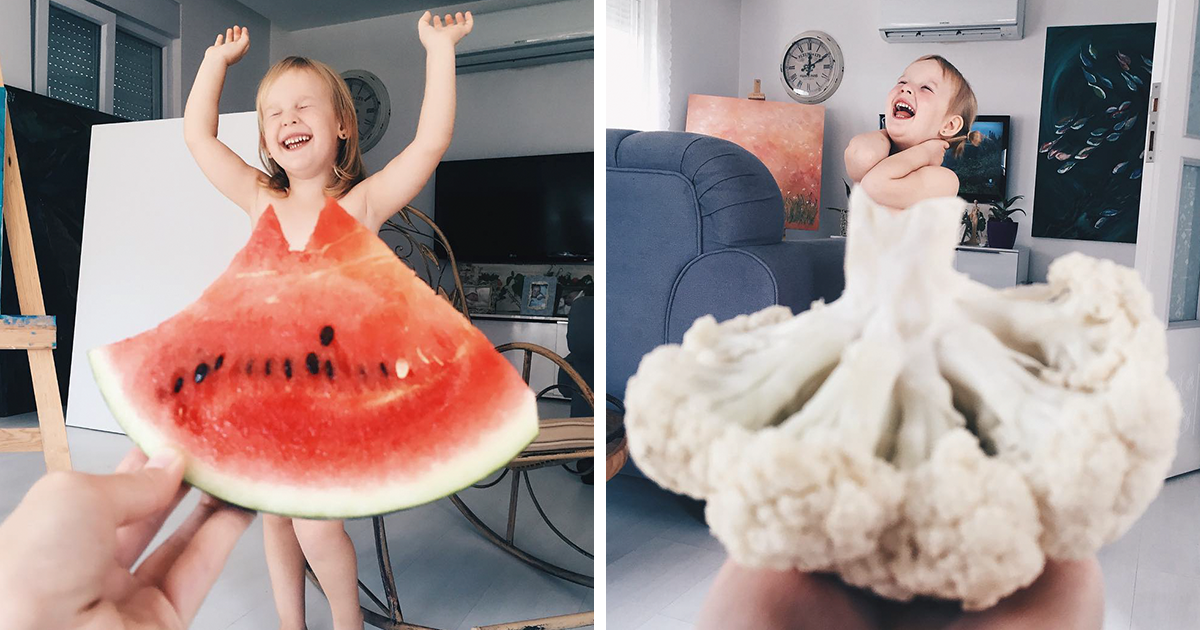
Some parents save macaroni art on the fridge. Alya Chaglar looked at watermelon, cauliflower, hot peppers, and bouquets and thought, “You know what this needs? A runway.” The result was one of the internet’s most charming visual tricks: photos that make it look as if her young daughter is wearing dresses made from food and flowers. It is silly, sweet, clever, and just polished enough to make people do a double take before smiling like they’ve stumbled into a tiny couture show sponsored by the produce aisle.
The viral appeal of these images is easy to understand. They are colorful, low-tech, family-friendly, and unexpectedly artistic. But the story is more interesting than a quick social media scroll suggests. Beneath the adorable photos is a real lesson in visual storytelling, perspective, imaginative play, and the kind of creativity that turns ordinary household objects into something magical. There is also a modern internet angle here: when a playful family project catches fire online, it can transform a private hobby into public fascination almost overnight.
This is the story of how one mom used forced perspective to turn everyday objects into fantasy fashion, why the photos resonated with so many people, and what the phenomenon says about creativity in the age of Instagram. Spoiler alert: sometimes all it takes to become an internet star is a watermelon slice, a willing kid, and the ability to stand in exactly the right spot.
The photo trick that turned groceries into gowns
Alya Chaglar first drew widespread attention for photographs of her daughter Stefani, who appeared to be wearing elaborate dresses made from food and flowers. In reality, the “outfits” were objects held close to the camera while Stefani stood farther back, lined up just right so the foreground item covered her body and created the illusion of a full dress. It was not digital wizardry. It was timing, patience, angle, and a very good eye.
What made the story even more likable was how casually it began. According to Chaglar, the first image happened almost by accident on a hot summer day when she tried using a slice of watermelon as a dress just for fun. She laughed at Stefani’s expression, posted the image, and the reaction encouraged the pair to keep going. From there, the photo series expanded into a miniature fashion universe built from broccoli, bananas, ice cream cones, peppers, lettuce, and flowers.
That origin story matters because it explains why the photos never felt overproduced. Even when the compositions became more polished, the energy stayed playful. The images did not scream, “Please admire my content strategy.” They felt more like, “We were having fun and happened to make something delightful.” On the internet, that distinction matters more than people admit.
Why forced perspective works so well
Forced perspective is one of those photography techniques that sounds technical but is really about fooling the eye in a charmingly old-school way. The basic idea is simple: an object placed close to the camera appears much larger than an object farther away. By controlling distance, camera angle, and composition, photographers can make things seem bigger, smaller, closer, farther, or more connected than they really are.
In Chaglar’s photos, that means a flower bouquet can become a ball gown, a wedge of watermelon can become a summer dress, and a few leaves can turn into something that looks ready for a garden gala. The illusion works because the viewer’s brain wants the foreground object and the child in the background to belong to the same plane. Once the alignment is close enough, the mind eagerly does the rest of the work. Human perception loves a shortcut. It also apparently loves pretending lettuce is couture.
Three things make the illusion convincing
First, the angle matters. A small shift up, down, left, or right can make the entire illusion collapse. Good forced perspective often depends on experimenting with vantage points until the object lines up naturally with the subject.
Second, the distance matters. The closer the prop is to the camera, the larger it appears. That gives the photographer control over scale without needing a giant object or fancy editing.
Third, the framing matters. Strong composition helps sell the fantasy. When the subject is centered well and distractions are minimized, the illusion lands faster and feels cleaner. That is one reason these images are so effective on social media, where viewers decide in about half a heartbeat whether to stop scrolling.
Why the internet fell in love with Stefani
Plenty of viral images are shocking, chaotic, or bizarre. These photos went viral for the opposite reason: they were warm. Viewers were not gawking at disaster. They were enjoying a tiny, funny, imaginative world where a little girl could wear cabbage, tulips, or citrus and somehow look like she belonged on a red carpet for very stylish rabbits.
Stefani herself was a huge part of the appeal. She did not look stiff or coached into oblivion. She looked amused, expressive, and game for the bit. That made the photos feel collaborative rather than mechanical. Chaglar herself emphasized that the series was not just about creativity but about showing Stefani’s bright personality. That emotional center gave the images staying power. People were not only admiring the visual trick; they were connecting with the joy in it.
The internet also loves a concept that can be understood instantly. No explanation is needed. You see a child. You see flowers. Your brain realizes the flowers are the dress. Your day improves by 7%, scientifically unverified but emotionally accurate. In a crowded feed, that kind of instant visual readability is gold.
And the story did not stop there. As the duo’s profile grew, Chaglar later expanded the concept into recreations of celebrity outfits using cardboard, paper, balloons, and other everyday materials. That follow-up phase proved the viral success was not a one-hit watermelon. It was an actual creative language.
More than a viral gimmick: this is creativity in action
It would be easy to dismiss the photos as cute internet fluff, but that would miss what makes them interesting. At their core, these images are a case study in imaginative play and visual problem-solving. They show how creativity often works in real life: not as a lightning bolt from the heavens, but as a playful experiment with whatever happens to be nearby.
Experts on child development regularly point out that pretend play is not just entertainment. It helps children practice creativity, communication, emotional regulation, empathy, and problem-solving. When kids engage with props, costumes, or made-up scenarios, they are not merely passing time. They are building cognitive and social skills while testing how the world works.
That wider context makes the Chaglar-Stefani collaboration feel even richer. These photos are not simply images of a child being dressed up. They are examples of a child participating in an imaginative scenario, responding to visual cues, posing, reacting, and helping create a story with everyday materials. In other words, this is play with a camera involved. Or, if you prefer, art class with better produce.
There is also something deeply appealing about the handmade nature of the project. In a culture drenched in filters, AI effects, and polished digital edits, there is refreshing power in a trick that mostly depends on physical space, timing, and perspective. The photos remind viewers that creativity is not always about expensive tools. Sometimes it is about looking at a melon and seeing a prom dress.
The internet star factor: what made the story spread
Virality rarely happens for one reason. In this case, several things came together at once. The visuals were instantly understandable. The subject was charming. The concept was repeatable enough to inspire admiration but hard enough to execute well that it still felt special. And the whole package sat at the perfect intersection of parenting, photography, humor, fashion, and feel-good internet culture.
Another reason the story traveled so well is that it invited imitation. Chaglar herself said she loved seeing people around the world post similar pictures with their kids or even themselves. That matters because the internet loves content that doubles as inspiration. A photo is nice. A photo that makes thousands of people think, “Wait, I could try that with a pineapple,” is a movement.
There is also a democratic charm to the idea. You do not need a studio, a stylist, or a suitcase full of designer clothes. You need a camera phone, a willing subject, and the confidence to hold a vegetable in front of a lens with absolutely no shame. Frankly, that last part may be the most advanced skill of all.
The modern parenting question: where creativity meets digital caution
Any story about children becoming online stars also comes with a more serious sidebar. Family creativity can be wonderful to share, but internet attention changes the stakes. What starts as a cute project can create a lasting digital footprint for a child who is too young to fully understand what public visibility means.
That does not erase the charm of Chaglar’s project, but it does add a necessary modern layer to the conversation. Experts on “sharenting” have warned that parents should think carefully about privacy, consent, and the long-term effects of posting children online. As kids grow older, they may care more deeply about how they appear on the internet and whether they had a say in what was shared.
The healthiest takeaway is balance. Family projects can be joyful, creative, and worth celebrating. But they are strongest when the child’s comfort stays front and center. Asking permission as children grow, respecting boundaries, avoiding embarrassing material, and being thoughtful about what becomes public are all part of responsible digital storytelling. The internet may love a viral star, but a kid’s sense of safety and dignity should still get top billing.
How to try the look yourself without turning your kitchen into chaos
If this story makes you want to stage your own optical-illusion fashion shoot, the good news is that the basic idea is wonderfully approachable. The better news is that you do not need a film degree. The even better news is that a slice of pizza probably qualifies as formalwear in this genre.
Start with a bold shape
Choose something with a silhouette that can plausibly read as a dress, skirt, cape, or dramatic fashion moment. Watermelon slices, bouquets, large leaves, umbrellas, patterned towels, and big paper cutouts all work well because their edges create a clear shape.
Keep the prop close and the subject farther back
Place the object near the camera lens and position the child several feet away. Move the camera and prop around until the item appears to cover the child’s torso naturally. Tiny shifts make a huge difference.
Use a simple background
Busy settings can make the illusion harder to read. A clean wall, open sky, or uncluttered outdoor space helps the trick land faster.
Let the child be part of the joke
The strongest pictures usually come from genuine reactions. Invite your child to pose, laugh, or suggest their own “outfit.” Collaboration almost always beats overdirection.
Keep it safe and comfortable
No heavy objects, sharp stems, hot items, or anything likely to slip and bonk someone on the head. Viral fame is optional. Basic safety is not.
Why this story still resonates years later
Internet trends usually expire faster than a bruised banana. Yet this story continues to pop back up because it taps into something bigger than a momentary fad. It celebrates invention without snobbery. It proves that beauty and humor can come from ordinary materials. It turns parenting into collaboration instead of performance. And it reminds people that some of the most memorable art starts with playing around.
That is probably why these images remain so shareable. They offer visual delight, yes, but they also carry a subtle message: imagination is not scarce. You do not have to wait for the perfect setup, the perfect budget, or the perfect plan. Sometimes creativity begins when you stop treating everyday objects like only what they are and start asking what else they could become.
Experiences related to the trend: what it really feels like to turn food and flowers into fashion
One reason this story keeps charming people is that it captures an experience many families recognize, even if they have never staged an optical-illusion photo. There is a special kind of joy in turning ordinary moments into make-believe. A kitchen becomes a studio. A bouquet becomes a costume department. A child becomes the star of a tiny production that exists for no reason other than fun. That experience is hard to measure, but easy to feel.
At first, the process often feels wonderfully ridiculous. An adult is crouching with a phone, trying to line up a cabbage leaf like it belongs at Paris Fashion Week, while a child either takes the role very seriously or dissolves into laughter. There is usually some trial and error. The prop is too high. The child steps too far left. The angle is off by half an inch. The “elegant floral gown” suddenly looks more like salad weather. Then, after a few adjustments, everything clicks. The object lines up, the child strikes a pose, and for one frozen second, the illusion works. That tiny moment of success can feel weirdly triumphant.
What makes the experience memorable is not just the final image. It is the collaboration. Kids often bring their own ideas into the process, and those ideas are almost always better, funnier, or stranger than what adults planned. A child might insist that a bunch of parsley is not a dress but a superhero cape. A paper plate may become a royal collar. A stack of orange slices may somehow turn into a mermaid tail because logic takes a holiday when imagination clocks in. That kind of participation matters. It transforms the activity from “stand there while I take a picture” into shared storytelling.
There is also something surprisingly calming about this kind of creative play. It slows everyone down. Instead of chasing perfect productivity, the family is focused on light, color, shape, and laughter. You notice details. You look more carefully. You experiment. Even when the results are goofy, the act of making them can feel grounding. In a daily routine full of errands, screens, and low-level chaos, a silly photo project can create a pocket of attention that feels almost luxurious.
Of course, the experience is not always elegant. Sometimes the flower petals fall apart. Sometimes the fruit attracts ants. Sometimes the child announces they are done with art and would prefer crackers immediately. Sometimes a parent realizes that getting one magical image required 47 failed attempts and a level of yoga flexibility that was never part of the original plan. But that imperfection is part of the charm. These moments are often funniest when they are a little messy.
There is a deeper emotional layer, too. Family photos are usually about documenting what people looked like. Projects like this document something else: how they played together, how they invented things together, and what kind of humor lived in the room. Years later, a child may not remember every flower or fruit, but they may remember that someone made space for their imagination and treated it like art. That is no small thing.
And yes, if the pictures get shared online, the experience changes. A private joke becomes public delight. That can be fun, flattering, and unexpectedly connective. Strangers respond. Friends try their own versions. A small family game suddenly belongs to a much bigger conversation about creativity. But even without internet fame, the heart of the experience stays the same. It is about seeing possibility where other people see groceries. It is about letting play lead for a while. And it is about proving that sometimes the most unforgettable fashion statement in the world is made of flowers, fruit, and excellent timing.
Conclusion
Alya Chaglar’s now-famous forced-perspective photos became an internet sensation because they delivered something people never seem to get tired of: joy with a clever twist. The images are adorable, yes, but they also reveal how much imagination can be packed into a simple frame. By combining perspective, composition, and a child’s willingness to play along, Chaglar turned everyday objects into visual punchlines and tiny works of art.
That is why the story has lasted. It is not just about a mom “dressing” her daughter in food and flowers. It is about creativity that feels accessible, playful, and human. It is about finding art in plain sight. And in an online world crowded with noise, there is something refreshing about a viral hit built from laughter, patience, and produce. Not every trend needs more tech. Sometimes it just needs better timing and a very photogenic watermelon.













