
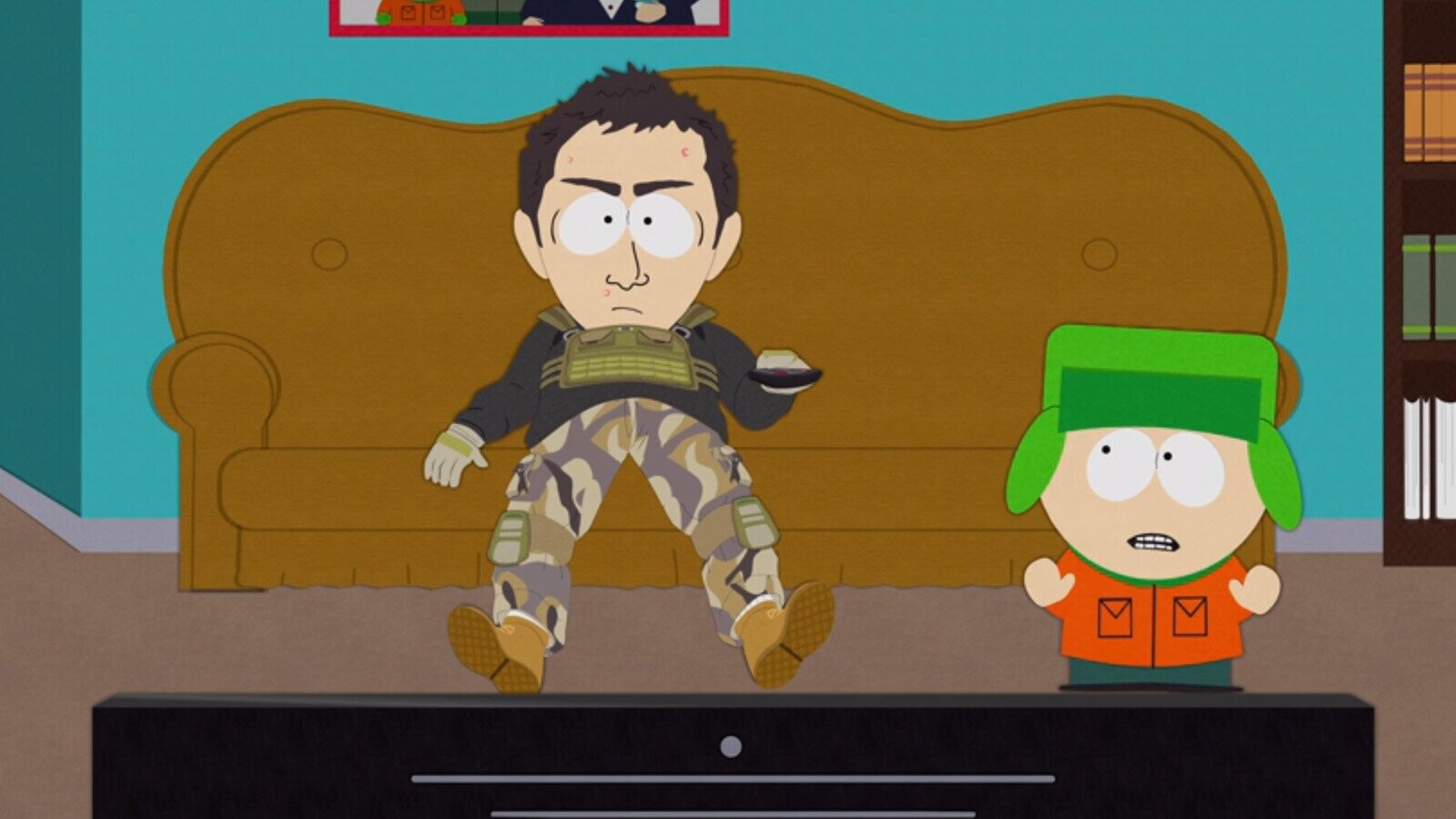
A cartoon born during the dial-up era has become one of the liveliest shows in the streaming, meme, and political-chaon>
When South Park premiered in 1997, smartphones did not exist, social media meant passing a note during math class, and streaming was something a garden hose did. Nearly three decades later, Stan, Kyle, Cartman, and Kenny are suddenly turning up in young adults’ feeds, group chats, reaction videos, Halloween costumes, and late-night viewing queues.
The renewed interest is not merely internet noise. The Season 27 premiere reached approximately 5.9 million viewers across Comedy Central and Paramount+ during its first three days. Paramount described it as the show’s biggest linear season-premiere audience share in more than 25 years. The following episode grew to roughly 6.2 million cross-platform viewers, suggesting that people did not simply stop by to inspect the wreckage. They came back with snacks.
Audience reporting synthesized from Paramount Press Express, Variety, The Hollywood Reporter, Deadline, the Los Angeles Times, and Business Insider.
Public ratings reports do not provide enough age-specific evidence to prove that every segment of young adulthood has reached a literal all-time record. What they do show is a major overall ratings surge, strong performance among adults ages 18 to 49, extraordinary social conversation, and fresh attention from Gen Z commentators who previously considered the series a dusty artifact from their older siblings’ DVD shelves.
So why are more young adults watching South Park now? The answer involves streaming convenience, algorithm-friendly comedy, political exhaustion, nostalgia for shows viewers never personally experienced, and the rare ability to make a 28-year-old television series feel as if it was written during lunch.
A Very Old Show Is Suddenly Acting Brand-New
Most long-running television programs gradually become cultural furniture. They remain in the room, everyone recognizes them, and nobody remembers the last time they paid attention. South Park has avoided that fate by repeatedly behaving less like a legacy sitcom and more like a mischievous live commentary feed.
Season 27 arrived amid enormous political and corporate drama. Its premiere mocked President Donald Trump, CBS, Paramount, media consolidation, and the network distributing the episode. That last detail mattered. Young viewers are accustomed to brands pretending to be rebellious while six lawyers approve every adjective. Watching a television show insult the company hosting it offered the thrilling sensation of seeing the office printer criticize management.
The result was not only high viewership but unusually intense online discussion. Paramount called the premiere the most socially discussed episode in the program’s history. Coverage spread far beyond traditional television reviews, appearing in business, technology, political, and cultural publications. South Park was no longer simply another show releasing another season. It had become an event people felt compelled to explain, argue about, clip, remix, praise, or angrily announce they had not watched.
Season 27’s political and corporate context was reported by Variety, Wired, The Guardian, the Los Angeles Times, Consequence, and Business Insider.
Topical comedy moves at internet speed
One of the show’s greatest advantages is its famously compressed production process. Traditional animated programs may be completed many months before broadcast. South Park developed a system in which an episode could be written, voiced, animated, and delivered within roughly six days.
That schedule sounds less like television production and more like a group project that everyone forgot about until Sunday night. Creatively, however, it allows the show to respond to news while the public is still arguing about it. A celebrity scandal, political fiasco, technology panic, or bizarre consumer trend can become an episode before conventional comedy writers have finished scheduling their first meeting.
The rapid production process was documented by Wired, Cartoon Brew, CBS’s “60 Minutes,” and the documentary “6 Days to Air.”
This speed is especially important to younger audiences. Their entertainment cycle is shaped by trending audio, live reactions, stitched videos, screenshots, and jokes that may feel ancient after two weeks. South Park cannot outpace every TikTok creator, but it can react much faster than nearly every other scripted television series.
Season 28 demonstrated that flexibility by building stories around the viral “6-7” meme, TikTok culture, collectible crazes such as Labubu, artificial intelligence, and online prediction markets. The show did not merely reference youth culture from a safe distance. It jumped directly into the digital mud puddle, occasionally wearing the wrong shoes but arriving while the puddle still existed.
Season 28’s use of viral trends was reported by Variety and The Hollywood Reporter. /section>
Young Viewers Are Discovering Television Backward
Previous generations generally encountered television in chronological order. A new program premiered, viewers watched it weekly, and reruns arrived later. Streaming reversed that process. A 22-year-old can encounter a 2007 episode today, watch six more from unrelated seasons, jump to the latest premiere, and understand the entire experience through memes posted by strangers.
Research on streaming behavior helps explain why an older show can suddenly become a younger favorite. One recent study found that 60% of viewers said their newest favorite streaming series was actually an older title. Among viewers ages 16 to 34, the share choosing an older series rose to 65%. Younger audiences are not necessarily waiting for Hollywood to create “the next Gen Z show.” They are excavating massive television libraries and choosing for themselves.
Library-viewing trends were reported by MNTN Research, The Ankler, The Guardian, Nielsen, and Fox Television Stations.
South Park is almost perfectly designed for this behavior. It has hundreds of episodes, recognizable characters, short runtimes, relatively self-contained plots, and multiple entry points. A new viewer does not need to begin with Season 1, complete a spreadsheet, or watch a 45-minute video titled “The Entire Cartman Timeline Explained.” One interesting clip can lead directly to one episode, which can lead to an entire weekend mysteriously disappearing.
Streaming removed the appointment
For years, the show’s identity was tied to late-night cable television. Younger viewers increasingly have little relationship with cable schedules. In May 2025, streaming accounted for 44.8% of total television viewing in the United States, surpassing broadcast and cable combined for the first time in Nielsen’s measurement.
U.S. viewing-platform figures come from Nielsen’s May 2025 Gauge report.
Moving the series into a more centralized streaming environment lowered the effort required to explore it. After the previous U.S. streaming arrangement ended in 2025, Paramount+ became the principal streaming home for the show under a widely reported multiyear agreement with creators Trey Parker and Matt Stone.
Young adults did not suddenly develop an emotional attachment to cable bundles. They followed the show because it became easy to find on the platforms and devices they already use. Convenience may not sound as exciting as political rebellion, but it has rescued more aging television franchises than any inspirational speech ever written.
The 2025 streaming agreement and reported franchise valuation were covered by the Los Angeles Times, Paramount, Variety, and Wired. /section>
Short Clips Have Become the New Syndication
In the 2000s, reruns introduced old sitcoms to new viewers. Today, discovery often begins with a vertical video surrounded by captions, reaction faces, gameplay footage, or a person silently cutting soap in the lower half of the screen.
South Park scenes work unusually well in this environment. The animation is visually simple, the characters are instantly identifiable, and many jokes reach a punch line within seconds. A scene involving Cartman’s fake confidence, Randy’s latest catastrophe, or Butters innocently entering a nightmare can circulate without requiring extensive context.
YouTube remains nearly universal among American adults ages 18 to 29, while Instagram, TikTok, Snapchat, and Reddit also skew heavily toward younger users. These platforms have become enormous informal distribution systems. A clip may be uploaded as nostalgia, transformed into a reaction meme, debated for its politics, and recommended to viewers who were born years after its original broadcast.
Younger Americans’ platform use was reported from Pew Research Center survey findings by Axios, The Verge, and the Associated Press.
The process creates a useful loop. Clips generate curiosity. Curiosity produces streaming views. New episodes create fresh clips. Fresh clips revive older episodes. Eventually, someone who intended to watch a 20-second joke is researching why Kenny stopped dying every week.
This also helps explain why the show can feel simultaneously ancient and current. Its original episodes belong to the era of flip phones and video stores, but its individual scenes are continuously detached from that era and recirculated as present-tense internet language.
The Humor Matches a Generation Raised on Absurdity
Gen Z did not invent surreal humor, but online life has certainly industrialized it. Younger adults have grown up with context-free memes, deliberately ugly edits, ironic product reviews, fake corporate apologies, chaotic livestreams, and jokes built from five unrelated cultural references colliding at highway speed.
South Park has operated in that comedic neighborhood for decades. It routinely turns complicated issues into ludicrous visual metaphors, treats celebrities as playground villains, and allows serious conversations to collapse because Randy has decided to start another business.
The show’s crude animation also works in its favor. It does not resemble prestige television demanding reverence. Its paper-cutout appearance gives everything the energy of an elaborate school presentation created by extremely talented students who should probably be supervised.
Its political identity remains difficult to package
Young viewers are surrounded by content carefully sorted into ideological teams. South Park remains harder to classify. It has criticized conservatives, liberals, corporations, activists, celebrities, organized religion, technology companies, environmental campaigns, media personalities, and its own previous arguments.
That does not make every joke politically neutral or equally insightful. The show has often been accused of treating sincerity as weakness, flattening complicated issues, or hiding behind the idea that mocking everyone automatically produces wisdom. Some older episodes contain arguments that now look simplistic, while others appear strangely prophetic.
Still, the refusal to become a reliable mascot for one political camp gives the series an unpredictable quality. Young adults may disagree with half an episode and continue watching because they are not entirely sure who will be attacked during the other half.
In a media environment filled with predictable partisan content, unpredictability is valuable. Viewers may arrive to see a politician roasted and remain long enough to discover that the next target is an influencer, a media conglomerate, or the audience itself.
The Characters Have Become Internet Archetypes
Even viewers who have never completed a full episode often understand the basic cast. Cartman is weaponized selfishness. Butters is optimism standing beneath a falling piano. Randy is an adult with the impulse control of a raccoon inside a convenience store. Stan and Kyle are the exhausted witnesses attempting to locate normal behavior in a town that considers normal behavior suspicious.
These personalities translate easily into memes because they represent recognizable types. A screenshot of Cartman can communicate entitlement without explanation. Butters can represent innocence, anxiety, or the moment someone realizes the group project has gone terribly wrong. Randy can embody every adult who turns a minor hobby into a legally questionable personal brand.
Character familiarity also makes the large back catalog less intimidating. New viewers do not need a detailed mythology lesson. They learn the emotional rules quickly and can enjoy episodes from different decades without feeling as though they entered a graduate seminar halfway through the semester.
Controversy Is Still Part of the Product
Young adults are not tuning in because the show has become safe. South Park remains intentionally vulgar, frequently offensive, and willing to pursue a joke long after polite society has packed its bags and left the building.
That approach generates both attraction and resistance. Some viewers appreciate comedy that does not appear focus-grouped into oatmeal. Others see the series as needlessly cruel, politically confused, or too dependent on shock value. Both reactions can intensify online attention, where criticism and promotion sometimes differ only in punctuation.
The show’s longevity also means its archive contains material shaped by several different cultural eras. A young viewer bingeing older seasons may encounter sharp satire in one episode and a stereotype that has aged like milk left on a radiator in the next.
That unevenness is part of watching a program with decades of history. The most rewarding approach is neither to treat every episode as sacred nor to dismiss the entire series because its creators once made a bad argument with puppets. Viewers can laugh, criticize, reconsider, and keep the remote nearby.
What the Surge Says About Modern Television
The renewed popularity of South Park reveals a larger problem for the entertainment business: young audiences do not necessarily care whether content is new. They care whether it feels discoverable, discussable, accessible, and alive.
A program created specifically to capture Gen Z can feel outdated by the time it survives development. Meanwhile, an older series can respond to yesterday’s controversy, release clips suited to today’s feeds, and offer decades of episodes tomorrow night.
South Park combines the advantages of a legacy franchise with the behavior of an internet-native comedy operation. It has recognizable intellectual property without acting overly precious about that property. It has a vast archive but continues reacting to the present. It has corporate backing while regularly making the corporation look nervous.
That combination is difficult to manufacture. Many shows can imitate the vulgarity. Others can reference trending topics. Few have characters, production infrastructure, creative independence, and cultural memory developed across nearly three decades.
The lesson for television producers is not that every series needs more profanity or a talking towel. The lesson is that young viewers respond when a show gives them something worth circulating. An episode must live beyond its broadcast window as a conversation, argument, meme, discovery path, or shared cultural event.
The Young-Adult South Park Experience
Discovery rarely begins with Episode 1
A common modern viewing experience begins in the least cinematic way possible: someone is half-awake, scrolling a phone while waiting for coffee or public transportation. A short South Park scene appears between a cooking hack and an advertisement for a device nobody has ever needed. The clip is funny enough to replay. The comments insist that the complete episode is even more ridiculous.
That evening, curiosity wins. The viewer searches for the episode, intending to watch only one. Twenty-two minutes later, the recommendation screen offers another story featuring the same character. A second episode becomes a third. The person who dismissed the series as “that old offensive cartoon” is suddenly comparing different eras of Randy Marsh.
This route feels natural because it does not require commitment. There is no obligation to watch hundreds of episodes in order. Young adults can build a personal version of the series from recommended clips, topical episodes, friends’ favorites, and online lists. Their relationship with the show resembles exploring a giant thrift store: most people do not inspect every item from left to right, but nearly everyone leaves carrying something unexpected.
Watching becomes a group-chat activity
New episodes also create a social experience that traditional ratings cannot fully capture. Friends send clips before everyone has watched the episode. One person praises the satire. Another argues that the joke completely missed its target. A third contributes a Cartman GIF and disappears.
The disagreement is part of the entertainment. South Park episodes provide compact prompts for conversations about politics, technology, celebrity culture, corporate behavior, dating apps, artificial intelligence, and whatever unusual product the internet decided to worship that week.
Young adults who rarely watch scheduled television may still experience a new episode as an appointment because they know the reactions will arrive immediately. Waiting several days risks encountering every punch line through screenshots. In this way, the show recreates live television urgency without requiring everyone to sit on the same couch at the same hour.
Older episodes become accidental history lessons
Bingeing the archive can also produce a strange encounter with recent American history. Episodes preserve old moral panics, election arguments, celebrity scandals, technology fears, and forgotten advertisements. A joke that once required no explanation may now send a younger viewer to a search engine to discover why the entire country was discussing a particular politician, reality star, or piece of consumer technology.
Sometimes the historical context makes the satire more impressive. Sometimes it reveals how quickly topical comedy expires. Occasionally, the viewer learns that society spent several months passionately fighting about something so trivial that even the internet has misplaced it.
This time-capsule quality gives South Park unusual replay value. The series does not simply show what happened. It captures what people were irritated, frightened, excited, or embarrassingly obsessed with at the time.
The experience includes discomfort
A serious binge inevitably produces moments when a joke lands badly. Younger viewers may encounter portrayals that feel careless or arguments that seem smug rather than insightful. Continuing to watch does not require defending every choice. In fact, discussing where the satire fails can be as interesting as celebrating where it succeeds.
The healthiest experience is active rather than devotional. Laugh at the effective joke. Question the weak premise. Notice when an episode challenges a comfortable belief, but also notice when “equal-opportunity offense” becomes an excuse for avoiding complexity.
That tension helps explain the renewed fascination. South Park does not provide the calm reassurance of comfort television, even when viewers feel nostalgic about it. It provides friction. At a time when algorithms constantly deliver content designed to confirm existing tastes, a show capable of making the same viewer laugh, wince, disagree, and keep watching has a peculiar advantage.
Conclusion: Respect Its Authorityor at Least Its Timing
South Park is reaching a new generation because it no longer depends on the habits that created its original success. Young adults do not need cable television, 1990s nostalgia, or memories of playground catchphrases to enter its world. They need one shareable scene, one timely controversy, or one recommendation from a friend who promises, “This episode is completely unhinged.”
The ratings surge reflects more than political curiosity. The series benefits from streaming access, a huge episode library, algorithm-friendly scenes, fast production, durable characters, and a comic style compatible with the absurdity of online life. It is old enough to have history but fast enough to respond to the present.
Whether this momentum lasts will depend on the quality and consistency of future episodes. Topical outrage can attract attention, but viewers remain only when the satire offers something sharper than shock. For now, however, a cartoon launched before many of its newest fans were born has once again become one of television’s loudest conversations.
Editorial note: Public reports confirm a major cross-platform ratings and social-engagement surge, but they do not provide a complete all-time breakdown specifically for every young-adult age group. References to growing young-adult interest are based on available demographic ratings, streaming behavior research, social-platform usage, cultural reporting, and documented online engagement.














