
At Maker Faire, the best robots are not always the biggest, loudest, or most aggressively covered in LEDs. Sometimes the most memorable machine is a six-legged critter powered by hair-thin muscle wire. Sometimes it is a half-built Android skeleton whose ping-pong-ball eyes hide tiny Raspberry Pi cameras. And sometimes, if you are lucky, both are sitting at the same booth, quietly proving that robotics is less about buying perfect parts and more about convincing imperfect parts to behave long enough for an audience to say, “Wait, how did you do that?”
The story of the Muscle Wire BugBot and Raspberry Pi Android at Maker Faire is a perfect snapshot of the maker movement: scrappy engineering, clever reuse, patient debugging, and just enough weirdness to make the project unforgettable. These builds appeared through the Homebrew Robotics Club, a community known for bringing together beginners, serious hobbyists, and professional engineers who simply enjoy making robots walk, roll, stare, wave, fail, recover, and occasionally look suspiciously alive.
This article explores what made these two Maker Faire robotics projects special, why muscle wire still fascinates robot builders, how Raspberry Pi vision systems changed hobby robotics, and what modern makers can learn from a bug-shaped walker and an Android with a mechanical gaze.
Why Maker Faire Is the Perfect Habitat for Odd Little Robots
Maker Faire has always been part science fair, part county fair, part engineering conference, and part “someone brought a flaming bicycle again.” That odd mix is exactly why robotics thrives there. Robots do not need to be polished commercial products to earn attention. They need personality, movement, and a maker willing to explain what went wrong before it went right.
The Homebrew Robotics Club booth at Maker Faire Bay Area captured that spirit beautifully. Instead of presenting robotics as a sealed black box, club members showed the guts: wires, solder joints, servo brackets, recycled components, experimental frames, and the occasional brave design decision that would make a factory engineer reach for a clipboard. This openness is the magic. Visitors do not just see a robot; they see the decisions that made it possible.
The Muscle Wire BugBot: A Six-Legged Lesson in Tiny Motion
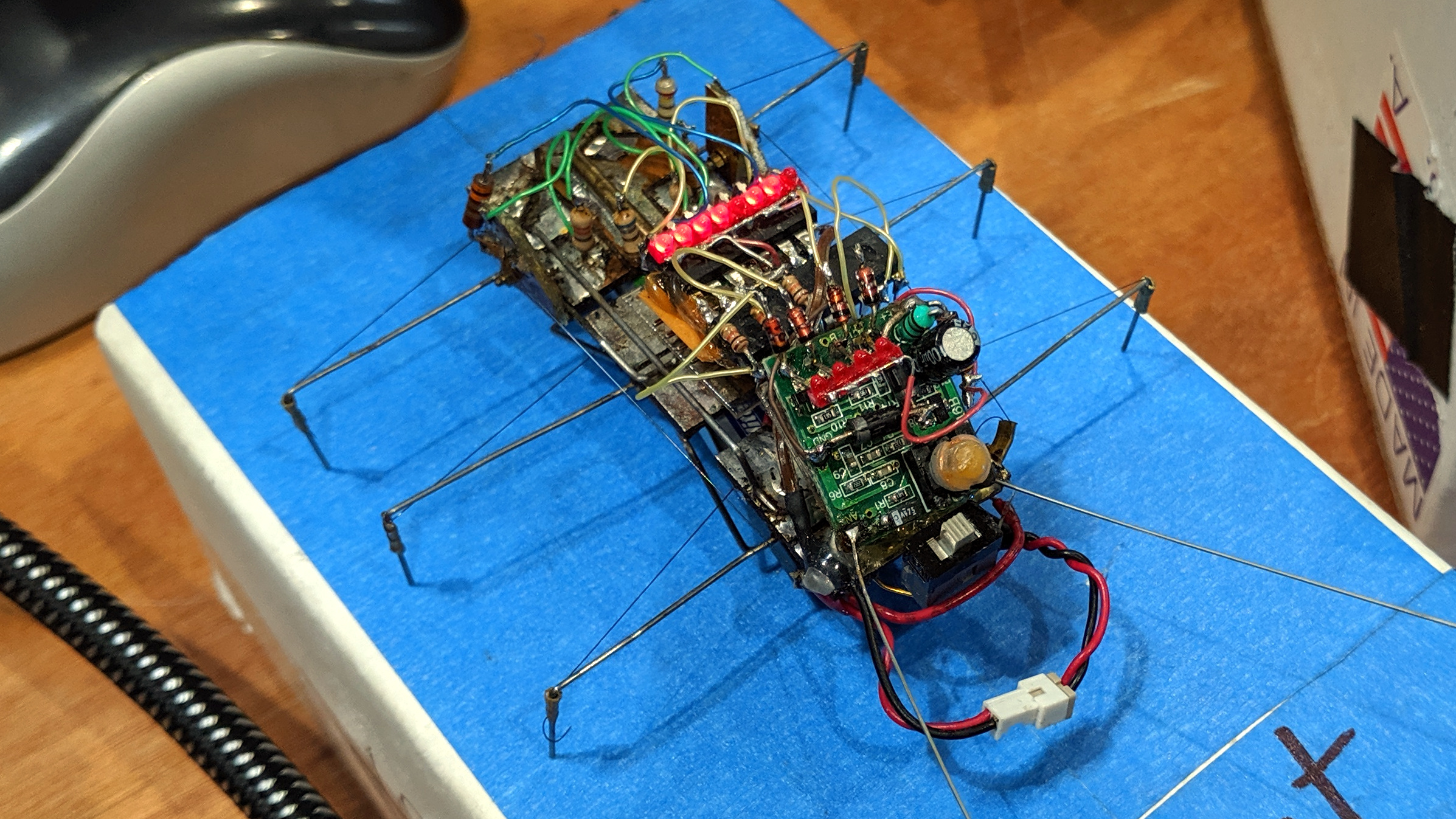
The BugBot, created by Mark Johnston, earns its name immediately. It is a six-legged walking robot with a body and gait that feel more insect than machine. But its real charm is not merely that it walks. It is how it walks.
Instead of using ordinary motors for every leg movement, the BugBot relies on muscle wire, also known as shape memory alloy wire or Nitinol actuator wire. This thin nickel-titanium wire contracts when heated by electrical current, creating a pulling motion that can be used like a tiny artificial muscle. When the current is removed and the wire cools, it relaxes again. In other words, the robot moves because metal remembers what shape it wants to be. That sounds like fantasy, but it is wonderfully real engineering.
How Muscle Wire Works in Simple Terms
Muscle wire is fascinating because it turns heat into motion without the usual spinning motor. At lower temperatures, the wire can be stretched. When current flows through it, resistance heats the wire, changing its internal structure. As it shifts phase, the wire contracts and produces usable force. The movement is small, usually only a few percent of the wire’s length, but in a lightweight mechanism, a few percent is enough to pull a leg, flap a wing, open a latch, or make a robotic bug creep across a table like it has somewhere important to be.
For the BugBot, that contraction drives the legs. The design shows both the beauty and the headache of muscle wire robotics. The beauty is silent, compact actuation. The headache is that muscle wire requires careful mounting, current control, cooling time, and mechanical leverage. It also does not enjoy being soldered like ordinary hookup wire. Heat it too much in the wrong way and congratulations: you have invented expensive spaghetti.
The Clever Crimping Trick
One of the most interesting details of the BugBot is how the muscle wire is attached. Because the wire can be damaged by soldering, Johnston used a more mechanical approach: wrapping the wire around the leg and securing it with small brass tubing as a crimp connection. That sounds simple, but simple is not the same as easy. On tiny robots, every connection is a negotiation between space, strength, electrical contact, and the builder’s remaining patience.
This is why the BugBot feels like a time capsule from a more difficult era of hobby robotics. Today, makers can buy tiny drivers, microcontroller breakout boards, battery modules, sensors, and 3D-printed brackets with a few clicks. The BugBot came from a period when builders often scavenged parts from toys, improvised mechanical linkages, and wired microcontrollers directly into their creations. The robot’s wireless control components were reportedly salvaged from children’s RC toys, which is exactly the kind of practical mischief that makes a project memorable.
A PIC Microcontroller at the Heart of the Bug
The BugBot’s control system used a PIC microcontroller, with point-to-point wiring connecting it to the rest of the robot’s electronics. That detail matters. Point-to-point wiring is not as neat as a modern printed circuit board or plug-and-play robotics shield, but it reveals the builder’s thinking. Every wire has a purpose. Every solder joint is a decision. Every repair requires courage, magnification, and possibly a quiet conversation with the robot.
At one point, the microcontroller was reportedly bricked and had to be replaced. Anyone who has built embedded hardware can appreciate the pain. Replacing a chip inside a cramped robot is not just maintenance; it is surgery, except the patient has no insurance and the surgeon is also the person who caused the problem.
Still, that is the lesson. Real maker robotics is not a straight road from idea to success. It is a loop: build, test, smell something suspicious, debug, rebuild, explain to strangers why the smoke was “part of the research,” and try again.
The Raspberry Pi Android: A Robot With Eyes That Actually Look
Across the booth, the Raspberry Pi Android offered a different kind of fascination. Built by Ralph Campbell, the Android named “Pat” was not just a decorative robot head. It was a mechanical platform designed for interactive features such as facial recognition, gesture recognition, and gaze control.
The most striking detail was the eye design. Inside each ping-pong-ball eye sat a tiny Raspberry Pi-compatible camera. The cameras acted as pupils, giving the Android the potential to see and respond to people. The result was both charming and slightly unsettling, which is exactly where a good humanoid robot should live: somewhere between “amazing educational project” and “please do not blink first.”
Why Raspberry Pi Changed Hobby Robot Vision
The Raspberry Pi became a favorite among makers because it made Linux-based computing, camera input, networking, and open-source software accessible in a small, affordable board. For robots, that changed everything. A microcontroller is excellent for timing motors and reading simple sensors, but a Raspberry Pi can process images, run Python scripts, stream video, and connect to computer vision libraries.
That means a hobby robot can move beyond bump switches and line sensors. With a camera and the right software, it can detect faces, track motion, recognize gestures, identify objects, or at least confidently mistake a backpack for a person. Even when imperfect, vision adds a layer of personality that simple remote control cannot match.
The Mechanical Genius of Paper Clips and Coat Hangers
The Android’s structure was delightfully maker-style. The skull frame used coat hanger wire soldered and lashed together. The eye mechanism used paper clips, servos, and a wooden matchstick. The matchstick helped hold the camera in place as the pupil while allowing it to pivot along the eye mechanism. This is the kind of detail that separates a memorable robot from a shopping cart full of expensive parts.
The servos were arranged so the eyes could move up and down, while another servo handled side-to-side motion. Mechanically, this gives the Android a basic but expressive gaze. Human beings are extremely sensitive to eyes. A small movement can imply attention, curiosity, suspicion, friendliness, or the classic robot emotion known as “I have detected your sandwich.”
By combining physical eye movement with camera input, the Android points toward a major goal in social robotics: making machines that do not simply process people but appear to engage with them. At Maker Faire, that engagement is powerful. A child does not need a lecture about embedded vision to understand that the robot is looking back.
BugBot vs. Android: Two Roads Into Robotics
The BugBot and the Raspberry Pi Android represent two different but complementary paths in DIY robotics.
BugBot Is About Actuation
The BugBot asks: How can we make a small robot move in an unusual way? It explores actuation, linkages, power limits, material behavior, and insect-like walking. The hero of the design is not software sophistication. It is physical motion. The challenge is turning a tiny contraction into a repeatable gait.
The Android Is About Perception
The Android asks: How can a robot sense people and respond with expression? It explores cameras, servos, gaze, facial recognition, gesture detection, and mechanical character. The hero of the design is interaction. The challenge is making hardware, software, and body language work together.
Together, they demonstrate a core truth about robotics: a robot needs both body and awareness. Motion without sensing is a wind-up toy. Sensing without motion is a webcam with ambitions. Combine the two and suddenly people gather around the booth.
What Modern Makers Can Learn From These Builds
These Maker Faire robots still feel relevant because they teach principles that outlast specific parts. Boards change. Cameras improve. Software libraries come and go. But good robotics habits remain stubbornly useful.
1. Use the Right Actuator for the Personality You Want
Motors are practical, but they are not always poetic. Muscle wire creates silent, subtle, organic motion. Servos create clear, controllable movement. Stepper motors offer precision. Pneumatics bring softness and drama. The actuator shapes the robot’s personality before you write a single line of code.
2. Mechanical Design Matters as Much as Code
The Android’s paper-clip eye mechanism is a reminder that clever geometry can replace expensive hardware. The BugBot’s crimped muscle wire connections show that material constraints often define the final design. Good code cannot rescue a bad linkage forever. Eventually the robot will shake itself loose and make your GitHub repository look very emotional.
3. Recycled Parts Are Not “Cheap”; They Are Educational
Scavenging RC toy electronics may not produce a perfect control system, but it teaches signal flow, packaging, power management, and troubleshooting. Makers learn a lot when parts were not designed to cooperate. The frustration is real, but so is the education.
4. Make the Robot Explainable
At a public event like Maker Faire, visible mechanisms are a feature, not a flaw. People love seeing how things work. A polished shell can be impressive, but an exposed skeleton invites questions. The best maker projects say, “Look closer.”
The Role of Homebrew Robotics Clubs in Keeping Robotics Human
Clubs like the Homebrew Robotics Club are important because they make robotics social. Building robots alone can be fun, but it can also become a long conversation with a stubborn machine that refuses to acknowledge your genius. A club turns that struggle into shared learning.
At meetings and exhibitions, members can show unfinished work, explain failures, ask for help, and inspire others. That matters because robotics has a steep learning curve. You need electronics, mechanics, programming, batteries, sensors, tools, and enough humility to admit that your robot drove under the couch because you forgot to invert a motor direction.
Maker Faire amplifies that club culture. Instead of hiding the messy middle, it celebrates it. A BugBot built with muscle wire and salvaged RC parts can stand proudly beside a Raspberry Pi Android with camera eyes because both projects represent curiosity made physical.
Why the Raspberry Pi Android Still Feels Ahead of Its Time
The idea of a robot that uses cameras for facial recognition and gaze behavior is even more relevant today than it was in 2019. Edge AI hardware, improved camera modules, and optimized machine learning models have made local computer vision more accessible. But the Android’s basic design question remains the same: how do you make a robot seem attentive without making it creepy?
That balance is harder than it sounds. If the eyes move too quickly, the robot feels nervous. If they move too slowly, it feels sleepy. If facial recognition fails, it may stare at a wall with deep mechanical confidence. The best interactive robots combine technical function with theatrical timing. Makers often discover this accidentally while tuning servo speeds at midnight.
Pat’s ping-pong-ball eyes demonstrate a useful principle: personality can come from inexpensive materials if the movement is believable. A robot face does not need silicone skin and Hollywood animatronics to feel alive. Sometimes it needs two small cameras, a few servos, and a gaze that follows the person asking questions.
Why Muscle Wire Still Deserves Attention
Muscle wire is not the easiest actuator for beginners, but it remains one of the most intriguing. It is lightweight, quiet, compact, and capable of direct linear motion. It can be used in small robots, kinetic art, soft robotics, wearable devices, and mechanisms where a motor would be bulky or visually distracting.
Its limitations are equally important. Muscle wire needs current, produces heat, requires cooling, and offers limited contraction distance. It also demands careful mechanical design so the wire is not overstressed. In other words, it teaches restraint. You cannot simply throw torque at the problem. You must design around physics.
That is why the BugBot is such a good educational project. It makes the invisible visible. Viewers can understand that electricity becomes heat, heat becomes contraction, contraction becomes leg movement, and leg movement becomes a tiny robotic insect that looks like it escaped from a very polite science-fiction movie.
Maker Faire Robotics as Inspiration, Not Just Exhibition
The most valuable thing about seeing robots at Maker Faire is not the robots themselves. It is the mental permission they give visitors. A child sees a Mars rover model and imagines building one. A parent sees a Raspberry Pi camera hidden in an eye and realizes computer vision is no longer locked inside a corporate lab. A hobbyist sees a BugBot and thinks, “I could make something weird too.”
That spark is the point. Maker Faire projects do not have to be commercially viable. They have to be contagious. They spread the belief that invention is something ordinary people can do with ordinary tools, extraordinary persistence, and occasionally a deeply questionable amount of hot glue.
Experience Notes: What It Feels Like to Build a Robot Like This
Building a project in the spirit of the Muscle Wire BugBot and Raspberry Pi Android is less like assembling furniture and more like adopting a small mechanical animal with strong opinions. The first lesson is that nothing moves the way you imagined it would. A leg binds. A servo jitters. A camera cable is too stiff. A battery fits perfectly until you add the one wire you forgot. Then it fits never.
A muscle wire robot teaches patience quickly. You connect the wire, apply current, and wait for that tiny contraction. The movement may be almost invisible at first. Then you adjust the lever arm, reduce friction, change the anchor point, and suddenly the leg twitches. That tiny twitch feels ridiculous to celebrate, but you celebrate anyway. In robotics, a twitch is not nothing. A twitch is a promise.
The next challenge is repeatability. One leg moving is a demo. Six legs moving in sequence is a negotiation with chaos. Muscle wire has heating and cooling behavior, so timing matters. If you fire the next movement too soon, the mechanism may not reset. If you wait too long, the robot looks like it is thinking about taxes. You start to understand why insects are impressive. Nature solved a lot of control problems without needing your messy breadboard.
A Raspberry Pi vision robot creates a different emotional roller coaster. The first time the camera stream appears on screen, the project feels alive. The first time face detection draws a box around your face, it feels magical. The first time it draws a box around a lamp, it feels educational. Computer vision at maker scale is powerful, but it is not wizardry. Lighting matters. Angles matter. Processing speed matters. The robot may recognize you perfectly in the morning and ignore you under fluorescent lights like a tiny judgmental coworker.
The mechanical eyes add another layer. Moving eyes are surprisingly expressive. A small upward tilt can make the robot seem curious. A quick side glance can make it seem mischievous. But the mechanism must be smooth. Loose linkages create wobble. Fast servos create panic. Poor alignment makes the robot look permanently confused, which is funny for five minutes and then becomes a design problem.
Preparing such a robot for a public event brings its own lessons. You learn to design for repair. You label wires. You bring spare batteries, tape, tools, and the cable you almost left at home. You practice a short explanation because visitors will ask the same good questions all day: What does it do? How does it see? Why does the wire move? Did you build it yourself? Is it supposed to make that sound?
The best moment comes when someone understands the trick. They see the muscle wire contract or notice the camera hidden in the eye, and their expression changes. The robot is no longer just a gadget. It becomes a doorway. That is the experience Maker Faire does better than almost anywhere else: it turns technical details into public wonder.
Conclusion
The Muscle Wire BugBot and Raspberry Pi Android with its eye on you at Maker Faire remind us that robotics is not only about advanced labs, expensive platforms, or glossy product demos. It is also about a builder crimping muscle wire because soldering would destroy it. It is about a robot skull made from coat hangers, paper clips, servos, matchsticks, and imagination. It is about using a Raspberry Pi camera not because it is flashy, but because it lets a homemade machine see the world.
These projects stand out because they are transparent in the best way. They reveal the thought process behind the machine. They show that old parts and modern boards can share the same table. They prove that personality often comes from constraints. Most importantly, they invite the next maker to try.
Whether you are building a six-legged walker, a camera-eyed Android, a backyard Mars rover, or a tiny robot that mostly bumps into chair legs with confidence, the lesson is the same: start with curiosity, respect the physics, show your work, and do not be afraid if your first prototype looks like it crawled out of a junk drawer. At Maker Faire, that might mean you are doing it exactly right.













