
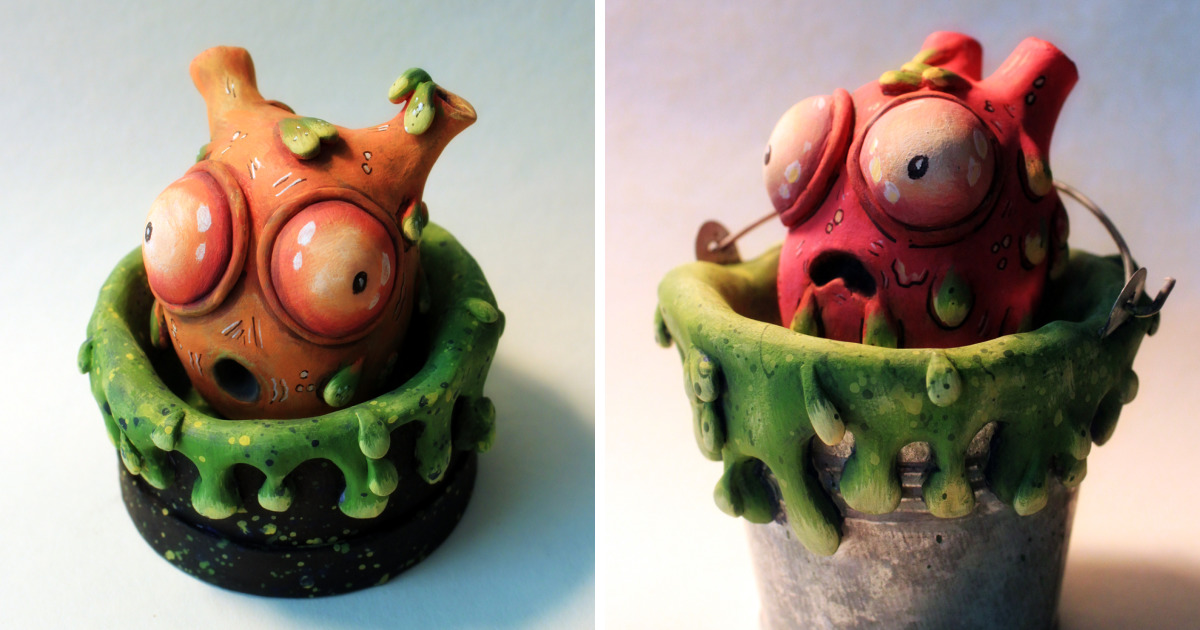
Serious health news has a rude habit of taking over the entire room. It sits at the breakfast table, rides along to medical appointments, and somehow sneaks into conversations that began with innocent questions such as, “What should we watch tonight?” When uncertainty becomes the loudest voice in the house, making something small, strange, and cheerful can be a surprisingly powerful way to turn down the volume.
That is what happened when one woman, facing a rare and painful health disorder, began sculpting a family of tiny creatures called the Grubbers. What started as a personal coping activity became a creative collaboration with her artist boyfriendand a reminder that hope does not always arrive wearing a cape. Sometimes it has stubby legs, bright paint, several alarming teeth, and the general appearance of a potato that has made questionable life choices.
When Medical Uncertainty Entered the Art Studio
The original story was shared in 2017 by multimedia artist Mark Gagne. He explained that his girlfriend had supported his painting and illustration work for years and had become an important partner in his creative business. Their relationship changed dramatically after extensive medical testing led to a diagnosis involving a rare brain disorder, excess fluid in the spinal column, and painful symptoms.
Although she had never thought of herself as artistic, she decided to experiment with sculpting as a way to manage the stress surrounding her condition. Gagne had already designed the Grubbers, a race of dimensional creatures that were deliberately cute, colorful, and slightly gross. She began translating his two-dimensional characters into sculptures. He then painted and assembled them, turning an individual coping exercise into a shared artistic project.
The first collection included orange, purple, blue, and red Grubbers. Each figure had its own personality, but all shared the same lovable-monster energy. They were playful enough to make people smile and peculiar enough to avoid looking like something mass-produced by a committee that had just discovered the word “adorable.”
Why Making Tiny Creatures Can Help During a Health Crisis
Sculpting cannot diagnose a disorder, remove pain, or replace medical treatment. It can, however, give an overwhelmed mind somewhere safe and manageable to go. Health anxiety often involves problems that feel enormous: uncertain test results, unfamiliar terminology, changing symptoms, financial concerns, and the uncomfortable realization that nobody can guarantee what next Tuesday will look like.
A small art project reduces the field of attention. Instead of trying to solve an entire medical future, the maker can focus on one immediate question: Should this creature have two horns or three?
It Turns Abstract Worry Into Something Tangible
Fear is difficult to hold because it has no clear shape. Clay does. It can be pressed, rolled, pinched, flattened, rebuilt, or transformed into a bug-eyed goblin with a heroic overbite. Working with physical material allows emotions to be expressed without requiring a perfectly organized explanation.
The American Art Therapy Association notes that creative work can be especially useful when people are facing crisis, illness, grief, or changes that are difficult to express verbally. Formal art therapy involves a trained mental health professional, but ordinary art-making can still serve as a meaningful personal coping practice outside a clinical setting.
It Creates a Present-Moment Task
Medical uncertainty pulls attention toward imagined futures. Sculpting pulls it back toward the object in front of you. The hands are measuring, smoothing, balancing, and correcting. The eyes are studying proportion and texture. The brain is occupied with a sequence of small decisions that have visible consequences.
This concentrated engagement resembles mindfulness because it redirects attention to present sensory information. Reviews of creative-arts interventions have found promising evidence that drawing, clay work, music, and other creative activities may reduce stress and anxiety, although results vary and stronger research is still needed. A small study of healthy adults also found that brief art-making was associated with lower cortisol levels regardless of previous artistic experience.
It Restores Choice and Control
Illness can make life feel scheduled by other people. Appointments determine the calendar. Symptoms decide whether plans are possible. Forms ask intensely personal questions while providing barely enough room to write the answer.
An art project offers choices that belong entirely to the maker. The creature can be enormous or pocket-sized. It can have green ears, six eyebrows, and a tail shaped like a cinnamon roll. Nothing requires prior authorization.
Hospitals and health organizations use creative therapies partly because art-making can support self-expression, coping, relaxation, attention, confidence, and a renewed sense of choice. For someone whose daily options have narrowed, deciding how a sculpture should look can provide a modest but meaningful experience of agency.
Why Clay Is an Especially Appealing Coping Material
Every art medium has advantages, but clay offers something unusually direct. It responds immediately to pressure. There is no confusing software menu, no battery warning, and no printer that suddenly develops strong personal boundaries.
Clay Encourages Sensory Engagement
The texture, temperature, resistance, and weight of clay create a hands-on experience. Repetitive movements such as rolling coils or smoothing surfaces can establish a comfortable rhythm. On a mentally noisy day, these simple actions provide a task that is structured without being demanding.
Clay Welcomes Revision
A pencil mark may feel permanent to a nervous beginner, but soft clay is forgiving. A crooked ear can be removed. A collapsed body can become a flatter creature with an excellent backstory. The material quietly teaches an important lesson: a mistake is sometimes just an unplanned design decision wearing muddy shoes.
Clay Produces a Physical Result
At the end of a session, there is evidence that time passed and something was accomplished. That evidence matters when illness disrupts ordinary measures of productivity. Even if the day involved fatigue, pain, or waiting for a doctor to call, a tiny finished sculpture can say, “This day was difficult, but it was not empty.”
From Private Coping Activity to Couple Collaboration
The Grubbers became more than stress-relief objects because both partners contributed different skills. Gagne provided drawings, painted details, and assembled the finished pieces. His girlfriend shaped the figures in three dimensions. Neither role canceled the other. The collaboration gave them a shared project that was connected to the health crisis without being entirely defined by it.
This distinction is important. Couples facing serious medical concerns often spend much of their time discussing symptoms, medications, appointments, insurance, and logistics. Necessary conversations can gradually make the relationship feel like a very small administrative department with terrible snacks.
A joint creative activity creates another language. Partners can discuss color, character, shape, and personality. They can laugh when a creature refuses to stand upright. They can celebrate a finished piece without pretending that the underlying illness has disappeared.
Social support is an important part of coping with prolonged health stress. Creative collaboration adds structure to that support: one person is not merely watching helplessly while the other suffers. Both people are participating in something constructive, playful, and emotionally meaningful. Long-term illness can place pressure on entire families, while supportive communication and shared problem-solving can strengthen coping.
Therapeutic Art Is Not the Same as Formal Art Therapy
The words are similar, but the distinction matters. Sculpting at home because it feels calming is a therapeutic creative activity. Art therapy is a mental health profession involving active art-making, psychological knowledge, treatment goals, and a relationship with a credentialed art therapist.
Qualified art therapists generally have graduate-level education and professional credentials. They may work in hospitals, schools, treatment centers, rehabilitation programs, community organizations, or private practices. Their role is not to judge whether a sculpture deserves a place in a gallery. Their role is to help clients use the creative process safely and meaningfully.
Home art-making and professional care can coexist. A person may sculpt independently for relaxation while also seeing physicians, counselors, physical therapists, or other specialists. Creative coping is best viewed as one tool in a larger toolbox, not a glitter-covered substitute for evidence-based treatment.
What Research Says About Creativity, Stress, and Illness
Research into the relationship between art and health is still developing, and not every study reaches the same conclusion. Still, several reviews suggest that creative participation may support emotional well-being, reduce perceived stress, encourage self-expression, and improve aspects of quality of life.
A review published through the National Institutes of Health found that many creative-arts interventions included in the research were associated with significant stress reduction. Another broad review connected creative engagement with possible reductions in stress, anxiety, depression, and the emotional burden of chronic illness. More recent research on crafts also suggests possible benefits for well-being while emphasizing the need for better-designed studies.
Major health systems similarly use art therapy as supportive care. The American Cancer Society describes it as a mind-body approach that may help people process emotions and cope with anxiety, depression, and pain. Cleveland Clinic programs use art-making to support relaxation, self-expression, coping skills, confidence, and a sense of control.
These findings should not be exaggerated. Art does not work identically for everyone, and relaxing activities are not replacements for appropriate treatment of anxiety disorders, depression, trauma, or physical illness. The National Center for Complementary and Integrative Health notes that relaxation-based approaches may help some people with health-related anxiety, but established treatments such as cognitive behavioral therapy may be more effective for certain conditions.
How to Create Your Own Coping Creatures
You do not need professional equipment, advanced technique, or an artistic identity dramatic enough to require a scarf indoors. The purpose is to create a manageable ritual, not an audition for a museum retrospective.
1. Choose an Accessible Material
Air-dry clay and polymer clay are common choices for small sculptures. People with hand pain, weakness, tremors, sensory sensitivity, or limited energy may prefer softer modeling materials, lightweight foam clay, collage, drawing, or digital sculpting. Comfort matters more than tradition.
2. Keep the First Project Tiny
Make something that can be completed in one short session. A small creature with a round body and two eyes is enough. Complicated wings, armor, and a functioning municipal government can wait until version two.
3. Give the Creature a Job
A playful purpose can guide the design. Create a “Waiting Room Worry Eater,” a “Test Result Guardian,” or a “Three-Minute Nap Supervisor.” The creature may represent an emotion, protect a hopeful thought, or simply exist because orange monsters with purple feet improve the general atmosphere.
4. Focus on Process Rather Than Quality
Notice the pressure of your fingers, the shape changing, and the decisions you make. A lopsided figure is not a failed figure. It is a creature with realistic posture after several hours in an uncomfortable clinic chair.
5. Stop Before the Activity Becomes Exhausting
People dealing with pain or fatigue may benefit from shorter sessions, supportive seating, larger tools, scheduled breaks, and help with baking or sealing materials. The activity should fit the body’s current capacity instead of becoming another standard the body is expected to meet.
6. Invite Collaboration Without Taking Over
A partner can prepare materials, paint finished pieces, photograph the results, or create stories for the characters. Collaboration works best when the person facing the health problem still controls the parts that matter most to them.
Related Experiences: What a Creative Coping Ritual Can Feel Like
The following experiences are representative of patterns many people encounter when they begin making art during a stressful health period. They are not additional claims about the original couple, whose public post provides only a brief account of their Grubber collaboration.
The First Session May Feel Awkward
The hardest part is often opening the package. A person who has never sculpted may sit at the table thinking, “This is ridiculous. I have medical calls to return, and I am currently manufacturing a bean with nostrils.” That self-consciousness usually fades once the hands become busy.
The first creature may lean. Its eyes may point toward different tax jurisdictions. Yet completing it can produce an emotion that has been scarce during weeks of tests: uncomplicated satisfaction. The result does not have to answer a medical question. It only has to exist.
A Bad Health Day Changes the Definition of Progress
On a high-energy day, progress might mean sculpting an entire figure. On a difficult day, it might mean choosing a color or rolling one piece of clay. Creative coping becomes more sustainable when success is flexible.
This flexibility can be emotionally important. Illness often compares the present self with a healthier past self. Art offers another measurement. Instead of asking, “Why can’t I do what I used to do?” the maker can ask, “What can I make with the energy I have today?”
The Creature Can Become a Conversation Starter
Friends and relatives sometimes struggle to discuss illness. They may avoid the subject, offer aggressive optimism, or repeatedly ask for updates that the patient is tired of giving. A peculiar sculpture creates a gentler entry point.
Someone can ask why the creature has seven teeth. The artist can explain the design, share as much or as little about the health situation as desired, and briefly occupy an identity beyond “the sick person.” They are also a maker, designer, storyteller, and authority on whether monsters should wear hats.
Collaboration Can Help the Supporting Partner Too
Health crises affect loved ones as well as patients. A partner may feel frightened, guilty, overprotective, or useless. Participating in a creative project does not eliminate those emotions, but it provides a constructive role.
Painting a sculpture, building a display shelf, or inventing a ridiculous biography for each creature can become a shared routine. The couple gains something to anticipate that is not a test, appointment, or bill. That small shift can protect a piece of ordinary relationship life.
The Finished Collection Becomes a Record of Survival
Over time, each figure may become connected to a particular chapter: the blue creature made before a specialist visit, the orange one finished during a difficult week, or the crooked purple one that caused both partners to laugh when almost nothing else felt funny.
The collection does not prove that every day was positive. It shows that creativity continued alongside fear. The objects become evidence of adaptationnot polished evidence, perhaps, but colorful, toothy, slightly wobbly evidence.
The Most Valuable Result May Be a New Identity
One of the most moving parts of the Grubber story is that the sculptor had not previously considered herself artistic. Illness changed her life in unwanted ways, but the creative process revealed an ability she had not known she possessed.
That discovery does not make illness a gift. Serious health problems do not need to be romanticized to produce meaningful experiences. It is possible to hate the diagnosis and appreciate the creativity that emerged while coping with it. Human beings are inconveniently capable of holding two truths at once.
A new creative identity can continue even if symptoms improve, worsen, or remain uncertain. The person is no longer merely passing time until life returns to normal. They are building a version of normal that includes imagination, skill, and a growing population of desktop monsters.
Small Creatures, Serious Meaning
The Grubbers are charming because they look funny, but their deeper appeal comes from what they represent. They show how creativity can transform an intimidating period into a series of manageable actions: shape the body, attach the feet, paint the eyes, finish one creature, and begin another when ready.
Art does not erase medical uncertainty. It changes the experience of living beside it. It can create breathing room, restore choice, invite laughter, and give partners something to build together. That is a substantial accomplishment for a handful of clay with an unreasonable number of teeth.
When circumstances feel too large to control, making one small thing can be enough for today. Tomorrow can begin with the next creature.














