
Some cities introduce themselves politely. Gwalior prefers to appear on the horizon wearing a gigantic sandstone crown.
The moment I saw its famous hilltop fort rising above the streets of Madhya Pradesh, I knew my camera was about to work
overtime. Battery percentage became more important than lunch, which is a serious statement from someone who considers
breakfast a constitutional right.
These ten Gwalior travel pictures capture the places, textures, colors, and small surprises that made the city memorable.
There are tiled palace walls, colossal Jain sculptures, peaceful tomb gardens, royal rooms, busy markets, and enough
architectural detail to keep a zoom lens emotionally fulfilled. More than a simple collection of tourist photographs,
this is a visual journey through a city shaped by kings, musicians, warriors, artists, and ordinary residents going about
their day beneath centuries of history.
Why Gwalior Belongs on a Central India Itinerary
Gwalior sits in northern Madhya Pradesh and is best known for Gwalior Fort, a vast fortified complex stretched across a
rocky plateau. The city has been influenced by numerous ruling powers, including the Tomars, Mughals, Marathas, Scindias,
and the British. That layered history is visible almost everywhere. A medieval temple may stand near a palace, while a
centuries-old monument overlooks a road filled with motorcycles, auto-rickshaws, food stalls, and modern storefronts.
What makes sightseeing in Gwalior especially rewarding is the variety. The city is not defined by one photogenic landmark.
Its heritage includes Hindu temples, Jain rock carvings, Indo-Islamic tombs, archaeological collections, royal European-style
interiors, and an important tradition of Hindustani classical music. In other words, Gwalior gives photographers options.
Lots of them.
My 10 Favorite Travel Pictures From Gwalior
1. The First View of Gwalior Fort
My first picture shows the fort from below, where its long defensive walls seem to merge with the stone ridge. This is the
photograph that best explains why the fort has such a commanding reputation. Even before stepping inside, visitors can
understand its strategic value. The elevated position provides sweeping views while making the complex difficult to approach
unnoticed.
I took several versions of this shot because the scale was surprisingly difficult to capture. A close photograph lost the
shape of the ridge, while a wide composition risked making the fort look smaller than it felt in person. Including a portion
of the city helped solve the problem. The buildings below provide perspective and make the fortress appear even more imposing.
It is the sort of scene that makes a traveler whisper “wow” and then immediately check whether the lens cap is still on.
2. Man Mandir Palace and Its Brilliant Tilework
The exterior of Man Mandir Palace is one of the most recognizable sights inside Gwalior Fort. Built during the reign of
Tomar ruler Man Singh, the palace combines massive sandstone construction with delicate carvings and bands of colorful glazed
tiles. Blue is the dominant color, creating a striking contrast against the warm, dusty stone.
Looking closely, I noticed decorative images of animals, birds, geometric patterns, and floral forms. From a distance, the
facade appears elegant. Through a zoom lens, it becomes playful. The palace clearly belonged to rulers who believed a military
stronghold could also use a little personality. Apparently, intimidating enemies and displaying excellent taste were not
mutually exclusive goals.
3. Light and Shadow in a Palace Courtyard
My third Gwalior picture is less famous but more atmospheric. It shows an interior courtyard where sunlight falls across
worn stone floors and disappears into dark doorways. The scene felt calm after the broad, exposed spaces outside. Every arch
suggested another passage, staircase, chamber, or story.
Palace interiors can be challenging to photograph because bright courtyards and shadowed rooms create extreme contrast.
Instead of fighting the darkness, I used it to frame the brighter section of the courtyard. The result captures something
I felt throughout the fort: Gwalior reveals itself gradually. The grand facade gets your attention, but the quieter corners
are where curiosity takes over.
4. The Giant Jain Sculptures Along the Fort Approach
On the approach to Gwalior Fort, enormous Jain figures appear in niches carved into the rock. Some are standing, others are
seated in meditation, and many are accompanied by smaller carvings. Their scale is difficult to judge until a person walks
into the frame and suddenly looks pocket-sized.
These sculptures are associated with Jain tirthankaras, revered spiritual teachers. Although many figures were damaged during
periods of conflict, their surviving forms remain deeply impressive. The expressions are composed and peaceful, creating a
striking contrast with the defensive walls above. This photograph became one of my favorites because it captures both human
ambition and spiritual stillness in a single cliff face.
5. The Elaborate Stonework of the Sas Bahu Temples
Despite the name commonly used today, the Sas Bahu temple complex was not originally dedicated to a mother-in-law and
daughter-in-law. Its name is generally connected to Sahastrabahu, a form of Vishnu. The complex contains two temples of
different sizes, positioned within the fort area and surrounded by open views.
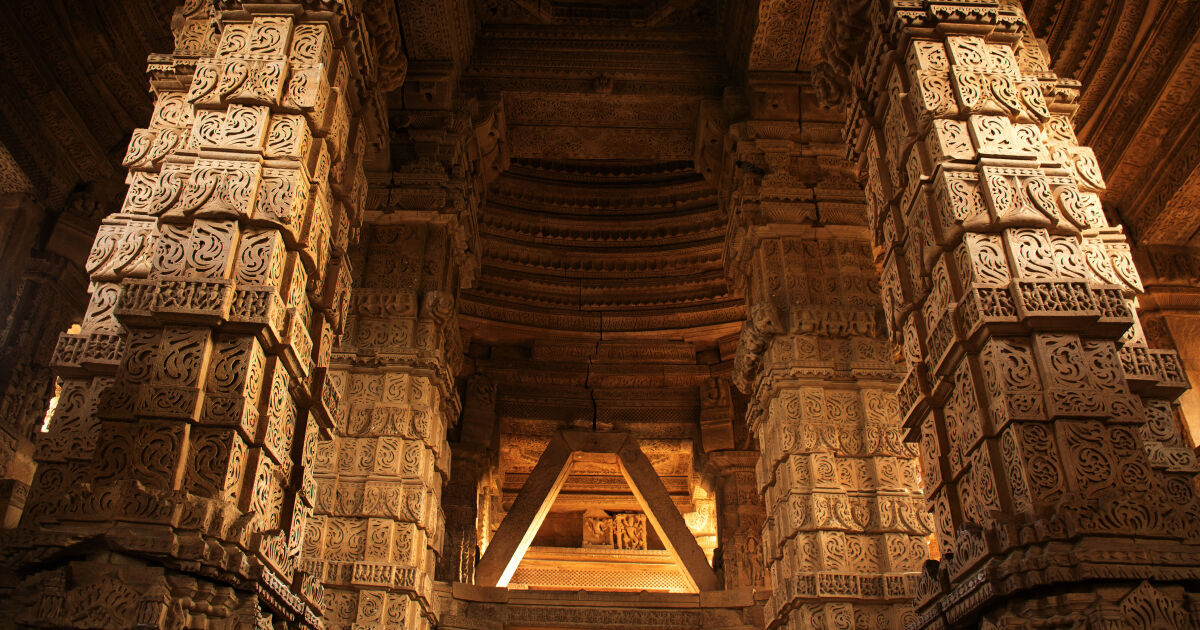
My picture focuses on the carvings rather than the entire structure. Pillars, brackets, ceilings, and wall panels are covered
with sculpted patterns and religious imagery. The closer I looked, the more details appeared. This is a recurring problem in
Gwalior: “one quick photograph” regularly becomes twenty-seven photographs and a mild concern about storage space.
6. Teli Ka Mandir and Its Unusual Silhouette
Teli Ka Mandir stands out because it does not look quite like the other monuments within the fort. The tall temple has a
distinctive rectangular tower and displays architectural features associated with more than one Indian regional tradition.
Its entrance is richly carved, while the upper structure creates a powerful silhouette against the sky.
I photographed it from a slight angle to emphasize its height. A straight frontal shot looked formal, but the angled view
showed the depth of the walls and the sculptural quality of the doorway. Weathering has softened parts of the decoration,
yet the building still feels bold and experimental. It is proof that historic architects were perfectly capable of ignoring
the phrase “keep it simple.”
7. A Quiet Moment at the Tomb of Tansen
Gwalior is often described as a city of music, and the tomb of Tansen explains why. Tansen was a celebrated musician associated
with the court of Mughal emperor Akbar and remains one of the most influential names in Hindustani classical music. His modest
tomb stands near the larger mausoleum of Sufi saint Muhammad Ghaus, his spiritual mentor.
The garden was quieter than the fort, allowing me to slow down and photograph the domes, lattice screens, pathways, and trees.
The complex is also associated with an annual music festival honoring Tansen. Even without a performance taking place, the
location has a reflective quality. My photograph includes visitors sitting on the lawn, which shows that heritage sites are
not frozen displays. They remain part of daily community life.
8. The Extravagant Rooms of Jai Vilas Palace
After the medieval atmosphere of Gwalior Fort, Jai Vilas Palace feels like walking into an entirely different chapter.
Constructed in the 19th century for the Scindia dynasty, the palace displays strong European architectural and decorative
influences. Part of the building houses a museum with royal furniture, portraits, decorative objects, carriages, weapons,
and rooms designed to impress visiting dignitaries.
The grand hall is famous for enormous chandeliers, gilded surfaces, mirrors, and richly arranged furnishings. Photographing
the room required patience because there was always another visitor stepping into the frame at the exact moment I pressed
the shutter. Eventually, I accepted that humans are a traditional feature of public museums and included them for scale.
The chandeliers looked even more enormous beside ordinary-sized people.
9. The Everyday Energy of Maharaj Bada
Gwalior’s monuments are impressive, but a travel photo collection should also show how the city feels beyond ticket counters
and protected walls. Maharaj Bada is a lively commercial area where historic buildings meet markets, traffic, food vendors,
and evening crowds. It is colorful, noisy, unpredictable, and much harder to photograph than a palace that politely remains
in one place.
I waited until the late afternoon light began to soften. Shop signs came alive, streetlights started glowing, and the movement
of scooters and pedestrians created a sense of momentum. This photograph does not have the clean symmetry of the fort, but it
captures Gwalior as a living city rather than a collection of monuments.
10. Ending the Photo Walk With Local Food
My final picture is not an ancient structure. It is a plate. After walking through fort gates, palace corridors, temple
courtyards, and crowded streets, food became less of a cultural activity and more of an emergency response.
Gwalior offers familiar North Indian favorites alongside regional snacks and sweets. Depending on where you stop, you may find
kachori, samosa, poha, jalebi, savory chaat, milk-based desserts, and strong tea served in small cups. I photographed the food
quickly because travel photography has limits, and one of those limits is the amount of time a hungry person will tolerate
decorative plate arrangement.
Practical Photography Tips for Gwalior
Begin Early
Morning light is generally softer, temperatures are more comfortable, and popular monuments may be less crowded. Starting
early is especially useful at Gwalior Fort, where the open plateau can become bright and hot later in the day.
Carry a Wide Lens and a Zoom
A wide-angle lens helps inside courtyards and narrow palace spaces, while a moderate zoom is useful for tilework, carvings,
architectural details, and distant city views. A phone camera can still perform well, particularly when its exposure is
adjusted to protect bright skies.
Ask Before Photographing People
Markets become more interesting when local residents appear in the frame, but permission matters. A smile and a simple request
can prevent discomfort and often lead to a more natural portrait.
Respect Monument Rules
Photography policies may differ between museums, palace interiors, religious spaces, and protected monuments. Check posted
signs and follow staff instructions, particularly regarding flash, tripods, video equipment, and restricted rooms.
Extra Travel Experiences: What My Camera Did Not Fully Capture
Photographs preserve appearances, but they are less successful at recording temperature, sound, effort, and emotion. My
pictures show Gwalior Fort glowing above the city, yet they do not show the warm air rising from the stone or the growing
awareness that every attractive viewpoint seems to be located at the top of another incline.
The journey through the fort felt like moving between several cities occupying the same hill. One area was defensive, with
gates, walls, and commanding viewpoints. Another felt ceremonial, filled with palace facades and royal courtyards. A few
minutes later, temples and sculptures changed the mood again. This variety prevented the visit from becoming monotonous.
Just when I thought I understood the complex, another structure appeared and politely proved me wrong.
I particularly enjoyed watching how the surfaces changed with the light. The sandstone looked pale in the harsh middle of
the day, warmer in late afternoon, and almost copper-colored as the sun moved lower. Blue tiles on Man Mandir Palace became
brighter from certain angles, while deeply carved temple details appeared more dramatic when shadows filled their recesses.
The experience reminded me that good travel photography is partly about waiting. The monument is already doing most of the
work; the photographer merely needs to stop blocking the view.
Conversations also shaped the day. Drivers recommended food stalls. Guides pointed toward carvings I might otherwise have
missed. Families asked one another to take group pictures, usually followed by a complicated exchange of phones and instructions.
These ordinary interactions made the heritage sites feel welcoming rather than distant.
Visiting Tansen’s tomb created a different kind of memory. The setting felt quieter and more intimate than the palace halls.
Birds moved between the trees, visitors rested on the grass, and the monument’s musical association encouraged a slower pace.
I found myself putting the camera down for several minutes, which is often a sign that a place is doing something right.
Jai Vilas Palace produced the opposite reaction. Every room seemed designed to encourage staring. Decorative objects,
portraits, elaborate furniture, and giant chandeliers competed for attention. It was fascinating, extravagant, and slightly
overwhelming. After a morning among medieval stone buildings, the European-inspired interiors felt like an unexpected costume
change midway through the trip.
The market area offered another contrast. Here, nobody cared that I had spent the day contemplating dynasties. Vendors were
selling snacks, shoppers were negotiating prices, horns were announcing the continued existence of traffic, and tea was being
poured at a speed that suggested centuries of professional practice. This everyday energy completed the experience. Historic
Gwalior is extraordinary, but modern Gwalior is what gives the monuments their living context.
By the end of the day, my camera contained grand architecture, tiny carvings, crowded streets, accidental blurry pigeons,
and several photographs of my own thumb. The imperfect images were part of the fun. Travel is rarely as polished as a brochure.
It includes wrong turns, tired feet, missed focus, unexpected conversations, and meals ordered by pointing at whatever looks
best.
That is ultimately what these Gwalior travel pictures mean to me. They are not simply records of ten attractions. Together,
they capture a city where military history, spiritual traditions, royal luxury, classical music, craftsmanship, and everyday
life overlap. Gwalior rewarded curiosity at every turn, and it left me with the pleasant problem of having far more than ten
pictures worth sharing.
Conclusion
Gwalior is one of those destinations that becomes more interesting the longer you look. Its famous fort may dominate the
skyline, but the city’s character also lives in palace details, temple carvings, musical traditions, garden tombs, busy
markets, and plates of hot street food.
These ten pictures only provide a starting point. The most memorable part of exploring Gwalior was discovering how many
different stories could fit into one destination. Come for the fortress, stay for the art, music, food, and street lifeand
bring an extra memory card. History, unlike your camera, does not seem concerned about storage limits.














