
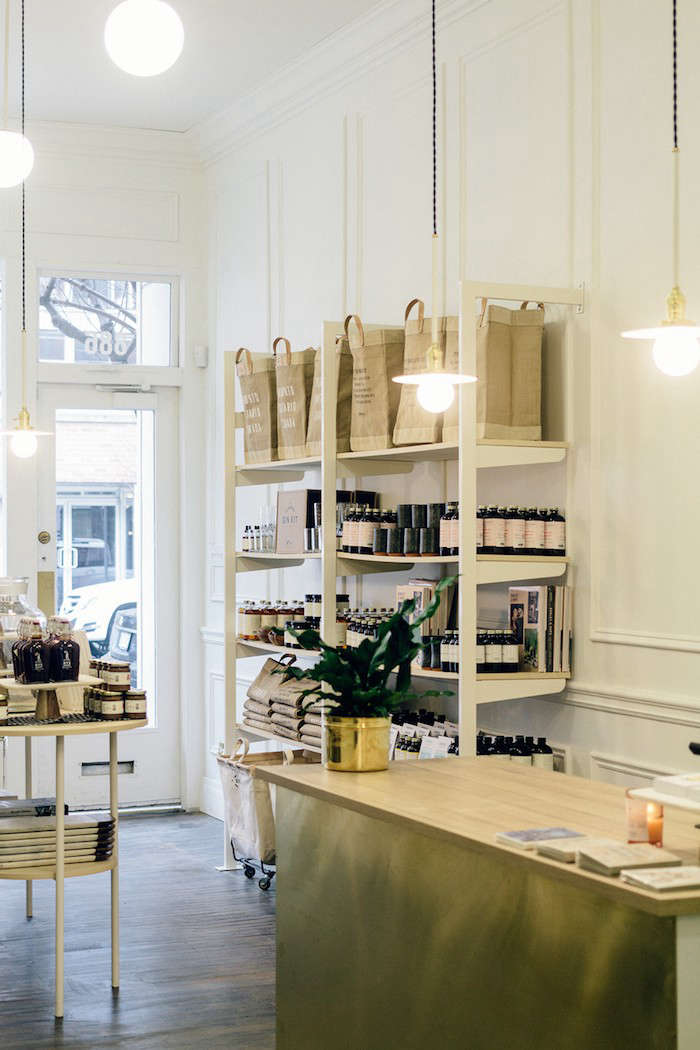
Some stores sell things. Others sell the delicious fantasy that your life could become calmer, tidier, and considerably more attractive if only you owned the right dustpan. When Old Faithful Shop opened its Toronto outpost in 2015, the Vancouver-born retailer belonged firmly in the second categorybut without slipping into empty lifestyle theater.
Located at 886 Queen Street West, the shop brought its modern general-store concept to one of Toronto’s most creative retail districts. Its shelves combined handsome kitchen tools, household brushes, ceramics, books, textiles, apothecary goods, pantry treats, and other objects selected for usefulness as much as appearance. The result felt less like a conventional home decor store and more like a beautifully organized supply room for grown-ups who had finally decided to stop buying disposable junk.
The Toronto location was also an architectural story. Rather than covering the century-old storefront with a glossy new shell, co-founder Walter Manning participated in a renovation that uncovered original materials, repaired damaged structural elements, and added new details designed to complement the building. It was an expansion rooted in restraint: preserve what works, repair what does not, and avoid making history wear an embarrassing costume.
A West Coast General Store Heads East
Old Faithful Shop was founded in Vancouver in 2010 by Walter Manning and Savannah Olsen. The business developed its identity in Gastown, a historic neighborhood whose brick buildings and independent businesses provided an ideal setting for a retailer interested in heritage, craftsmanship, and everyday utility.
The inspiration reached further back than Vancouver. Manning grew up around a family tradition of general-store ownership. His grandparents on both sides, along with earlier generations, operated stores that served their communities in Newfoundland. Those shops supplied practical necessities, but their larger purpose was social. People might arrive for food or household goods, then linger for conversation, news, advice, and the reassuring pleasure of being recognized.
Manning carried that idea into Old Faithful Shop. The goal was not to reproduce an old rural store plank by plank, complete with barrels and a shopkeeper dramatically polishing a jar of buttons. Instead, the founders translated the general store’s dependable service and broad usefulness into a contemporary design business.
A Modern Interpretation of Dependability
The name “Old Faithful” neatly summarizes the approach. Products were chosen because they were intended to work reliably, age gracefully, and remain appealing beyond a single decorating season. A broom did not need to look futuristic. A kettle did not require Bluetooth. A ceramic cup simply needed to feel good in the hand, survive regular use, and avoid becoming visually annoying six months after purchase.
This philosophy distinguished the shop from retailers built around rapid product turnover. Instead of encouraging customers to replace their belongings whenever a new color became fashionable, Old Faithful Shop emphasized objects that could become familiar parts of daily routines. Today, the company still describes its assortment as cookware, textiles, furniture, books, and other objects selected for integrity, function, character, and the ability to age well.
Why Queen Street West Was the Right Toronto Address
Bringing Old Faithful Shop to Queen Street West was not a random pin dropped on a Toronto map. The neighborhood had long been associated with independent fashion, music, art, hospitality, vintage shopping, and design-conscious businesses. It offered the foot traffic of a major commercial street without completely surrendering its personality to uniform chain retail.
The store’s address also placed it near Trinity Bellwoods Park and the restaurants, hotels, cafés, galleries, and boutiques that made West Queen West a destination for both residents and visitors. American travel publications have repeatedly described the district as one of Toronto’s strongest areas for locally operated stores, vintage goods, creative culture, and neighborhood exploration.
Old Faithful Shop fit that ecosystem because it rewarded browsing. A customer could enter without a shopping list and still spend twenty minutes examining brushes, linens, cookware, planters, books, or an unusually dignified ball of twine. It was the sort of place where practical objects received the merchandising attention normally reserved for jewelry.
Restoring a Century-Old Storefront
The Toronto shop occupied a building estimated to be roughly 100 years old. That age gave the space character, but character in old buildings often arrives with an invoice. Renovation work revealed damaged floor joists, covered surfaces, old tile, original flooring, and a brick archway concealed behind later construction.
Manning described the process as an attempt to “grace the space rather than disgrace it.” That principle shaped the renovation. Workers removed a wall to expose the hidden brick arch, lifted old tile to recover original floorboards, repaired rotting structural components, and introduced hexagonal tile where new flooring was required. Wall moldings, millwork, lighting, and a concealed jib door completed the interior without erasing the building’s age.
Preservation Without Turning the Store Into a Museum
The smartest feature of the renovation was its balance. The space was not frozen in the past. Customers did not have to tiptoe around historic floorboards while a guide whispered about the emotional significance of a nail. The building remained a functioning retail environment with clear displays, usable circulation, modern lighting, and contemporary fixtures.
At the same time, the original materials gave the store a texture that would have been difficult to reproduce convincingly. The restored boards, exposed masonry, molding, tile, and wood shelving created a backdrop that reinforced the merchandise. Well-made objects looked at home in a building that had also been repaired rather than discarded.
That relationship carries a broader environmental logic. The U.S. Environmental Protection Agency prioritizes source reduction and reuse above disposal, while preservation organizations note that adapting older buildings can avoid some of the material extraction, transportation, demolition waste, and construction impacts associated with replacement.
The Product Mix: Useful Objects With Better Manners
Old Faithful Shop’s Toronto selection crossed conventional retail categories. Reports from the opening described cocktail bitters near colorful chocolate bars, silver kettles beside twine, apothecary products resting near hardcover cookbooks, and rows of traditional cleaning tools displayed with almost comic elegance.
Classic kitchenware occupied a central role. These were the tools and serving pieces people might use every day: kettles, utensils, storage containers, glassware, ceramics, cutting accessories, and tabletop goods. The visual language leaned toward natural materials, straightforward forms, and colors that would not start shouting at the wallpaper.
The store also carried ceramics from makers such as West River Field Lab, brushes and dustpans from Redecker, and plants sourced from Toronto businesses. These local and international elements prevented the assortment from feeling like a rigid tribute to any single country or design movement.
When a Dustpan Becomes a Design Object
One of the shop’s cleverest accomplishments was making humble tools desirable without stripping away their usefulness. A well-proportioned dustpan, natural-bristle brush, grass broom, or wooden scrubber could remain visible instead of being shoved into a closet like evidence from a housekeeping crime scene.
That does not mean every customer needs an artisanal brush collection arranged by emotional significance. It does suggest that ordinary chores can become less irritating when tools are comfortable, durable, repairable, and pleasant to handle. The EPA similarly recommends reusable cleaning supplies and repairing durable products where practical, rather than treating every worn object as disposable.
Japanese and Scandinavian Influences
Old Faithful Shop became known for a contemporary mix that often included Japanese and Scandinavian design. Both traditions contain many different styles, but the products selected by the store tended to share clarity of purpose, careful material choices, restrained ornament, and respect for everyday rituals.
A Japanese cleaning brush, Nordic table, compact lamp, hand-finished ceramic vessel, or thoughtfully designed coffee tool could coexist because the common thread was not geography. It was usefulness supported by craftsmanship.
Later coverage of the company’s Vancouver expansion described Manning’s interest in Japanese and Scandinavian furniture, lighting, tableware, and kitchen tools. The current Old Faithful Shop catalog continues to feature globally sourced design objects, including books on Japanese and Nordic design, household tools, furniture, textiles, cookware, and tableware.
Why the Toronto Opening Mattered
The Toronto outpost arrived during a period when “buy less, buy better” was becoming a more visible response to fast fashion, throwaway furniture, and constantly changing home trends. Old Faithful Shop did not invent durable design, of course. Humanity had been producing long-lasting bowls and chairs for quite some time before Instagram noticed. But the store packaged the principle in an accessible and highly photogenic way.
It demonstrated that sustainability did not always need to begin with futuristic materials or complicated technology. Sometimes it started with a brush that could be used for years, a solid table that could survive several homes, a linen textile that improved with washing, or a building renovated instead of demolished.
Architectural Digest has similarly highlighted durable materials, vintage furnishings, locally sourced products, repairable objects, and responsibly made home goods as practical ways to reduce waste and create interiors that outlast short-lived trends.
The Store as an Editor
Independent design shops also perform a role that enormous marketplaces struggle to replicate: editing. An online search for “white ceramic cup” can produce thousands of results and a mild spiritual crisis. A curated store narrows the field. It communicates, “We examined many cups. These are the cups that survived the meeting.”
That filter can justify higher prices when the selection reflects material quality, provenance, construction, durability, and practical performance. Customers are not only paying for the object. They are paying for the time and judgment required to locate it, compare it, transport it, display it, and explain why it belongs on the shelf.
Retail Lessons From Old Faithful Shop Toronto
The Queen West store offered several useful lessons for independent retailers. First, a clear point of view is more memorable than a huge inventory. Old Faithful Shop did not need to sell every possible kitchen tool. It needed to sell kitchen tools that made sense together.
Second, the physical store should express the same values as the merchandise. A company promising longevity would have weakened its message by installing a disposable-looking interior. Restoring the old storefront allowed the architecture to become proof of concept.
Third, practical products can support an emotional experience. Customers may technically need a broom, but they also respond to texture, lighting, storytelling, scale, scent, and conversation. The best retail spaces do not manipulate shoppers into forgetting utility. They make utility easier to appreciate.
Finally, community remains a competitive advantage. Manning’s family history emphasized stores as gathering places, not anonymous transaction points. In an era of instant checkout and algorithmic recommendations, knowledgeable service and human recognition can feel surprisingly luxurious.
The Toronto Chapter and Old Faithful Shop Today
The Queen Street West location was a significant chapter rather than a permanent Toronto fixture. The outpost later closed, and current Toronto design directories no longer list it as an active physical shop. Old Faithful Shop, however, continues operating online and through two Vancouver stores: its Gastown location on West Cordova Street and its Kitsilano location on West Fourth Avenue.
The Toronto project still matters because it captured the company’s philosophy in a particularly complete form. The merchandise was durable. The renovation respected existing materials. The neighborhood supported independent retail. The product displays elevated daily routines without pretending that owning a handsome scrub brush would solve every adult problem.
An Extended Old Faithful Shop Toronto Experience
Imagine approaching the storefront during an unhurried afternoon on Queen Street West. The neighborhood is busy without feeling entirely commercialized. Cyclists pass, streetcars rumble nearby, and people drift between cafés, clothing stores, restaurants, and Trinity Bellwoods Park. You are not hunting for a specific product. This is fortunate, because browsing is the main event.
Through the window, the store appears warm and orderly. Nothing screams for attention. There are no flashing screens, mountains of sale merchandise, or cardboard signs insisting that a decorative pillow will change your destiny before midnight. Instead, the displays use repetition, spacing, natural materials, and carefully controlled color.
Entering the shop, you notice the building before any individual product. Restored wooden floorboards show their age without appearing neglected. The brick archway gives depth to the room, while the new tile and millwork feel crisp but not overly polished. The interior has the confidence to let old surfaces remain old.
Your attention moves toward a wall of brushes and dustpans. This is unexpected. At most stores, cleaning supplies are displayed as urgently replaceable necessities in aggressive plastic packaging. Here, wooden handles, metal pans, and natural fibers form a calm visual arrangement. You pick up a brush and immediately understand the appeal: balanced weight, comfortable shape, dense bristles, no unnecessary gadget attached.
Nearby, shelves of kitchenware offer another kind of temptation. A silver kettle looks sturdy enough to become a family witness. Ceramic tumblers have slight variations that reveal the maker’s hand. Glassware is simple but distinctive. Wooden utensils look increasingly attractive as you remember the melted plastic spatula currently living in your kitchen drawer.
You begin mentally renegotiating your definition of “need.” A beautiful broom is still a broom, but it may be a broom you maintain instead of replacing. A ceramic cup is hardly essential when you already own six, yet perhaps only two of those cups are enjoyable to use. The shop quietly encourages a different calculation: not how many things can be purchased, but which things deserve a place in daily life.
Books slow the experience further. Design volumes, cookbooks, and practical guides invite customers to imagine the objects in context. A coffee tool belongs beside a book about morning rituals. A serving bowl makes sense near a cookbook. Textiles become more appealing when folded beside furniture and lighting rather than sealed in plastic on an anonymous shelf.
A staff member explains where a product was made and why the shop carries it. The conversation is informative rather than theatrical. There is no suggestion that you have failed morally by owning an inexpensive saucepan. Instead, you are given enough information to decide whether a better-made replacement would be worthwhile when the old one finally retires from active duty.
You may leave with a small purchase: a brush, candle, ceramic cup, pantry item, or book. The object is wrapped carefully. It feels less like an impulse souvenir and more like something selected. Even without buying furniture or lighting, you carry away an idea about domestic lifethat useful objects can be visible, repairs can be preferable to replacement, and daily routines deserve tools made with some degree of thought.
Back outside, Queen Street West seems louder than it did a moment earlier. The visit has not transformed you into a minimalist monk. You will still lose your keys and own at least one drawer filled with mysterious cables. But the store has made you more attentive. The next time you need a kettle, broom, table, or set of glasses, you may pause before choosing the cheapest disposable option. That small pause is perhaps the most valuable product the shop offered.
Conclusion
Old Faithful Shop’s move into Toronto showed how a retailer could combine history, craftsmanship, interior restoration, and contemporary design without becoming precious or impractical. The Queen West outpost treated household tools as worthy objects, adapted a century-old storefront with restraint, and revived the community-minded spirit of the traditional general store.
Although the Toronto location is no longer open, its design story remains relevant. Consumers continue to question disposable products, while independent retailers continue searching for ways to make physical shopping meaningful. Old Faithful Shop’s answer was refreshingly straightforward: choose useful things carefully, explain why they matter, build a welcoming room around them, and trust that quality does not require shouting.
Note: This article examines the 2015 opening of Old Faithful Shop’s former Toronto location as a historical retail and interior-design case study. The brand currently operates online and maintains physical stores in Vancouver’s Gastown and Kitsilano neighborhoods as of July 2026.













