
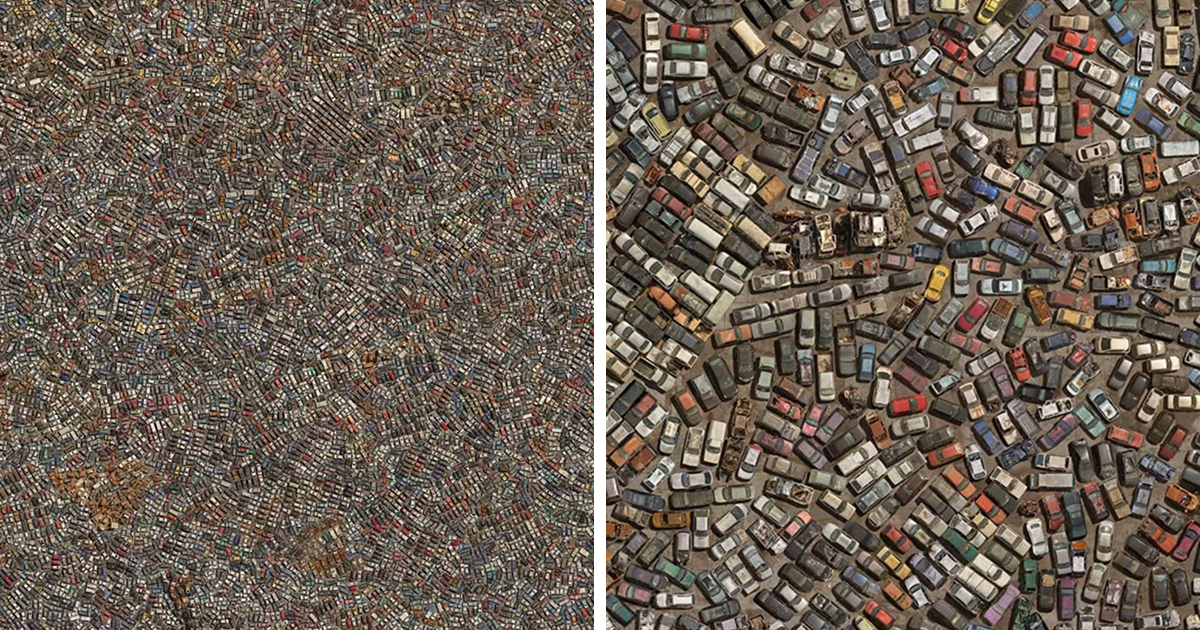
From crowded airports to endless rows of discarded vehicles, Cássio Vasconcellos’ aerial photo composites turn human consumption into a strange, beautiful, and slightly alarming visual puzzle.
When the Planet Looks Like a Pattern, We Should Probably Zoom In
At first glance, Cássio Vasconcellos’ aerial photos can look almost decorative. A field of cars becomes a shimmering texture. Airplanes gather like metallic insects. Containers, roads, scrap, sand, roofs, and machines form geometric designs so precise they could pass for luxury wallpaper in a very intense architect’s office.
Then the viewer looks closer. The pattern is not abstract at all. It is made of vehicles, aircraft, industrial debris, parking lots, ports, beaches, roadways, and the thousands of tiny decisions that build modern life. Suddenly the image stops being “pretty” and starts whispering, “Congratulations, humanity, you have turned convenience into a landscape.”
That tension is the power of Vasconcellos’ work. His series Collectives uses aerial photography and digital assembly to create large-scale imaginary landscapes built from real places. The scenes are not documentary in the simple “one camera, one moment” sense. They are constructed from thousands of individual photographs, then carefully arranged into panoramas that feel both impossible and uncomfortably familiar.
The result is a visual language for the Anthropocene, the era in which human activity has become a force large enough to reshape land, water, air, and even the way Earth looks from above. It is environmental photography with the volume turned up. It is also proof that, given enough cars, humans can accidentally invent a new kind of plaid.
Who Is Cássio Vasconcellos?
Cássio Vasconcellos is a Brazilian fine art photographer from São Paulo, a city where scale is not exactly shy. He has worked with aerial photography for decades and is known for transforming real-world infrastructure into layered visual compositions. His subjects often include transportation systems, crowded urban environments, industrial sites, natural landscapes, and the physical traces of consumption.
His long-running series Collectives is especially fascinating because it does not simply show a busy place. It exaggerates and reorganizes busy places until viewers can feel the weight of systems that usually remain invisible. Cars are not just cars; they become evidence of oil, steel, roads, commutes, parking lots, shipping networks, insurance paperwork, drive-thru coffee, and that one person who still parks diagonally across two spaces.
Vasconcellos’ images often begin with helicopter photography. He shoots from above, collecting visual fragments from airports, junkyards, beaches, roads, ports, and industrial spaces. Later, he assembles these fragments digitally. The final artworks are not meant to trick viewers into believing the scenes exist exactly as shown. Instead, they operate like visual metaphors: real parts arranged into an invented whole that tells the truth more loudly than a single frame could.
This approach makes his work different from ordinary aerial photography. A drone image may show one beach, one highway, or one warehouse district. Vasconcellos shows the system behind them. He builds a world where accumulation is the subject, repetition becomes the composition, and scale becomes the punchline with a very serious aftertaste.
The “Collectives” Series: Beauty, Anxiety, and a Lot of Parking
The Collectives series looks at modern life through mass movement, mass storage, and mass consumption. Its scenes include packed airports, huge gatherings of vehicles, scrapped airplanes, junkyards, shipping containers, and other landscapes shaped by mobility and waste. From a distance, these works can resemble embroidery, circuit boards, coral reefs, or abstract paintings. Up close, they reveal the machinery of everyday life.
The Airport That Should Never Exist
One of Vasconcellos’ best-known works is an imaginary airport packed with aircraft, terminals, runways, and jet bridges. The image feels like every holiday travel nightmare compressed into one grand aerial hallucination. It is mesmerizing, but it also makes you want to check whether your flight has been delayed until next Tuesday.
The scene is not a real airport photographed in one moment. It is a constructed image made from many aerial photographs. By arranging planes and infrastructure into an overwhelming composition, Vasconcellos captures the energy of global travel: speed, connection, crowding, fuel, logistics, and the strange modern belief that crossing continents should be as casual as ordering a sandwich.
Cars as Civilization’s Confetti
Another recurring subject in Collectives is the automobile. From above, thousands of cars lose their individuality. They become color, texture, density, and evidence. That is part of the brilliance. On the ground, a car feels personal: your playlist, your coffee cup, your weird air freshener shaped like a pine tree. From the air, it becomes one unit in a giant human-made swarm.
This shift in perspective changes the emotional effect. A parking lot no longer looks ordinary. It looks like a species behavior. We see how much space is required not just to drive vehicles, but to store them, maintain them, sell them, discard them, and build cities around them. The aerial view makes the invisible footprint visible.
Junkyards, Scrap, and the Afterlife of Stuff
In later works, Vasconcellos turns toward scrapped vehicles, airplane graveyards, metal piles, and dumps. These images are striking because they show consumption after the showroom shine has worn off. The object has completed its glamorous phase and entered its “please do not ask where I go next” era.
The environmental message is clear without becoming preachy. Every product has a second landscape attached to it. A phone, car, sofa, appliance, or airplane does not vanish when we replace it. It moves into another system: recycling, storage, landfill, export, repair, stripping, burning, resale, or abandonment. Vasconcellos’ aerial composites make that afterlife impossible to ignore.
Why Aerial Photography Makes Human Impact Feel So Huge
Ground-level photography is intimate. It shows faces, emotions, streets, gestures, and moments. Aerial photography does something else: it reveals patterns. It shows the shape of decisions repeated thousands or millions of times. That is why images from airplanes, helicopters, drones, and satellites have become so important in conversations about human impact on Earth.
From above, cities expand like ink drops. Farms become grids. Mines become wounds. Ports become circuitry. Highways become arteries. Suburbs become repeating modules of roofs, driveways, lawns, and cul-de-sacs, as if someone copied and pasted the American dream until the printer got tired.
This viewpoint is powerful because the human brain understands pattern before it understands data. A report can tell us that waste generation, land use, and transportation networks are massive. Aerial photography lets us feel it. The viewer does not need a spreadsheet to understand that a desert filled with planes or a field packed with cars represents a system bigger than any individual buyer, traveler, or commuter.
That is where Vasconcellos’ work lands so effectively. His composites are not just “look how many objects there are” images. They are visual essays about systems. They ask how modern comfort is produced, moved, parked, stored, and eventually discarded. They also ask why we are so good at scaling production and so much slower at scaling responsibility.
The Real-World Context: Human Footprints You Can See From Above
The themes in Vasconcellos’ art connect with real environmental observations made by scientists, satellites, and government agencies. Earth-observing programs have documented urban expansion, agricultural transformation, deforestation, shrinking water bodies, coastal development, and other landscape changes over decades. The camera above Earth is no longer just an artistic tool; it is a witness.
For example, long-term satellite imagery has shown the outward growth of cities such as Las Vegas, where desert land has been transformed by housing, roads, resorts, golf courses, and infrastructure. Similar patterns appear around the world as cities expand to house more people and serve more consumption. Urban growth is not automatically bad, but it does require land, water, energy, transportation, and waste systems. In other words, cities have appetites.
Agriculture is another major visible footprint. From space, irrigated fields form circles, rectangles, terraces, and patchworks. These patterns are beautiful, but they also represent enormous demands for water, soil management, fertilizer, fuel, labor, and distribution networks. The food system that fills a grocery store is not small. It is a continent-sized choreography involving farms, roads, warehouses, packaging, refrigeration, trucks, ports, and refrigerators that somehow still contain three expired bottles of mustard.
Waste is equally visible, even when it is hidden from daily life. Municipal solid waste in the United States has reached hundreds of millions of tons in a single year, and while recycling and composting help, enormous quantities still go to landfills or other disposal systems. Aerial views of dumps, scrap yards, and industrial storage sites show what ordinary shopping receipts do when they grow up.
Marine debris adds another layer to the story. Plastic pollution can range from large discarded fishing gear and household items to microplastics smaller than five millimeters. These materials move through waterways, coastlines, and oceans, often far from where they were first used. The fact that some human-made materials are now found in remote environments is a reminder that “away” is not a place. It is usually just somewhere else.
Why the Images Feel Beautiful Even When the Subject Is Troubling
One of the most interesting things about Vasconcellos’ work is that it is undeniably beautiful. The colors pop. The compositions are balanced. The repetition is hypnotic. The images reward slow looking. This creates a complicated emotional response: admiration, discomfort, curiosity, guilt, and maybe a sudden urge to clean out the garage.
This beauty is not a distraction from the message. It is the doorway into it. If the images were only ugly, many viewers would look away. If they were only beautiful, the environmental meaning would dissolve into decoration. Vasconcellos keeps both forces alive at once. The eye enjoys the pattern while the mind slowly realizes what the pattern is made of.
That strategy is common in some of the strongest environmental art. It does not simply scold. It seduces first, then complicates the seduction. The viewer enters through color and scale, then discovers consumption, waste, crowding, and fragility. It is a bit like biting into a gorgeous pastry and finding a tiny invoice inside.
By using constructed aerial compositions, Vasconcellos also avoids a simple moral lecture. The images do not say, “You are bad for owning things.” Instead, they say, “Look at the scale of the systems we all participate in.” That distinction matters. Modern human impact is collective. It is built from billions of ordinary actions, many of them necessary, convenient, or even joyful. The problem is not that humans move, eat, build, and create. The problem is that our systems often fail to account for what happens afterward.
What the 17 Pics Reveal About Modern Life
The 17 images associated with this kind of project work like chapters in a visual book. Each one focuses on a different form of accumulation: transportation, industry, waste, storage, or crowding. Together, they show a world organized around movement and material abundance.
1. Scale Is Hard to Understand Until You See It
Numbers can become numb. Ten thousand cars, millions of tons of waste, billions of packages, thousands of flightsthese figures are technically meaningful, but emotionally slippery. Aerial images translate numbers into shapes. Suddenly scale has edges, color, density, and shadow.
2. Convenience Has a Physical Body
Fast shipping, cheap flights, personal vehicles, packaged food, and endless product choice feel digital or invisible when experienced through screens. Vasconcellos’ images remind us that convenience is built from metal, asphalt, plastic, fuel, warehouses, roads, and labor. Every “Buy Now” button has a backstage.
3. Waste Is Not the End of the Story
The disposal phase of an object is often just the beginning of another journey. A scrapped car may be stripped for parts, crushed, melted, exported, stored, or left to decay. An aircraft may sit for years in a desert boneyard. A plastic object may fragment slowly over time. The aerial view turns disposal into geography.
4. Human Systems Can Look Natural
One eerie effect of the images is that human-made landscapes sometimes resemble natural formations. Cars look like pebbles. Containers resemble mineral deposits. Road networks mimic veins. This resemblance is visually fascinating, but it also raises a question: if our systems are now shaping Earth at landscape scale, should we design them with the care we usually reserve for ecosystems?
Lessons for Viewers, Cities, and Consumers
Vasconcellos’ photographs are not policy documents, but they can change how people think. That is one of art’s quiet superpowers. A single image can make a familiar problem feel new. It can bypass defensive arguments and land directly in the imagination.
For viewers, the lesson is not necessarily to feel guilty about every object we own. Guilt is a terrible long-term strategy; it has the battery life of an old flip phone. A more useful response is awareness. We can ask better questions: How long will this product last? Can it be repaired? Where does it come from? Where does it go? Do I need it, or am I just being emotionally bullied by a sale banner?
For cities, the images point toward planning decisions that reduce wasteful sprawl and car dependency. Better public transit, walkable neighborhoods, smarter land use, circular material systems, and green infrastructure can reduce the size of the footprint without reducing quality of life. The goal is not a joyless world where everyone lives in a gray box and apologizes to a compost bin. The goal is a society designed with fewer dead ends.
For businesses, the images offer a reminder that product life cycles matter. Manufacturing, packaging, shipping, repair, resale, recycling, and end-of-life management are not separate from brand identity. In a world where consumers increasingly notice environmental impact, the companies that design for durability and circularity may earn trust while also reducing waste.
Related Experiences: Seeing Human Impact From Above Changes How You See Everything
There is a strange mental shift that happens after spending time with aerial photographs like Vasconcellos’ Collectives. You begin noticing scale everywhere. A parking lot outside a supermarket stops being a background detail and starts looking like a small civilization of bumpers. A distribution warehouse on the edge of town no longer feels boring; it becomes a clue about how products move through the world. Even the neat rows of carts near a store entrance begin to resemble a tiny metallic migration waiting for instructions.
Many people have a similar experience the first time they look out of an airplane window during takeoff. At street level, a city feels chaotic, personal, and full of separate stories. From above, it becomes a system: roads feeding highways, neighborhoods arranged by income and era, industrial zones pushed toward edges, rivers squeezed by development, airports sprawling like mechanical wetlands. You can see how humans organize desire into pavement.
That perspective can be uncomfortable, but it can also be clarifying. On the ground, environmental issues often feel abstract or too large to hold in the mind. Climate change, waste management, plastic pollution, land conversion, and resource extraction become phrases we hear so often they begin to blur. Aerial imagery makes them visible again. It takes the vague idea of “impact” and gives it a shape.
The experience is especially powerful when the image is beautiful. Beauty keeps the viewer looking long enough for understanding to arrive. A junkyard from the street may look like clutter. From above, it can look like a tapestry of color and geometry. That does not make the waste harmless. It makes the image harder to dismiss. The viewer has to sit with two truths at once: humans are astonishing makers, and we are also astonishing accumulators.
This dual feeling can change everyday behavior in small but meaningful ways. After seeing images like these, a person may think twice before replacing a working device, buying disposable decor, or treating recycling as a magical portal. They may become more interested in repair, reuse, public transit, secondhand markets, local production, or simply buying fewer things that are destined to become future aerial texture.
For photographers and visual storytellers, Vasconcellos’ work is also a lesson in patience and concept. The camera is not only a tool for capturing what exists; it can be a tool for revealing what is otherwise too dispersed to see. By assembling thousands of real fragments into one fictionalized scene, he creates an emotional truth about modern life. The pictures say: this is not one place, but it is our world. This is not one moment, but it is our habit.
That may be why these images stay in the mind. They do not simply show environmental damage. They show scale, repetition, beauty, absurdity, and dependence. They reveal a civilization that can build airplanes, ship goods across oceans, feed megacities, light deserts, and park more cars than any sane bird would care to count. They also ask whether we can bring the same creativity to reducing the damage. After all, if humanity can assemble a planet-sized supply chain, surely we can figure out how to make it less messy than a junk drawer with a GDP.
Conclusion: The View From Above Is a Mirror
Cássio Vasconcellos’ aerial composites are memorable because they make the modern world visible at a scale we rarely confront. His photographs are not simple records of places. They are assembled reflections of how humans move, consume, discard, and organize the planet around our needs.
The 17 images are captivating because they balance beauty with warning. They invite viewers to admire the patterns, then question the systems that created them. They show that human impact is not always dramatic in the movie-trailer sense. Sometimes it is repetitive, organized, colorful, and parked in neat rows under the sun.
Most importantly, the work reminds us that perspective matters. From the ground, we see errands, vehicles, buildings, products, and routines. From above, we see the footprint. And once we see it, the challenge is not to look away. The challenge is to build, buy, travel, design, and live with the wider view in mind.
SEO Tags
Note: This article is an original, plagiarism-free synthesis based on real information about Cássio Vasconcellos’ aerial photography, environmental observation, land-use change, waste systems, and human impact from above.













