
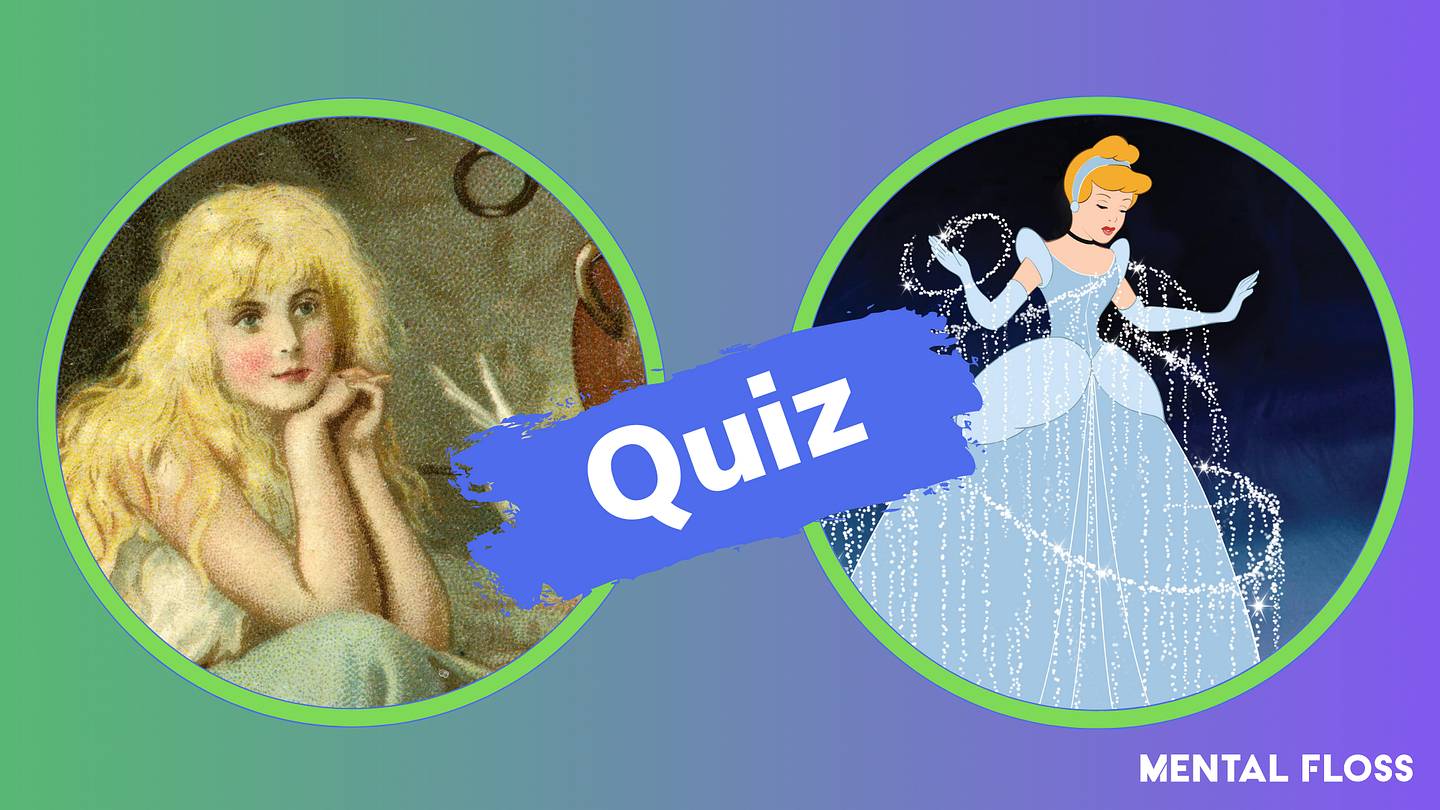
Think you know your Disney movies? Excellent. Now let’s see whether you can spot the older stories hiding behind the castles, talking animals, dramatic staircases, and suspiciously catchy songs. Disney has built some of its most beloved films from fairy tales, legends, folktales, literary stories, and myths that existed long before anyone animated a pumpkin carriage or gave a crab a Caribbean accent.
This Disney fairy tales quiz is designed for fans who love the movies but also enjoy discovering what came before them. Some answers are easy enough for a casual viewer. Others are sneaky little storybook goblins. You may know that Snow White and the Seven Dwarfs came from the Brothers Grimm, but what about Frozen? Is Mulan technically a fairy tale? And does Aladdin come from the original Arabic manuscript of One Thousand and One Nights, or is the story’s history a little messier than a magic carpet in a wind tunnel?
Grab your imaginary quill, polish your glass slipper, and keep an eye on any suspicious spinning wheels. It is time to test your knowledge of Disney films inspired by fairy tales and classic stories.
Why Disney Keeps Returning to Fairy Tales
Fairy tales are built for reinvention. They are short, symbolic, flexible, and full of big emotional ideas: jealousy, courage, transformation, family conflict, identity, sacrifice, and hope. That makes them perfect raw material for animation. A filmmaker can take a centuries-old story, soften the darker edges, add music, invent comic sidekicks, and suddenly a tale once told beside a fireplace becomes a global blockbuster.
Disney did not simply copy old stories. The studio often reshaped them for a new audience. In many traditional versions, the tone is sharper, stranger, and more morally direct. Disney’s versions usually emphasize romance, comedy, family-friendly adventure, visual wonder, and emotional optimism. In other words, the old tales brought the bones, and Disney brought the Broadway number.
That is why a quiz about fairy tale origins is more than trivia. It is a miniature tour through storytelling history. Behind every singing princess or enchanted object is a trail of authors, oral traditions, translators, collectors, and cultures that kept these stories alive.
How to Play This Disney Fairy Tales Quiz
Each question names a Disney film. Your job is to identify the fairy tale, folktale, legend, or literary source that helped inspire it. Some questions include multiple-choice answers. Others ask you to match the film to the correct original story. Keep score as you go:
- 10–12 correct: Royal Archivist of the Magic Kingdom
- 7–9 correct: Fairy-Tale Detective With Excellent Hair
- 4–6 correct: Apprentice Story Wizard
- 0–3 correct: Still invited to movie night, but please stop trusting talking mirrors
The Quiz: Name the Fairy Tales Behind These Disney Films
1. Snow White and the Seven Dwarfs
Which story inspired Disney’s first full-length animated feature?
- Little Snow-White
- The Snow Queen
- The Goose Girl
- The Twelve Dancing Princesses
Answer: A. Little Snow-White. Disney’s 1937 film was inspired by the Grimm fairy tale commonly known as Snow White. The core ingredients are all there: a jealous queen, a magic mirror, a young heroine, a forest escape, and seven small companions. Disney made the dwarfs more individual and comedic, giving them distinct names and personalities. The result helped define the animated fairy-tale film for generations.
2. Cinderella
Which famous fairy-tale version most strongly shaped Disney’s Cinderella?
- The Little Glass Slipper by Charles Perrault
- Beauty and the Beast by Madame de Villeneuve
- Rapunzel by the Brothers Grimm
- The Snow Queen by Hans Christian Andersen
Answer: A. The Little Glass Slipper. Cinderella stories exist around the world, but Disney’s 1950 version draws heavily from Charles Perrault’s elegant French telling. Perrault’s version helped popularize key elements such as the fairy godmother, pumpkin carriage, royal ball, and glass slipper. The Grimm version, called Aschenputtel, is much rougher around the edges. Let’s just say Disney wisely chose sparkle over nightmare fuel.
3. Sleeping Beauty
Disney’s Sleeping Beauty is connected to which older tales?
- The Sleeping Beauty in the Wood and Briar Rose
- The Little Mermaid and The Snow Queen
- The Frog Prince and Rumpelstiltskin
- East of the Sun and West of the Moon
Answer: A. The Sleeping Beauty in the Wood and Briar Rose. Disney’s 1959 film blends the broader Sleeping Beauty tradition, especially versions by Charles Perrault and the Brothers Grimm. The familiar pieces include the royal celebration, the offended fairy or enchantress, the spinning wheel curse, the long sleep, and the prince who reaches the hidden princess. Disney added grand visual style, Tchaikovsky-inspired music, and one of animation’s most unforgettable villains: Maleficent.
4. The Little Mermaid
Which author wrote the literary fairy tale that inspired Disney’s undersea classic?
- Hans Christian Andersen
- Jacob Grimm
- Charles Perrault
- Lewis Carroll
Answer: A. Hans Christian Andersen. Disney’s 1989 The Little Mermaid was inspired by Andersen’s 1837 tale. The original story is more bittersweet and spiritual than the animated film, focusing on longing, transformation, and the mermaid’s desire for a different kind of existence. Disney transformed that material into a colorful musical adventure with Ariel, Sebastian, Flounder, Ursula, and enough oceanic drama to make every beach vacation feel slightly theatrical.
5. Beauty and the Beast
Which fairy tale inspired Disney’s Beauty and the Beast?
- Beauty and the Beast
- The Frog Prince
- Bluebeard
- Donkeyskin
Answer: A. Beauty and the Beast. The story was first published in a long version by Gabrielle-Suzanne Barbot de Villeneuve in 1740 and later became widely known through Jeanne-Marie Leprince de Beaumont’s shorter 1756 adaptation. Disney’s 1991 film keeps the central idea of looking beyond appearances but adds enchanted household objects, musical numbers, a book-loving heroine, and a villain whose ego could probably rent its own castle.
6. Aladdin
Which story is Disney’s Aladdin most closely connected to?
- Aladdin and the Magic Lamp
- Ali Baba and the Forty Thieves
- Sinbad the Sailor
- The Fisherman and the Jinni
Answer: A. Aladdin and the Magic Lamp. The story is associated with One Thousand and One Nights, often called The Arabian Nights, though its textual history is complicated. It was introduced to European readers through Antoine Galland’s French translation, based on a tale he heard from the Syrian storyteller Hanna Diyab. Disney’s 1992 film turns the tale into a fast-moving adventure with a magical lamp, a powerful genie, a street-smart hero, and a flying carpet that somehow has more personality than many human characters.
7. Mulan
Trick question: Is Mulan based on a European fairy tale?
- Yes, it is from the Brothers Grimm
- No, it is inspired by the Chinese Ballad of Mulan
- Yes, it is from Charles Perrault
- No, it was invented entirely by Disney
Answer: B. Mulan is inspired by the Chinese Ballad of Mulan. It is better described as a legend or ballad than a fairy tale. The core story follows a young woman who takes her father’s place in the army and serves bravely while disguised as a man. Disney’s 1998 version adds songs, a dragon sidekick, humor, and a strong coming-of-age arc. So yes, this one belongs in the quizbut only if we allow the “fairy tale” category to stretch like Mushu trying to look intimidating.
8. Tangled
Which classic tale inspired Disney’s Tangled?
- Rapunzel
- The Wild Swans
- The Princess and the Pea
- The Goose Girl
Answer: A. Rapunzel. Disney’s Tangled is a lively reimagining of the famous tower-and-hair story, best known from the Brothers Grimm. Earlier versions also exist, including the French tale Persinette. Disney keeps the tower, the long hair, and the controlling guardian figure, but gives Rapunzel a bright personality, magical hair, a frying pan, and a dream bigger than her tower window. The film is a strong example of how Disney updates older tales with modern humor and more active heroines.
9. Frozen
Which Hans Christian Andersen tale loosely inspired Frozen?
- The Snow Queen
- The Ice Maiden
- The Little Match Girl
- The Red Shoes
Answer: A. The Snow Queen. Disney’s Frozen is only loosely based on Andersen’s story. The original features a girl named Gerda who searches for her friend Kai after he falls under the influence of the Snow Queen. Disney changed the emotional center into a story about sisters, fear, love, and self-acceptance. That creative shift is why Frozen feels less like a direct adaptation and more like a new story grown from old icy roots.
10. The Princess and the Frog
Which classic fairy tale is part of the inspiration behind The Princess and the Frog?
- The Frog Prince
- The Brave Little Tailor
- The Twelve Brothers
- King Thrushbeard
Answer: A. The Frog Prince. Disney’s 2009 film draws on the famous frog-prince motif but gives it a New Orleans setting, a hardworking heroine named Tiana, jazz energy, and a fresh emotional message about ambition, love, and balance. The movie also owes a modern debt to The Frog Princess by E.D. Baker, which playfully reworked the old tale. Disney’s version proves that even a frog story can put on a sharp suit and dance through the bayou.
11. Pinocchio
Is Pinocchio based on a fairy tale collected by the Brothers Grimm?
- Yes
- No, it is based on Carlo Collodi’s Italian literary story
Answer: B. Pinocchio is based on Carlo Collodi’s The Adventures of Pinocchio, first published in Italy in the 1880s. It is not a Grimm fairy tale, though it shares fairy-tale qualities: transformation, moral tests, magical helpers, danger, temptation, and growth. Disney’s 1940 film softened and streamlined Collodi’s episodic story, creating one of the studio’s most iconic moral adventures. The lesson is simple: tell the truth, listen to your conscience, and avoid suspicious entertainment venues run by shady adults.
12. Hercules
Final trick question: Is Disney’s Hercules inspired by a fairy tale?
- Yes, it is a Grimm fairy tale
- No, it is inspired by Greek mythology
- Yes, it is from Hans Christian Andersen
- No, it is based on a modern novel
Answer: B. Hercules is inspired by Greek mythology, not a fairy tale. Disney’s 1997 version takes the ancient hero Heracles, changes plenty of details, and turns the mythic material into a bright musical comedy with gospel-style Muses and a fast-talking villain. This is a useful reminder: not every old story with monsters, magic, and destiny is a fairy tale. Some are myths, legends, ballads, epics, or literary fantasies.
Answer Key at a Glance
- Snow White and the Seven Dwarfs: Little Snow-White
- Cinderella: The Little Glass Slipper
- Sleeping Beauty: The Sleeping Beauty in the Wood / Briar Rose
- The Little Mermaid: Hans Christian Andersen’s The Little Mermaid
- Beauty and the Beast: Beauty and the Beast
- Aladdin: Aladdin and the Magic Lamp
- Mulan: The Ballad of Mulan
- Tangled: Rapunzel
- Frozen: The Snow Queen
- The Princess and the Frog: The Frog Prince
- Pinocchio: The Adventures of Pinocchio
- Hercules: Greek mythology
What This Quiz Reveals About Disney Storytelling
The most interesting thing about this Disney movie quiz is not simply whether you got the answers right. It is what the answers reveal about adaptation. Disney often begins with a recognizable story shape, then changes the emotional engine. A passive character may become more independent. A tragic or bittersweet ending may become hopeful. A frightening magical figure may become a theatrical villain with excellent branding. A brief old tale may expand into a full world with music, comedy, side characters, and visual spectacle.
That process can be controversial, but it is also the reason these stories keep traveling. Fairy tales have always changed. Before print, they shifted from teller to teller. Later, writers such as Perrault, the Brothers Grimm, Andersen, and others fixed certain versions on the page. Disney then fixed new versions on the screen. Today, fans remix them again through quizzes, cosplay, fan art, memes, classroom discussions, and late-night debates about whether a magic mirror counts as the worst royal advisor in fiction.
The best way to enjoy Disney fairy-tale origins is to see both versions clearly. The film is not the whole story, and the older story is not automatically “better” just because it came first. They are related works built for different audiences, different eras, and different expectations. The fun is in comparing them.
Experience Corner: Hosting a Disney Fairy-Tale Quiz Night
A Disney fairy-tale quiz works surprisingly well as a party game, classroom activity, family-night challenge, or online post because almost everyone recognizes at least a few of the movies. The trick is to make the questions easy enough to invite casual fans but clever enough to reward people who know the original tales. That balance keeps the quiz from feeling like homework wearing mouse ears.
One of the best ways to run the quiz is to divide it into rounds. Start with the obvious classics: Snow White, Cinderella, Sleeping Beauty, and The Little Mermaid. These warm-up questions build confidence. Most players will guess a few correctly, and the room quickly fills with that wonderful sound of people saying, “Oh, I knew that one!” even when they absolutely did not know that one.
The second round should introduce the trickier titles. Frozen is perfect because many viewers know Elsa and Anna but may not know the connection to The Snow Queen. Mulan also creates a great discussion because it is not really a European fairy tale. It comes from a Chinese ballad tradition, which helps players understand that Disney inspiration reaches beyond castles and glass slippers. Aladdin is another excellent curveball because its relationship with One Thousand and One Nights is more complex than many people assume.
For a more interactive experience, show a still image or give a clue before revealing the film title. For example, “This story involves a forbidden tower, unusually useful hair, and a guardian with control issues.” Most players will shout “Rapunzel!” before you finish the sentence. Another clue could be, “This heroine trades one world for another and has a very complicated relationship with her voice.” That points to The Little Mermaid, though someone will inevitably yell “Ariel!” with the urgency of a game-show contestant who has consumed too much soda.
To make the quiz more memorable, add mini-explanations after each answer. Don’t just say, “Correct, it was Andersen.” Explain that Andersen’s version of The Little Mermaid is more bittersweet than Disney’s musical romance. Mention that Disney’s Beauty and the Beast expands the older tale by turning household objects into comic characters. Point out that Disney’s Cinderella uses many elements associated with Perrault’s version, especially the fairy godmother and glass slipper.
The best part of this experience is watching people realize that the Disney films they grew up with are part of a much older storytelling chain. A quiz can turn nostalgia into curiosity. Suddenly, a person who only came for snacks and cartoon trivia wants to read The Snow Queen or compare Grimm’s Rapunzel with Tangled. That is the magic of a well-made fairy-tale quiz: it entertains first, then quietly opens a door into literature, folklore, and cultural history.
Conclusion
So, how did you score? Whether you ruled the quiz like a royal librarian or stumbled through it like a prince who forgot which castle he was visiting, you now know more about the fairy tales and classic stories behind Disney films. From Snow White and Cinderella to Frozen, Tangled, Mulan, and Aladdin, Disney’s greatest hits often begin with older tales that have traveled across centuries, languages, and cultures.
The next time you watch a Disney movie, look past the songs and sparkle for a moment. Behind the animation may be a French salon tale, a German folktale, a Danish literary fairy tale, a Chinese ballad, an Italian children’s classic, or a myth from the ancient world. That hidden history makes the movies even more fun. After all, every good story has a backstoryand sometimes that backstory is wearing a cloak, carrying a lamp, or hiding in a tower with extremely marketable hair.
Note: This article is written as original, web-ready HTML body content for publication. It avoids source-link clutter in the article itself while remaining based on real Disney adaptation history and established fairy-tale scholarship.













