
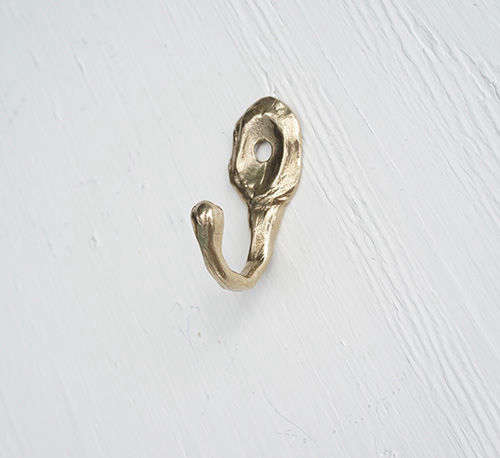
The Ramsey Conder Small Hook proves that an object does not need to dominate a room to change how that room feels. Measuring only about one inch by half an inch, this tiny piece of solid brass hardware combines everyday usefulness with the irregular character of a handmade object.
At first glance, it is simply a place to hang something. Look more closely, however, and it becomes a miniature sculpture, a lesson in traditional metalworking, and a reminder that even the humblest household hardware can have personality. It is small enough to disappear when not in use but distinctive enough to attract attention when the light catches its warm brass surface.
What Is the Ramsey Conder Small Hook?
The Ramsey Conder Small Hook is a compact wall hook made from solid, uncoated brass. According to the maker’s product information, it is produced through lost-wax casting and measures approximately 1 inch by 0.5 inch. The official listing places it at $28 at the time of writing, although prices and availability may change.
Those specifications sound almost comically modest. One inch is roughly the length of the first segment of an adult thumb. Yet that limited scale is part of the hook’s appeal. It is not trying to become an architectural handrail, a coat rack, or a piece of gym equipment. It is a carefully shaped point of utility intended for smaller belongings and visually sensitive spaces.
Because the manufacturer does not publish a clearly defined load rating on the product page, buyers should avoid making heroic assumptions about what it can support. It is better suited conceptually to keys, jewelry, lightweight accessories, small bags, kitchen loops, or decorative objects unless the maker confirms a heavier application.
A Functional Object With a Sculptural Identity
Ramsey Conder’s broader body of work includes lighting, furniture, cups, drawer pulls, shelf brackets, bathroom accessories, and other objects made from substantial materials such as brass, bronze, steel, wood, leather, and gold. The common theme is not a single decorative style. It is an interest in materials that can age visibly and acquire evidence of use.
The Small Hook fits neatly into that philosophy. Its form is organic rather than mechanically perfect. It does not resemble a generic piece of stamped hardware produced by the million. The surface retains the visual softness and slight irregularity associated with hand-shaped forms and casting.
That difference matters. Mass-produced hooks often attempt to erase their manufacturing history beneath flawless coatings. The Ramsey Conder Small Hook does the opposite. It lets the material and process remain part of the finished design. In other words, it is not embarrassed about where it came from.
Why the Small Scale Works
Oversized hardware creates an immediate statement, but a miniature hook offers something more subtle. It can be repeated in a row without making the wall look crowded. It can sit beside artwork, cabinetry, or handmade tile without fighting for attention. It can also solve a practical problem in a narrow location where a standard hook would appear bulky.
The hook behaves a little like punctuation in a room. One is a comma. Three become a sentence. Seven might be an essay, although at that point you should probably own several hats.
Why Lost-Wax Casting Makes a Difference
Lost-wax casting is an ancient process used to reproduce detailed forms in metal. In its simplest version, a model is created in wax and surrounded by a heat-resistant mold material. Heating removes the wax, leaving an empty cavity. Molten metal is poured into that cavity, allowed to cool, and then released by breaking or removing the surrounding mold.
The process is especially valuable for objects with curves, texture, and sculptural detail. It can capture qualities that would be difficult to achieve through basic stamping or bending. Depending on the production method, small variations may remain from one cast or finishing session to another.
For the Ramsey Conder Small Hook, lost-wax casting helps explain why such a simple item feels more like a designed object than a standard utility fitting. The hook begins with a modeled form rather than a flat industrial blank. Its shape appears to have grown into a hook instead of being forced into one by a machine with no patience for artistic drama.
The technique also connects an ordinary household accessory to a metalworking tradition used for sculpture and decorative art across many cultures. You are not buying a museum bronze, obviously, but the family resemblance in process is real.
Solid Uncoated Brass and the Beauty of Patina
Brass is generally an alloy of copper and zinc. Its exact characteristics depend on the proportions and additional elements used, but brass is widely appreciated for its workability, strength, corrosion resistance, and warm appearance.
The Small Hook is described as uncoated. That detail is important because uncoated brass changes as it encounters air, moisture, skin oils, cleaning products, and ordinary household life. A new piece may begin with a brighter golden tone. Over time, it can become darker, softer, browner, or unevenly polished where fingers touch it most frequently.
This evolving surface is known as patina. Some homeowners love it because it gives the object depth and makes every installation slightly different. Others prefer brass to remain bright and regularly polish it. Neither approach is automatically correct. The meaningful question is whether you want a finish that records time or one that repeatedly returns to showroom condition.
Patina Is Not a Manufacturing Defect
Natural darkening on unlacquered brass should not be confused with paint peeling or plating failure. There is no clear topcoat to flake away. The metal itself is reacting to its environment.
In a dry bedroom, the change may happen gradually. In a humid bathroom or frequently used entryway, the surface may develop character more quickly. Fingerprints can temporarily appear, producing a tiny historical archive of everyone who forgot to use the hook and poked it instead.
Where the Ramsey Conder Small Hook Works Best
Entryway Organization
A row of small brass hooks can provide a dedicated place for keys, pet leashes, lightweight tote bags, or reusable shopping pouches. Their compact profile is useful in a narrow entrance where larger hooks might catch sleeves or make the wall look busy.
Bedroom and Closet Details
In a bedroom, the hook can hold necklaces, bracelets, a fabric pouch, or a lightweight scarf. Several hooks arranged inside a closet door can turn unused vertical space into an orderly accessory station. Because jewelry can scratch metal and metal can scratch jewelry, delicate pieces should be placed carefully rather than tossed on with Olympic enthusiasm.
Kitchen Utility
The hook can be considered for utensils with hanging loops, a small oven mitt, measuring spoons, or a decorative brush. Brass pairs especially well with wood cabinetry, natural stone, plaster walls, handmade tile, and deep paint colors.
In food-preparation areas, placement matters. Keep it away from direct heat, heavy grease, and locations where a hanging item could interfere with a burner, appliance door, or walkway.
Bathroom Storage
Its warm finish can complement bathroom mirrors, faucets, cabinet pulls, and lighting. A small hook may work for a jewelry pouch, hand towel loop, grooming accessory, or lightweight robe tie. Constant moisture will accelerate surface changes, so buyers should be comfortable with patina before installing uncoated brass in a steamy room.
Decorative Displays
The hook can become part of a wall arrangement rather than functioning only as storage. It might support a tiny woven object, dried botanical bundle, seasonal ornament, or handmade cord. Repeating several hooks at irregular heights can produce a display that feels informal and collected.
How to Style the Hook Without Overdoing It
The Ramsey Conder Small Hook has enough character to work alone, but it becomes especially effective when placed in conversation with other materials. Warm brass looks inviting against dark green, navy, charcoal, terracotta, cream, and natural wood. It also contrasts beautifully with cooler surfaces such as white tile or gray stone.
Matching every metal finish in the room is unnecessary. A brass hook can coexist with blackened steel lighting, polished nickel plumbing, or stainless-steel appliances when the combination appears intentional. Repeating the brass in one or two additional details often helps, but turning the room into a brass showroom is not required.
Scale should guide spacing. Because the hook is very small, a single piece can look lost on a large empty wall. Positioning it beside a doorframe, cabinet, mirror, shelf, or artwork gives it a visual relationship to something larger. When installing a row, test the arrangement with removable paper markers before drilling.
Installation Considerations
A beautiful hook is only useful when the wall connection is secure. The correct installation method depends on the wall material, the hook’s mounting design, the fastener, and the weight of the intended object.
Mounting directly into a wood stud or solid blocking generally provides a more dependable connection than attaching only to a thin wall surface. For drywall, an appropriately rated anchor may be necessary. Plaster, masonry, tile, and hollow doors require different fasteners and drilling methods.
Before installation, buyers should confirm whether mounting hardware is included and ask the maker or retailer for specific guidance. The screw head should fit the hook properly, and the fastener must be compatible with the wall. Avoid overtightening, which can damage the wall, strip an anchor, or place unnecessary stress on the hardware.
Tile installation deserves particular care because drilling in the wrong place can crack the surface or damage waterproofing. When the location involves plumbing, electrical wiring, or an uncertain wall structure, professional installation is the sensible choice. A one-inch hook should not create a six-foot repair project.
Cleaning and Caring for Uncoated Brass
For routine care, start with the gentlest approach: dust the hook and wipe it with a soft, dry cloth. When necessary, use a slightly damp cloth with mild soap, then dry the surface thoroughly.
Avoid abrasive pads, aggressive scraping, and harsh cleaners that may scratch the metal or cause uneven coloration. Household polishing mixtures can behave unpredictably on textured surfaces, especially when residue collects in small recesses.
Owners who enjoy the natural patina can simply let the brass age. Those who prefer a brighter finish may use an appropriate brass polish according to its instructions after confirming that the product is solid brass. Polishing should be deliberate rather than compulsive. Otherwise, caring for the hook can become a second job, and it does not offer dental coverage.
Is a $28 Small Hook Worth It?
Compared with basic hardware-store hooks, $28 for one tiny hook is undeniably a premium price. The value depends on what the buyer expects to receive.
A low-cost hook is mainly purchased for function. The Ramsey Conder Small Hook adds handmade character, solid brass construction, a traditional casting process, and a surface intended to become more personal with age. Those qualities can justify the cost when the hook will remain visible and contribute to the room’s overall design.
It is less convincing for hidden storage, a temporary rental solution, or a utility area where dozens of inexpensive hooks are required. Installing twenty would create an impressive wall, but it would also create a $560 conversation with your budget.
Who Is Most Likely to Appreciate It?
The Small Hook is best suited to homeowners, designers, and collectors who appreciate handcrafted hardware, organic forms, honest materials, and finishes that evolve. It may not appeal to someone who wants every piece of metal to remain perfectly uniform and permanently untouched by time.
Final Verdict
The Ramsey Conder Small Hook transforms a basic household necessity into a quiet design feature. Its success comes from the combination of compact scale, solid uncoated brass, lost-wax casting, and a form that feels shaped rather than manufactured.
It will not reorganize an entire home by itself. It may, however, make one overlooked corner feel more thoughtful. In interior design, that is often how meaningful improvement begins: not with a demolition crew, but with one excellent detail placed exactly where it belongs.
The Experience of Living With a Ramsey Conder Small Hook
Because long-term experience varies by placement and use, the most realistic way to evaluate the Ramsey Conder Small Hook is to imagine how it behaves through an ordinary year rather than pretending it remains frozen in a product photograph.
On the first day, the hook is likely to attract more attention than its size suggests. The brass appears warm and substantial, especially beside painted wood, plaster, tile, or natural stone. The curved shape creates small highlights and shadows as the light changes. Visitors may not immediately identify it as a designer object, but they may notice that the wall hardware feels unusually tactile.
The first practical adjustment is learning what belongs on such a compact hook. Bulky coats and overloaded backpacks are poor choices without verified load guidance. Keys, jewelry, lightweight accessories, and small looped objects feel more appropriate. Once a specific purpose is assigned, the hook becomes part of a routine. Keys stop wandering around the house. A favorite necklace no longer disappears into a drawer. A kitchen brush finally receives an address.
During the first few weeks, fingerprints may appear on the bright brass. Someone expecting a permanently flawless finish could find this irritating. Someone who understands uncoated brass may find it encouraging. The hook is beginning to respond to its surroundings rather than merely occupying them.
After several months, the most frequently touched areas may remain brighter while recessed portions darken. This contrast can make the shape easier to read. In a dry room, the transformation may remain subtle. In a bathroom, kitchen, or coastal environment, the color may develop more quickly and unevenly.
The hook also changes the experience of nearby objects. A simple canvas pouch looks more considered when hung from sculptural brass. A handmade towel gains a warm metallic accent. Even a plain set of keys looks oddly important, as though it has been promoted to management.
There may be occasional frustrations. The small size requires accurate installation. A poorly chosen location can make it inconvenient, while an unsuitable anchor can undermine confidence in the setup. The organic surface may not align with someone who prefers perfectly machined minimalism. Bright-finish enthusiasts may also discover that regular polishing is less romantic than it sounded while shopping.
Yet the strongest experience is usually one of gradual familiarity. The hook stops feeling like a new purchase and begins to feel like part of the building. Its patina records repeated gestures: reaching for keys, hanging a scarf, removing a necklace, or returning a small tool to its place.
That quiet relationship is the real argument for handcrafted hardware. The Ramsey Conder Small Hook is not valuable because it performs a complicated task. It is valuable because it performs a simple task with unusual material presence. Over time, the owner does not merely use the hook. The owner participates in finishing it.
SEO Metadata
</section














