
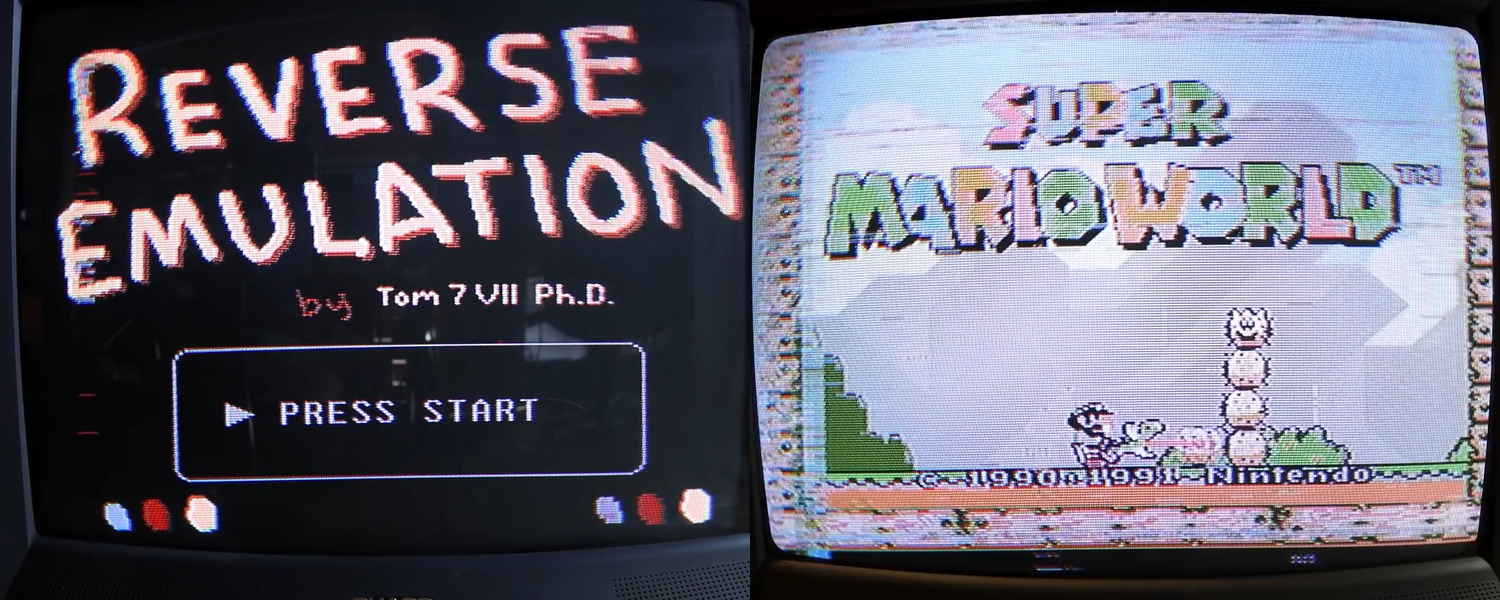
Some hacks make you say, “That’s clever.” Others make you stare at a gray plastic box from the 1980s and whisper, “Wait… did the Nintendo just swallow another Nintendo?” Reverse-Emulating NES: Nintendception! belongs firmly in the second category. It is a wonderfully absurd hardware experiment where a real Nintendo Entertainment System is not merely emulated by a modern computer. Instead, a modern computer hides inside a cartridge and feeds the original NES hardware new information in real time, like a tiny cybernetic lunchbox whispering secrets into a very old console.
The idea became famous through Tom Murphy VII, also known as Tom7, whose “reverse emulation” project demonstrated full-motion video and even Super NES-style gameplay appearing through an unmodified NES console. The console itself was not replaced, bypassed, or turned into a decorative toaster. The magic happened through the cartridge slot, where the NES normally expects static game code and graphics. In this project, however, the cartridge became a living, thinking, Raspberry Pi-powered trickster.
To understand why this is so delightful, we need to talk about what the NES expects, what a normal emulator does, and why “reverse emulation” is such a deliciously weird phrase. Buckle up. We are going deep into 8-bit architecture, cartridge mappers, graphics timing, and the philosophical question that has haunted humanity since the dawn of plug-in game cartridges: if a Super Nintendo game appears on an NES, did the NES play it, or did the cartridge do all the homework while the console took credit?
What Does “Reverse-Emulating NES” Actually Mean?
Normally, NES emulation means using software on a modern computer to imitate the old Nintendo Entertainment System. The emulator recreates the NES CPU, graphics chip, audio behavior, controller input, memory map, cartridge mapper behavior, and all the fussy timing details that make retro game development both charming and slightly cursed.
Reverse emulation flips that idea inside out. Instead of a computer pretending to be an NES, the real NES remains in the loop. A modern device acts like a supercharged cartridge, feeding the console data at the exact moment the NES expects to read it. The NES is still producing the video signal. The controllers are still connected to the console. The old hardware still matters. But the cartridge is no longer a passive memory box. It becomes a dynamic computing partner.
In Tom7’s famous version, a Raspberry Pi was placed into a custom NES cartridge setup. The Pi could compute graphics on the fly, translate output from other systems, and present data to the NES as though the console were reading ordinary cartridge graphics. In plain English: the cartridge became a tiny stage crew changing the scenery faster than the audience could blink.
Why the NES Cartridge Slot Is the Secret Door
The NES is a beautifully constrained machine. Its CPU, a Ricoh 2A03 in NTSC systems, is based on the 6502 family and runs at roughly 1.79 MHz. That number looks adorable next to modern processors, but the NES did not become legendary by brute force. It became legendary through clever architecture, especially the partnership between the CPU, the Picture Processing Unit, and the cartridge.
Unlike many later systems, the NES often reads graphics data directly from the cartridge. The graphics chip, commonly called the PPU, fetches tile graphics from a region usually supplied by CHR-ROM or CHR-RAM on the cartridge. Games are built from 8-by-8 pixel tiles, and the console assembles backgrounds and sprites from those tiles. This tile-based design saves memory, which mattered a lot when every byte was treated like it paid rent.
That direct relationship between PPU and cartridge is the key. If the cartridge can provide different tile data at different moments, then the NES can be persuaded to display graphics that were not sitting permanently in a traditional ROM chip. The console thinks it is asking for graphics. The custom cartridge replies, “Sure, here is exactly the graphic you wanted, freshly cooked.”
The Role of Mappers: Nintendo’s Original Cartridge Superpowers
NES cartridges were never just plastic shells with memory inside. Many included extra hardware called mappers. A mapper changes how the console sees memory, allowing larger games, save RAM, bank switching, special scrolling tricks, and sometimes extra sound features. Without mappers, many beloved late-era NES games would have been squeezed down into simpler, smaller forms. Imagine trying to fit a mansion into a shoebox. Mappers made the shoebox suspiciously bigger on the inside.
That is why Tom7’s project is best understood as an extreme mapper experiment. A normal mapper might swap one bank of graphics for another. A wildly advanced reverse-emulation cartridge can generate or transform graphics dynamically. It is still using the console’s original pathways, but it stretches the concept until the NES starts doing things it was never commercially designed to do.
This is where the “Nintendception” joke lands. The NES is not simply running a standard NES game. It is being fed data from a modern device that may be running another emulator, translating another system’s graphics, and then squeezing the result into the NES display model. It is a game system inside a game system inside a technical joke wearing a cartridge costume.
How Super NES Graphics Can Appear on an NES
The most eye-catching part of the reverse-emulation demo was the appearance of Super Mario World-style gameplay through an NES. To be precise, the NES was not magically transformed into a Super Nintendo. The SNES game logic and rendering work were handled by the Raspberry Pi. The output then had to be converted into a form the NES could display.
That distinction matters. The NES has stricter color and tile limitations than the SNES. It cannot simply accept a modern framebuffer like a monitor. It wants tiles, palettes, name tables, sprites, and timing that match its own architecture. So the Pi’s job was not merely “play SNES game.” It was more like “play SNES game, reinterpret the visual output, predict what the NES will ask for, and answer quickly enough that the 1980s hardware does not panic.”
This is why the project is technically impressive even when the output is imperfect. The NES is picky. The PPU fetches data according to a strict rhythm. If the custom cartridge is late, wrong, or jittery, the screen shows glitches. Those glitches are not failures in spirit; they are visible battle scars from trying to make a general-purpose computer impersonate cartridge memory in real time.
Full-Motion Video on NES: The Tile Trick Goes Hollywood
Before you even get to SNES-style output, full-motion video on an NES is already a fabulous stunt. The NES was not built to stream video like a modern device. It was built to reuse tiles efficiently. But if you keep changing the tile data quickly enough, the result can resemble animation or video.
In a traditional NES game, tiles are like reusable stickers. A brick tile can appear many times on a screen. A grass tile can fill a whole field. A character sprite can be assembled from a handful of small graphic pieces. In reverse emulation, the cartridge can keep changing what those tiles contain, almost like replacing the stickers while the player is looking at them. Do it carefully and repeatedly, and the NES shows images that feel much more dynamic than a normal cartridge would allow.
Of course, the NES still enforces its own personality. Limited palettes, tile boundaries, and timing constraints remain part of the aesthetic. The result is not smooth 4K video. It is more like convincing a calculator to perform Shakespeare: technically unreasonable, emotionally moving, and a little crunchy around the edges.
Why Timing Is the Villain Wearing a Lab Coat
The hardest part of a project like this is not the basic idea. The basic idea is simple enough to explain at a dinner party, although you may not be invited back. The hard part is timing.
A real cartridge ROM responds extremely quickly and predictably. When the NES asks for a byte, the ROM does not open a calendar app, check its notifications, and think about brunch. It just presents the data. A Raspberry Pi, by contrast, is a powerful little computer that normally runs an operating system and handles many tasks. That is great for flexibility but awkward for cycle-perfect bus behavior.
To make reverse emulation work, the custom cartridge must watch address lines, predict or detect what the console is reading, and place the correct data on the bus quickly enough. If the system has to guess ahead, a wrong guess can create visual artifacts. If the response timing varies, the NES exposes it immediately on screen. Retro hardware is not polite. It does not hide your mistakes; it decorates them in pixels.
Why This Is Different From Just Putting a Mini Computer in a Cartridge
There is a less interesting way to “run anything on an NES”: put a tiny computer inside a cartridge, ignore most of the console, and output video separately. That is not the same trick. In a real reverse-emulation project, the NES remains responsible for important work. The display comes through the NES. The cartridge communicates through the cartridge interface. The console is not merely a plastic case with nostalgia fumes inside.
That is why the project sparked debate among emulator developers and retro hardware fans. Is the NES “running” the game? Is the cartridge running it? Is it an NES game if the majority of computation happens in the cartridge? These questions sound silly until you remember that many real cartridges used extra chips. Super Mario Bros. 3, Kirby’s Adventure, Castlevania III, and many other classics depended on cartridge-side hardware to expand what the base console could do.
Reverse emulation simply takes that tradition to a hilarious extreme. If a mapper chip is a helpful assistant, a Raspberry Pi cartridge is a full production company with catering.
The Philosophy of Nintendception
The best hacks are not only technical demonstrations. They are arguments disguised as blinking electronics. Reverse-Emulating NES: Nintendception! asks us to reconsider where a console ends and a cartridge begins.
In the cartridge era, the game cartridge was part software and part hardware. It could contain memory, special chips, copy-protection components, save batteries, and mapper logic. The console was a platform, but each cartridge could reshape that platform. This is different from modern downloadable games, where hardware boundaries are more fixed and the software environment is more standardized.
So when a custom cartridge gives an NES “superpowers,” it is not completely alien to the spirit of the machine. It is an exaggerated version of something NES developers were already doing: using cartridge hardware to cheat limitations with elegance, desperation, and the occasional electrical gremlin.
What Builders Can Learn From This Project
1. Old Hardware Is More Flexible Than It Looks
The NES looks simple because it is old. That is a mistake. Old hardware often exposes low-level signals and behaviors that modern systems hide behind layers of abstraction. The cartridge connector gives builders access to the machine in a very direct way. That directness makes the NES both fragile and surprisingly hackable.
2. Constraints Create Creativity
Modern developers can throw memory, GPU power, and storage at problems. NES hackers cannot. They must think in tiles, banks, cycles, and palettes. Reverse emulation is exciting because it adds modern computing power without erasing the original constraints. It is not about making the NES disappear. It is about dancing with its limitations while wearing rocket boots.
3. Emulation Is Not Only Software
When people hear “emulator,” they usually think of a program on a laptop. But emulation is broader than that. A circuit can emulate a ROM. A mapper can emulate memory behavior. A cartridge can emulate the data patterns expected by a PPU. Reverse emulation reveals that the boundary between software emulation and hardware impersonation is delightfully blurry.
4. “Because It’s Funny” Is a Valid Engineering Goal
Not every project needs a business model, a productivity angle, or a pitch deck featuring the phrase “synergistic retro innovation.” Sometimes the purpose is to prove that an idea is possible, strange, and funny. That does not make it less valuable. Playful engineering often teaches more than safe engineering because it wanders into corners nobody was paid to inspect.
Practical Challenges Behind a Reverse-Emulated NES
Anyone tempted to build a similar project should understand that this is not beginner-level soldering with a cheerful “just connect wire A to nostalgia point B” diagram. A reverse-emulation cartridge requires knowledge of digital logic, voltage levels, bus timing, NES memory behavior, cartridge pinouts, PPU fetch patterns, and probably the emotional resilience to watch a screen fill with corrupted tiles at 2 a.m.
Hardware protection matters too. The NES is old. Cartridges are old. Some components are no longer easy to replace. A mistake on the bus can damage hardware. Safe level shifting, careful testing, and a conservative design approach are essential. The goal is to give the NES superpowers, not turn it into a commemorative smoke machine.
There is also a legal and ethical side. Studying hardware, writing homebrew code, and experimenting with personally owned equipment are very different from distributing copyrighted ROMs. A responsible reverse-emulation article should say this clearly: enjoy the engineering, respect intellectual property, and do not confuse technical curiosity with permission to pirate commercial games.
Why Retro Developers Still Care
The NES remains popular among homebrew developers because it offers a rare combination of simplicity, documentation, community knowledge, and cultural affection. Modern tools make it easier to write 6502 assembly, design tiles, test ROMs in emulators, and flash cartridges for real hardware. Yet the platform still refuses to become boring.
Reverse emulation pushes NES homebrew discussion into deeper territory. It forces developers to ask how much cartridge hardware is “allowed” before a project stops feeling like an NES game. Some purists prefer tight limits: standard mappers, modest ROM sizes, authentic constraints. Others enjoy pushing cartridge-side hardware as far as possible. Both approaches are valid. One preserves the traditional challenge; the other explores the platform as a living laboratory.
That tension is healthy. Without purists, retro development loses its discipline. Without experimenters, it loses its spark. Nintendception sits right in the delightful danger zone between “technically legitimate” and “this is nonsense, please continue.”
Experiences Related to Reverse-Emulating NES: What It Feels Like at the Workbench
The experience of exploring reverse-emulating NES concepts is a mix of archaeology, electrical engineering, and comedy performed for an audience of unforgiving pixels. You begin with a simple thought: “The NES reads graphics from the cartridge. What if the cartridge changed those graphics constantly?” Five minutes later, you are reading about PPU address lines, bus conflicts, nametable mirroring, CHR memory, and why a machine older than many software engineers has the timing standards of a Swiss train conductor.
The first emotional stage is optimism. You look at the NES architecture and think, “This is only an 8-bit console. How hard can it be?” This is the same sentence that has launched many noble disasters. The second stage is humility. You realize that the NES may be simple, but it is not vague. Every cycle matters. Every address range has a purpose. The PPU does not care about your intentions. If you provide the wrong byte at the wrong time, it will paint your failure directly onto the television.
Working through the idea also changes how you see old games. Suddenly, background tiles are not just graphics. They are evidence of a clever storage strategy. Sprite flicker is not merely a flaw. It is the visible result of hardware limits. Mapper chips are not obscure trivia. They are the reason later NES games feel bigger, smoother, and more ambitious than early titles. The cartridge stops looking like a storage device and starts looking like an expansion bus with a plastic jacket.
There is also a wonderful “aha” moment when reverse emulation clicks conceptually. The NES does not need to know that a Raspberry Pi, FPGA, or other device is calculating graphics. It only needs the right signals at the right time. From the console’s perspective, data is data. That realization is powerful. It is the same principle behind many hardware hacks: if you can satisfy the interface, you can transform the behavior.
At the same time, the experience teaches respect for real-time systems. Modern programming often hides timing behind operating systems, APIs, buffering, and fast processors. Retro hardware does not offer that cushion. It asks for immediate answers. This makes projects like Nintendception feel almost physical. You are not just writing code; you are negotiating with electricity.
For writers, makers, and retro fans, the biggest takeaway is not “go build a Raspberry Pi NES cartridge tomorrow.” The takeaway is that old systems still contain unexplored creative space. A console from the 1980s can still surprise us because its limitations are not walls; they are rules for a very strange game. Reverse-emulating the NES is funny because it is excessive, but it is inspiring because it proves that deep knowledge can turn a fixed machine into a flexible instrument.
And yes, there is something emotionally satisfying about seeing a humble NES become the display endpoint for a system-within-a-system trick. It feels like watching a grandparent casually solve a modern puzzle after pretending not to understand smartphones. The NES may be old, but with the right cartridge whispering in its ear, it can still make the room gasp.
Conclusion: Nintendception Is More Than a Party Trick
Reverse-Emulating NES: Nintendception! is funny, nerdy, technically rich, and weirdly profound. It combines modern computing with original Nintendo hardware in a way that honors the NES instead of replacing it. The project works because the NES cartridge was always more than a container for code. It was a hardware partner, a memory mapper, a graphics supplier, and sometimes a sneaky little expansion system.
By pushing that idea to the extreme, reverse emulation shows why retro computing remains exciting. The point is not to outperform modern consoles. That would be like entering a lawn mower in Formula 1 and then acting surprised. The point is to understand a classic machine so deeply that you can bend its assumptions without breaking its soul.
Nintendception reminds us that the most interesting technology stories often happen at the boundary between “impossible” and “pointless.” That is where creativity lives. That is where engineers giggle. And that is where an old NES, armed with a wildly overqualified cartridge, can briefly become something stranger, smarter, and more magical than Nintendo ever intended.
Note: This article is based on real public technical information about NES architecture, cartridge mappers, emulation practices, and Tom7’s reverse-emulation project. Source links are intentionally not inserted into the article body as requested.














