
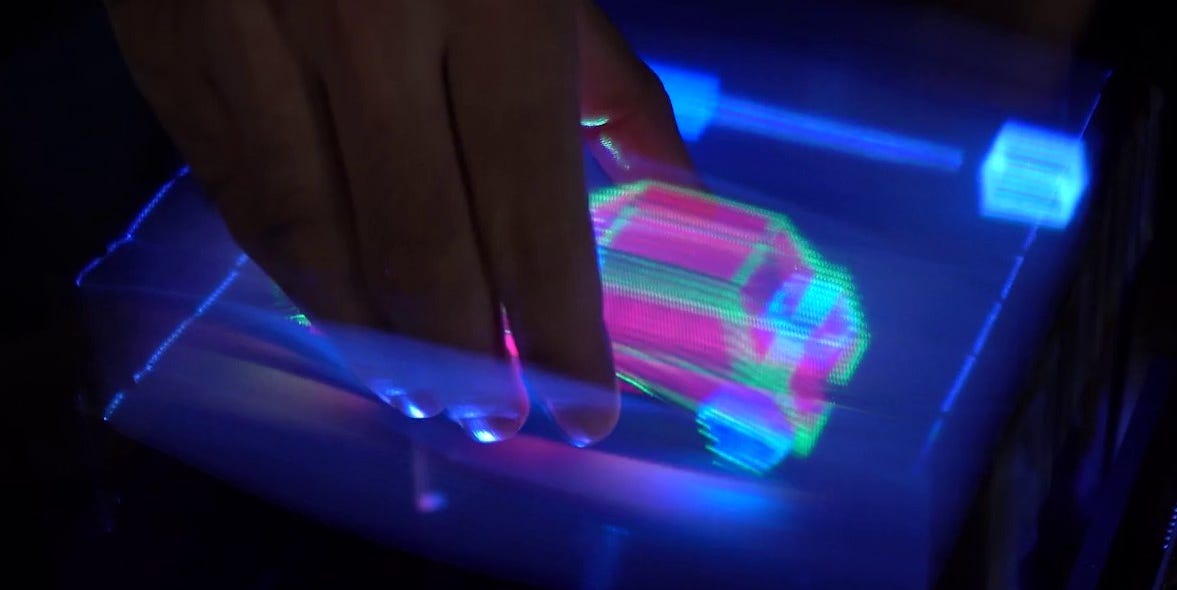
For decades, holograms have been the dependable overachievers of science fiction. They pop up in movies, hover above tables, spin obediently in mid-air, and let some genius in a very dramatic jacket pinch, drag, and resize a glowing spaceship as if the laws of physics had politely stepped out for coffee. In real life, however, most “holograms” have been more like very impressive stage magic: beautiful to look at, less impressive when you try to poke them.
That is beginning to change. Researchers have developed a new kind of interactive 3D display that lets people reach into a floating image and manipulate virtual objects directly with their hands. The system, known as FlexiVol, is not a Hollywood holodeck yet, and it will not let you slap a holographic alarm clock across the room on Monday morning. But it does mark a major step toward hands-on holograms: three-dimensional graphics that appear in physical space and respond to natural gestures like grabbing, pushing, rotating, and dragging.
The breakthrough is exciting because it tackles one of the biggest problems in volumetric display technology: how to let people interact with 3D images without breaking the display, injuring their fingers, or requiring a glove, headset, controller, wand, or suspiciously expensive gadget with a charging cable that will vanish in two weeks.
What Did Scientists Actually Build?
The researchers built a reach-through volumetric display, a type of system that creates true 3D graphics viewable from multiple angles without virtual reality goggles. While people often call these images “holograms,” the more precise technical term is volumetric display. Instead of showing a flat image that tricks the eyes into seeing depth, a volumetric display creates the appearance of an object occupying a real three-dimensional volume.
FlexiVol does this by projecting many two-dimensional image slices onto a fast-moving surface called a diffuser. The diffuser moves so quickly that the human eye blends the slices together, creating the impression of a complete 3D object floating in space. Imagine a flipbook, a projector, and a hummingbird’s wings all collaborating on a group project. Somehow, instead of chaos, you get a floating cube, car, skull, virtual pet, or landscape.
The big upgrade is that FlexiVol replaces the rigid diffuser used in many volumetric displays with elastic diffuser strips. That sounds simple, but it solves a very real safety problem. A rigid diffuser moving at high speed is not something you want to casually jab with your finger. Traditional systems often need protective covers or indirect controls because the display mechanism is too delicate, too fast, or too dangerous to touch.
By using elastic material, the FlexiVol team made it possible for users to insert their fingers into the display volume and physically interact with the projected graphics. Users can grasp a virtual cube between two fingers, move it around, rotate it, or perform gestures similar to what they already do on smartphones and tablets. The difference is that instead of dragging an icon across glass, they are interacting with a 3D object that appears to be suspended in the air.
How Interactive Holograms Work
The Role of the Diffuser
At the center of the technology is the diffuser, which acts like a moving screen for the projected image. In a swept volumetric display, the projector sends image slices at precise moments while the diffuser moves through space. Each slice lands at a different depth. When this happens fast enough, your eyes and brain combine those slices into a 3D form.
In FlexiVol, the system can project thousands of image slices per second. This high-speed synchronization is what allows a shape to look complete rather than like a pile of flickering pancakes. The elastic diffuser strips move rapidly while the projected content is adjusted in real time, allowing the display to maintain the 3D illusion even when a hand touches or disturbs the material.
Why Elastic Strips Matter
The elastic diffuser is the clever part. A normal rigid diffuser is better behaved optically, but it is not friendly to fingers. Elastic strips bend, flex, and allow hands to pass through them. That makes direct interaction possible, but it introduces a new problem: elastic materials deform. When the diffuser bends, the projected image can distort.
To solve that, the researchers developed correction methods that compensate for deformation. In other words, the system does not just throw an image onto wiggly elastic and hope for the best. It adjusts the graphics so the 3D object still appears where it should. This is important because a floating cube is much less useful if it melts visually every time someone touches it. Unless, of course, the application is “surrealist cheese simulator,” which is probably not the first commercial market.
Hand Interaction Without Controllers
One of the most important parts of the breakthrough is the removal of external controllers. Many mixed reality and 3D display systems allow interaction, but they often require a headset, a hand-tracking device, a 3D mouse, or a wand. FlexiVol focuses on direct physical interaction. The user’s hand occupies the same space as the visual object, so the action feels more natural.
This matters because humans are already excellent at manipulating objects in 3D space. We grab cups, turn keys, stack boxes, open jars, and rescue phones from couch cushions with impressive accuracy. A good interface should take advantage of those instincts instead of making users learn a new control scheme that feels like piloting a tiny submarine through a spreadsheet.
Why This Breakthrough Is a Big Deal
Interactive holograms are not just cool because they look futuristic. They could change how people learn, design, collaborate, and explore complex information. Flat screens are powerful, but they squeeze 3D ideas into 2D rectangles. That works for many tasks, but it can feel limiting when the subject is naturally spatial, such as anatomy, architecture, engineering, chemistry, geography, or industrial design.
With manipulable 3D holograms, a student could examine the parts of an engine by pulling components apart and reassembling them in mid-air. A medical trainee could rotate a model of a skull, explore a joint, or practice spatial reasoning before entering a real clinical setting. Museum visitors could interact with fragile artifacts digitally without risking damage to the original object. Designers could review prototypes collaboratively without everyone wearing headsets or crowding around a laptop like confused penguins.
The key phrase is natural interaction. When a user can simply walk up to a display, reach in, and start manipulating the content, the barrier between person and machine becomes much thinner. That “come-and-interact” model could make 3D technology easier for children, older adults, museum visitors, patients, and professionals who do not want to spend half the session learning which button means “rotate left.”
Possible Uses for Touchable 3D Holograms
Education and STEM Learning
Science education could benefit enormously from interactive holograms. Many students struggle with concepts that require spatial imagination. Molecules, organs, engines, planets, magnetic fields, and geometric shapes are easier to understand when learners can examine them from different angles. A manipulable hologram could turn abstract lessons into hands-on experiences.
Instead of showing a classroom a flat diagram of a human heart, a teacher could present a floating 3D model that students can rotate, enlarge, and inspect. Instead of explaining how gears interlock using a static image, an instructor could let students move the gears themselves. Learning becomes less like memorizing a diagram and more like discovering how a thing behaves.
Medical Visualization and Training
Medicine is full of complex 3D structures. Surgeons, dentists, physical therapists, and medical students all need to understand anatomy spatially. Interactive holograms could help professionals visualize scans, rehearse procedures, explain conditions to patients, and collaborate on treatment plans.
A doctor could show a patient a 3D model of a knee joint and point directly to the damaged area. A surgical team could review a tumor’s position relative to surrounding tissue. Medical students could explore anatomy without relying only on textbooks, flat screens, or cadaver labs. The technology is not a replacement for real clinical training, but it could become a powerful visual aid.
Engineering, Design, and Manufacturing
Engineers and designers already use 3D modeling software, but most of that work still happens through flat monitors, keyboards, and mice. Touchable holograms could make digital prototyping more intuitive. A team could gather around a floating model, rotate it, test assemblies, mark problem areas, and discuss improvements in real time.
For manufacturing, interactive volumetric displays could help workers understand complex assembly steps. Instead of reading a manual with tiny diagrams and heroic amounts of patience, a technician could view a 3D guide showing exactly how parts fit together. That could reduce training time and improve accuracy, especially for complicated machinery.
Museums, Exhibits, and Public Spaces
Museums love interactive technology because visitors remember what they can touch, move, and explore. Holographic exhibits could let people handle digital versions of rare artifacts, fossils, spacecraft parts, historical objects, or biological specimens. A dinosaur bone could be rotated without risking the actual fossil. A model of an ancient city could be explored from above. A visitor could assemble a virtual machine and finally experience the thrill of engineering without losing a screw under the couch.
Gaming and Entertainment
Of course, entertainment will come knocking immediately. Interactive holograms could open the door to tabletop games, 3D puzzles, collaborative storytelling, virtual pets, strategy maps, and immersive installations. The first consumer versions may not be as dramatic as science fiction, but even simple manipulable 3D objects could make games feel more physical and social.
Imagine a tabletop strategy game where units are projected as tiny 3D figures that players move by hand. Or a puzzle game where the object floats in front of you and must be twisted, opened, and rearranged. The appeal is obvious: people like screens, but people really like touching things. We are basically raccoons with Wi-Fi.
How This Compares with Other Hologram Technologies
There are several paths toward futuristic 3D displays. Computer-generated holography uses light wave control to create realistic depth cues and may become important for augmented reality glasses. Artificial intelligence is helping researchers generate holographic content faster and more efficiently. Metasurface waveguides and compact optical systems are being explored for thinner, lighter AR displays. Mid-air haptics, often using focused ultrasound, can create tactile sensations on the skin without gloves.
FlexiVol is different because it emphasizes direct reach-through interaction with a true 3D volumetric image. It does not require a headset. It does not rely only on hand tracking. It gives users a display volume they can physically enter with their fingers. That makes it especially interesting for shared experiences, public exhibits, and collaborative workspaces.
Still, the best future systems may combine several technologies. A next-generation interactive hologram might use volumetric visuals, hand tracking, AI-enhanced rendering, and ultrasonic haptic feedback. That would allow users not only to see and move a floating object, but also to feel taps, edges, resistance, or textures. At that point, the line between screen and object becomes delightfully blurry.
The Current Limitations
As exciting as this is, FlexiVol is still an early research prototype. It is not ready to replace your monitor, your phone, or your suspiciously large collection of HDMI cables. Current challenges include display size, brightness, resolution, image distortion, gesture recognition, and the lack of rich tactile feedback.
The display volume is still relatively small, which limits the size and complexity of the objects users can manipulate. The system also needs better image correction when hands disturb the elastic diffuser strips. Lighting matters too; holographic and volumetric displays often look best in controlled environments. Bright public spaces may require more powerful projectors or improved optical materials.
Hand tracking is another challenge. Fingers can block cameras or sensors, especially when they pass through moving display elements. Fine gestures, two-handed interaction, and multi-user collaboration will require more robust sensing and software. Then there is haptic feedback. Right now, the experience is visually interactive, but the illusion would become much stronger if users could feel virtual surfaces in a convincing way.
In short, scientists have opened the door. The furniture has not arrived yet.
Why the Human Hand Is the Real Interface
The most interesting lesson from this research is not just that holograms can become touchable. It is that the best interface may be the one humans already know how to use. The hand is a remarkable tool. It can pinch, push, tap, trace, rotate, hold, compare, and explore. It can apply delicate pressure or enthusiastic force, sometimes in the same afternoon, especially during furniture assembly.
When digital objects respond to hand movements in the same space where they appear, interaction becomes more intuitive. Users do not need to translate a mouse movement into a 3D action. They simply reach, grasp, and move. That directness could reduce cognitive load and make complex 3D data easier to understand.
This is why interactive holograms matter beyond novelty. They suggest a future where digital information is no longer trapped behind glass. Screens will still be everywhere, but some tasks may move into shared, physical, spatial interfaces. A holographic model could sit between collaborators like a real object. A child could learn by touching a floating solar system. A doctor could explain anatomy with a model that feels present in the room.
Experience Section: What It Might Feel Like to Manipulate a Hologram by Hand
Picture walking up to a display table and seeing a small glowing car floating above it. It is not on a screen. It is not inside a headset. It simply appears there, suspended in the display volume, waiting for your hand like it has an appointment. Your first instinct is probably suspicion. Your second instinct is to poke it. That is normal. Humanity’s oldest user-testing method is “poke it and see what happens.”
When you reach in, the experience would feel different from touching a tablet. There is no solid glass surface stopping your finger. Instead, your hand enters the same region where the image appears. The elastic diffuser strips may lightly move or brush around your fingers, reminding you that there is still a physical mechanism creating the illusion. The hologram itself is not a solid object, but the alignment between your hand and the projected content can make the interaction feel surprisingly direct.
If the hologram is a cube, you might pinch it between your thumb and index finger. The image responds by moving with your hand. Rotate your wrist, and the cube turns. Push it sideways, and it slides through the volume. Try docking it into a target shape, and your brain immediately treats the task like placing a real object into a real slot. You do not need a menu, a joystick, or a 40-page onboarding document written by someone who uses the phrase “intuitive workflow” too often.
The most memorable part would likely be the sense of shared space. A normal screen keeps digital content behind a boundary. You look at it, but you do not occupy the same space. With an interactive volumetric display, the object appears to sit in the room with you. That makes collaboration feel different. Two people can stand around the display, point to the same floating part, discuss it, and manipulate it without passing a controller back and forth like a ceremonial remote control.
For students, the experience could make hard subjects feel less abstract. A floating molecule could be rotated until its shape finally makes sense. A model engine could be assembled piece by piece. A geography lesson could turn into a hands-on landscape where mountains, rivers, and cities rise from the display. The lesson becomes something the learner does, not just something the learner watches.
For professionals, the appeal is speed and clarity. A designer could quickly show what needs to move. A doctor could explain a scan without flattening it into confusing slices. An engineer could demonstrate how a component fits into a larger system. The hologram becomes a shared reference point, which is often exactly what teams need when words begin to fail and someone starts drawing rectangles on a napkin.
The experience would not be perfect yet. The image may shimmer. The display may be small. Your hand may occasionally distort the projection. You would not feel a fully solid object unless future haptic systems are added. But even with those limitations, the core sensation would be powerful: digital content behaving more like a physical thing. That single shift can make technology feel less like a tool you operate and more like a world you enter with your hands.
Conclusion
Scientists have not built the full science-fiction hologram of our dreams yet, but FlexiVol shows that the dream is getting less ridiculous by the year. By replacing rigid display components with elastic diffuser strips, researchers created a volumetric display that users can reach into and manipulate directly. That may sound like a small material change, but it opens a new path for human-computer interaction.
The future of interactive holograms will depend on better resolution, larger display volumes, brighter projections, improved hand tracking, and convincing tactile feedback. But the direction is clear. Digital objects are becoming more spatial, more collaborative, and more physical. One day, students may assemble virtual engines in classrooms, doctors may explain anatomy with floating models, designers may sculpt prototypes in mid-air, and museum visitors may handle priceless artifacts without giving curators a collective panic attack.
The most exciting part is not simply that holograms can float. It is that we may finally be able to reach out and do something with them.
Note: This article is written for web publication and synthesizes current research on FlexiVol, volumetric displays, holographic interfaces, hand-based interaction, and mid-air haptic technology.













