
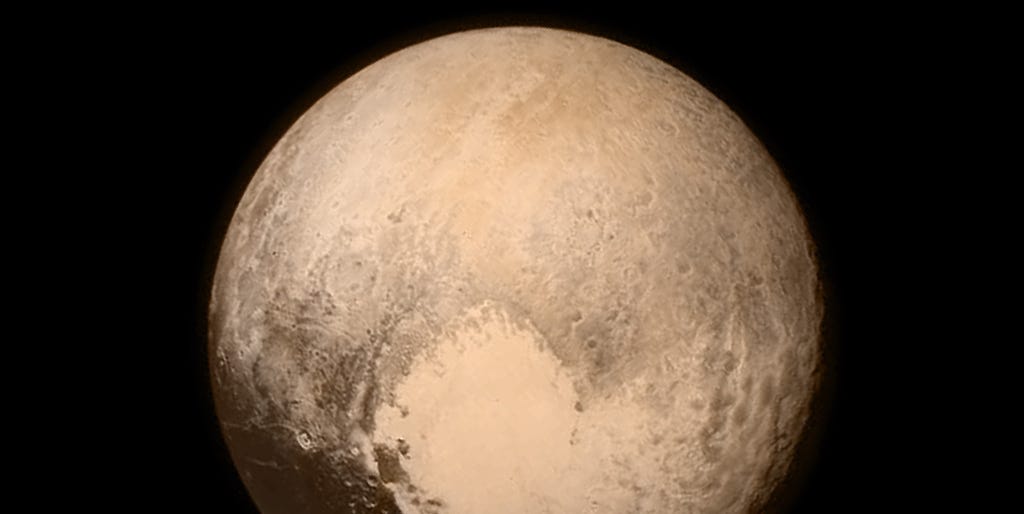
Pluto may be small, cold, and very far away, but it has excellent branding. When NASA’s New Horizons spacecraft flew past the dwarf planet in July 2015, the world suddenly saw Pluto not as a blurry dot at the edge of the solar system, but as a complex icy world with mountains, glaciers, haze, and one unforgettable feature: a giant bright heart.
That heart-shaped region, officially called Tombaugh Regio, immediately became one of the most famous landscapes in planetary science. It looked sweet enough for a Valentine’s card, but scientists suspected the story behind it was anything but gentle. Now, researchers think they have a much better explanation for how Pluto got its mysterious heart: a slow, angled, ancient collision with a large planetary body that left a massive scar filled with bright nitrogen ice.
In other words, Pluto’s heart may have been born from a cosmic crash. Space, as usual, has a flair for drama.
What Is Pluto’s Heart?
Pluto’s “heart” is not a single smooth patch. It is a huge bright region on Pluto’s surface, with two distinct lobes that tell different geological stories. The western lobe is called Sputnik Planitia, a broad, pear-shaped basin filled mostly with nitrogen ice. The eastern lobe is rougher, brighter terrain that appears to be coated by volatile ices transported from elsewhere on Pluto.
Sputnik Planitia is the star of the mystery. It is roughly 1,000 kilometers wide, incredibly smooth in many places, and unusually bright compared with much of Pluto’s darker reddish terrain. It also sits near Pluto’s equator and close to the side facing Pluto’s largest moon, Charon. That location is not random-looking to scientists. It is a clue.
Before New Horizons, Pluto was mostly a question mark with an orbit. After the flyby, scientists saw a world with icy mountains, possible cryovolcanic features, dunes, glaciers, pits, and strange polygon-like cells across Sputnik Planitia. Instead of being a dead frozen ball, Pluto looked geologically expressivelike a tiny planet that had spent billions of years quietly redecorating.
The Big New Idea: Pluto’s Heart Came From a Giant Impact
A major 2024 study proposed that Sputnik Planitia formed when an object hundreds of kilometers wide slammed into Pluto early in its history. This was not a neat, straight-down meteor strike like a dart hitting a board. The model suggests a slow, oblique impact, meaning the object came in at an angle and at relatively low speed by solar-system collision standards.
The impactor may have been about 650 to 700 kilometers acrosslarge enough to be a serious planetary troublemaker. Instead of completely vaporizing or punching cleanly through Pluto, the object may have partially merged with Pluto’s crust and interior. Researchers used numerical simulations to test how different impact speeds, angles, and compositions would affect Pluto’s surface. The slow, angled collision produced a shape that looked a lot like Sputnik Planitia: broad, elongated, and pear-shaped.
This matters because Sputnik Planitia has always been difficult to explain. A simple circular crater would be easier. But Pluto gave scientists a lopsided basin with a weird shape, a special location, and a large amount of bright nitrogen ice. The 2024 impact model offers one explanation that connects several of those features at once.
Why the Impact Was More of a “Splat” Than an Explosion
The fun word that keeps appearing in discussions of this model is “splat.” It sounds like something from a cartoon, but it helps describe the physics. Pluto is extremely cold, and its rocky material may have behaved more rigidly than it would on a warmer body. In the simulations, the impactor did not simply melt into Pluto like butter on toast. Instead, parts of it may have remained relatively intact, leaving dense material beneath or within the basin.
That dense leftover material could help explain why Sputnik Planitia stayed in such an important position on Pluto. Planetary bodies can reorient over time if mass is redistributed on their surfaces. This process, called true polar wander, can slowly shift a large feature toward a more stable location. If Sputnik Planitia contains or overlies a dense mass concentration, that could help explain why the basin ended up near Pluto’s equator and close to the Pluto-Charon tidal axis.
So Pluto’s heart may not just be a surface stain. It may be a frozen window into a deep, violent event from the dwarf planet’s youth.
The Older Explanation: Was There a Hidden Ocean?
Before the new impact model gained attention, one popular explanation involved a subsurface ocean. Scientists proposed that a giant impact created the Sputnik Planitia basin, and then a hidden ocean beneath Pluto’s icy crust helped create a positive mass anomaly. Since liquid water is denser than ice, an ocean bulge beneath the basin could have made that region gravitationally heavier. Add nitrogen ice on top, and Sputnik Planitia might have become massive enough to shift Pluto’s orientation.
That idea was exciting because it suggested Pluto might still haveor once hada buried ocean. And when planetary scientists hear “ocean,” they immediately lean forward in their chairs. Oceans raise questions about heat, chemistry, habitability, and the surprising complexity of icy worlds.
The 2024 model does not completely erase the possibility of a Pluto ocean, but it shows that scientists may not need one to explain Sputnik Planitia’s shape and location. If a dense rocky remnant from the impactor remained in place, it could create the needed mass effect without requiring a present-day global subsurface ocean. That is a big deal because it changes what Pluto’s heart may be telling us about Pluto’s interior.
Why Sputnik Planitia Is So Bright
The impact may have created the basin, but it did not paint the heart white all by itself. The bright appearance comes largely from volatile ices, especially nitrogen ice. On Pluto, nitrogen can behave in ways that feel oddly familiar and totally alien at the same time. It can freeze, sublimate into gas, condense again, and flow slowly like a glacier.
Sputnik Planitia is a natural cold trap. Because it is a low-lying basin, nitrogen ice can collect there over long periods. Once inside, the ice does not just sit politely. It moves, circulates, and refreshes the surface. That helps explain why parts of Sputnik Planitia appear young and relatively free of impact craters. If the surface keeps renewing itself, it can erase or bury old scars.
Pluto’s Heart Beats With Nitrogen
Scientists often describe Pluto’s heart as “beating,” although no one is suggesting the dwarf planet needs a cardiologist. The phrase refers to Pluto’s nitrogen cycle. Sunlight can warm nitrogen ice enough for it to sublimate into vapor. Later, that vapor can condense back as frost. This cycle helps drive winds in Pluto’s thin atmosphere and may shape parts of the landscape.
It is a strange little climate engine. Earth has oceans that help regulate weather; Pluto has a giant nitrogen-ice basin that influences atmospheric circulation. That comparison is not perfect, but it captures the idea: Sputnik Planitia is not just decoration. It helps Pluto function as a dynamic world.
What New Horizons Revealed About Pluto’s Surface
New Horizons changed Pluto science forever because it gave researchers close-up data for the first time. The spacecraft revealed a surface far more varied than expected. There were icy mountains several kilometers high, smooth plains, dark equatorial regions, hazy atmospheric layers, and terrain that looked almost cellular.
Those polygon-like patterns in Sputnik Planitia are especially important. They are thought to be caused by convection within nitrogen ice. Warmer ice from below rises slowly, spreads out, cools, and sinks again along cell boundaries. Imagine a lava lamp, but replace the glowing liquid with nitrogen ice at temperatures so low your freezer would look tropical by comparison.
This convection helps renew the surface. It also shows that even at the edge of the solar system, internal heat can still matter. Pluto is not powered by strong sunlight; the Sun is much weaker there than it is on Earth. Yet the dwarf planet has found ways to remain active, subtle, and scientifically annoying in the best possible way.
Why the Heart’s Shape Matters
The shape of Sputnik Planitia is not just a pretty outline. In planetary science, shapes are evidence. A round basin might suggest a more direct impact. An elongated, pear-shaped basin suggests something more complicated, such as an angled collision, uneven crustal response, or a combination of impact physics and later ice movement.
The new simulations are important because they reproduce the basin’s unusual geometry better than earlier simple-impact ideas. They also explain why dense material may remain associated with the basin. That matters for understanding how Pluto reoriented and why Sputnik Planitia occupies its current location.
Scientists are essentially reading Pluto like a crime scene. The bright ice is the fresh snow over the evidence. The basin is the outline. The mass anomaly is the hidden clue. The suspect? A long-gone planetary body that crashed into Pluto billions of years ago and left behind one of the most photogenic scars in the solar system.
What This Means for Pluto’s Interior
If Sputnik Planitia formed from an impactor remnant, Pluto’s interior may be different from what some scientists previously assumed. The model suggests Pluto could be more rigid and colder inside, with no need for a present-day subsurface ocean to explain the heart. That does not mean Pluto definitely lacks an ocean. Planetary science rarely gives answers with a neon sign saying “case closed.” But it does mean the ocean is not the only possible explanation.
This is how science gets better. A spacecraft sends back surprising data. Researchers propose models. Other researchers challenge those models. New simulations test the possibilities. The best explanation is not the one that sounds most exciting; it is the one that explains the most evidence with the fewest unnecessary assumptions.
Why Pluto Still Matters Even Though It Is a Dwarf Planet
Pluto’s reclassification as a dwarf planet in 2006 still has fans occasionally reaching for emotional support snacks. But scientifically, Pluto did not become less interesting. If anything, New Horizons showed that small worlds can be astonishingly complex.
Pluto belongs to the Kuiper Belt, a distant region filled with icy bodies left over from the solar system’s formation. Studying Pluto helps scientists understand how these ancient worlds formed, collided, evolved, and preserved clues from the early solar system. Its heart-shaped basin is not just a cute feature. It is a record of impact history, volatile ice behavior, climate cycles, and internal structure.
Pluto is proof that “small” does not mean “simple.” A world can be smaller than Earth’s Moon and still have glaciers, atmosphere, tectonic hints, and one of the best logos in astronomy.
Could Other Dwarf Planets Have Similar Stories?
The Pluto heart mystery also raises a bigger question: how many other icy worlds carry hidden impact scars, buried mass anomalies, or volatile ice cycles? The Kuiper Belt contains many objects that remain poorly understood because they are distant, faint, and difficult to observe in detail from Earth.
If a giant angled impact can create a feature like Sputnik Planitia on Pluto, similar collisions may have shaped other dwarf planets and icy moons. Some may have basins filled with nitrogen, methane, carbon monoxide, or water ice. Others may hide dense impactor remnants below their surfaces. Some may have oceans; others may not. Each world has its own recipe, depending on size, temperature, composition, impact history, and internal heat.
That is why Pluto remains a key case study. It gives scientists a real example of how icy geology can work in the outer solar system. And because New Horizons gathered so much data during one fast flyby, researchers will likely continue mining that information for years.
What Scientists Still Do Not Know
The new impact model is powerful, but it does not answer every question. Scientists still want to know exactly what Pluto’s interior looks like, how much heat remains inside, whether any liquid water exists below the crust, and how volatile ices have moved across the surface over billions of years.
They also want better gravity data, more global coverage, and ideally a future orbiter mission. New Horizons was a flyby, which means it had one brief chance to collect close-up observations before racing deeper into the Kuiper Belt. It performed spectacularly, but a Pluto orbiter could map the surface in greater detail, measure gravity more precisely, monitor seasonal changes, and possibly settle debates about Pluto’s hidden interior.
Until then, scientists will keep building models, comparing simulations with New Horizons data, and arguing politely in the traditional academic manner: with equations, conference slides, and extremely specific disagreements about ice.
Experience: What Pluto’s Heart Teaches Us About Wonder
There is something deeply human about the way people reacted to Pluto’s heart. Most of us are not planetary geologists. We do not spend our lunch breaks calculating impact angles or modeling nitrogen ice convection. Yet when that first clear image appeared, people immediately connected with it. A tiny world billions of miles away had a heart. The universe, which often seems cold and indifferent, had accidentally made a symbol we recognized.
That emotional reaction matters. Science does not become weaker when it inspires wonder. In fact, wonder is often the doorway into deeper understanding. A person may first notice Pluto because it looks charming, then stay to learn about volatile ices, oblique impacts, true polar wander, and the Kuiper Belt. The heart is the hook; the science is the adventure.
Imagine being on the New Horizons team in July 2015. The spacecraft had traveled for nearly a decade, crossing billions of miles to reach a target that had never been seen up close. There was no second chance if something went wrong. Then the images arrived: mountains of water ice, smooth nitrogen plains, haze layers, and that enormous bright heart. It must have felt like opening a locked door and finding not an empty room, but an entire world with personality.
For students, space fans, and casual readers, Pluto’s heart is a reminder that discovery often begins with surprise. Textbooks can make science look tidy, as if every answer marches in a straight line from question to conclusion. Real science is messier and more exciting. Pluto was expected to be interesting, but few expected it to be this geologically alive. Sputnik Planitia turned into a puzzle with multiple possible explanations: a hidden ocean, a giant impact, moving nitrogen ice, and a dense buried remnant. Each new idea sharpened the next.
The story also teaches patience. New Horizons passed Pluto in a matter of hours, but scientists have spent years interpreting the data. That is how exploration works. The dramatic moment gets the headline, but the deeper understanding comes slowly, through careful measurement, modeling, debate, and revision. Pluto’s heart did not give up its secrets immediately. It made researchers earn them.
There is also a useful lesson in humility. Pluto was once treated by many people as a simple frozen leftover. Then it revealed weather, geology, glaciers, and a landscape shaped by ancient violence and delicate ice cycles. The universe keeps warning us not to underestimate small things. A dwarf planet can rewrite expectations. A basin of nitrogen ice can drive winds. A distant heart-shaped scar can reshape scientific thinking about icy worlds.
For anyone who loves astronomy, Pluto’s heart is more than a feature on a map. It is a symbol of why exploration matters. We send spacecraft not just to confirm what we already know, but to be surprised. Sometimes the surprise looks like a crater. Sometimes it looks like a mountain. And sometimes, against all odds, it looks like a heart.
Conclusion: A Heart Made by Impact, Ice, and Time
Scientists now think Pluto’s mysterious heart may have formed when a large planetary body struck Pluto at a slow, shallow angle billions of years ago. That collision likely created Sputnik Planitia, the bright western lobe of Tombaugh Regio. Over time, the basin collected nitrogen ice, which flowed, convected, sublimated, condensed, and helped power Pluto’s unusual climate system.
The most exciting part is not simply that scientists have a new answer. It is that the answer connects many pieces of Pluto’s story: the basin’s shape, its location, its brightness, its mass, and its active surface. Pluto’s heart is not just a cute cosmic accident. It is evidence of a violent beginning, a frozen engine, and a world that refuses to be boring.
Pluto may be small, but its heart is a giant reminder that the outer solar system is full of stories still waiting to be decoded.










