
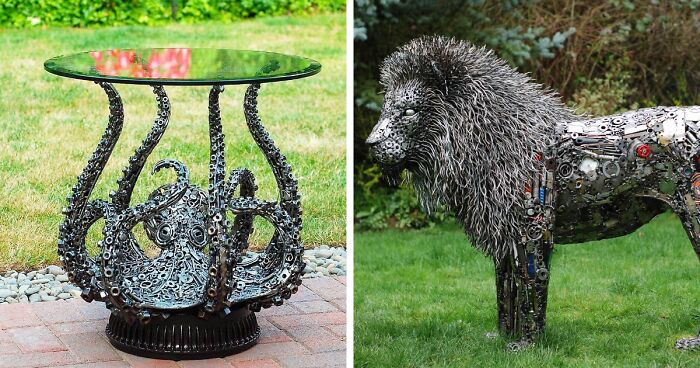
Some people see a pile of bolts, bent forks, rusted chains, and retired car parts and think, “Yep, that’s definitely junk.” Brian Mock sees a prowling snow leopard, a loyal dog, a gleaming rooster, or a guitar big enough to make a rock star blush. And honestly? That kind of vision deserves a standing ovation and maybe its own dramatic soundtrack.
If you came for the 30 pictures, fair enough. They are the eye candy. But the real story is even better: behind every reclaimed metal sculpture is a self-taught American artist who has turned resourcefulness into a signature style. Mock doesn’t just make art out of discarded materials. He transforms the entire idea of waste into something muscular, elegant, playful, and strangely emotional.
His work sits at the intersection of craftsmanship, sustainability, and plain old human curiosity. You look once because the forms are impressive. You look twice because suddenly you notice that the animal’s shoulder is built from gears, the feathers are made from cutlery, and the muzzle is shaped from hardware that once had a totally different life. That double take is where the magic lives.
Meet the Artist Behind the Metal Menagerie
Brian Mock is based in Oregon, and his path into sculpture didn’t begin in some polished art-school studio full of expensive jargon and intimidating silence. He spent years drawing, painting, and woodcarving before teaching himself to weld and eventually diving headfirst into sculpture made from reclaimed materials. That self-taught background matters, because his work never feels over-theorized or trapped in a glass case. It feels alive, practical, and deeply hands-on.
There is something especially compelling about an artist who learns by doing, failing, adjusting, and trying again with sparks flying in the studio. You can feel that energy in Mock’s sculptures. They aren’t precious. They’re precise, yes, but they also have grit. They seem to understand the weight, texture, and history of the materials they use. That gives the work a kind of built-in backstory before the viewer even starts interpreting it.
Mock has often described his practice in terms of resourcefulness, and that word fits like a glove. He works with what other people leave behind, which means each sculpture begins with limitations. Yet those limitations seem to sharpen his imagination rather than shrink it. Instead of asking, “What brand-new material should I buy?” the process asks, “What can this old thing become?” That question is the engine of the whole body of work.
Why Reclaimed Material Sculpture Feels So Fresh
Art made from found or reclaimed objects has a long history, but it still feels thrilling when an artist does it well. Maybe that is because transformation is one of the oldest and most satisfying stories humans know. We love before-and-after reveals. We love glow-ups. We love redemption arcs. Mock’s sculptures give us all three, except the stars of the makeover are scrap metal, discarded tools, springs, silverware, and industrial leftovers.
In his hands, reclaimed materials don’t read like leftovers. They read like language. A chain can suggest movement. A curved piece of steel can become a floppy ear. A cluster of bolts can create muscle tension or feather texture. That is what makes the work so compelling: the materials are never random. They are chosen, arranged, welded, balanced, and refined until they feel inevitable.
That sense of inevitability is harder to achieve than it looks. Great reclaimed sculpture always performs a balancing act. It has to let you recognize the original materials while also allowing you to see beyond them. Too much emphasis on the “junk,” and the piece becomes a novelty act. Too much polish, and the reclaimed story disappears. Mock threads the needle beautifully. You see the parts, but you also see the creature.
More Than Junk Art
Calling work like this “junk art” undersells it. Yes, the source materials are discarded. No, the result is not random pile-up. These sculptures are built with design intelligence, observational skill, and a strong sense of anatomy. Mock researches his subjects, sketches them, and then translates those forms into a three-dimensional puzzle made of metal. That means the work operates on two levels at once: it celebrates the material history of each part while also convincing your brain that the finished figure might inhale if you stare at it long enough.
That’s the secret sauce. A reclaimed sculpture succeeds not because it is made from trash, but because it transcends the expectation that trash must stay trash. The materials do not lower the artistic standard. They raise the challenge.
The Details Are Doing Heavy Lifting
One of the most striking things about Brian Mock’s sculptures is their attention to detail. Not vague “wow, neat texture” detail. We’re talking about the kind of detail that makes a viewer lean in, squint, point, and say, “Wait, is that a wrench?” The answer is often yes, and that’s part of the fun.
His animals are especially memorable because they do not feel stiff or assembled for assembly’s sake. They have gesture. Their posture communicates mood. A dog can look alert and affectionate. A lion can feel regal rather than merely large. A bird can look as if it might shake itself and launch into the air. That kind of expressive realism is difficult in any medium. It is even more impressive when the medium includes gears, screws, cut metal, and salvaged machine parts.
Mock’s best pieces reward slow looking. From far away, they read as coherent forms. Up close, they break into a fascinating mosaic of everyday objects. The visual pleasure comes from moving back and forth between those two experiences. First you meet the sculpture. Then you meet the hundreds of decisions inside it.
Animals, Instruments, and Human Figures
Although many viewers first discover Mock through his animal sculptures, his range is broader than one might expect. His portfolio includes dogs, wild animals, musical instruments, human figures, and custom commissions. That variety matters because it shows he is not repeating one successful trick. He is building a visual language that can adapt to very different subjects while staying unmistakably his.
The musical pieces are especially clever because they already belong to a world of performance, glamour, and emotion. Turning reclaimed metal into a guitar or another instrument creates a layered effect: the sculpture references sound while remaining resolutely silent. It becomes a kind of visual music made from industrial leftovers. That contrast is delicious.
His figurative work, meanwhile, highlights a different strength: mood. A human form made from reclaimed material can easily drift into gimmick territory, but Mock tends to keep the emotional center intact. The best pieces preserve tension in the shoulders, energy in the stance, and intention in the pose. That’s what separates sculpture from hardware cosplay.
The Sustainability Angle Isn’t Just a Bonus
It would be easy to frame the environmental story here as a nice extra, like parsley on a restaurant plate. But in this case, sustainability is part of the core meaning of the work. Reclaimed-material sculpture asks viewers to reconsider what is disposable, what is valuable, and how quickly modern consumer culture tosses things aside.
Mock’s art does not lecture. It doesn’t arrive waving a giant sign that says, “Bad human, recycle more.” Instead, it does something more effective: it makes reuse look imaginative, skillful, and desirable. That subtle shift matters. People are more likely to rethink waste when they see what is creatively possible, not just what they should feel guilty about.
There is also something beautifully stubborn about turning landfill-bound material into objects people want to protect, photograph, commission, and live with. A bent piece of metal that once seemed worthless becomes part of a sculpture that might anchor a hotel lobby, a private collection, or a public conversation. That is a serious upgrade. Somewhere, a rusty bolt is having the best career pivot of its life.
Beauty as a Form of Persuasion
One reason environmental messaging often falls flat is that it can become abstract very quickly. Terms like sustainability, reuse, and circularity are important, but they do not always spark emotion on their own. Sculpture can do what buzzwords cannot. It creates physical proof. It says: here is what transformation looks like. Here is what imagination can rescue.
That is why reclaimed sculpture feels especially relevant right now. It aligns artistic practice with broader cultural questions about excess, material waste, and the afterlife of objects. But it does so without losing joy. Mock’s work is not gloomy. It’s energetic, witty, and deeply tactile. The environmental message lands because the art lands first.
Why These 30 Pics Are So Easy to Fall Into
Let’s be honest: photo galleries like this are catnip for the internet. You click for one image and suddenly you’ve spent fifteen minutes zooming into a sculpture’s ear trying to identify whether that shiny little piece used to live in a toolbox, a junk drawer, or somebody’s long-forgotten garage. Time well spent.
But the photos work because the sculptures do. They are cinematic from a distance and intricate up close, which makes them perfect for visual storytelling online. A strong gallery gives viewers the big reveal first, then the detail shots that make the brain light up. With Mock’s work, every close-up feels like opening a secret compartment.
The phrase “breathtaking” gets tossed around online like confetti at a parade, but here it actually fits. These sculptures are breathtaking not because they are flashy for the sake of flash. They are breathtaking because they combine labor, design, wit, and reinvention in a way that feels both surprising and strangely inevitable. Once you’ve seen a lion made from reclaimed metal done this well, it becomes very hard to go back to seeing a pile of scrap as just a pile of scrap.
What Brian Mock’s Work Says About Self-Taught Artists
There’s a tendency in art conversations to over-romanticize formal training on one side and self-taught genius on the other. Real life is usually messier and more interesting. Mock’s career shows that self-taught does not mean accidental, naïve, or less rigorous. In many cases, it means the artist built a method through repetition, discipline, observation, and raw stubbornness.
That self-directed path can create a distinctive voice because it is shaped less by academic fashion and more by lived problem-solving. How do you make a shoulder curve from metal scraps? How do you create softness using hard material? How do you preserve the identity of found objects without losing the integrity of the final form? Those are not theoretical questions. They are studio questions. And the answers are written into every piece.
In that sense, Mock belongs to a broader American tradition of self-taught makers whose work is fueled by invention, material intelligence, and persistence. The tools may be industrial, but the spirit is deeply handmade. You can feel the hours in the seams.
Experience Section: What It Feels Like to Encounter Reclaimed Sculpture Up Close
Seeing art like this in photos is satisfying. Seeing it in person is a whole different experience. A screen can show shape, shine, and clever detail, but it cannot fully deliver scale, weight, or the weird emotional jolt that happens when cold industrial material suddenly feels almost warm with personality.
Many viewers describe a moment of visual confusion when they first stand in front of reclaimed sculpture. The mind tries to process two truths at once. On one hand, you are clearly looking at metal parts that once belonged to ordinary life: tools, hardware, machine fragments, kitchen pieces, scraps with histories you can only guess at. On the other hand, you are also looking at a coherent living form that seems to possess motion, attitude, and even humor. That tension creates a memorable encounter.
There is also a tactile imagination involved. You may not actually touch the sculpture, but your eyes do the touching for you. You can almost feel the roughness of a welded seam, the cool curve of a spoon transformed into plumage, the stubborn heaviness of a steel element now serving as muscle. The surface becomes a story. Every part looks like it arrived with a past and left with a purpose.
For people who work with their hands, the experience can be especially powerful. Welders, mechanics, builders, woodworkers, and tinkerers often recognize the labor immediately. They understand what it means to search for the right part, grind it down, fit it into place, and make something technically difficult appear graceful. There is an unspoken respect in that recognition. The work doesn’t merely look good; it proves something about patience and skill.
For other viewers, the emotional response may come from the transformation itself. In a culture that is obsessed with the new, reclaimed sculpture quietly argues for another kind of beauty. It suggests that age, wear, dents, scratches, and previous use do not diminish value. Sometimes they deepen it. That message lands beyond the gallery. It resonates with people thinking about homes, objects, habits, and even their own lives. Reinvention is a deeply human theme, and sculpture made from discarded materials gives it a solid, visible form.
There is often a playful side to the experience, too. People lean closer and start identifying parts like they are solving a visual riddle. “That looks like a gear.” “Is that a wrench?” “No way, that might be silverware.” The sculpture turns passive viewing into active discovery. It invites curiosity rather than distance. In an age of fast scrolling and shorter attention spans, that kind of sustained looking feels almost luxurious.
And then there is the aftereffect. Good reclaimed sculpture lingers. You leave and start noticing the material world differently. The pile in the garage no longer looks entirely useless. The broken object on the curb feels less final. You begin to understand that design is not always about buying something new; sometimes it is about seeing more clearly. That may be the most lasting experience of all. Art like this does not just decorate a space. It retrains perception.
That is why Brian Mock’s sculptures stay with people. They deliver spectacle, yes, but they also deliver a shift in awareness. They make viewers slower, sharper, and a little more imaginative. Not bad for a bunch of old bolts, bent metal, and castoff parts that were once headed for a far less glamorous fate.
Conclusion
Brian Mock’s reclaimed sculptures are impressive on the surface, but their real power runs deeper. They show how a self-taught artist can turn discipline into style, discarded material into beauty, and everyday hardware into animals, instruments, and figures with remarkable presence. The work is technically accomplished, environmentally relevant, and visually irresistible without ever feeling preachy or overly polished.
That combination is rare. Plenty of art is clever. Plenty of art is sustainable. Plenty of art photographs well online. Mock’s work manages to do all three while still feeling grounded, tactile, and emotionally direct. The result is a body of sculpture that rewards casual viewers, close observers, collectors, design lovers, and anyone who has ever looked at a broken object and wondered whether its story might not be over yet.
So yes, the 30 pics are worth your time. But the bigger takeaway is this: Brian Mock isn’t just making sculptures from reclaimed materials. He’s making a persuasive case for imagination itself. And that might be the most breathtaking transformation in the whole gallery.










