
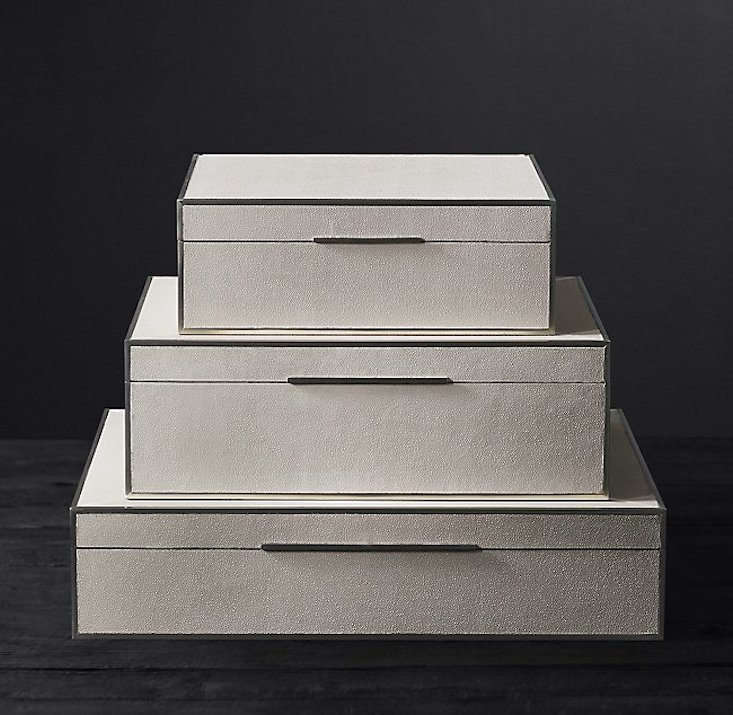
A well-designed storage box performs a small domestic miracle: it hides the things you need while looking far more composed than the things it hides. The Shagreen Box Collection takes that useful idea and dresses it in pebbled texture, precise geometry, and a hint of Art Deco glamour. It is the organizational equivalent of putting on a tailored jacket before answering the door.
These decorative storage boxes are designed to hold papers, jewelry, photographs, remote controls, keepsakes, and other small objects that tend to migrate across a room. Yet their real appeal is visual. A shagreen-inspired surface catches light softly, metal edging sharpens the silhouette, and a hinged lid keeps clutter politely out of sight. Whether displayed on a coffee table, console, desk, dresser, or bookshelf, a shagreen box can make everyday storage feel intentional rather than improvised.
What Is the Shagreen Box Collection?
The name commonly refers to a coordinated group of rectangular decorative boxes covered in shagreen or shagreen-embossed material. One prominent example from RH uses pebbled shagreen-embossed leather, hinged lids, and slim stainless-steel trim with a pewter finish. The boxes have been produced in graduated sizes, making them suitable for everything from small valuables to documents and larger keepsakes.
The collection’s visual language is distinctly Art Deco: clean lines, luxurious texture, restrained ornament, and polished metal details. Nothing swirls, curls, or performs decorative gymnastics. The texture supplies the drama, while the box shape stays disciplined. That balance helps the design work in traditional, transitional, contemporary, and modern interiors.
Although shoppers may encounter both genuine and faux shagreen boxes, the term “shagreen box collection” is often used broadly in home décor. Always read the product description carefully. “Shagreen,” “faux shagreen,” “shagreen effect,” “embossed leather,” and “shagreen-embossed leather” do not describe exactly the same material.
Why Shagreen Has Such a Distinctive Look
A Texture Borrowed From Nature
Traditional shagreen is a textured hide historically made from ray, shark, or related fish skin. Its dotted surface comes from hard dermal denticles, also known as placoid scales. When prepared and polished, these natural beads create a tight pattern that can look pearly, mineral-like, or almost cellular. Stingray shagreen often features a larger central cluster that artisans may position as a focal point.
Modern faux shagreen recreates that pattern through embossing, molding, printed texture, resin, vinyl, polyurethane, coated fabric, or leather. High-quality versions do more than stamp a uniform field of dots. They vary the size and depth of the pattern, soften the sheen, and reproduce some of the subtle irregularity that makes natural shagreen visually interesting.
From Sword Grips to Art Deco Interiors
Shagreen has a long decorative history. Ray skin was used in Asia for weapon grips and cases because its rough surface offered durability and traction. European artisans later used shagreen on small boxes, scientific instruments, travel cases, and personal accessories. An 18th-century French shoe-buckle case in the Los Angeles County Museum of Art, for example, features a shagreen-covered exterior and padded interior.
In France, the material became closely associated with luxury case maker Jean-Claude Galluchat, which is why shagreen is also known as galuchat. Its most famous design revival arrived during the 1920s and 1930s, when Art Deco designers applied the textured material to desks, cabinets, lighting, and decorative accessories. Shagreen returned again during the mid-20th century and remains a reference point in luxury interiors. In other words, it has survived several centuries of trend cycles, which is more than can be said for carpeted bathrooms.
Design Features That Define a Quality Shagreen Box
Balanced Proportions
A decorative box should look substantial without resembling a shipping container that wandered indoors. Low, wide boxes work well for documents, photographs, stationery, and remote controls. Taller boxes suit jewelry pouches, charging cords, game pieces, or layered keepsakes. A coordinated set adds flexibility because each size can serve a different room or function.
Clean Seams and Pattern Alignment
Inspect the corners and edges. The covering should lie flat without bubbles, lifted seams, puckering, or excessive adhesive. On better pieces, the embossed pattern appears thoughtfully positioned rather than abruptly chopped at every corner. Genuine shagreen naturally varies; faux shagreen should imitate variation without looking blurry or mechanically repetitive.
Hardware That Supports the Design
Metal trim gives shagreen boxes their architectural quality. Pewter, stainless steel, brass, bronze, and nickel finishes can all work, but the joints should be neat and the lid should close evenly. Hinges should move smoothly without wobbling or scraping. A box that looks elegant but snaps shut like an alligator is not elegant; it is merely well dressed and angry.
A Finished Interior
Velvet, suede-like fabric, linen, paper, or another soft lining protects contents and creates a more refined experience. For jewelry, watches, eyeglasses, or delicate keepsakes, choose an interior with no exposed staples, sharp seams, or rough hardware. Contemporary shagreen jewelry boxes frequently combine embossed exteriors with brass details and suede-lined compartments.
How to Style a Shagreen Box Collection
On a Coffee Table
Use one medium or large shagreen box as the visual anchor. Pair it with a small stack of books and a vase, candle, or sculptural object. Vary the heights but keep enough empty surface for real life, including coffee cups, snacks, and the occasional elbow.
Groups of three, mixed materials, varied heights, and a limited color palette can produce a layered arrangement without making the table look crowded. Decorative boxes also add height and hide practical objects, allowing the styling to remain useful after the photographer has left.
A pale gray, ivory, or taupe box looks sophisticated on dark wood, black lacquer, smoked glass, or veined stone. A deep charcoal, navy, or green box can add visual weight to a light oak or white table. Metal trim should connect with at least one other finish in the room, such as a lamp base, picture frame, cabinet pull, or side table.
On a Console or Entry Table
A shagreen storage box is excellent for keys, sunglasses, charging cables, receipts, and other pocket debris. Place it beside a lamp or beneath a mirror, then add one vertical element such as branches or flowers. The box provides visual calm while quietly absorbing the small objects that otherwise form an unauthorized tabletop colony.
In a Home Office
Use a larger box for photographs, correspondence, stationery, folders, notebooks, or presentation materials. Shagreen envelope boxes and document boxes are specifically designed around flat papers and office essentials.
For sensitive paperwork, remember that a decorative box is not automatically fireproof, waterproof, lockable, or secure. Store irreplaceable legal and identity documents in an appropriate protective container and use the shagreen box for copies or items that benefit from tidy access.
On a Dresser or Nightstand
A small box can hold watches, reading glasses, hand cream, earbuds, or jewelry. Choose a low profile so the piece does not compete with a lamp or block a mirror. In a bedroom, soft neutrals create a restful effect, while deep green, navy, burgundy, or black can add a polished boutique-hotel mood.
On Bookshelves
Decorative boxes are useful for breaking up rows of books and hiding visually noisy objects. Place a box horizontally beside upright books, or stack a smaller box on two large volumes. Repeating the same finish on two shelves can make the entire bookcase feel connected, but avoid filling every shelf with matching boxes unless your goal is “very elegant evidence archive.”
What Can You Store in Shagreen Decorative Boxes?
- Living room: remote controls, coasters, charging cords, cards, dominoes, and small game pieces.
- Bedroom: jewelry, watches, eyeglasses, letters, scarves, and personal keepsakes.
- Office: stationery, photographs, notebooks, receipts, spare cables, and presentation materials.
- Entryway: keys, sunglasses, wallets, stamps, and small pet accessories.
- Guest room: Wi-Fi instructions, charging adapters, toiletries, and locally useful information.
The best use is specific. A box labeled only in your imagination as “miscellaneous” can become a small, attractive landfill. Assign each piece a purpose, and periodically remove anything that no longer belongs.
Real Shagreen vs. Faux Shagreen
Genuine Shagreen
Real shagreen offers natural depth, tonal variation, and artisanal character. Each hide is unique, and the preparation, dyeing, polishing, cutting, and application require specialized skill. Those qualities usually increase the price and create natural differences between finished pieces.
Buyers should ask for clear information about species, sourcing, import compliance, and whether the skin is a documented by-product of a food fishery. Some workshops state that their stingray skins come from fish harvested for food, but sourcing practices vary among makers. Vague language is not a sustainability policy.
Faux Shagreen
Faux shagreen is widely available and can be easier to maintain, more consistent in color, and less expensive. It also avoids the direct use of exotic animal skin. Retail examples range from embossed leather and synthetic coverings to molded or resin-based surfaces.
However, “faux” does not automatically mean environmentally harmless. Some imitations are made with PVC, polyurethane, resin, coated textiles, or synthetic leather, so composition, durability, repairability, and manufacturing standards still matter.
For many decorative-box buyers, a well-made faux or embossed-leather version provides the desired visual effect with fewer sourcing concerns. Look for convincing texture, strong construction, neat edges, a stable lid, and a finish that does not feel sticky or excessively plastic.
How to Care for a Shagreen Box
Start with the manufacturer’s instructions because natural shagreen, embossed leather, resin, and vinyl respond differently to moisture and cleaning products. For routine maintenance, dust gently with a soft, dry microfiber cloth. Work lightly across the surface rather than pressing debris into the textured pattern.
- Keep the box away from prolonged direct sunlight, which may fade dyes or alter certain coverings.
- Avoid placing wet glasses, leaking vases, cosmetics, or oil-based products directly on the lid.
- Blot spills promptly instead of scrubbing aggressively across the raised texture.
- Do not apply furniture polish, bleach, alcohol, or leather conditioner unless the manufacturer approves it.
- Lift the box with both hands instead of pulling it by the lid or decorative trim.
- Use felt pads beneath the base when placing it on delicate lacquer, glass, or polished stone.
Care instructions for commercially available shagreen and faux shagreen products commonly recommend keeping surfaces dry, limiting direct sunlight, and using a soft or nonabrasive cloth. Natural specialty finishes may require professional care. Enthusiasm is admirable; experimenting with a mystery cleaner from beneath the sink is less so.
How to Choose the Right Shagreen Box Collection
Measure the Intended Surface
Check the width, depth, and height of the table, shelf, or cabinet. Leave breathing room around the box and confirm that the lid can open without hitting a wall, mirror, or shelf above it. For a coffee table, the box should usually occupy only part of the surface so the table remains usable.
Match the Scale to the Contents
Choose dimensions based on what will actually go inside. A shallow document box is poor storage for bulky chargers, while a tall jewelry box can waste space when used for flat photographs. Check internal measurements when available because wall thickness, hinges, trays, and lining reduce usable capacity.
Coordinate, Do Not Overmatch
A shagreen box does not need to match every finish in the room. It should relate to the palette through color, metal, or texture. In a warm room, consider taupe, camel, cream, olive, or brass-trimmed designs. In a cool room, gray, blue, charcoal, pewter, or nickel can feel natural. Black and ivory are the tuxedos of decorative storage: dependable, formal, and rarely surprised by the guest list.
Inspect Construction and Return Policies
Before buying, review the listed materials, weight, hinge design, lining, cleaning requirements, and return terms. Product photographs can conceal uneven lids, weak hinges, thin coverings, or overly shiny surfaces. When possible, view the box in person or order from a retailer that provides detailed specifications and reasonable returns.
Experiences With a Shagreen Box Collection: What It Is Like to Live With One
The first surprise is how quickly a decorative box changes the mood of a surface. A coffee table covered with two remote controls, a charging cable, loose coasters, and a pen looks unfinished. Put those objects inside a shagreen box, add one book and a small vase, and the same table suddenly appears edited. The room has not become larger, cleaner, or wealthier, but it has become more convincing.
The tactile quality matters, too. A good shagreen-inspired finish invites touch without shouting for attention. In daylight, the pebbled pattern creates tiny highlights; in evening light, it becomes quieter and more architectural. Metal trim catches just enough brightness to outline the form. This is why a shagreen box often looks richer in person than in a flat product image.
A graduated collection is especially practical. The smallest box can live on a nightstand with glasses and earbuds. A medium box can hold remote controls and coasters in the living room. The largest can organize photographs, stationery, or document folders in an office. Separating the set usually makes each piece more useful, while grouping two boxes can create a stronger decorative statement on a large console.
There are minor realities. Textured surfaces collect dust more readily than smooth lacquer. Dark colors may reveal lint, while very pale finishes can show marks around frequently handled edges. Heavy boxes are satisfying once placed but less charming when moved during weekly cleaning. Hinged lids also need clearance, so a beautiful box pushed tightly beneath a low shelf becomes a beautiful box that cannot open.
The most successful experience comes from choosing a clear purpose before styling. A box intended for remote controls should open easily from the sofa. A jewelry box should have a soft lining. A document box should fit standard folders. A keepsake box should be stored away from heat, moisture, and direct sunlight. When function guides placement, the object becomes part of daily life rather than a prop that must be moved whenever anyone wants to use the table.
Over time, the box may also develop a personal role. It becomes the place where ticket stubs, handwritten notes, old photographs, travel coins, or family objects gather. That is the quiet strength of decorative storage: it gives ordinary possessions a boundary and important possessions a home. The exterior may reference French Art Deco and centuries of craft, but the contents are wonderfully specific to the owner.
For renters and frequent redecorators, shagreen boxes are particularly adaptable. They can move from a console to a desk, from a dresser to a bookshelf, or from one color scheme to another. Unlike large shagreen furniture, a decorative box introduces texture without making the room commit to an entire design era. It is a low-risk way to add polish, and unlike a velvet sofa, it fits in the moving carton without requiring three friends and a negotiation.
Conclusion
The Shagreen Box Collection combines storage, texture, and decorative history in a compact form. Its Art Deco lines can sharpen a traditional room, soften a modern one, and add a refined focal point to everyday surfaces. Whether made from genuine shagreen, embossed leather, or a carefully crafted faux material, the best box should feel substantial, open smoothly, protect its contents, and look attractive from every commonly viewed angle.
Choose the material transparently, select a size that suits a real storage need, and give the piece enough space to be noticed. Done well, a shagreen decorative box does not merely hide clutter. It turns organization into part of the room’s designand that is a much nicer outcome than relocating everything to the nearest drawer and hoping for the best.
Note: Natural shagreen is animal-derived. Before purchasing, confirm whether a product uses genuine shagreen, embossed leather, or synthetic faux shagreen, and review the seller’s sourcing and care information.













