
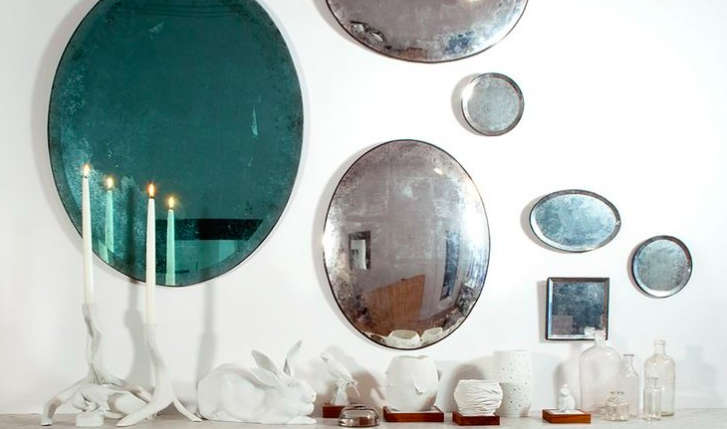
Some mirrors want to be the star of the room. They arrive shiny, loud, and ready to scream, “Look at me!” Maureen Fullam’s handmade mirrors do something smarter. They glow instead of shout. They soften light instead of bouncing it around like a disco ball at a family brunch. And that quiet confidence is exactly what makes them memorable.
For design lovers who are tired of overly polished surfaces and factory-perfect sameness, Fullam’s work offers a different kind of beauty: handmade, lightly oxidized, slightly moody, and unmistakably human. Her mirrors carry the romance of old-world craft while still feeling crisp enough for modern rooms. They can live happily in a townhouse with antique furniture, a minimal apartment with pale plaster walls, or a carefully layered bedroom where texture matters more than trends.
This is the magic of subtle shine. It is not about flash. It is about atmosphere, character, and the kind of reflection that flatters a room the way candlelight flatters everyone. If mass-market mirrors are all sharp elbows and bright opinions, Maureen Fullam’s pieces are more like a low, elegant voice that somehow still commands the table.
Grounding: official studio background, craft process, and the original Remodelista feature framing her mirrors as atmospheric and handmade.
Who Is Maureen Fullam?
Maureen Fullam is an artist and maker whose work centers on mirrors, reflective surfaces, and decorative objects created through verre églomisé, the historic technique of reverse gilding on glass. She has been working with that process since the late 1980s, building a practice that bridges fine craft, interior design, and functional art. Over the years, her commissions have ranged from small objects to custom furniture, mirrored walls, and even ceiling installations.
That range matters. It tells you Fullam is not simply producing pretty accessories for a shelf. She operates in the much rarer space where decorative arts meet architectural imagination. A small oval mirror and a large site-specific installation may live at different scales, but they share the same DNA: layered surfaces, deliberate oxidation, and a refined understanding of how glass interacts with light.
Her work has also circulated through respected design channels rather than quick-trend retail. Official studio information points to special commissions as well as retail relationships with shops in Los Angeles, San Francisco, and Nantucket. Editorial coverage has placed her mirrors in galleries, boutiques, and thoughtfully designed homes rather than in anonymous “top 50 home hacks” roundups where everything is described as “stunning” and nothing actually is. That kind of context helps explain why her mirrors feel collected rather than merely purchased.
Another useful detail: retailers that have profiled her work describe Fullam as a graduate of the Philadelphia College of Art and place her studio practice in the Hudson Valley. That setting feels right for the work. Hudson Valley craft culture has long favored material honesty, skilled handwork, and the kind of aesthetic restraint that lets surfaces speak for themselves. Fullam’s mirrors fit squarely within that sensibility, though they also carry a whisper of European glamour. Think less “barn chic,” more “old soul with excellent taste.”
Grounding: official About page, E.R. Butler event page, August profile, retail/stockist references.
What Makes Her Handmade Mirrors Different?
The craft starts at the back, not the front
Most people think of a mirror as a finished surface. Fullam’s work asks you to think about what sits behind the reflection. In reverse gilding, leaf is applied to the back of the glass rather than the front, creating depth, variation, and tone that feel richer than a standard mirror finish. This is where her handmade mirrors gain their distinctive character. The reflection is still functional, but it is softened by the hand of the maker and by the chemistry of the process.
It is slow work, and the slowness shows
Retail descriptions of Fullam’s pieces explain that the process can involve multiple layers of silver or gold leaf, applied with a fine badger-hair brush, then dried, burnished, buffed, antiqued, sealed, and framed. Some sources describe a single mirror taking roughly a week to complete. In a world where “handmade” sometimes means “assembled near a glue gun,” that is real labor. And real labor leaves evidence: subtle tonal shifts, oxidized edges, a surface that seems to breathe rather than glare.
Her mirrors are moody in the best possible way
Fullam’s mirrors are often described with words like antiqued, smoked, oxidized, convex, beveled, and leafed. Those details matter because they shape the emotional temperature of the object. A bright standard mirror gives a direct answer. One of Fullam’s mirrors gives an interpretation. The image is still there, but it arrives with softness, depth, and a little mystery. It is the visual equivalent of a jazz standard played on vinyl instead of blasted through a phone speaker.
The frames are restrained, so the surface gets to shine
Editorial coverage has noted blackened metal edging and minimalist framing around some of her mirrors. That restraint is part of the appeal. The frame does not compete with the glass; it contains it. The result is a piece that can work in layered traditional interiors, modern spaces, and rooms that mix old and new without turning into a decorating identity crisis.
Grounding: Remodelista feature, Remodelista product page, August product descriptions.
Why “Subtle Shine” Is the Right Phrase
The phrase subtle shine captures Fullam’s work because these mirrors are not designed to behave like hard, glossy punctuation marks. They are closer to atmosphere. They hold light gently. They add luminosity without creating visual noise. They can brighten a wall while still preserving a room’s mood.
That is a huge reason designers keep returning to this kind of piece. In a thoughtfully designed room, not every object should scream for attention. Some things should hum. A handcrafted mirror with a softened, antiqued surface can catch morning light, reflect a lamp at dusk, or echo the color of nearby textiles without turning the space into a hall of glare. It becomes part of the room’s rhythm.
There is also a psychological appeal. Perfectly clear mirrors can feel clinical. Fullam’s surfaces feel warmer, more forgiving, and frankly more civilized. They suggest age without looking fake, luxury without looking flashy, and artistry without becoming impractical. That balance is hard to achieve. Plenty of mirrors are pretty. Far fewer feel cultured.
And yes, there is a little theater in them too. Convex forms slightly distort perspective. Smoked and tinted finishes deepen shadows. Light leafing warms the reflection. Those elements create a subtle drama that reveals itself over time rather than in one loud first impression. The mirror ages well in the eye because it is built on nuance, not gimmick.
Grounding: descriptive editorial framing from Remodelista, product details on coloration and finishing, and designer usage in interiors.
How Designers Use Maureen Fullam Mirrors in Real Interiors
One of the strongest signals of Fullam’s design relevance is how often her mirrors appear in professionally designed spaces. These are not “styled for five minutes and then forgotten” props. They show up in rooms with lasting point of view.
Architectural Digest featured a convex Maureen Fullam mirror in a richly layered Mississippi home, proving that her work can hold its own in rooms full of pattern, antiques, and serious decorative confidence. Veranda placed one in a moody upstate New York bedroom, where its presence supported a palette of blue-gray textiles and soft luxury. Curbed highlighted a black-framed smoked mirror by Fullam in an East Village alcove studio, showing how naturally her work also fits compact, contemporary city living.
More recent design coverage keeps the point going. Modern Luxury described a Fullam convex mirror with smoked glass and an oxidized black frame in a revamped Beacon Hill townhouse. Another Modern Luxury home feature in San Francisco mentioned a Maureen Fullam mirror sourced through March, the design shop in San Francisco. Even a New York real estate listing used a platinum-leaf Fullam mirror to help define a foyer as a quietly luxurious moment rather than just a pass-through space.
What do all these examples have in common? The mirrors are used as punctuation with feeling. Above a fireplace, in a bedroom, in a living room corner, in a foyer: each placement allows the mirror to do more than reflect. It anchors. It softens. It adds depth. It keeps the room from becoming too flat, too literal, or too aggressively “done.”
This is where Fullam’s work separates itself from ordinary decorative mirrors. A mass-produced mirror often fills a blank wall. A handmade Maureen Fullam mirror changes the weather of the room.
Grounding: AD, Veranda, Curbed, Modern Luxury, and Christie’s Real Estate examples.
Shapes, Finishes, and the Signature Look
Part of the charm of Fullam’s handmade mirrors is that they do not lock themselves into one house style. Official and retail pages show round mirrors, oval mirrors, rectangles, convex pieces, small tabletop or wall versions, and mirrored coasters and ornaments that extend the same visual language into smaller objects. Some are silver leafed. Others use gold, deep gold, rose gold, palladium, smoked tones, or colored effects.
Even with that variety, the signature look remains consistent. The pieces are elegant without becoming precious. They have enough irregularity to feel alive, but not so much that they become rustic. They are luxurious, but the luxury comes from process and finish rather than ornament overload.
That balance makes them unusually flexible. A beveled oval mirror with rose-gold leaf can lean romantic. A smoked convex mirror with an oxidized black frame can look almost sculptural. A small round gold-leafed piece can function like jewelry for a wall. In every case, the mirror gives off light in a way that feels intimate, not industrial.
Grounding: official mirrors/small objects pages and August retail assortment.
How to Style a Handmade Mirror by Maureen Fullam
If the goal is to let a handmade mirror earn its keep, placement matters. In a foyer, one of Fullam’s mirrors can create a gracious first impression without the coldness that a standard clear mirror sometimes brings. In a living room, it can reflect lamps, artwork, or window light while adding a quiet metallic note. In a bedroom, especially one layered with textile texture, the softened reflection feels calm rather than jarring.
For smaller mirrors, think like a jeweler, not a warehouse manager. One well-placed piece on a narrow wall, above a console, or tucked into a powder room can do more than a huge mirror that dominates everything around it. Fullam’s work rewards close looking, so it tends to be strongest when viewers can appreciate the surface, bevel, tint, or oxidation rather than seeing it only from across the room.
These mirrors also pair beautifully with materials that have their own quiet complexity: plaster, linen, aged brass, dark wood, marble, parchment tones, and matte paint. They can contrast with sleeker modern pieces, but they especially sing when surrounded by materials that understand restraint. In other words, they are not begging to be hung next to a neon sign that says “But first, prosecco.”
Custom sizing is another point worth noting. Editorial and retail sources indicate that special orders have long been part of Fullam’s practice. That opens the door for designers and homeowners who want a mirror tailored to a specific wall, fireplace, or architectural niche instead of forcing a generic size into a custom-feeling room.
Grounding: custom-order references and examples from stockists/interior features.
Why Handmade Mirrors Matter in a Machine-Made World
It is easy to underestimate what a handmade mirror contributes because mirrors are so familiar. But that familiarity is exactly why a better one can change a room so dramatically. Most people are used to mirrors that exist only to perform. Fullam’s mirrors perform, yes, but they also communicate. They tell you that surface is not shallow. They remind you that reflection can have texture, mood, and memory.
There is a larger design lesson here too. Handmade objects slow the eye down. They ask people to notice finish, proportion, and process. In an era where rooms are often assembled from quick-scroll inspiration and delivered in cardboard, a handmade mirror stands out because it resists sameness. It offers variation, not flawlessness. Character, not perfection.
That is one reason Maureen Fullam’s work continues to resonate across eras of taste. Whether tucked into a traditional guesthouse, a Manhattan apartment, or a freshly renovated townhouse, the mirrors never feel trapped by one trend cycle. Their appeal rests on craft and proportion, which age far better than whatever color the internet has currently decided counts as a personality.
Grounding: cross-publication placement across multiple interiors and retail/editorial descriptions of process.
Extended Reflections: The Experience of Living with Subtle Shine
Living with a handmade mirror like one of Maureen Fullam’s is different from living with a standard reflective surface, and the difference reveals itself gradually. At first glance, the appeal may seem obvious: beautiful shape, nuanced finish, lovely craftsmanship. But the deeper experience is about atmosphere. These mirrors do not behave the same way all day, and that is part of their charm.
In the morning, a softly gilded or lightly oxidized mirror can catch natural light without throwing it back harshly. Instead of creating a bright glare, it often gives a room a kind of softened illumination. A pale wall nearby may look warmer. A dark paint color may seem deeper and more dimensional. Even flowers on a table can look richer when their reflection passes through a subtly toned surface rather than a perfectly sharp one.
By afternoon, the mirror becomes less about brightness and more about depth. Because Fullam’s surfaces often carry antiquing, smoke, tint, or convexity, the room reflected inside them feels slightly edited. That tiny visual shift has a surprisingly calming effect. The reflection is real, but it is not aggressive. It does not demand attention every time someone walks by. It simply enlarges the room’s mood.
At night, the experience becomes especially compelling. Lamp light, candlelight, and shadow all interact beautifully with handcrafted glass. This is where the phrase “subtle shine” truly earns its keep. A Fullam mirror can take one warm lamp and make an entire corner feel more layered. It can echo a brass sconce, deepen the glow of a fireplace, or make a quiet dining space feel more intimate. It is not dramatic in the obvious sense. It is dramatic in the way a great dinner party is dramatic: elegant, low-key, and somehow better lit than real life.
There is also the tactile, emotional pleasure of knowing the piece was made slowly. Even when no one is actively thinking about badger-hair brushes, silver leaf, burnishing, buffing, or week-long production, that labor is present in the result. The surface looks considered because it was considered. The mirror feels personal because a person, not a faceless system, shaped its final character.
That quality changes the relationship between object and owner. A handmade mirror is easier to live with for years because it keeps revealing small things: a shift in tone near the edge, a different mood in winter light, a new dialogue with the artwork hung across from it. It does not flatten into background noise. It stays quietly alive.
And then there is the social experience. Guests notice these mirrors. Not always instantly, but eventually. Someone walks into the room, pauses, and asks where the mirror came from. That question says a lot. It means the object is doing more than filling a wall. It is creating curiosity. It is giving the room a sense of authorship. In design terms, that may be the highest compliment of all.
So the experience related to Maureen Fullam’s mirrors is not just visual. It is architectural, emotional, and even a little poetic. The mirror changes with light. The room changes with the mirror. And the people inside the room end up seeing both the space and themselves with a bit more softness. Not blur, not distortion, just gentleness. In a home, that is a rare and worthwhile luxury.
Grounding: synthesis of documented process, materials, and repeated placement in professionally designed interiors.










