
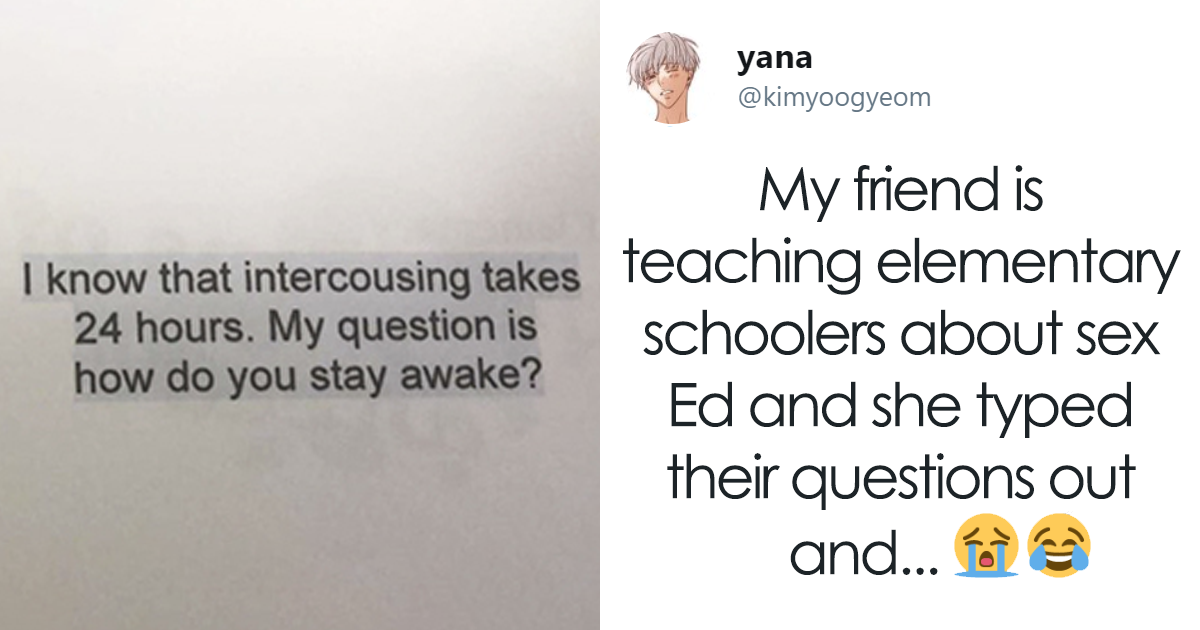
There are classroom moments that no teacher-training handbook can fully prepare you for. You can study child development, lesson planning, classroom management, and how to keep a straight face while explaining fractions for the eighth time. But then comes sex education day, a student raises a hand, and suddenly the room turns into a comedy club staffed entirely by confused preteens with excellent timing.
The title “Teacher Teaches Kids About Sex, Can’t Stop Laughing At Their Questions” sounds like the setup for a viral story, but beneath the giggles is something surprisingly important: children ask funny questions because they are trying to make sense of bodies, puberty, relationships, babies, privacy, and social rules with the limited vocabulary they have. Their questions may come out sideways, upside down, or with the confidence of a tiny courtroom lawyer, but most of the time they are not trying to be inappropriate. They are trying to understand life.
That is why good sex education for kids is not about shocking them, embarrassing them, or handing them information they are not ready for. It is about age-appropriate, medically accurate, calm, honest, and respectful conversations. When teachers and parents respond without shame, children learn that bodies are normal, questions are allowed, boundaries matter, and trusted adults are safer sources than playground rumors or random internet videos.
Why Kids’ Sex Ed Questions Are Often Hilarious
Children have a gift for turning serious topics into accidental stand-up comedy. Ask a group of adults to define puberty and you may get awkward silence. Ask a group of fifth graders and someone may describe it as “when your armpits get a personality.” Is it scientifically perfect? No. Is it emotionally accurate? Honestly, yes.
Kids’ questions are funny because children think literally. If an adult says “your body changes,” a child may imagine waking up as a giraffe. If a teacher explains that hormones send signals through the body, someone may ask whether hormones use Wi-Fi. If the lesson mentions that babies grow in a uterus, a student may wonder whether the baby gets bored in there. The humor comes from innocence, not disrespect.
For teachers, the challenge is not laughing at children in a cruel way. The best educators laugh gently, breathe deeply, and turn the moment back into learning. Humor can lower tension, but it should never make a student feel foolish for asking. A good rule is simple: laugh at the surprise, not at the child.
The Real Purpose of Sex Education for Kids
Sex education is often misunderstood as one big uncomfortable conversation. In reality, it includes many topics that grow with a child’s age: body parts, hygiene, puberty, emotions, consent, friendship, personal boundaries, media literacy, reproduction, healthy relationships, and safety. The goal is not to rush childhood. The goal is to give children the right information before misinformation gets there wearing sneakers and carrying a juice box.
Major health and education organizations support developmentally appropriate instruction. That means a lesson for young children may focus on correct names for body parts, privacy, safe and unsafe touch, and how to talk to trusted adults. A lesson for older students may include puberty, menstruation, body odor, emotional changes, peer pressure, online safety, and respectful relationships. Teens may learn more detailed information about sexual health, pregnancy prevention, STIs, consent, and decision-making.
The best sex education is not a single dramatic “talk.” It is a series of smaller conversations that become normal over time. That way, when a child has a question, they do not have to climb Mount Awkward just to ask it.
Classic Questions Kids Ask During Sex Education
Every teacher who has taught puberty or sex education knows the anonymous question box is both a blessing and a comedy grenade. It gives students a safe way to ask what they are too embarrassed to say out loud. It also gives teachers questions that require the emotional control of a professional poker player.
“Is puberty contagious?”
This question sounds silly, but it reveals a real concern. Kids notice friends changing at different times and may wonder whether puberty spreads like a cold. A helpful answer is: “No, puberty is not contagious. It happens when your body is ready, and everyone’s timing is different.” Simple, reassuring, and no need to call the school nurse for a quarantine sign.
“Can you run out of hormones?”
This is actually a clever question. Children hear that hormones cause body changes, so they imagine hormones as a limited classroom supply, like glue sticks in April. Teachers can explain that hormones are chemical messengers the body makes naturally. They do not disappear because you used them all while growing leg hair.
“Why do voices crack like broken speakers?”
This one deserves applause. During puberty, the voice box grows and changes, and the voice may temporarily squeak or crack. A teacher might say, “Your voice is adjusting, like an instrument being tuned.” That sounds nicer than “your throat is doing jazz without permission.”
“Do babies eat sandwiches before they are born?”
Children are practical. If babies grow, they must eat. If they eat, surely someone is sending snacks. An age-appropriate answer can explain that babies get nutrients from the pregnant person through the umbilical cord. No tiny lunchbox required.
“Can my period start during math?”
This question is funny only because it is so painfully real. Yes, a first period can start at school, during math, lunch, gym, or while someone is trying to remember the difference between numerator and denominator. The important message is preparation: periods are normal, supplies are available, and students should know which adults they can ask for help.
Why Teachers Need a Straight Face and a Soft Heart
Teaching sex education requires a special combination of knowledge, patience, and facial muscle control. A teacher may hear a question that sounds hilarious, but the child asking may be genuinely worried. If the teacher reacts with shock, shame, or ridicule, the student may stop asking questions altogether. That silence is not maturity. It is a locked door.
A calm response teaches students that their bodies are not embarrassing. It also models how to handle sensitive topics respectfully. This matters because kids are building lifelong attitudes about health, privacy, boundaries, and communication.
Teachers can use humor carefully. For example, if a student asks whether deodorant is “mandatory for survival,” the teacher can smile and say, “Not for survival, but your classmates may consider it a community service.” Then the lesson can move into body odor, sweat glands, and hygiene. The laugh opens the door; the facts walk through it.
How Age-Appropriate Sex Education Works
Age-appropriate does not mean vague. It means accurate information delivered in language a child can understand. Younger children do not need adult-level details. They need safety, vocabulary, and reassurance. Older children need more information because puberty often arrives before confidence does.
For Younger Children
Lessons often focus on naming body parts correctly, understanding privacy, recognizing boundaries, and knowing that they can say no to unwanted touch. This kind of education can help children communicate clearly if something is wrong. It also teaches that bodies are not shameful, which is a surprisingly powerful foundation.
For Tweens
Tweens need practical puberty education: periods, erections, wet dreams, acne, body hair, growth spurts, sweat, mood swings, and the confusing reality that one person in class may look sixteen while another still looks like they collect dinosaur stickers. Both are normal. This age group especially benefits from reassurance that development happens on different timelines.
For Teens
Teen sex education should include consent, contraception, STI prevention, healthy relationships, digital boundaries, peer pressure, sexual orientation, gender identity, and where to get reliable health information. Teens are already receiving messages from social media, entertainment, friends, and the internet. Education helps them sort facts from nonsense.
The Anonymous Question Box: Tiny Papers, Big Truths
The anonymous question box is one of the most useful tools in sex education. Students can submit questions without attaching their names, which makes it easier to ask about embarrassing topics. Teachers can sort questions, group similar ones, skip inappropriate jokes, and prepare thoughtful answers.
Question boxes also reveal what students actually need to know. Adults may assume children are worried about one thing, while the box shows they are secretly panicking about deodorant, bras, periods, voice cracks, crushes, body hair, or whether everyone else already knows some mysterious life manual they missed.
A good question box has clear rules. Questions should be respectful. The teacher will answer general questions for the class and handle personal or urgent concerns privately. Students should know that some questions may be answered later after the teacher checks the best wording or school policy. This protects both the students and the educator.
Why Kids Need Trusted Adults More Than Ever
Children today are surrounded by information, but information is not the same as understanding. A student can search a question online and receive ten answers, four myths, three advertisements, two panic attacks, and one comment section that should be sealed in concrete. That is why parents and teachers matter.
When adults answer calmly, children learn where to go next time. When adults shut questions down, children still look for answers; they just look somewhere else. That somewhere else may be a friend, a meme, a video, or an older kid who sounds confident but is absolutely making things up.
Sex education also supports safety. Children who know body boundaries, correct terms, and trusted-adult rules are better equipped to describe concerns. Teens who understand consent and healthy relationships are better prepared to respect others and recognize red flags. This is not about removing innocence. It is about giving children tools.
What Parents Can Learn From Laughing Teachers
Parents often dread sex education more than children do. Kids may ask a question and move on to cereal. Adults may hear the same question and mentally leave the planet. But teachers who handle these conversations well show parents an important lesson: the tone matters as much as the content.
If a child asks, “Where do babies come from?” the adult does not have to deliver a medical lecture with diagrams, dramatic lighting, and a laser pointer. The adult can ask, “What have you heard?” or “What are you wondering about?” That helps match the answer to the child’s actual question.
Parents can also admit when they need a moment. Saying, “That is a good question. I want to answer it clearly, so let me think about the best way to explain it,” is better than panicking and changing the subject to weather patterns. Children do not need perfect adults. They need available ones.
How to Answer Funny Questions Without Making It Weird
Here is the secret: most sex education awkwardness comes from adults, not children. Kids ask direct questions because they do not yet know which topics make grown-ups turn into malfunctioning robots. Adults can keep the conversation healthy by using a simple approach.
Stay Calm
A neutral face says, “This topic is safe.” Even if the question is wildly phrased, the adult can breathe, smile gently, and answer the real concern underneath it.
Use Correct Words
Correct anatomical language reduces confusion and shame. It also helps children communicate more clearly about health or safety concerns. Nicknames may feel cute, but clarity matters.
Keep It Short
Children often need less information than adults fear. Answer the question asked, then pause. If they want more, they will ask. Sometimes a child’s entire curiosity can be satisfied in three sentences, after which they will return to discussing snacks.
Do Not Shame the Question
Even a strange question may be rooted in worry. “That is a common thing to wonder about” is a magical sentence. It tells the child they are not weird, even if their wording briefly made the teacher stare at the wall.
Specific Classroom Examples That Turn Into Teachable Moments
Imagine a teacher explaining puberty when a student asks, “Will everyone smell bad forever?” The class laughs. The teacher smiles and says, “Bodies sweat more during puberty, and sweat can cause odor. That is why people use soap, clean clothes, and deodorant. So no, not forever, and yes, laundry becomes a hero.” The room relaxes, and the lesson lands.
Another student asks, “Why do people get crushes and then act weird?” This is a perfect opening to discuss emotions, attraction, respect, and boundaries. The answer does not have to be dramatic. “Crushes can make people nervous because they care what someone thinks. But liking someone does not mean you get to bother them. Respect still matters.” Simple. Useful. No violins required.
A third student asks, “Can you tell your body not to start puberty until summer break?” Many children wish puberty followed the school calendar. A teacher can explain that puberty timing is controlled by the body, not personal scheduling preferences. It may be inconvenient, but so are pop quizzes and rain on field day.
The Bigger Lesson Behind the Laughter
The funniest sex education questions usually point to the most important lesson: children are paying attention. They notice changes in themselves, their classmates, their families, and the media around them. They may not have the words yet, but they have curiosity. Curiosity is not the enemy. Silence is.
A good teacher uses laughter as a bridge. The class giggles, the teacher steadies the moment, and then everyone learns something real. That is the magic of education: taking a question that sounds like chaos and turning it into understanding.
Additional Experiences: What These Lessons Feel Like in Real Life
Anyone who has ever helped with a puberty or sex education lesson knows that the room has its own weather system. At first, the emotional forecast is cloudy with a strong chance of awkward. Students slide down in their chairs. Someone suddenly becomes fascinated by the ceiling tile. A brave kid whispers, “This is going to be weird,” as if announcing the arrival of a tornado.
Then the questions begin, and the mood changes. One student asks something practical. Another asks something deeply imaginative. A third submits a question that is clearly designed to make the teacher’s soul leave their body. The teacher reads it silently, pauses, takes a professional breath, and says, “I think what this question is really asking is…” That sentence deserves its own trophy.
The most memorable experiences are rarely the outrageous ones. They are the moments when a child’s worry becomes visible. A student may ask whether it is normal to be the only one without body hair. Another may wonder if periods hurt every time. Someone else may ask why they feel angry or sad for no clear reason. These questions remind adults that puberty is not just biology; it is identity, confidence, comparison, fear, and hope all packed into a body that suddenly needs stronger deodorant.
Teachers often discover that humor makes the room safer. When a student asks whether voice cracks are “permanent damage,” a light joke can soften the embarrassment. But the teacher must always circle back to reassurance: no, it is not damage; yes, it is common; no, you are not the only one. That combination of warmth and facts can change how a child feels about growing up.
Parents have similar experiences at home, usually at the least convenient times. Children rarely schedule big questions for calm family meetings. They ask in grocery aisles, in the car, during dinner, or while the parent is holding a laundry basket and questioning every life choice. A child may ask, “How does a baby get in there?” while the parent is comparing pasta sauce prices. Suddenly, the marinara section becomes a seminar.
The best response is not panic. It is presence. Parents can answer briefly and honestly, then invite more questions later. The first conversation does not have to cover everything. In fact, it should not. Children process information in layers. Today they may want to know why bodies change. Next year they may ask about relationships. Later they may need help understanding consent, pressure, online messages, or health care. The door should stay open.
There is also a powerful lesson for adults: if we can stop treating children’s curiosity as scandalous, we can make growing up less scary. Kids are not asking questions to ruin everyone’s day. They are asking because the world is large, bodies are strange, and nobody is born knowing why armpits suddenly need management.
So yes, a teacher may laugh. Parents may laugh too. Sometimes the questions are comedy gold wrapped in notebook paper. But after the laughter comes the real work: answering with kindness, protecting dignity, correcting myths, and making sure every child leaves the conversation feeling less confused than before. That is the heart of good sex education. It is not about having all the perfect words. It is about being the kind of adult a child can ask.
Conclusion
“Teacher Teaches Kids About Sex, Can’t Stop Laughing At Their Questions” is more than a funny headline. It captures the wonderfully human side of education: children trying to understand grown-up topics with kid-sized logic, and adults trying to answer without turning redder than a fire alarm. The laughter is real, but so is the responsibility.
Age-appropriate sex education helps children understand their bodies, respect boundaries, prepare for puberty, and build healthier relationships. It gives them accurate language, trusted adults, and the confidence to ask questions before myths take root. Whether in a classroom or at home, the best approach is calm, honest, respectful, and gently humorous.
Kids will always ask surprising questions. That is part of the job. The goal is not to stop the laughter. The goal is to make sure the laughter leads somewhere useful.










