
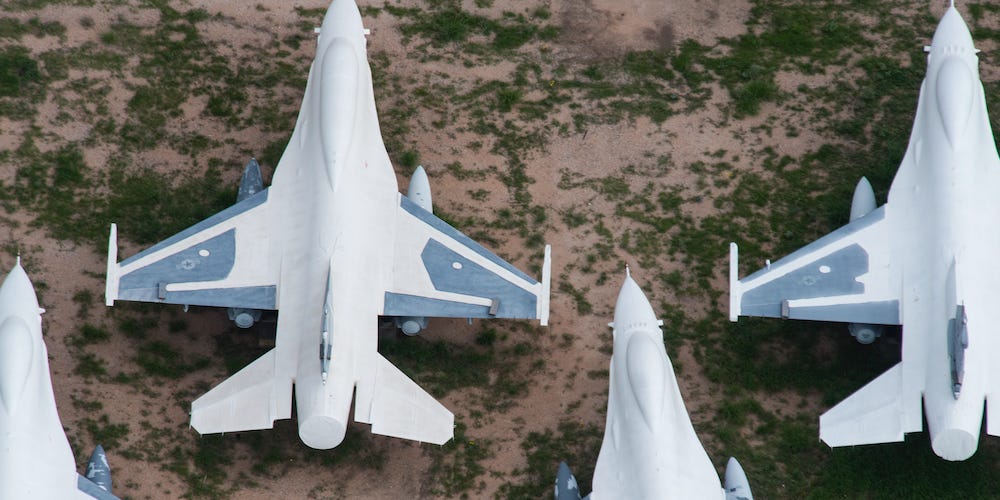
Some aircraft retire gracefully. Others end up sunbathing in the Arizona desert, wearing faded paint and waiting for spare-parts duty. But a provocative defense idea suggests that America’s aging jets may not be finished after all. Instead of leaving retired fighters to become museum pieces, target drones, or extremely expensive lawn ornaments, the Pentagon could revive them as “undead” drones: unmanned, semi-autonomous aircraft brought back for one last mission.
The phrase sounds like something cooked up in a Hollywood writers’ room after too much coffee: zombie jets, resurrected fighters, ghostly airframes with no pilots inside. Yet the concept sits at the intersection of several very real trends in U.S. defense planning: aircraft shortages, expensive next-generation fighters, rapid advances in autonomy, the rise of drone warfare, and the enormous inventory of retired aircraft preserved by the U.S. military.
The basic idea is simple: take aging but structurally usable aircraft, remove the need for a human pilot, add modern control systems and autonomy, and send them into roles too risky, dull, or costly for crewed aircraft. They might act as decoys, missile trucks, electronic warfare platforms, test aircraft, or one-way strike assets. In other words, the Pentagon may be able to turn yesterday’s jets into tomorrow’s robotic force multipliers. That is not exactly “Night of the Living F-16s,” but it is close enough to make defense planners smile and maintenance crews reach for a larger wrench.
What Are ‘Undead’ Drones?
“Undead drones” is an informal term for retired or aging aircraft restored and converted into unmanned systems. Unlike purpose-built drones such as the MQ-9 Reaper or future Collaborative Combat Aircraft, undead drones would begin life as conventional aircraft. Many would be fighter jets, trainers, transports, or other military platforms that have already served decades in uniform.
The concept is not pure fantasy. The U.S. Air Force has already converted retired F-16 Fighting Falcons into QF-16 full-scale aerial targets. These aircraft can fly without pilots and are used for missile testing, weapons evaluation, and realistic training. Before the QF-16, the Air Force used QF-4 Phantom target drones. In other words, America has already proven that old fighters can be made to fly without a person in the cockpit. The question is whether that same idea could move beyond target practice and into operational combat support.
Why the Pentagon Is Interested in Old Aircraft Again
Modern airpower has a math problem. Advanced fighters are spectacular, but they are also expensive, maintenance-heavy, and limited in number. The F-35 brings stealth, sensors, networking, and combat power, but no one wants to waste a fifth-generation fighter on a mission that could be done by a cheaper unmanned platform. The Air Force also faces aging fleets, rising sustainment costs, and the challenge of preparing for large-scale conflict across huge distances, especially in the Pacific.
That is where revived aircraft become tempting. The United States has thousands of retired aircraft in storage, many at the 309th Aerospace Maintenance and Regeneration Group, often called “the boneyard,” at Davis-Monthan Air Force Base in Arizona. Some airframes are kept for parts. Some can be regenerated. Some are preserved well enough that, with time and money, they can return to flight. For defense planners trying to build mass quickly, that inventory looks less like a junk drawer and more like a strategic reserve.
In a conflict where numbers matter, a revived aircraft does not need to be perfect. It may not need decades of service life. It may only need enough reliability to fly a dangerous mission, confuse an adversary, carry sensors, jam radar, launch weapons, or absorb enemy missiles that would otherwise target crewed aircraft. That sounds harsh, but warfare has never been known for sentimental retirement parties.
The QF-16 Shows the Idea Is Technically Possible
The QF-16 program is the clearest real-world example of “undead aircraft” already in motion. Retired F-16s have been regenerated, modified, and flown as full-scale aerial targets. These aircraft help the Air Force test weapons against realistic threats, because a real fighter-sized target behaves differently from a small drone or a towed target. The QF-16 can fly manned or unmanned, giving testers flexibility while preserving safety controls.
That matters because it proves several important pieces of the puzzle: a retired fighter can be restored, equipped with remote-control systems, integrated into a range-control environment, and flown safely without a pilot onboard. It also shows the practical limits. Conversion is not magic. It requires inspection, maintenance, software integration, flight testing, safety systems, logistics support, and trained operators. Reviving an aircraft is not like jump-starting an old pickup truck, unless that pickup truck can break the sound barrier and costs millions of dollars to sneeze near.
Autonomy Has Changed the Conversation
For years, unmanned aircraft were typically remote-controlled or followed preplanned routes. Today, the conversation has shifted toward autonomy, machine learning, and human-machine teaming. DARPA’s Air Combat Evolution program has demonstrated AI algorithms flying a modified F-16 test aircraft, the X-62A VISTA, in complex air combat scenarios against human-piloted aircraft. The Air Force has also used the X-62A to explore how machine learning can support advanced aerial combat testing.
This does not mean robot jets are being handed a license to make every decision alone. Human oversight remains central, especially for lethal force. But autonomy can reduce operator workload, allow drones to react faster in complex environments, and make it possible for one crewed aircraft to coordinate multiple unmanned teammates. That is the core promise of the Air Force’s Collaborative Combat Aircraft program, which aims to field uncrewed aircraft that can fly alongside human pilots.
How Undead Drones Could Be Used
1. Decoys That Force the Enemy to Waste Missiles
Air defenses are dangerous, but they are not unlimited. A revived aircraft could be used as a decoy to trigger enemy radars, draw fire, and reveal air-defense locations. If an adversary launches an expensive surface-to-air missile at an unmanned aircraft that was already near the end of its useful life, the trade may favor the United States.
2. Missile Trucks With No Pilot at Risk
Older aircraft may not survive deep inside contested airspace, but they could still carry weapons. An unmanned converted jet might act as a missile truck, flying under the control of a crewed fighter or command network. It could launch standoff weapons from safer distances, adding firepower without placing another pilot in danger.
3. Electronic Warfare and Jamming Platforms
Electronic warfare aircraft often need to get close enough to confuse, jam, or deceive enemy systems. That can be risky. An undead drone could carry jamming pods or electronic payloads into areas where commanders might hesitate to send a crewed aircraft. If the aircraft survives, wonderful. If not, no family receives the worst kind of visit from uniformed officers.
4. Training and Testing
Even if revived aircraft never become frontline combat drones, they can still serve valuable roles in testing and training. Full-scale target drones help pilots and weapons developers practice against realistic threats. As enemy aircraft and missiles become more capable, realistic training becomes more important. You cannot simulate everything with a laptop, even if the laptop has excellent stickers.
5. Foreign Military Support
Converted aircraft could also support allies. In theory, revived drones could provide partner nations with additional airpower, decoys, or strike capacity without transferring the newest and most sensitive U.S. aircraft. This idea would come with export-control, training, and escalation concerns, but it fits a broader pattern: using affordable unmanned systems to expand battlefield options.
The Big Advantage: Affordable Mass
The phrase “affordable mass” has become a favorite in defense circles because it captures a hard lesson from modern war: quality matters, but quantity still has a vote. The war in Ukraine has shown how drones can saturate battlefields, scout targets, strike vehicles, and force expensive air-defense systems to respond to relatively cheap threats. The Pentagon is watching closely.
Purpose-built drones will remain essential. However, resurrected aircraft could add another layer. They are larger, faster, and potentially able to carry heavier payloads than small drones. They already have aerodynamic performance, fuel systems, landing gear, and hardpoints. If their remaining airframe life is limited, that may be acceptable for missions where survival is not guaranteed anyway.
In a major conflict, the United States may need to overwhelm defenses, complicate enemy planning, and create more targets than an adversary can comfortably track. A mixed fleet of crewed fighters, new autonomous wingmen, expendable drones, cruise missiles, and revived aircraft could make the air picture much harder to solve.
The Big Problem: Old Jets Are Still Old Jets
The undead aircraft idea has a major catch: old aircraft are not free just because they are parked in the desert. Every airframe has fatigue, corrosion risk, outdated wiring, obsolete parts, and maintenance needs. Some retired aircraft are preserved carefully; others are cannibalized for components. Turning them into drones requires engineering work, certification, cybersecurity testing, control systems, mission computers, datalinks, and safety procedures.
There is also the question of cost. If conversion becomes too expensive, the Pentagon may be better off buying purpose-built drones. A revived F-16 with limited remaining life might be useful, but not if it costs nearly as much as a new unmanned aircraft designed from the start for autonomous operations. The bargain only works if the aircraft can be converted quickly, safely, and cheaply enough to justify the effort.
Cybersecurity and Control Are Not Optional
Any unmanned aircraft is also a flying software problem. If an aircraft carries weapons, sensors, or electronic warfare equipment, the command-and-control link must be secure. The autonomy must be predictable. The aircraft must avoid friendly forces, respect mission boundaries, and fail safely if communications are jammed or lost.
This is especially important for converted aircraft because they were not originally designed as drones. Their systems must be adapted. Their software must be tested. Their human operators must understand what the aircraft can and cannot do. A zombie jet that ignores instructions is not a capability; it is a congressional hearing with wings.
How This Fits With Collaborative Combat Aircraft
The Air Force’s Collaborative Combat Aircraft program is the more official, purpose-built version of the same strategic trend. The service has designated General Atomics’ YFQ-42A and Anduril’s YFQ-44A as prototype collaborative combat aircraft. These drones are intended to use autonomous capabilities and crewed-uncrewed teaming to help defeat threats in contested environments.
Undead aircraft would not replace that effort. Instead, they could complement it. Purpose-built CCAs are likely to be more efficient, easier to maintain, and better optimized for autonomy. Revived aircraft, meanwhile, could offer a faster or cheaper way to experiment with tactics, payloads, command systems, and operational concepts. They could also provide temporary capacity while new aircraft move from prototype to production.
Could the Pentagon Really Do This?
Yes, but with limits. The Pentagon has already shown it can turn retired fighters into unmanned targets. DARPA and the Air Force have shown that advanced autonomy can fly fighter-like aircraft in demanding scenarios. The military already stores large numbers of retired aircraft. The strategic demand for unmanned mass is growing. All the ingredients exist.
The hard part is deciding which aircraft are worth reviving, what missions they should perform, and whether the conversion cost beats alternatives. Not every old jet deserves a second life. Some should remain parts donors. Some belong in museums. Some should be left alone before they develop opinions. But a carefully selected group of aircraft could provide real value if the Pentagon uses them for the right missions.
What Experience Teaches About Reviving Aging Aircraft
Experience from aircraft regeneration, drone conversion, and military flight testing suggests one important lesson: the airframe is only the beginning. A parked jet may look complete from the outside, but returning it to useful service requires a chain of practical work. Mechanics inspect structures, repair systems, replace parts, update records, test engines, check wiring, and verify that the aircraft can safely fly. Then engineers add remote-control equipment, datalinks, software, mission systems, and fail-safe features. The glamorous part is the unmanned flight. The less glamorous part is paperwork, testing, and someone discovering that a 30-year-old connector has the emotional stability of wet cardboard.
The QF-16 experience shows that conversion is possible, but it also shows that every aircraft has to be treated as an individual machine. Two retired fighters of the same model may have very different histories. One may have spent years in harsh climates. Another may have flown demanding missions that consumed more structural life. A third may be missing parts because it served as a donor for other aircraft. Successful revival depends on choosing the right candidates, not simply pointing at a row of old jets and saying, “Make those robots by Friday.”
Operational experience also suggests that revived drones would need clear roles. A converted aircraft should not be asked to do everything. If it is a decoy, design it to be convincing and expendable. If it is a missile carrier, prioritize payload, communications, and safe launch procedures. If it is an electronic warfare platform, focus on power, cooling, antennas, and survivability. The more missions planners pile onto one undead aircraft, the more it begins to resemble a regular aircraft program, complete with delays, cost growth, and meetings where acronyms reproduce at alarming speed.
Another lesson is that human trust matters. Pilots, commanders, maintainers, and policymakers must understand how these aircraft behave. Autonomy can be powerful, but military users need confidence that the system will follow rules, respond predictably, and fail safely. That is why test programs like the X-62A VISTA are important. They build experience before autonomy is pushed into operational missions. The goal is not to remove humans from responsibility; it is to give humans more tools without asking them to personally sit inside every dangerous aircraft.
Finally, experience from recent conflicts shows that mass matters only when it is sustainable. A revived aircraft fleet would need spare parts, trained crews, storage plans, launch bases, software support, and secure communications. If the Pentagon can solve those practical problems, undead drones could become a useful bridge between legacy aircraft and next-generation autonomous warfare. If not, the idea may remain a clever concept with a spooky nickname. Either way, the debate reveals something important: the future of airpower may not belong only to brand-new aircraft. Some of it may be hiding in the desert, waiting for one more mission.
Conclusion
The Pentagon’s possible revival of aging aircraft as “undead” drones is not just a quirky defense idea with a catchy name. It reflects a serious shift in how the U.S. military thinks about airpower. Expensive crewed fighters will remain vital, but they may increasingly operate alongside autonomous teammates, expendable decoys, converted aircraft, and lower-cost systems designed to create mass.
Revived aircraft would not be a silver bullet. They would face real challenges in cost, safety, cybersecurity, airframe condition, autonomy, and logistics. But the concept is credible because the United States has already converted retired fighters into unmanned targets and is actively developing autonomous combat aircraft. The undead drone idea asks a practical question: if an old jet can still fly, carry payloads, and confuse an enemy, why let it spend the rest of its life getting a desert tan?
The answer may shape the next chapter of American airpower. The future fleet could include sleek new drones, advanced crewed fighters, and a few resurrected aircraft that refuse to stay retired. In defense planning, as in zombie movies, it is wise to keep an eye on what appears to be dead.
Note: This article is intended for public web publication and is based on publicly available defense information, official military releases, and reputable reporting. It does not include classified details, operational instructions, or source-link clutter.














