
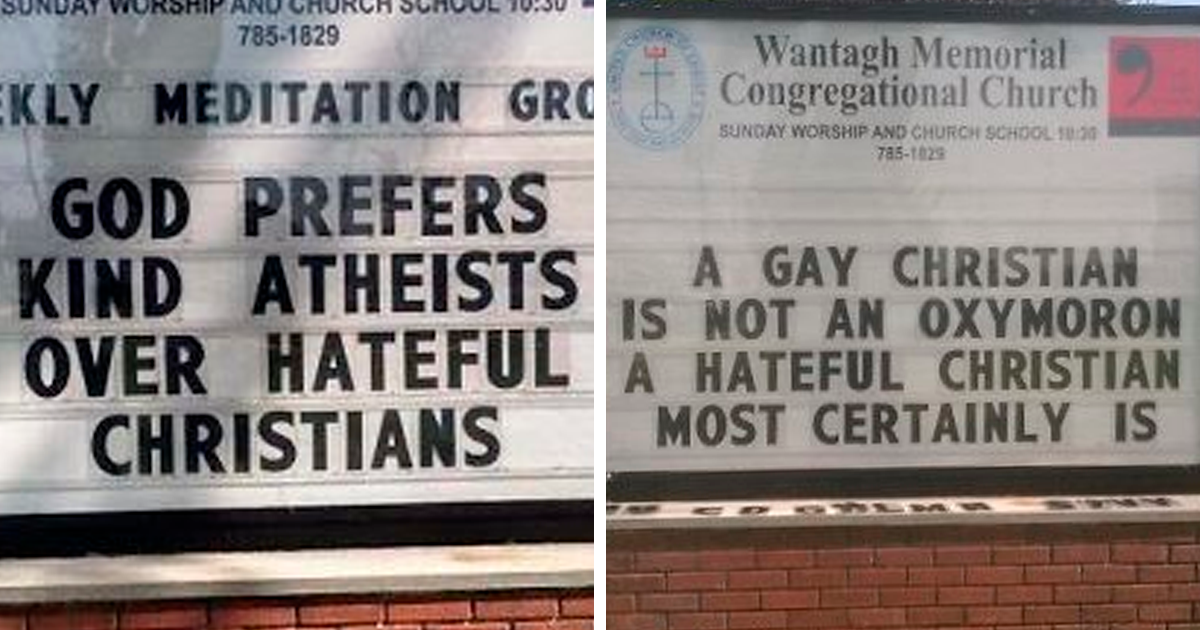
Every town has that one sign you drive past and remember. Sometimes it is advertising half-price tacos. Sometimes it is warning you about roadwork that appears to have been “almost finished” since the Clinton administration. And sometimes, if you are lucky, it is a church sign so sharp, funny, and unexpectedly humane that you nearly miss your turn because you are busy laughing, thinking, or both.
That is exactly why Wantagh Memorial Congregational Church in Wantagh, New York, became an internet favorite. The church’s clever signs are not the usual polite reminders about Sunday service and bake-sale brownies. They are witty, bold, occasionally cheeky, and often deeply thoughtful. They talk about kindness, refugees, LGBTQ inclusion, poverty, peace, bigotry, and the awkward business of being a decent human in public. In other words, they do what great signs do: they stop people for a second.
The viral collection known as “This Church Is Going Viral For Its Clever Signs (19 Pics)” struck a nerve because it showed faith communication with a pulse. Instead of sounding like a dusty bulletin board from 1974, these signs feel like tiny roadside sermons written by someone who understands both the Bible and the internet. That combination is rarer than a church potluck with no casserole.
Why These Clever Church Signs Went Viral
Church signs have always had a small-town charm. For decades, they have offered Bible verses, seasonal greetings, sermon titles, and occasional puns that range from delightful to “Dad, please step away from the marquee letters.” But Wantagh Memorial Congregational Church took the format further. Its messages were not merely cute. They were timely, pointed, and easy to photograph.
That matters. A roadside sign has only a few seconds to work. Drivers are moving. Pedestrians are distracted. Everyone has a phone, a playlist, a notification, and at least one unresolved life decision. The sign must be brief, legible, and memorable. Wantagh’s signs succeed because they sound like real thoughts, not committee-approved wallpaper.
Some of the church’s best-known signs have included messages such as “God prefers kind atheists over hateful Christians,” “Bigotry wrapped in prayer is still bigotry,” “How do we worship a homeless man on Sunday and ignore one on Monday?” and “War is costly. Peace is priceless.” These lines work because they are simple enough to understand instantly but layered enough to sit with afterward. They are funny, but they are not disposable.
The Church Behind the Signs
Wantagh Memorial Congregational Church is located on Long Island, New York, along Wantagh Avenue, a spot with enough traffic to make its signboard a real public platform. The church describes itself as an open and affirming congregation of the United Church of Christ, with a stated commitment to justice and equality. Founded in 1889, it is not a brand-new internet stunt disguised as a congregation. It is a historic local church that found a very modern way to speak outside its walls.
The phrase the church uses for its sign ministry is especially good: it wants to “preach to the street.” That is a compact mission statement. The sign is not just decoration. It is outreach. It comforts, challenges, jokes, nudges, and occasionally pokes the bear. In an age when people may never walk through a sanctuary door, the sign turns the sidewalk into a conversation.
Pastor Ron Garner has been widely associated with the signs and has explained that the goal is to show that Christianity does not have to be stale, lifeless, or afraid of public issues. That is the secret ingredient. The signs do not try to make religion trendy by slapping a hashtag on it and calling it a day. They make faith feel engaged with real life.
Not Just Funny: Why the Messages Hit So Hard
The most viral church signs usually share three qualities: humor, clarity, and a little bit of nerve. Wantagh’s signs have all three. A sign like “A gay Christian is not an oxymoron; a hateful Christian most certainly is” is not just wordplay. It is theology, social commentary, and a mic drop squeezed into one roadside message.
That is why people share these signs even if they are not religious. Many readers are not reacting only to the church identity. They are reacting to the moral common sense behind the message. Kindness is better than cruelty. Compassion should not stop at the sanctuary door. Faith should not be used as gift wrap for prejudice. These ideas are simple, but apparently humanity still needs reminders, preferably in large black letters visible from a passing Honda.
In the United States, religious affiliation has changed dramatically over the past two decades. Pew Research Center has reported long-term declines in the share of Americans identifying as Christian, while Gallup has found that regular attendance at religious services has fallen compared with previous generations. At the same time, many people remain spiritually curious, socially concerned, and hungry for authentic community. That gives signs like these unusual power. They speak to people who may be skeptical of institutions but still care deeply about justice, meaning, and decency.
What Makes a Church Sign Internet-Friendly?
1. It Has to Be Short
The best church sign sayings do not need a footnote, a glossary, or a three-part sermon series. They land fast. “Bigotry wrapped in prayer is still bigotry” works because it is direct. No fluff. No throat-clearing. It says the quiet part with excellent font placement.
2. It Has to Sound Human
People can sense when a message was assembled by a committee trying not to offend oxygen. Wantagh’s clever church signs feel like they were written by someone with a moral backbone and a sense of humor. That human tone is what makes them shareable.
3. It Has to Invite Conversation
A great sign does not end the discussion; it starts one. Some people agree. Some people grumble. Some people take a picture and send it to a group chat titled “Family Drama.” Either way, the sign has done its job. It moved an idea from the church lawn into public conversation.
4. It Has to Balance Humor and Heart
Pure jokes are fun, but they fade quickly. Pure lectures can feel heavy. The magic happens when a sign has both. Wantagh’s signs often make you smile first, then quietly ask you whether you are living up to the values you claim to admire. Sneaky? A little. Effective? Absolutely.
Examples That Show the Sign Game Is Strong
The viral Wantagh Memorial Congregational Church signs cover several themes, and each theme reveals why the collection has had staying power online.
Inclusion
Messages about LGBTQ acceptance stand out because they push against the stereotype that churches are automatically exclusionary. Lines like “Jesus had two dads, and he turned out just fine” use humor to open a larger conversation about belonging. Whether readers laugh, nod, or raise an eyebrow, they remember it.
Social Justice
The church’s signs often connect Christian teaching to social issues such as poverty, refugees, healthcare, racism, and homelessness. “How do we worship a homeless man on Sunday and ignore one on Monday?” is especially powerful because it compresses an entire sermon into one uncomfortable question. It is hard to dodge, which is the point.
Kindness Over Labels
“God prefers kind atheists over hateful Christians” is one of those lines that makes people either applaud or clutch their pearls so tightly the pearls file a complaint. It challenges religious identity without rejecting religion itself. The message is not “belief does not matter.” It is “belief without love is not the flex you think it is.”
Peace and Public Responsibility
“War is costly. Peace is priceless” has the rhythm of a bumper sticker but the weight of a prayer. It shows how a church sign can address civic issues without becoming a campaign flyer. The best signs do not merely chase controversy; they point toward conscience.
Why This Works in the Age of Social Media
A church sign is basically an analog tweet. It is brief, public, visual, and built for reaction. Before social media, a good sign might reach commuters and neighbors. Now, one person can snap a photo and send it around the world before the pastor has finished coffee.
That is exactly why clever church signs have become their own genre online. Reader’s Digest, Southern Living, Bored Panda, and many humor sites have published collections of funny church signs because people love the collision of sacred space and playful language. The contrast is irresistible. Churches are expected to be serious; signs with wit feel like finding a whoopee cushion in a cathedralsurprising, slightly dangerous, and difficult not to discuss.
But Wantagh’s signs are not viral only because they are funny. They are viral because they are sincere. The jokes are attached to a worldview. The humor is not there to distract from the message; it is the spoonful of sugar that helps the prophetic medicine go down.
The Risk of Being Clever in Public
Of course, clever church signs can be risky. A sign that says something bold will not please everyone. Some readers may feel challenged. Others may feel criticized. A few may decide that the church has officially gone too far, usually around the same time someone mentions refugees, equality, or kindness toward people they personally find inconvenient.
But public faith has always involved risk. A church that speaks only in safe slogans may avoid backlash, but it may also become invisible. Wantagh Memorial Congregational Church appears to understand that relevance requires more than keeping the lawn trimmed and the service times updated. It requires a voice.
That does not mean every church should copy the exact tone. A rural congregation, a downtown cathedral, a suburban megachurch, and a small UCC community on Long Island will all communicate differently. The lesson is not “be snarky.” The lesson is “be clear, be honest, and sound like someone who is awake.”
What Other Churches Can Learn From Wantagh’s Viral Signs
The biggest takeaway is that outreach does not always require a giant budget. A simple signboard, used consistently and creatively, can become a signature. It can tell the neighborhood what a church values. It can make strangers feel welcome before they ever meet a greeter. It can also tell people that the congregation has not mistaken dullness for holiness.
For churches trying to improve their communication, Wantagh’s example offers several practical lessons. First, know your audience. A sign on a busy street must be readable in seconds. Second, choose messages that match your actual values. If a church puts “All are welcome” on the sign but treats newcomers like suspicious luggage, the sign becomes decoration. Third, do not fear humor. A well-placed joke can lower defenses and make people open to a deeper message.
Finally, remember that a sign is not a substitute for community. It is an invitation. If the message outside says “love,” the experience inside needs to say the same thing. Otherwise, the sign is just a billboard for disappointment, and nobody needs more of that.
Why People Love These Signs Even If They Do Not Go to Church
One reason the viral Wantagh signs appeal beyond religious audiences is that they speak in moral language without sounding self-righteous. They do not scold people for sleeping in on Sunday. They ask what kindness, justice, and compassion should look like on Monday morning.
That is an important distinction. Many Americans who do not regularly attend religious services still care about spiritual questions. They wonder what makes a life meaningful. They want communities that are honest about suffering and serious about hope. They are tired of hypocrisy, especially when it comes dressed in formal clothes and quotes scripture at people.
Wantagh’s clever church signs meet that audience at the curb. They say, in effect, “We know you may be skeptical. We also know the world is messy. Let’s talk about what love requires.” That is not a bad elevator pitch for faith in the twenty-first century.
The Beauty of a Tiny Sermon
The best thing about these signs is their size. They do not have room to ramble. They cannot hide behind jargon. They must do one thing well. In that sense, a church sign is a tiny sermon with no pulpit, no microphone, and no chance to clarify itself after the fact.
That limitation makes the art form interesting. Every word matters. A clever sign has to be punchy but not cruel, funny but not shallow, challenging but not smug. Wantagh Memorial Congregational Church’s viral signs show how powerful that balance can be. They are not perfect, because no public message is. But they are alive.
Experience Section: What It Feels Like to Encounter a Clever Church Sign in Real Life
There is a particular kind of joy in stumbling across a clever church sign when you are not expecting it. You may be running late, stuck behind a delivery truck, mentally negotiating with your coffee level, and then suddenly a church lawn starts talking to you. Not in a thunder-from-the-clouds way. More like a witty neighbor leaning over the fence with a truth bomb and a grin.
The best church signs work because they interrupt ordinary life without demanding too much from us. You do not have to park. You do not have to sit through announcements. You do not have to pretend you know the second verse of a hymn. You simply pass by, read a sentence, and carry it with you. Sometimes it is a laugh. Sometimes it is a small conviction. Sometimes it is both, which is honestly rude but helpful.
Many people have had the experience of seeing a sign that stayed with them all day. Maybe it said something about forgiveness when they were busy rehearsing an argument in their head. Maybe it made a joke about prayer at the exact moment they felt overwhelmed. Maybe it challenged them to think about homelessness, refugees, racism, or inclusion in a way that was hard to shrug off. A good sign can become a pebble in the shoe of the conscience. Small, persistent, impossible to ignore.
There is also something charmingly physical about it. In a world of endless digital content, a church sign still requires someone to walk outside and change the letters. Someone has to decide what the neighborhood needs to hear. Someone has to line up the words, probably drop a few plastic letters in the grass, and hope nobody steals the “E.” That handmade quality gives the message personality. It says, “A real human put this here for other humans.” That matters.
And then comes the modern twist: the phone. A driver sees the sign, laughs, circles back, takes a photo, and posts it. Suddenly, a message meant for one street becomes content for millions. The local becomes global. The church lawn becomes a shareable square of public theology. It is old-school communication traveling by new-school speed.
That is why Wantagh Memorial Congregational Church’s signs feel so memorable. They create a tiny moment of contact between institution and individual, between tradition and now, between faith and the messy public square. They remind us that communication does not have to be expensive to be meaningful. It just has to be honest enough to matter and clever enough to be noticed.
The experience is not only about religion. It is about the human need to be surprised by goodness. We expect traffic, ads, warnings, political yard signs, and “garage sale Saturday” posters with arrows pointing to nowhere. We do not always expect a church sign to make us laugh and then quietly ask us to become less terrible. When it happens, it feels like finding a fortune cookie written by a theologian with excellent comedic timing.
In the end, clever church signs are proof that small messages can have a big afterlife. One sentence on a board can become a conversation at dinner, a screenshot in a group chat, or a memory someone keeps for years. That is not a bad return on a few plastic letters and a little courage.
Conclusion
“This Church Is Going Viral For Its Clever Signs (19 Pics)” is more than a funny internet gallery. It is a reminder that public messages can still be smart, kind, brave, and genuinely useful. Wantagh Memorial Congregational Church became widely discussed because its signs did something rare: they made faith feel conversational rather than closed off.
The signs are funny, yes. But their real strength is that they refuse to separate humor from compassion. They use jokes to talk about justice. They use puns to make people think. They use a roadside board to suggest that Christianity, at its best, is not about winning arguments but practicing love in public.
In a time when many Americans are rethinking their relationship with organized religion, that kind of communication matters. A clever sign will not solve every problem facing churches. It will not instantly refill pews, fix polarization, or stop anyone from misusing the church coffee urn. But it can open a door. It can soften a heart. It can make a stranger feel seen. And sometimes, that is where the better conversation begins.
Note: This article is based on publicly available information about Wantagh Memorial Congregational Church, its viral church sign collection, broader American church sign culture, and U.S. religious participation trends. Source links are intentionally not embedded in the article body to keep the publishing copy clean.










