
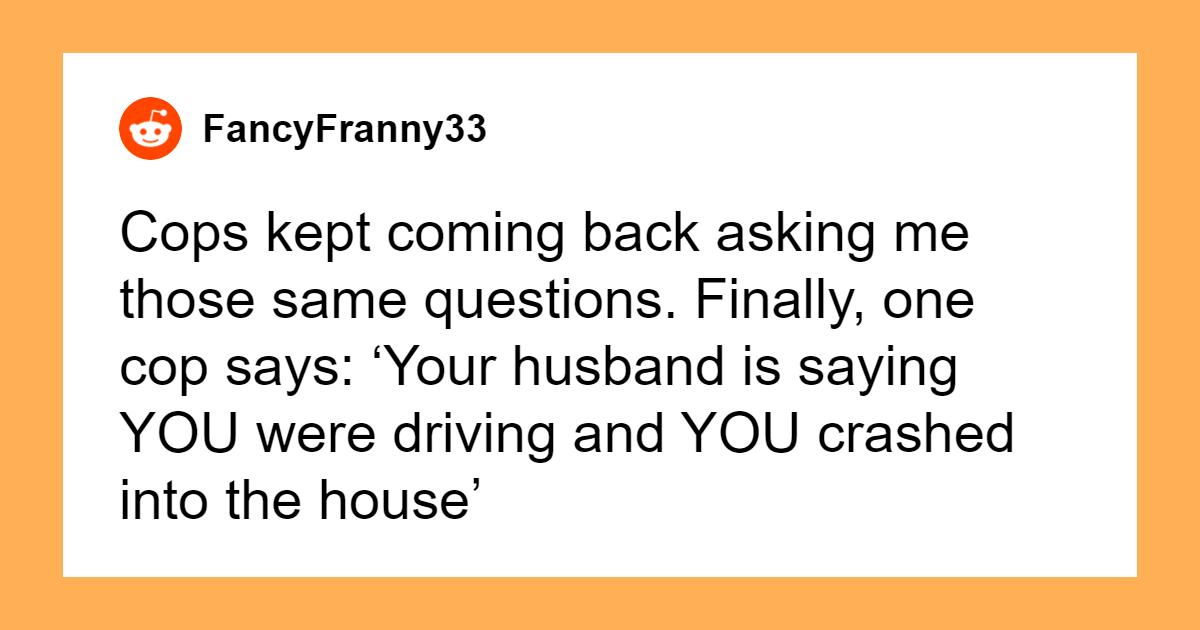
An anonymous relationship story went viral after a woman described an evening that sounded less like a marital disagreement and more like the opening scene of a legal thriller. According to her account, her intoxicated husband drove away from home, crashed into a house, returned for her and then told police that she had been behind the wheel.
When officers noticed that he smelled of alcohol while she appeared freshly showered and dressed for bed, the alleged plan quickly developed a flat tire. The husband received a DUI, spent time in custody and reportedly called his wife from jailnot to apologize, but to blame her for the financial consequences.
One commenter summarized the situation with a line that became the story’s headline: “This man would light you on fire to avoid a paper cut.” Dramatic? Certainly. Yet it captured the disturbing heart of the account: a spouse was allegedly willing to place an innocent partner in legal danger to protect himself from consequences he had created.
What Allegedly Happened That Night
The story originally appeared in an online advice community, where the woman asked whether she had been wrong not to “take the fall” for her husband. That question alone alarmed readers. Most people do not need a committee meeting to decide whether accepting responsibility for another person’s drunk-driving crash is a bad idea.
According to the post, the husband had been drinking heavily. Although his wife tried to prevent him from leaving, he drove away anyway. Within minutes, he returned and told her that he had crashed into a house. She followed him outside without knowing that he had reportedly already identified her as the driver.
Police detained and questioned her. An officer eventually explained that her husband claimed she had driven the vehicle. However, the physical details did not support his allegation: he appeared intoxicated and dressed to go out, while she did not smell of alcohol and was wearing sleep clothes. Neighbors reportedly saw only one person leaving the crashed vehicle, further weakening his version of events. The anonymous account has not been independently verified, so its details should be treated as allegations rather than established court findings.
The Blame Continued From Jail
The husband allegedly argued that his wife should have accepted the charge because doing so would have been better for the couple financially. He referred to the high cost of a DUI and accused her of damaging their household by refusing to lie.
That is not financial planning. Financial planning is comparing mortgage rates, building an emergency fund or finally canceling the streaming service nobody has watched since 2022. Asking your spouse to cosplay as the defendant in your criminal case is something else entirely.
The poster later said that her husband called from custody, shouted insults and insisted that his arrest was her fault. She also described years of yelling, denial, isolation and being told that his behavior would improve if she cooked, cleaned, earned or behaved differently. Readers increasingly viewed the crash not as a bizarre isolated episode but as part of a much larger pattern.
Drunk Driving Is Not a Private Marital Mistake
The most immediate issue is the decision to drive while intoxicated. That choice does not affect only the person holding the keys. It places passengers, pedestrians, neighbors, emergency workers and anyone sleeping inside a roadside home at risk.
Alcohol interferes with judgment, coordination, attention, reaction time and the ability to recognize danger. At a blood alcohol concentration of 0.08, drivers typically experience impaired reasoning, memory, speed control and information processing. In 2024, 11,904 people were killed in alcohol-impaired crashes in the United Statesapproximately one death every 44 minutes.
A house does not unexpectedly change lanes. Crashing into one suggests that the vehicle traveled far outside the space where a controlled car should have been. The absence of a reported fatality does not make the conduct harmless; it makes the outcome fortunate.
DUI penalties differ by state and circumstance, but they may include fines, license suspension, ignition-interlock requirements, legal expenses and jail time. The National Highway Traffic Safety Administration estimates that even a first offense can cost more than $10,000. Those consequences are severe because impaired driving can cause irreversible harm.
Alcohol Can Explain Impairment, Not Transfer Responsibility
Alcohol can help explain why someone exercised terrible judgment. It does not magically assign that person’s choices to the nearest spouse.
Health authorities note that alcohol can impair decision-making and impulse control. Relationship-abuse specialists also warn that abusive partners sometimes use intoxication as an excuse, claiming that drinking created an entirely different personality. Alcohol may influence behavior, but it does not make the harmed partner responsible for that behavior.
In the viral account, drinking allegedly contributed to the dangerous drive. The attempt to frame the wife, however, involved several separate decisions: returning home, bringing her to the scene, identifying her to police and later demanding that she support the false story. Even through the fog of intoxication, the strategy appeared remarkably focused on self-preservation.
Why the Blame-Shifting Disturbed So Many Readers
Ordinary defensiveness sounds like, “I know I messed up, but I panicked.” Blame-shifting sounds like, “My decision is your fault because you refused to suffer the consequences for me.”
Gaslighting and blame-shifting may involve denying fault, questioning another person’s memory, minimizing concerns, insisting the target is too sensitive and making that person feel responsible for the aggressor’s actions. Over time, these behaviors can damage confidence and cause someone to distrust their own judgment.
That pattern appeared in the poster’s question. She was not asking whether her husband had behaved perfectly. She was asking whether she had done something wrong by refusing to confess to an act she said she did not commit. The moral answer seems obvious from the outside, yet prolonged manipulation can make obvious boundaries feel selfish or unreasonable.
The Real Message Behind “You Should Have Taken the Fall”
When someone asks a partner to accept punishment for their wrongdoing, the request communicates several troubling beliefs:
- Their freedom matters more than the partner’s freedom.
- Their record matters more than the partner’s record.
- Their reputation matters more than the partner’s reputation.
- The partner’s loyalty should include lying to authorities.
- Love should function as an unlimited liability policy.
A healthy marriage involves mutual support, but support is not the same as self-destruction. A spouse can help someone find an attorney, arrange treatment for alcohol misuse or organize transportation. A spouse is not obligated to become a human shield between that person and accountability.
Taking the Fall Could Create Even More Trouble
Had the wife falsely claimed to be the driver, she might not have solved anything. Knowingly giving false information to police can itself be illegal, with the exact offense and penalty depending on state law and the circumstances. A false account connected to an accident may also raise questions about obstruction or insurance fraud.
She could also have faced consequences associated with a serious driving charge, such as legal fees, license problems, increased insurance costs, employment complications and a damaging record. Meanwhile, investigators might still have uncovered evidence showing who actually drove.
The husband’s proposal was therefore not merely cruel. It was badly engineered. It risked turning one person’s case into two people’s legal crisis, which is the criminal-justice equivalent of trying to extinguish a kitchen fire with gasoline because water seemed expensive.
The Financial Argument Falls Apart
The husband allegedly framed his demand as a practical attempt to save the household money. Yet the household expense resulted from his reported decision to drink and drive. Refusing to absorb a false charge did not create the cost.
This distinction matters in financially abusive dynamics. An abusive partner may cause a financial emergency and then pressure the other person to sacrifice savings, credit, employment or legal security to repair it. Domestic-violence organizations identify financial control and manufactured financial dependence as powerful tools that can make leaving difficult.
When a Relationship Problem Becomes a Safety Problem
No online reader can diagnose a marriage from a single post. Still, the additional behaviors described by the womanyelling, insults, isolation, property destruction, prior physical aggression and persistent denialare serious warning signs.
The Centers for Disease Control and Prevention defines psychological aggression as verbal or nonverbal communication intended to harm a partner emotionally or exert control. Coercive control can include preventing contact with friends and family, threats, humiliation and other tactics that reduce independence.
Domestic violence is not limited to visible injuries. It may include emotional, physical, sexual, digital and financial abuse. A pattern in which one partner seeks power and control over another deserves attention even when every incident does not involve physical violence.
Why “Just Leave” Is Incomplete Advice
Many commenters urged the woman to leave immediately. Their concern was understandable, but leaving an abusive relationship can involve financial dependence, fear, isolation, housing insecurity, children, pets and the risk of escalation.
Safety organizations recommend personalized planning rather than announcing a departure during a volatile confrontation. A safety plan may include preserving evidence, securing identification and medication, identifying a safe destination, protecting money, changing passwords and contacting a trained advocate.
In an immediate emergency, contacting 911 may be appropriate. In the United States, the National Domestic Violence Hotline offers confidential support at 1-800-799-SAFE and by texting START to 88788. People concerned about monitored devices should seek help using a safer phone or computer when possible.
What Genuine Accountability Would Have Looked Like
A responsible response after the crash would not have erased the danger, but it would have demonstrated basic moral awareness. It might have sounded like this:
“I drove after drinking. I could have killed someone. I lied because I panicked, and putting you at risk was inexcusable. I will cooperate with the legal process, stop driving, seek professional help and accept that you may no longer trust me.”
Notice what is missing: no “but,” no invoice handed to the wife and no Olympic-level attempt to turn the guilty party into the victim.
A meaningful apology identifies the harmful action, acknowledges its impact, accepts consequences and is followed by changed behavior. Research and clinical discussions of apology consistently distinguish genuine repair from statements designed merely to end conflict or restore the speaker’s comfort.
Even a sincere apology would not obligate the wife to remain in the marriage. Accountability is not a coupon that guarantees forgiveness. It is simply the minimum starting point for change.
Experiences and Lessons From Similar Situations
The following examples are illustrative composites based on commonly reported relationship and accountability patterns. They do not describe specific identifiable individuals.
Experience One: The “Small” Favor That Was Not Small
Imagine a partner who damages a parked car and asks the other person to say they were driving because the insurance policy is in their name. The request may initially be presented as teamwork: “We are married, so we solve problems together.” When the innocent partner hesitates, the language changes. Suddenly they are selfish, disloyal and responsible for whatever financial trouble follows.
The useful lesson is that manipulation often arrives wearing the costume of cooperation. The request is not truly mutual when one person receives protection and the other receives the risk. A quick test is to ask, “Would this person make the same sacrifice for me, and would it be legal, safe and ethical for either of us to do it?” If the plan requires lying to police or insurers, the teamwork speech can be placed directly into the recycling bin.
Experience Two: The Apology That Resets Every Morning
Another common experience involves a partner who becomes cruel while drinking, apologizes after sobering up and then repeats the behavior. Each apology sounds heartfelt. There may be tears, flowers, promises and a dramatic declaration that alcoholnot the personcaused everything.
For a while, the harmed partner may focus on the remorse rather than the repetition. Eventually, the pattern becomes clearer: the apology is functioning as a reset button rather than a bridge to change.
Real improvement is measurable. It may include treatment, sobriety support, respect for boundaries, repayment of damages and a sustained end to intimidation. Promises without action are simply trailers for the next episode, and nobody asked for another season.
Experience Three: Losing Confidence One Argument at a Time
Some people do not realize how much confidence they have lost until they hear themselves asking permission to believe basic facts. A partner may deny previous insults, insist that broken objects were accidents or claim that shouting happened only because the other person “provoked” it.
After years of this, the target may start documenting conversations, replaying memories and asking friends whether ordinary reactions are unreasonable. This uncertainty is not proof that the target is irrational. It may be evidence that their perspective has repeatedly been challenged and minimized.
Reconnecting with trusted people can be powerful. A counselor, advocate, attorney, relative or friend can help separate facts from pressure. The goal is not to let strangers make every decision. It is to rebuild enough clarity to make informed decisions without someone else shouting over the internal compass.
Experience Four: The Quiet Safety Plan
In potentially dangerous relationships, the wisest first step is not always a dramatic confrontation. One survivor might quietly copy important documents, store emergency money, change account passwords from a safe device and speak with an advocate before revealing any intention to leave.
From the outside, this preparation can look slow. From the inside, it may be careful, courageous risk management. Leaving is not a single movie scene in which someone packs a suitcase while triumphant music plays. It can be a process involving housing, finances, transportation, legal advice and emotional recovery.
The broad lesson from these experiences is simple: another adult’s misconduct is not a debt automatically transferred to their partner. Love can include compassion, but it does not require false confessions, financial ruin, legal jeopardy or surrendering personal safety.
Conclusion: A DUI Was Only Part of the Warning
The viral story attracted attention because the husband allegedly blamed his wife for his arrest. Yet the more disturbing allegation was that he tried to make her responsible before the arrest even happened.
He reportedly made the decision to drink, the decision to drive, the decision to leave the crash scene, the decision to bring his wife outside and the decision to identify her as the driver. When that strategy failed, he allegedly treated her refusal to lie as the real offense.
That is why the “light you on fire to avoid a paper cut” comment resonated. It described a person who appeared willing to expose someone else to enormous harm to avoid discomfort of his own making.
A healthy partner does not demand proof of love through self-sacrifice to the legal system. A trustworthy partner protects your future rather than wagering it. And an accountable partner says, “I did this,” not, “You should have saved me from what I did.”














