
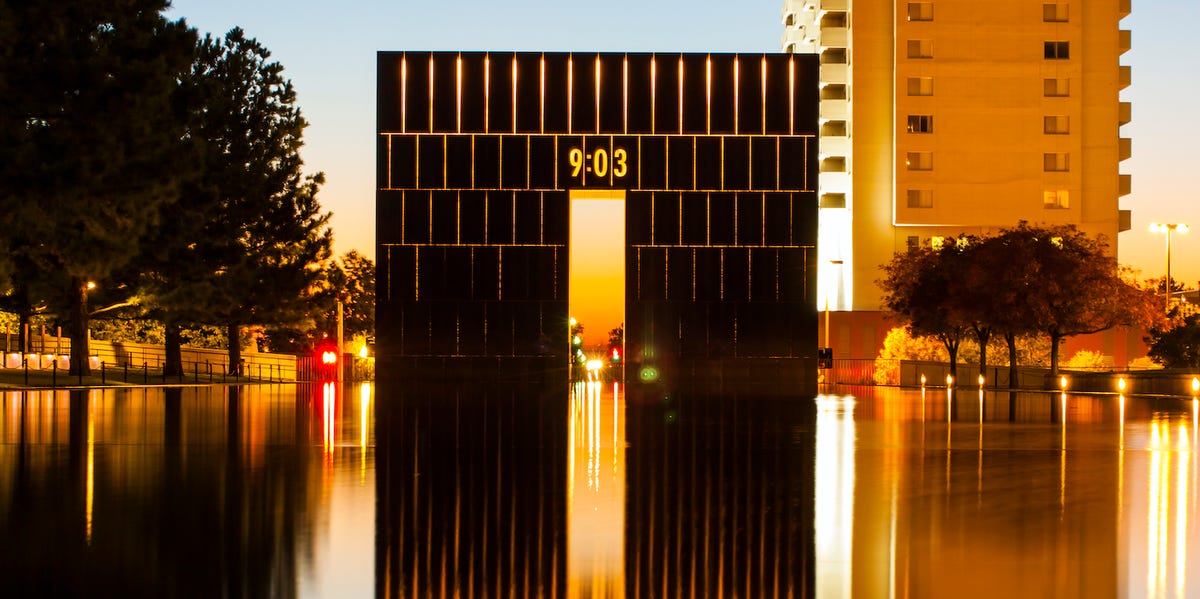
At 9:02 a.m. on April 19, 1995, an ordinary spring morning in downtown Oklahoma City became one of the darkest moments in modern American history. The Alfred P. Murrah Federal Building, a place filled with office workers, parents, federal employees, visitors, and children in day care, was torn open by a truck bomb parked outside. In seconds, glass became rain, concrete became dust, and routine became memory.
The Oklahoma City bombing killed 168 people, including 19 children, and injured hundreds more. It remains a defining act of domestic terrorism in the United States, not only because of its scale, but because of what survivors have carried ever since: grief, guilt, gratitude, fear, resilience, and the difficult work of turning pain into purpose.
This is not a story about statistics alone. Numbers tell us how large the wound was. Survivors tell us how deep it went. Through the recollections of Amy Downs, Priscilla Salyers, and Dennis Purifoy, the 1995 Oklahoma City bombing becomes more than a date in a textbook. It becomes a human story about being trapped, being rescued, waking up to loss, and learning how to live after the world has split in two.
A Day That Began Like Any Other
Before the blast, April 19 looked harmless. Survivors have described a beautiful Oklahoma morning, the kind that makes people notice the sky, the flowers, and the small comfort of arriving at work without drama. That detail matters because tragedy rarely announces itself with cinematic thunder. It arrives while people are answering phones, checking paperwork, dropping children at day care, pouring coffee, or making plans for lunch.
The Murrah Building housed several federal offices, including the Social Security Administration, the Department of Housing and Urban Development, the Secret Service, Customs, and a credit union. America’s Kids Day Care Center was also inside. That mix of everyday public service and family life is part of why the attack shocked the country so deeply. It was not a battlefield. It was a workplace. It was a child care center. It was a place where people expected fluorescent lights, not falling floors.
Timothy McVeigh, aided by Terry Nichols, used a rented Ryder truck packed with a fertilizer-and-fuel explosive mixture. The blast destroyed a large section of the building and caused floors to collapse onto one another. Rescue teams rushed in, then were forced at times to pull back because of fears that another device might explode. For those trapped inside, minutes stretched into something much longer and stranger: a private battle against dust, pain, darkness, and the terrifying question of whether anyone knew they were alive.
Amy Downs: A Promise Made Under Concrete
Amy Downs was 28 years old and working for the Federal Employees Credit Union when the bomb went off. One moment she was at her desk near a window. The next, she was buried under rubble, unable to move, struggling to breathe, and trying to understand whether she was alive. She would later describe the darkness, the burning in her throat, and the disorientation of being trapped beneath concrete.
Downs was wedged in the debris for more than six hours. Her body had been thrown from the third floor into a collapsed space below. In those hours, fear turned into reflection. She thought about the life she had lived, the choices she had postponed, the health she had ignored, the dreams she had filed away like paperwork for another day. The rubble became, in the harshest possible way, a mirror.
Many survivors speak of time changing shape after a disaster. For Downs, time became a reckoning. She prayed. She tried to remember Scripture. She thought about becoming a mother. She promised that if she survived, she would not live the same way again. It was not a polished motivational speech. It was a desperate bargain made in dust and darkness.
When rescuers finally reached her, she was carried out into the open air. Surviving, however, was not the neat ending people sometimes imagine. Downs later learned that 168 people had died, including her close friend Sonja Sanders and many of her coworkers. Survival brought relief, but also guilt. Why had she lived when others had not? Why had chance, timing, architecture, and rescue landed on her side?
Over time, Downs began to act on the promise she had made. She sought counseling, returned to school, became a mother, lost significant weight, took up cycling and running, and eventually completed endurance events. She also continued working with the credit union, which later became Allegiance Credit Union, and eventually served as its chief executive. Her story is often told as one of transformation, but the transformation did not erase the trauma. It grew beside it.
That is one of the most important lessons in her survivor story: healing is not a magic wand, even if Downs herself has used the idea of imagining a magic wand to help set goals. Healing is more like showing up again and again, sometimes bravely, sometimes grumpily, sometimes with a bike helmet and sore knees. Progress does not need to look glamorous to be real.
Priscilla Salyers: Falling Five Floors and Facing the Pit
Priscilla Salyers worked on the fifth floor of the Murrah Building for the United States Customs Service. When the bomb detonated, the floor beneath her gave way. She fell into the center of the collapsed building, an area survivors and rescuers would remember as “the Pit.” She later recalled being trapped so tightly that she could move only one arm.
Her account is almost impossible to absorb casually. She had been on the fifth floor, yet after the collapse she heard rescuers talking about the child care center on the second floor. That detail told her something physically impossible had happened: she had fallen through the building as floors collapsed around and above her. She survived under enormous debris, including concrete that could easily have crushed her.
Salyers’ survival was followed by a long recovery, not just from physical injuries but from emotional trauma. Public memory often focuses on the moment of rescue, because rescue offers a clean image: a person pulled from wreckage, a crowd relieved, a life saved. But survivors know rescue is the beginning of another road. The body heals on one schedule. The mind may keep its own stubborn calendar.
She later spoke about depression, survivor’s guilt, and the challenge of moving forward after seeing coworkers die and after falling through the building. She also testified in legal proceedings connected to the bombing. That required her not only to remember, but to remember in public, under pressure, in a courtroom shaped by national attention.
One of the most striking parts of Salyers’ later reflections was her refusal to let bitterness own the rest of her life. That does not mean she minimized the crime or softened the truth. The bombing was a deliberate act of mass murder. But for Salyers, refusing bitterness became a form of survival. She understood that if hatred controlled her future, the attack would continue stealing from her.
Her story also reminds readers that survivor strength is often quiet. It is not always a triumphant finish line or a dramatic public speech. Sometimes it is going to therapy. Sometimes it is telling the same painful story again so others understand. Sometimes it is choosing, one ordinary morning after another, not to surrender the rest of your life to the worst thing that happened to you.
Dennis Purifoy: The Ground Floor Changed Forever
Dennis Purifoy was an assistant manager in the Social Security office on the ground floor of the Murrah Building. His workplace was one of the areas devastated by the blast. He lost coworkers, and people waiting in the lobby were also killed. In later reflections, Purifoy said he did not remember hearing the explosion itself. Instead, his mind tried to make sense of the impossible by reaching for something familiar: he thought perhaps the computer he was working on had exploded.
That small detail is powerful because it shows how the brain scrambles during catastrophe. In the first instant, the mind does not always say, “This is history.” It says, “What just happened to my desk?” or “Why is it dark?” or “Where is everyone?” Human beings often process disaster through the closest available explanation, even when that explanation is wildly inadequate.
Purifoy’s memories also connect the bombing to a broader warning about extremism and conspiracy thinking. The attack was fueled by anti-government rage, distorted beliefs, and the willingness to turn ideology into violence. For public servants like Purifoy, that motive carried a particular cruelty. The people inside the Murrah Building were not symbols. They were employees helping retirees, families, veterans, job seekers, and citizens navigate ordinary government services.
Survivors such as Purifoy have emphasized that conspiracy theories and extremist rhetoric are not harmless when they dehumanize real people. The lesson is not simply historical; it remains civic. A society that forgets the humanity of office workers, children, and neighbors becomes easier to poison. The Oklahoma City bombing stands as a warning that words, myths, and grudges can become physical violence when they are fed long enough.
What the Three Survivors Teach Us
Amy Downs, Priscilla Salyers, and Dennis Purifoy survived the same attack, but their memories show different dimensions of trauma. Downs’ story centers on transformation after entrapment. Salyers’ story reveals the terror of physical collapse and the long fight against bitterness. Purifoy’s story highlights the shock of ordinary public service becoming a target and the danger of violent extremism aimed at government workers.
Together, their accounts make the bombing harder to flatten into a headline. The phrase “Oklahoma City bombing survivors” can sound simple, but survival is not one experience. Some survivors were pulled from rubble. Some walked out bleeding. Some searched for coworkers. Some waited at churches for news. Some grew up with scars before they were old enough to understand why they had them. Some carried guilt for decades. Some built new lives that looked strong from the outside while still managing fear, crowds, anniversaries, and sudden sounds.
Their stories also challenge a common misunderstanding about resilience. Resilience is not the absence of pain. It is not smiling for a camera and pretending everything is fine. Real resilience is more complicated and more honest. It is grief plus action. Fear plus service. Memory plus responsibility. It is the decision to keep living without requiring the past to become painless.
The Memorial and the Meaning of Memory
Today, the Oklahoma City National Memorial stands where the Murrah Building once stood. Its Field of Empty Chairs includes 168 chairs, one for each person killed. Nineteen smaller chairs represent the children who died. The Survivor Wall honors more than 600 people who survived. The Survivor Tree, an American elm that endured the blast, has become a living symbol of resilience.
Memorials matter because memory needs a place to stand. Without them, history can drift into abstraction. Visitors can walk the grounds, see the chairs, read the names, and understand that mass violence is never just “an event.” It is a collection of interrupted lives. It is a lunch never eaten, a phone call never returned, a child never picked up, a desk left empty.
The Memorial also preserves a phrase closely associated with the city’s response: the Oklahoma Standard. It refers to the generosity, service, and neighborly action that followed the bombing. People donated blood, brought supplies, comforted strangers, supported families, and helped rescue workers. In the face of horror, the community answered with care. That response did not undo the loss, but it did show what people can become when they choose one another.
Why These Survivor Stories Still Matter
The 1995 Oklahoma City bombing is sometimes discussed as a past tragedy, sealed safely in the 1990s. But survivors often warn against treating it like a dusty chapter. The forces behind the bombingdehumanization, conspiracy thinking, anti-government extremism, and political rage sharpened into violenceremain relevant. Remembering the bombing is not about living in fear. It is about refusing to be naive.
The survivors’ memories also matter because they defend the dignity of public servants. The people killed and injured were not faceless representatives of a system. They were parents, grandparents, coworkers, customers, babies, clerks, agents, loan officers, managers, and neighbors. They had favorite breakfasts, messy desks, family jokes, weekend plans, and bills to pay. Violence tried to turn them into symbols. Memory turns them back into people.
Additional Reflections: Living With April 19
Experiences related to the Oklahoma City bombing often begin with a strange emotional contrast: the day was beautiful, and then it was unbearable. Survivors and family members have repeatedly described that split. The brightness of the morning did not soften the tragedy; it made it more surreal. One moment belonged to spring. The next belonged to sirens, smoke, dust, and the heavy silence of waiting for names.
For survivors, living with April 19 can mean carrying invisible alarms. A loud noise may pull the body backward in time. A crowded public place may feel unsafe. A news alert about violence may land with extra weight. Anniversaries can be especially complicated. Some survivors attend ceremonies every year because remembrance feels necessary. Others may need distance because the memories are too sharp. Both responses are human. There is no single correct way to survive the anniversary of the day you nearly died.
Family life after the bombing also changed in ways outsiders may not immediately see. Spouses became caregivers. Children grew up around trauma they did not choose. Parents who lost children had to endure a grief that language barely reaches. Survivors who later had children often described gratitude mixed with fear: gratitude for the future they were allowed to have, fear because they knew how quickly safety could disappear.
Workplaces changed too. The bombing attacked people while they were doing ordinary jobs, which meant returning to work was not simple. For some, work became a mission. Helping clients, rebuilding offices, and serving the public became ways to push back against the attack. For others, the old routines were too painful. Even a ringing phone or a government hallway could become a reminder.
Community experiences were equally important. Oklahoma City’s response showed how practical kindness becomes emotional infrastructure after disaster. People did not need perfect words. They needed blood donors, meals, rides, child care, hotel rooms, clean socks for rescue workers, and someone willing to sit nearby without trying to fix the unfixable. That kind of help may not sound dramatic, but in real emergencies, casseroles and phone chargers can be tiny acts of civilization.
Another lasting experience is the struggle over meaning. Survivors often face the impossible question of why they lived. Some answer through faith. Some through service. Some through advocacy, education, memorial work, or private acts of compassion. Some never find a neat answer, and that is honest too. The value of their lives does not depend on turning trauma into a perfect lesson. Still, many have chosen to speak because silence would allow the bombing to become only a criminal case rather than a human warning.
What these experiences reveal is that recovery is not a straight sidewalk. It is a weather system. There are clear days, sudden storms, and seasons when grief returns with no invitation. Yet the stories of Oklahoma City survivors show that people can rebuild meaning without pretending the damage was small. They can honor the dead, protect memory, warn the living, and still make room for birthdays, bike rides, weddings, children, work, laughter, and ordinary mornings. That is not forgetting. That is living with remembrance.
Conclusion
Three survivors recall the 1995 Oklahoma City bombing in three different but deeply connected ways. Amy Downs remembers a promise made beneath concrete. Priscilla Salyers remembers falling through floors and refusing to let bitterness claim her future. Dennis Purifoy remembers the shock of an ordinary office becoming the target of violent extremism. Their stories ask readers to remember not only what happened, but who it happened to.
The bombing remains one of America’s most painful lessons about domestic terrorism, conspiracy-fueled hatred, and the fragility of everyday life. But the survivor stories also reveal something stronger than destruction: the stubborn human ability to grieve, rebuild, serve, and speak. Oklahoma City’s wound is permanent, but so is its witness.














