
Revolutions rarely stay politely inside their national borders. They cross oceans in books, speeches, trade routes, armies, migration patterns, and occasionally very nervous diplomatic cables. A rebellion in one country can inspire reformers elsewhere, frighten monarchs several time zones away, or alter what millions of people eat, manufacture, believe, and expect from government.
This list examines ten of the most influential revolutions in world history. It includes political uprisings as well as transformations in science, agriculture, and industry because a revolution does not always arrive carrying a flag. Sometimes it arrives with a telescope, a steam engine, or the radical suggestion that people might grow food instead of following it around.
The ranking considers geographic reach, ideological influence, institutional change, and the length of each revolution’s global afterlife. It is not a ranking of moral virtue. Revolutions can expand liberty while producing violence, replace one elite with another, or promise a glorious future before handing everyone a very complicated present.
10. The Cuban Revolution
A Caribbean uprising enters the Cold War
The Cuban Revolution culminated on January 1, 1959, when forces led by Fidel Castro overthrew the government of Fulgencio Batista. What began as a struggle against dictatorship, corruption, and inequality soon developed into a socialist revolution closely aligned with the Soviet Union.
Cuba’s location made the revolution globally explosive. A Soviet-allied government had appeared approximately 90 miles from Florida, turning the island into a central battlefield of Cold War strategy. The failed Bay of Pigs invasion in 1961 and the Cuban Missile Crisis in 1962 brought the United States and Soviet Union dangerously close to nuclear war.
Beyond superpower politics, Cuba became a symbol for anti-imperialist and left-wing movements in Latin America, Africa, and Asia. Cuban military personnel, doctors, teachers, and political advisers worked abroad, while guerrilla organizations studied the Cuban example with varying degrees of success. Some apparently forgot that copying another country’s revolution is rather like borrowing someone else’s shoes for a mountain hike: the fit matters.
The revolution expanded literacy, education, and public health services, but it also established one-party rule, restricted political opposition, and contributed to decades of migration and economic isolation. Its achievements and failures remain fiercely debated.
9. The Iranian Revolution
When political Islam became a governing force
In 1979, a broad coalition of religious conservatives, liberals, students, workers, nationalists, and leftists brought down Iran’s monarchy. Mohammad Reza Shah Pahlavi left the country, Ayatollah Ruhollah Khomeini returned from exile, and the Islamic Republic replaced a strategically important government closely associated with the United States.
The coalition that defeated the shah did not remain united for long. Clerical leaders consolidated power, marginalized competing revolutionary factions, and created a political system combining elected institutions with religious supervision. The new government promoted the idea that an Islamic revolution could resist both Western influence and secular authoritarianism.
Its international effects were immediate. The U.S. Embassy hostage crisis transformed American politics and damaged relations between Washington and Tehran. Gulf monarchies feared revolutionary agitation, while political movements across the Muslim world reconsidered the relationship between religion, government, and resistance.
The revolution also altered energy politics, regional alliances, and conflicts involving Iraq, Lebanon, Israel, Saudi Arabia, and the United States. More than four decades later, debates over Iran’s nuclear program, regional partnerships, sanctions, and domestic freedoms still carry the unmistakable fingerprints of 1979.
8. The Haitian Revolution
The enslaved defeat slavery and empire
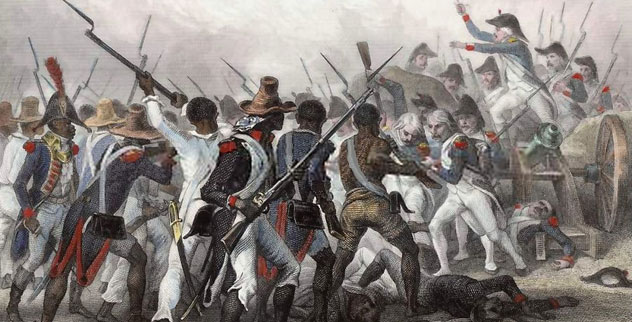
The Haitian Revolution began in 1791 in the French colony of Saint-Domingue, one of the world’s most profitable plantation societies. Its wealth depended on the brutal labor of enslaved Africans who vastly outnumbered free residents and plantation owners.
Enslaved people rose against the colonial system, beginning a long and complex struggle involving France, Spain, Britain, competing local factions, and leaders such as Toussaint Louverture and Jean-Jacques Dessalines. In 1804, Haiti declared independence after defeating forces sent by Napoleon Bonaparte.
It was the only major slave revolt in modern history to create an independent state. That achievement made Haiti a symbol of Black sovereignty and self-emancipation. It inspired enslaved and free Black communities throughout the Americas while alarming governments and plantation owners who understood the message perfectly: slavery was not an unchangeable institution, no matter how many laws, armies, and balance sheets said otherwise.
The revolution weakened France’s ambitions in the Americas and contributed to the circumstances surrounding the Louisiana Purchase. Yet Haiti was punished economically and diplomatically for its victory. France later demanded a crushing indemnity in exchange for recognizing Haitian independence, imposing a burden that shaped the country’s development for generations.
7. The American Revolution
A colonial rebellion becomes a constitutional experiment
The American Revolution grew from disputes over taxation, political representation, imperial authority, and colonial rights. Fighting began in 1775, the Declaration of Independence was adopted in 1776, and the war formally ended with the Treaty of Paris in 1783.
The revolution demonstrated that colonies could defeat a major European empire and establish a republic based on written constitutional principles. Ideas concerning natural rights, representative government, divided powers, and popular sovereignty traveled widely. They influenced political discussions in France, Latin America, Europe, and beyond.
The American example, however, arrived with a warehouse full of contradictions. A revolution declaring that people possessed equal rights preserved slavery, excluded women from formal political power, and accelerated the displacement of Indigenous nations. Those contradictions did not make its principles meaningless; they turned the principles into tools later used by abolitionists, civil rights leaders, suffragists, and independence movements to demand that governments honor their own impressive vocabulary.
The revolution also became a global conflict after France, Spain, and the Dutch Republic challenged Britain. Its outcome reshaped Atlantic trade, diplomacy, and imperial competition while establishing the United States as a new political experiment whose influence would grow dramatically.
6. The Chinese Communist Revolution
The creation of the People’s Republic of China
On October 1, 1949, Mao Zedong announced the establishment of the People’s Republic of China. The declaration followed years of conflict between the Chinese Communist Party and the Nationalist government, interrupted by the enormous destruction of Japan’s invasion and World War II.
The Communist victory forced Chiang Kai-shek’s Nationalist government to retreat to Taiwan, creating a political division that remains one of the world’s most consequential geopolitical disputes. It also brought one of the world’s largest populations under Communist rule and dramatically changed the balance of power in Asia.
China’s revolution influenced conflicts and revolutionary movements in Korea, Vietnam, Cambodia, and other parts of the developing world. Maoism presented a model that emphasized rural peasants and prolonged guerrilla warfare rather than relying primarily on urban industrial workers.
Domestic campaigns such as the Great Leap Forward and Cultural Revolution caused immense suffering and upheaval. After Mao’s death, economic reforms beginning in the late 1970s produced another transformation: a Communist Party-led state became deeply integrated into global manufacturing and trade. Today, supply chains, international finance, technology competition, and diplomatic strategy are all shaped by a government created through the 1949 revolution.
5. The Russian Revolution
The uprising that divided the twentieth century
The Russian Revolution unfolded in two major stages during 1917. The February Revolution ended the rule of Tsar Nicholas II and produced a provisional government. In October, the Bolsheviks, led by Vladimir Lenin, seized power with promises of peace, land, and authority for workers’ councils.
A civil war followed, and the Soviet Union was created in 1922. The new state attempted to build an economy and political system based on Marxist principles, although the result became highly centralized and authoritarian. Under Joseph Stalin, rapid industrialization was accompanied by forced collectivization, famine, purges, imprisonment, and mass repression.
Few revolutions generated such a large international echo. Communist parties emerged around the world, labor movements gained confidence, and colonial activists studied Soviet support for anti-imperial causes. Capitalist governments responded with a mixture of repression, reform, and expanded social programs, partly because ignoring unhappy workers suddenly seemed like a rather adventurous business plan.
After World War II, rivalry between the Soviet Union and the United States defined the Cold War. Nuclear competition, proxy wars, espionage, the space race, and ideological struggles across several continents all grew from the political order established in 1917.
4. The French Revolution
Citizenship, equality, nationalism, and the guillotine
The French Revolution began in 1789 amid government debt, food shortages, unequal taxation, political exclusion, and growing hostility toward aristocratic privilege. The fall of the Bastille became its most famous symbol, but the revolution’s deeper achievement was the destruction of France’s old political and social order.
Revolutionaries abolished feudal privileges, issued the Declaration of the Rights of Man and of the Citizen, challenged the authority of the Catholic Church, and eventually replaced the monarchy with a republic. They transformed people from royal subjects into citizens, at least in theory.
The revolution also produced civil conflict, foreign war, the execution of Louis XVI, and the Reign of Terror. Napoleon Bonaparte eventually seized power, but revolutionary principles continued through legal reforms, administrative centralization, mass conscription, and the spread of nationalism.
Across Europe and the Atlantic world, the French Revolution inspired liberals, nationalists, republicans, abolitionists, and social reformers. It also terrified monarchies, which spent decades trying to contain its ideas. Modern political language still reflects its influence: left and right, citizen and nation, liberty and equality, revolution and reaction. Even people who have never worn a tricolor sash are arguing with 1789 more often than they realize.
3. The Scientific Revolution
Humanity rewrites the instruction manual for reality
Between the sixteenth and seventeenth centuries, European scholars transformed the study of nature. Nicolaus Copernicus challenged the Earth-centered model of the cosmos, Johannes Kepler described planetary motion mathematically, Galileo Galilei used telescopic observations to question accepted assumptions, and Isaac Newton connected motion on Earth with motion in the heavens.
The Scientific Revolution was not one sudden discovery, nor was it exclusively the product of Europe. Its participants drew upon knowledge preserved and expanded by scholars in the Islamic world, as well as mathematical, astronomical, and technological traditions from several civilizations.
Its revolutionary feature was a new combination of observation, experimentation, measurement, skepticism, and mathematical explanation. Claims about nature increasingly had to survive testing rather than simply arrive wearing an ancient philosopher’s name tag.
This change influenced medicine, navigation, engineering, agriculture, communication, and industrial technology. It also changed political and philosophical thought by encouraging people to ask whether human institutions could be examined as critically as the natural world. Modern laboratories, research universities, public-health systems, and space programs belong to its long legacy, as does the mildly inconvenient habit of demanding evidence.
2. The Agricultural Revolution
The change that made civilization possibleand complicated
Beginning roughly 12,000 years ago, human communities in several regions independently began domesticating plants and animals. Farming developed in areas including Southwest Asia, East Asia, Africa, New Guinea, Mesoamerica, and the Andes. There was no single inventor who woke up one morning, planted wheat, and immediately founded civilization before lunch.
Agriculture allowed communities to produce food surpluses and establish permanent settlements. Villages expanded into towns and cities. Populations grew, occupations became specialized, and societies developed more complex systems of trade, government, religion, taxation, recordkeeping, and warfare.
The consequences were enormous but not universally pleasant. Farming could provide more total food while giving individuals less varied diets. Dense settlements helped infectious diseases spread. Surpluses encouraged social hierarchy, private property, organized states, and inequality. People became tied to fields, seasons, water supplies, and the political authorities controlling them.
Nearly every later revolution depended on this earlier transformation. Empires, universities, factories, parliaments, armies, and social-media arguments all required large settled populations supported by food production. The Agricultural Revolution did not simply change dinner. It created the social conditions in which history became crowded.
1. The Industrial Revolution
The transformation still powering modern life
The Industrial Revolution began in Britain during the eighteenth century and expanded through Europe, North America, and eventually much of the world. Mechanized textile production, improved steam power, coal mining, iron manufacturing, railways, and factory organization dramatically increased the scale and speed of production.
Its impact reached far beyond machinery. Industrialization pulled people toward cities, reorganized family life, altered working hours, expanded consumer markets, and strengthened new business and financial institutions. It produced immense wealth while exposing factory workers, including children, to long hours, dangerous conditions, low wages, and remarkably creative forms of employer stinginess.
Industrial growth strengthened imperial powers hungry for raw materials and overseas markets. It also encouraged organized labor, socialist politics, public education, sanitation reform, and modern regulatory government. Later industrial waves brought electricity, automobiles, chemicals, telecommunications, computers, and automation.
The Industrial Revolution ranks first because its effects are present in almost every ordinary day. Packaged food, apartment buildings, global shipping, mass clothing, office schedules, electricity, transportation, and digital devices all belong to the industrial world. So do carbon emissions, resource depletion, factory pollution, and climate change. Humanity is still negotiating the invoice for a revolution that began more than two centuries ago.
What the World’s Greatest Revolutions Have in Common
These revolutions emerged in different eras, but several patterns connect them. Established systems had lost legitimacy, influential ideas had spread beyond elite circles, and large groups believed that ordinary reform could no longer solve extraordinary problems.
Communication mattered in every case. Pamphlets helped circulate revolutionary arguments in the eighteenth century. Newspapers, political clubs, sermons, radio broadcasts, and clandestine organizations performed similar work in later revolutions. Scientific books and professional networks spread intellectual transformation, while railways and factories accelerated industrial change.
Revolutions also created outcomes their participants did not fully anticipate. American revolutionaries did not plan the French Revolution. French leaders did not intend to inspire Haiti’s successful rebellion against slavery. Russian revolutionaries could not completely predict the Cold War, and the inventors of industrial machinery did not schedule a future climate crisis.
The central lesson is that revolutions are processes, not single dramatic afternoons. Removing a monarch, capturing a capital, or announcing a republic may be the memorable scene, but the harder questions arrive afterward: Who governs? Who benefits? Which freedoms survive? Who pays for the transformation? History loves a triumphant entrance, but it spends much more time dealing with the furniture.
Experiencing the History Behind These Global Revolutions
Begin with the people who lived through them
The most rewarding way to explore revolutionary history is to move beyond famous leaders. Start with letters, petitions, newspaper reports, trial records, diaries, speeches, songs, posters, and oral histories. These sources reveal how major events felt to workers, soldiers, enslaved people, merchants, farmers, women, religious minorities, and families trying to survive while governments reinvented themselves nearby.
A political declaration explains what leaders wanted the public to believe. A letter complaining about bread prices, military conscription, or a missing relative explains what the revolution meant at street level. Reading both creates a richer experience than memorizing a parade of dates and important-looking men in dramatic coats.
Build a connected timeline
Create a timeline showing when the ten revolutions occurred and draw lines between related events. Connect the American Revolution to France, France to Haiti, Russia to China, and Cuba to Cold War conflicts. Add technological connections linking scientific investigation to industrial machinery and industrialization to modern military and communication systems.
This exercise makes one point immediately clear: revolutions do not occur in historical isolation. Ideas travel with sailors, refugees, diplomats, books, traders, students, political exiles, and armies. A connected timeline turns history from a row of locked rooms into a crowded railway station.
Visit historical sites with questions
Museums, archives, monuments, former prisons, battlefields, factories, plantations, and government buildings can make revolutionary history tangible. Visitors might explore sites associated with American independence, walk through Parisian neighborhoods shaped by 1789, examine industrial machinery, or view collections documenting revolutionary Russia, China, Cuba, Haiti, and Iran.
The best visits begin with questions rather than a camera. Whose story does the site emphasize? Who is missing? Is the revolution presented as liberation, tragedy, national birth, or political warning? Monuments often reveal as much about the generation that built them as the generation they commemorate.
Compare promises with outcomes
Choose one revolutionary slogan or founding promise and trace what happened to it. Compare declarations of equality with laws governing slavery, race, religion, property, or gender. Compare promises of workers’ power with actual workplace conditions. Compare calls for independence with later economic dependence or foreign intervention.
This is not an exercise in declaring every revolution fraudulent. It shows how political ideals can be sincere, incomplete, manipulated, expanded, or revived by later generations. A promise can fail in its own era and still become useful to people demanding justice decades later.
Notice the revolution in everyday life
Finally, examine an ordinary day. Breakfast reflects the Agricultural Revolution and global trade. Transportation, clothing, and electricity reflect industrialization. Medicine and digital technology depend on scientific methods. Voting, citizenship, constitutional rights, labor protections, and political parties carry the influence of earlier political revolutions.
This approach turns the topic from distant history into lived experience. Revolutions are not only represented by statues, manifestos, or grainy photographs. Their legacies appear in school schedules, factory-made furniture, passports, public hospitals, national flags, workplace rules, and the expectation that governments must somehow justify their authority. The past is not hiding. Most mornings, it is already waiting in the kitchen.
Conclusion: Revolutions End, but Their Arguments Continue
The revolutions felt most strongly around the world did more than replace leaders. They changed the rules by which societies understood knowledge, work, property, citizenship, equality, religion, empire, and political power.
Some expanded human freedom, while others created new systems of repression. Most did both in uneven proportions, depending on who was asking. Their consequences spread because people elsewhere adopted their ideas, resisted their influence, copied their institutions, or organized entire governments around preventing something similar from happening at home.
Studying these global revolutions is therefore not an exercise in collecting dramatic anniversaries. It is a way to understand why the modern world looks, works, and argues as it does. Revolutions may begin with a local crisis, but the most powerful ones leave everyone else rearranging the furniture.














