
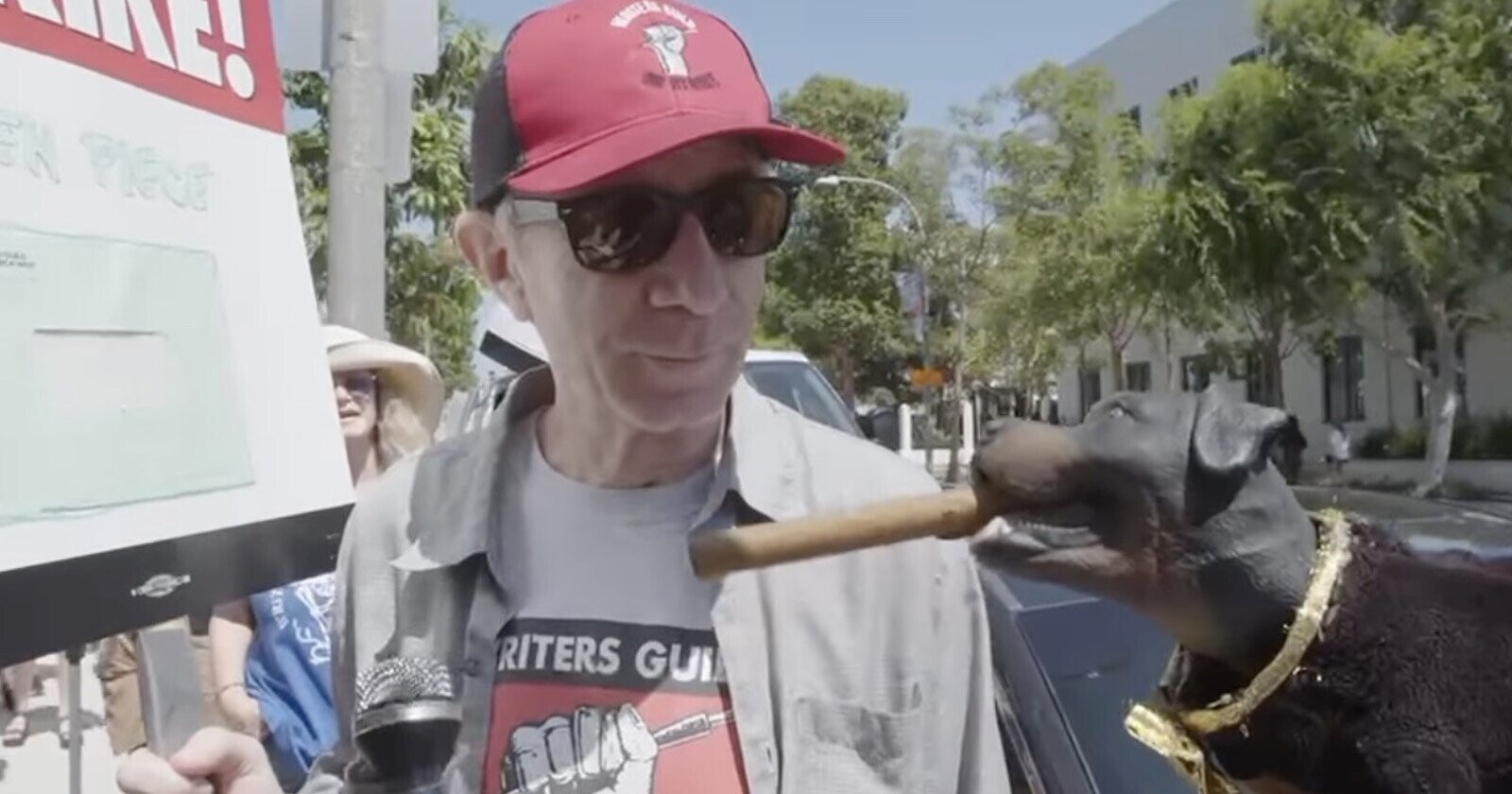
Hollywood has seen plenty of dramatic entrances: movie stars stepping out of limousines, executives arriving with carefully prepared statements, and actors walking red carpets as if gravity signed an NDA. But every so often, show business gets a much-needed reminder that a rubber dog puppet with a cigar can cut through industry tension better than a 40-page corporate memo. That is exactly the energy behind the headline: Triumph the Insult Comic Dog Finds Big Media Company for Him to Poop On.
The story centers on Triumph the Insult Comic Dog, the legendary trash-talking puppet voiced and operated by comedian and writer Robert Smigel. Known for turning awkward public moments into comedy gold, Triumph showed up in the orbit of the 2023 Hollywood labor strikes, when writers and actors were challenging the biggest studios and streaming companies over pay, artificial intelligence, residuals, and the future of creative work. Naturally, Triumph did what Triumph does best: he aimed his smoky little snout at powerful people and turned frustration into a punchline.
At first glance, a puppet at a picket line sounds like a joke with paws. But the moment worked because it captured something much larger. The entertainment industry was in a tense standoff. Writers wanted fair compensation in the streaming era. Actors wanted protections against digital replicas and AI misuse. Studios and streamers were under pressure from unions, audiences, and their own disrupted production calendars. Into that serious, high-stakes environment waddled Triumph, ready to remind everyone that sometimes the sharpest political commentary comes from a fake dog with a bad attitude.
Who Is Triumph the Insult Comic Dog?
Triumph the Insult Comic Dog is not your average puppet. He is not here to teach the alphabet, sell breakfast cereal, or make children feel better about sharing toys. Triumph exists to roast, heckle, and puncture ego. Created by Robert Smigel, Triumph first became famous through appearances connected to Conan O’Brien’s late-night universe. The character’s formula is beautifully simple: place a rude dog puppet in a real public setting, let people react naturally, and watch the comedy build from the collision of absurdity and reality.
Triumph’s classic image is instantly recognizable: a cigar in his mouth, a gruff accent, and a habit of ending compliments with the immortal phrase “for me to poop on.” His humor is blunt, but it is not random. The best Triumph segments work because the joke lands on power, pretension, or group behavior. He can roast Star Wars fans waiting in line, celebrities on camera, politicians, media personalities, and now, giant entertainment companies. The puppet may be ridiculous, but the target is often very real.
Robert Smigel’s comedy background gives Triumph a sharper edge than a simple insult act. Smigel has worked as a writer, performer, producer, and satirist, with credits connected to late-night television, animation, sketch comedy, and film. That matters because Triumph is not just a novelty character. He is a delivery system for a very specific kind of satire: childish on the surface, smart under the fur.
Why the 2023 Hollywood Strike Was the Perfect Triumph Moment
The 2023 Hollywood labor strikes created one of the most important entertainment-industry stories of the decade. The Writers Guild of America went on strike after negotiations with the Alliance of Motion Picture and Television Producers broke down. SAG-AFTRA later joined the work stoppage, creating a rare double strike that disrupted film and television production across the country.
The key issues were not abstract. Writers were concerned that streaming had changed the economics of television and film while leaving many creative workers with less reliable income. Traditional residual payments had once helped writers and performers benefit when shows aired repeatedly. Streaming complicated that model. A series could become a global hit, live on a platform for years, and still not produce the kind of long-term compensation that older television models made possible.
Artificial intelligence added another layer of anxiety. Writers worried about AI being used to generate or rewrite material in ways that could reduce jobs, credit, and bargaining power. Actors worried about scans, digital replicas, and future uses of their likeness. The debate was not simply “technology bad.” It was about consent, compensation, transparency, and whether creative labor would be treated as replaceable raw material.
That is where Triumph’s appearance found its bite. A union picket line can be serious, emotional, and exhausting. It can also be repetitive from a media standpoint: signs, chants, interviews, and official statements. Triumph brought attention by turning the labor dispute into a public comedy event. His jokes made people laugh, but they also helped frame the conflict in a way ordinary viewers could understand: creators were angry at huge companies that seemed to have forgotten who actually makes the shows.
Big Media Companies Became the Joke
The phrase “big media company” in this context points toward the major studios and streaming giants represented in negotiations by the AMPTP. These included traditional entertainment powerhouses and newer streaming-era giants. For decades, studios had controlled distribution, financing, and access to audiences. Streaming made that power feel even bigger, because platforms could own the pipeline from production to global release.
Triumph’s comedy thrives when the target is oversized. A small insult aimed at an already powerless person feels mean. A small insult aimed at a massive corporation feels like a balloon popping in a boardroom. That is why the image of Triumph confronting companies such as Netflix, Amazon, Disney, Apple, Warner Bros. Discovery, and other entertainment players worked so well. A rubber dog could say what many frustrated workers were thinking: the companies had become too polished, too protected, and too comfortable speaking in bland corporate language.
Corporate statements during labor disputes often sound like they were assembled by a committee trapped in a conference room with decaf coffee. They use phrases like “mutually beneficial solutions,” “evolving marketplace,” and “sustainable business models.” Triumph’s style is the opposite. He reduces grand corporate positioning to a punchline. That contrast is exactly why the bit gained attention.
Why Comedy Belongs on the Picket Line
Labor movements need facts, strategy, leadership, and negotiation. But they also need morale. A picket line is not just a place where workers stand; it is a place where people remind one another that they are not alone. Humor helps with that. It makes long days more bearable. It turns frustration into shared energy. It gives journalists and audiences a fresh reason to pay attention.
Triumph’s appearance did not replace the serious arguments made by writers and actors. Instead, it translated those arguments into cultural language. Many people do not read contract summaries. Many do not follow entertainment business reporting closely. But they understand a funny dog puppet mocking rich companies. That is the strange magic of pop-culture satire: it can sneak a real issue into the public imagination wearing a fake mustache and a cigar.
There is also a long tradition of comedians supporting labor causes, criticizing media consolidation, and using public performance to challenge powerful institutions. Late-night comedy, sketch shows, political cartoons, and satirical characters have all played roles in shaping how audiences understand public debates. Triumph fits into that tradition, except with more barking and less concern for table manners.
Robert Smigel’s Role Behind the Puppet
Robert Smigel is the human engine behind Triumph. That is important because Triumph’s appearance at a writers’ strike was not just a celebrity cameo. Smigel is himself a veteran comedy writer. He understands the television business from the inside. He has worked in rooms where jokes are built, rewritten, cut, rescued, and occasionally blamed on the intern. His presence at a WGA-related event carried the weight of someone who knows what creative labor actually looks like.
Smigel’s career helps explain why Triumph can be silly without being shallow. The jokes may sound chaotic, but the instincts behind them are disciplined. Triumph is funny because he walks into environments filled with tension and exposes the social rules everyone is pretending not to notice. At a dog show, he mocks the strange seriousness around purebred competition. At a fan event, he teases obsessive fandom while still depending on fans being good sports. At a labor protest, he highlights the absurdity of massive companies bargaining with the people who write their most valuable stories.
That combination of insider knowledge and outsider absurdity is rare. Triumph can say things a human comedian might struggle to say because the puppet creates distance. People tolerate sharper jokes from a fake dog than from a person with a microphone and a LinkedIn profile. The puppet becomes a shield, a megaphone, and a tiny furry wrecking ball.
The Streaming Era Needed a Mascot for Creative Frustration
The streaming revolution promised abundance. Viewers got huge libraries of content, instant access, binge releases, and more niche programming than traditional television could comfortably hold. But behind that abundance, many creative workers argued that the business model had become less stable. Shorter seasons, smaller rooms, fewer long-term jobs, and opaque viewership data changed how writers built careers.
Actors faced similar uncertainty. Streaming created more projects, but not always more security. The old promise that a successful show could generate meaningful residual income became less predictable. Add AI to the equation, and performers had reason to worry about how their faces, voices, and performances might be used in the future.
Triumph’s picket-line moment landed because it condensed those concerns into a cartoonishly clear image: the people who make entertainment were outside with signs, while the companies that distribute entertainment were inside defending the economics of the platform age. The joke was not just that Triumph was rude. The joke was that a rude puppet somehow sounded more emotionally honest than the industry’s official language.
What Made the Headline So Clickable?
From an SEO and media-writing perspective, “Triumph the Insult Comic Dog Finds Big Media Company for Him to Poop On” is a headline with obvious viral ingredients. It has a recognizable pop-culture figure. It has conflict. It has a big target. It has a crude but familiar catchphrase. Most importantly, it promises a specific comedic situation: Triumph has found a new enemy worthy of his signature insult.
The headline also works because it balances nostalgia and news. Readers who remember Triumph from Conan-era segments immediately recognize the character’s voice. Younger readers who may know the 2023 strike from TikTok, news clips, or celebrity picket-line photos can still understand the premise. The title tells both groups: this is a comedy story, but it is attached to a real industry fight.
That dual appeal matters in entertainment journalism. A plain headline such as “Robert Smigel Supports WGA Strike” would be accurate, but not especially irresistible. A headline built around Triumph’s signature phrase adds personality. It turns labor coverage into a cultural moment without losing the underlying point.
Triumph’s Best Trick: Making Serious People React
Triumph is funniest when the people around him are forced to decide how seriously to take him. Do they laugh? Do they play along? Do they look offended? Do they pretend the puppet is not there? This tension has powered many of his most memorable appearances. The character creates a social test: can you survive being roasted by a fake dog without looking like the least fun person in the room?
On a picket line, that dynamic becomes even richer. Writers and actors are performers by nature, so they understand the bit. They can laugh while still believing deeply in the cause. Executives and corporations, on the other hand, are not built to respond to puppet-based mockery. There is no elegant corporate strategy for being insulted by Triumph. You cannot release a quarterly statement saying, “We respectfully disagree with the dog.”
That imbalance is part of the fun. The puppet thrives because powerful institutions are bad at being teased. They are designed for control, polish, and message discipline. Triumph is designed to be the opposite: messy, loud, shameless, and impossible to invite to a shareholder meeting.
How the Strike Eventually Changed the Conversation
The 2023 Hollywood strikes eventually led to new agreements that addressed major concerns around compensation, streaming, and AI. The WGA contract included gains tied to streaming residuals, staffing, pay, and artificial intelligence protections. SAG-AFTRA’s agreement also included wage increases, streaming-related gains, and AI protections for performers. These outcomes did not solve every problem in Hollywood, but they showed that the strikes forced serious movement on issues that had been building for years.
Triumph’s role was not to negotiate contract language. No one asked the puppet to review minimum staffing provisions or explain digital replica consent rules, which is good because he would probably have insulted the font. His role was cultural. He helped turn a labor fight into something visible, shareable, and emotionally memorable. Sometimes that matters more than it appears. Public attention can influence pressure, pressure can affect negotiations, and humor can keep a movement from feeling invisible.
Why This Moment Still Matters
The headline remains interesting because it captures the intersection of comedy, labor, technology, and media power. Hollywood’s future is still being shaped by streaming economics, AI tools, platform consolidation, and shifting audience habits. Writers and actors continue to ask how creative people can survive in an industry that depends on their work but often treats their work as a cost to be minimized.
Triumph’s appearance reminds us that satire is not a distraction from serious issues. At its best, satire is a shortcut to clarity. It strips away the fog. It says, “Here is the absurd thing everyone is dancing around.” In this case, the absurdity was that giant entertainment companies were locked in conflict with the very people who make entertainment entertaining.
That is why the story has staying power. It is not just about a puppet making poop jokes. It is about a poop joke landing because the target was big enough, the timing was sharp enough, and the underlying issue was real enough. Comedy does not have to be polite to be useful. Sometimes it just has to point its cigar in the right direction.
Experience Notes: Watching Triumph Turn a Labor Story Into a Human Story
For many viewers, the 2023 Hollywood strike was easy to understand in broad terms but harder to feel in a personal way. People knew writers and actors were on strike. They knew studios and streamers were involved. They knew AI and streaming money were major issues. But the daily mechanics of labor negotiation can feel distant, especially when discussed through legal language and industry shorthand. Triumph’s appearance helped make the story feel more human because it brought personality to the picket line.
The experience of watching a Triumph segment is different from reading a standard entertainment news update. A news article explains what happened. A Triumph bit lets you feel the weirdness of the moment. You see people laughing while holding signs. You sense exhaustion mixed with determination. You notice that comedy writers, even while fighting for fair treatment, cannot help turning their frustration into jokes. That is not a small detail. It is a reminder that the people behind television and film are not abstract “content creators.” They are workers with timing, wit, bills, families, anxiety, and pride in their craft.
There is also something satisfying about seeing a comic character aim upward. In the modern media world, ordinary viewers are used to hearing about huge corporations making decisions that affect what gets produced, renewed, canceled, promoted, buried, or deleted from a platform. The public often has little control over those decisions. Triumph gives viewers a tiny symbolic revenge fantasy. He cannot rewrite a contract, but he can make a giant company look ridiculous for a moment. Sometimes that moment is enough to make people pay attention.
Another relatable part of the story is the tension between loving entertainment and questioning the business behind it. Viewers enjoy streaming shows, late-night clips, movies, and celebrity interviews. At the same time, many people are increasingly aware that convenience can hide unfair systems. A platform may feel magical from the couch, but someone wrote the dialogue, acted the scene, edited the episode, built the set, handled the lighting, and kept the production moving. Triumph’s picket-line humor pushed audiences to remember the workers behind the screen.
The moment also shows why old-school comedy characters can still matter in a fragmented digital culture. Triumph was born in late-night television, an era before every joke was instantly clipped, ranked, remixed, and argued over online. Yet the character still works because the core idea is timeless: arrogance deserves mockery. Whether the target is a celebrity, a fandom, a politician, or a media corporation, Triumph succeeds by saying the rude thing in the room with just enough absurdity to keep it funny.
For writers, performers, and anyone who works in a creative field, the story may feel especially familiar. Creative work is often treated as magical when it succeeds and disposable when budgets tighten. People praise the final product but overlook the labor behind it. Triumph’s appearance made that contradiction visible. The joke was silly, but the feeling underneath it was serious: creative people wanted recognition, protection, and a fair share of the value they helped create.
In that sense, “Triumph the Insult Comic Dog Finds Big Media Company for Him to Poop On” is more than a funny headline. It is a snapshot of a media industry being forced to look at itself. And because the mirror was held by a rude puppet dog, the reflection was impossible to ignore.
Conclusion
Triumph the Insult Comic Dog’s brush with the Hollywood labor movement worked because it combined the ridiculous with the real. Robert Smigel’s cigar-chomping puppet did not need to explain every detail of streaming residuals, AI protections, or contract negotiations. He simply had to show up, bark at the powerful, and remind everyone that comedy can make a serious point without wearing a serious face.
The big media companies became perfect Triumph targets because they represented scale, control, and corporate polish. The writers and actors on the picket lines represented the human side of entertainment: the people who create the words, performances, and moments audiences remember. Between those two forces stood a rubber dog with impeccable bad manners. Somehow, that was exactly what the story needed.
In the end, Triumph’s greatest strength is not the insult itself. It is the way the insult reveals what people are already thinking. When the entertainment industry becomes too glossy, too automated, or too corporate, a little comic chaos can be clarifying. And if that chaos arrives with a cigar and a catchphrase, well, that is show business.













