
Note: This article is written for publication and is based on practical small-space design, closet organization, home office ergonomics, lighting, and residential safety guidance.
There comes a moment in every home when the front entry closet looks less like storage and more like a tiny museum of forgotten umbrellas, mystery gloves, and coats nobody has worn since “business casual” meant khakis with confidence. If your home needs a workspace but does not have a spare room, that overlooked closet may be quietly auditioning for a better job. Enter the cloffice: a closet office that turns dead space into a compact, functional, and surprisingly stylish work zone.
Turning a front entry closet into an office is especially smart because entry closets often sit near natural traffic flow, have doors that can hide clutter, and are usually deep enough for a shallow desk or built-in work surface. The goal is not to cram a corporate cubicle into a coat closet. The goal is to create a focused, efficient mini office where you can answer emails, manage household paperwork, study, plan projects, or take video calls without balancing a laptop on the kitchen counter next to yesterday’s cereal bowl.
What Is a Cloffice?
A cloffice is exactly what it sounds like: a closet converted into an office. It can be a walk-in closet, bedroom closet, hallway closet, or front entry closet. The best versions use smart storage, comfortable proportions, good lighting, and a little design personality. Think less “I work in a closet now, send snacks,” and more “I carved out a private productivity nook from space I already had.”
The front entry closet is a strong candidate because it is often underused. Many households store seasonal coats, extra shoes, dog leashes, reusable bags, and random hardware-store receipts in this space. With a thoughtful plan, those items can be relocated, reduced, or reorganized, freeing the closet for a built-in desk, floating shelves, charging station, corkboard, printer shelf, and task lighting.
Step One: Decide Whether Your Entry Closet Is a Good Candidate
Before grabbing a screwdriver and declaring war on the coat rod, measure the closet carefully. Most reach-in closets are shallow, so every inch matters. A comfortable seated workstation generally needs enough depth for a laptop, keyboard, notebook, and your elbows. If the closet is too shallow for a standard desk, a wall-mounted desktop, fold-down surface, or custom plywood slab may work better.
Measure These Areas First
Measure the width, depth, height, door swing, baseboard thickness, and any trim that could interfere with furniture. Also check the floor. If the closet has uneven flooring, old carpet, or a raised threshold, fix that before installing the desk. A chair that catches on a threshold every time you sit down will test your patience faster than a slow Wi-Fi connection during a meeting.
Also think about traffic. Since this is a front entry closet, ask whether someone opening the front door will bump into your chair. If the closet faces a busy hallway, consider doors that close neatly, a chair that tucks all the way in, or a compact stool for short work sessions.
Step Two: Clear, Sort, and Rehome the Closet Clutter
A cloffice begins with an honest cleanout. Remove everything and sort items into four categories: keep nearby, move elsewhere, donate, and toss. Entry closets tend to collect “just in case” objects. Just in case it rains. Just in case guests need a coat hanger. Just in case someone wants a scarf from 2009. Be realistic. The more you ask this closet to remain a storage zone, the less successful it will be as an office.
That does not mean you must eliminate entry storage entirely. You can preserve a few hooks on the side wall, add baskets above the desk, or use labeled bins on high shelves for seasonal gear. The trick is to separate office items from entry items so your printer paper does not end up sharing a basket with muddy winter gloves.
Step Three: Remove or Rework the Existing Closet Hardware
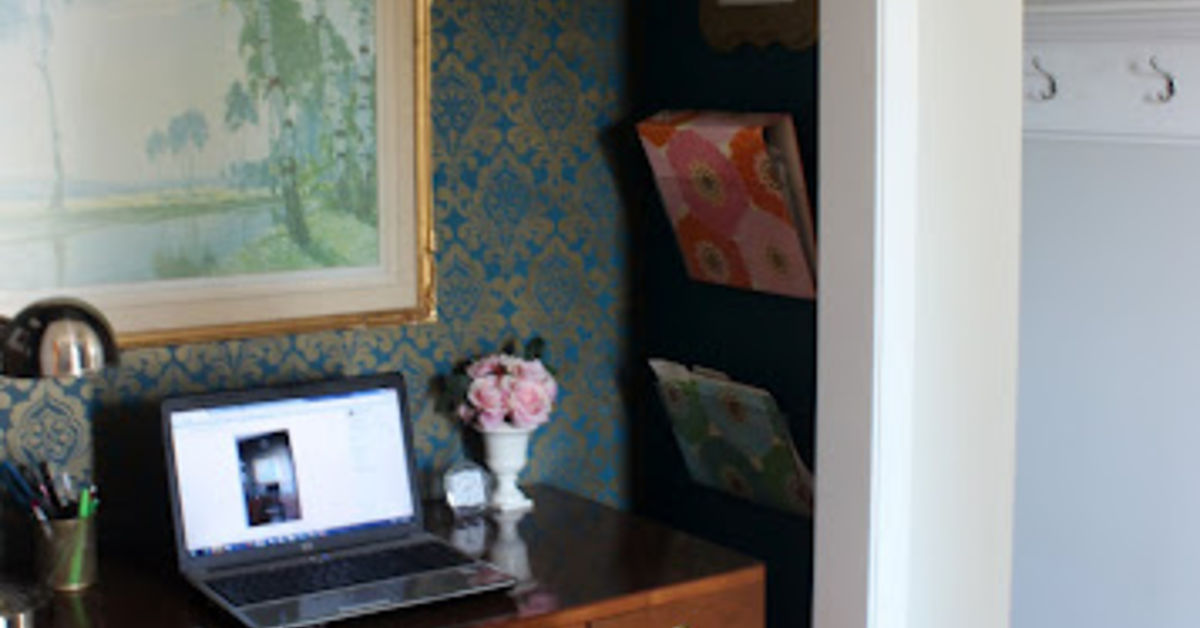
Most entry closets have a hanging rod and one basic shelf. For a cloffice, the rod usually has to go. Patch holes, sand rough spots, and paint the interior before installing the desk. This is the easiest time to add wallpaper, beadboard, peel-and-stick panels, or a bold color. Small spaces can handle personality. In fact, a cloffice is a perfect place to use a dramatic paint color or patterned wallpaper because the area is contained. Your hallway stays calm; your closet gets to wear the fun outfit.
If the existing shelf is sturdy and at a useful height, keep it. It can become overhead storage for files, baskets, Wi-Fi equipment, or office supplies. If it is flimsy, replace it with properly supported shelving. A front entry cloffice should feel intentional, not like a laptop was accidentally abandoned in a closet during spring cleaning.
Step Four: Choose the Right Desk Style
The desk is the heart of the cloffice. For a narrow closet, the best options are usually a floating desktop, built-in slab, small writing desk, or fold-down desk. A floating desk makes the space feel lighter and allows room for your legs. A built-in desktop can be cut wall-to-wall for a custom look. A freestanding desk is easiest if you rent or want a reversible setup.
Floating Desk
A floating desk works well when the closet is narrow but structurally suitable for wall-mounted supports. It creates a clean, built-in look and leaves open space underneath for a rolling file cabinet, basket, or tucked-in chair. Use strong brackets, wall cleats, or a properly anchored support system. If you are unsure what the wall can support, ask a qualified handyperson or contractor.
Built-In Desktop
A built-in desktop is ideal for homeowners who want the cloffice to look permanent and polished. A butcher-block countertop, plywood desktop with edge banding, or laminate slab can be cut to size. The surface should be deep enough for work but not so deep that your chair blocks the entryway. A depth of around 18 to 24 inches often works for laptop-based tasks, depending on your body size and equipment.
Fold-Down Desk
If the closet is very shallow, a fold-down desk can be a clever solution. Close it when not in use, and the space becomes visually quiet. This is especially useful in a front entry area where guests may walk by. Nobody needs to see your sticky notes labeled “urgent” from three months ago.
Step Five: Plan Power, Outlets, and Cord Control
A cloffice without power is just a shelf with ambition. You will likely need charging access for a laptop, monitor, lamp, phone, printer, or Wi-Fi extender. If your entry closet does not already have an outlet, hire a licensed electrician to add one safely and according to local code. Avoid running extension cords under rugs, through doorways, or across walking paths. That is not “creative problem solving”; that is a tripping hazard wearing a tiny mustache.
For cord control, add a cable raceway along the back wall, adhesive cord clips under the desktop, and a mounted power strip if local rules and product instructions allow. Keep cords away from chair wheels and foot traffic. A small grommet hole in the desktop can make wires disappear neatly.
Step Six: Light It Like a Real Workspace
Closets are often dark because they were designed to hold coats, not host spreadsheets. Lighting is one of the biggest differences between a cloffice that feels cozy and one that feels like you are emailing from a cave. Use layered lighting: overhead light for general brightness, task lighting for the desk, and optional accent lighting for style.
Battery-powered puck lights or rechargeable LED bars can work for renters, while hardwired fixtures should be installed by a professional. For safety, closet light fixtures should be enclosed and appropriate for closet use. Avoid exposed bulbs, dangling pull-chain fixtures, or anything that can overheat near paper, coats, baskets, or other stored items.
A small adjustable desk lamp is helpful if the desktop has room. If not, use a wall sconce, clamp lamp, or under-shelf LED strip. Position the light so it does not cast harsh shadows across your keyboard or shine directly into your eyes during video calls.
Step Seven: Make the Cloffice Ergonomic
Small does not have to mean uncomfortable. A good cloffice should support your body, not fold you into the shape of a question mark. Set the chair so your feet rest flat on the floor or on a footrest. Your elbows should stay close to your sides, your keyboard should be easy to reach, and your shoulders should feel relaxed.
If you use a monitor, place it directly in front of you, roughly an arm’s length away. The top of the screen should be at or slightly below eye level. Laptop users can improve comfort with a laptop stand, external keyboard, and mouse. It sounds like a small upgrade, but your neck may write you a thank-you card.
Step Eight: Use Vertical Storage Without Overcrowding
The secret weapon of any closet office is vertical space. Install shelves above the desk for books, files, baskets, and decor. Use the highest shelf for items you rarely need, such as tax folders, extra cables, printer ink, or seasonal stationery. Keep daily items within arm’s reach.
Floating shelves, pegboards, magnetic boards, wall pockets, and narrow cabinets all work well. Just remember that storage should serve the workday, not overwhelm it. If every shelf is packed to the edge, the cloffice will feel cramped. Leave some breathing room for a plant, framed print, or small lamp. A little negative space is design’s way of saying, “Relax, we planned this.”
Step Nine: Decide What to Do with the Doors
Front entry closet doors can be an advantage. Close them at the end of the day and your office disappears. This is especially helpful if your work style includes piles, cables, and a coffee mug that has emotionally committed to staying there forever.
However, traditional swinging doors may interfere with the chair or hallway. Consider removing the doors, replacing them with bifold doors, installing pocket-style alternatives where possible, or using curtains. If you remove the doors entirely, make the interior attractive because it will become part of the entryway. Paint, wallpaper, trim, and neat shelves matter more when the cloffice is visible.
Step Ten: Design a Background for Video Calls
If you take video calls, think about what the camera sees. A front entry cloffice can look polished with a simple shelf, framed art, a plant, or a clean corkboard behind you. Avoid placing reflective surfaces or bright lights directly behind your head. Keep the background tidy and personal but not chaotic. A few books say “thoughtful professional.” A leaning tower of unopened mail says “send help.”
If the closet is too narrow for a camera-friendly angle, use a virtual background or position the laptop so the camera faces a nearby wall instead of the closet interior. Test the view before your first important call. Nobody wants to discover mid-meeting that their background features a basket labeled “miscellaneous chaos.”
Budget-Friendly Cloffice Ideas
You do not need a luxury renovation to make a front entry closet office work. A simple version can include a painted interior, premade desktop, basic brackets, rechargeable LED light, compact chair, and two shelves. A mid-range version might add custom shelving, wallpaper, a hardwired outlet, a better chair, and built-in drawers. A higher-end version can include custom cabinetry, integrated lighting, pocket doors, decorative trim, and a stone or butcher-block work surface.
Affordable Upgrades That Make a Big Difference
- Paint the closet interior a rich color to make the space feel intentional.
- Add peel-and-stick wallpaper behind the desk for a stylish focal point.
- Use matching baskets to hide office supplies.
- Install a corkboard, magnetic board, or dry-erase panel.
- Choose a chair that fully tucks under the desk.
- Add a slim LED light under the lowest shelf.
- Use drawer organizers so small supplies do not become a junk-drawer festival.
Common Mistakes to Avoid
The first mistake is making the desk too deep. In a closet, oversized furniture can block movement and make the workspace annoying to use. The second mistake is ignoring lighting. Even a beautiful cloffice will fail if you have to squint every time you write a note. The third mistake is skipping ventilation and comfort. Closets can feel stuffy, especially with doors closed. Leave doors open while working, use a quiet fan if needed, and avoid packing the space with heat-producing electronics.
Another common mistake is forgetting the entryway’s original purpose. If your household truly needs coat and shoe storage near the front door, create a backup plan before converting the closet. Add wall hooks, a storage bench, a slim shoe cabinet, or seasonal bins elsewhere. The best cloffice solves one problem without creating three new ones wearing boots.
Real-Life Layout Example
Imagine a front entry closet that is 48 inches wide and 24 inches deep. Remove the hanging rod, patch the walls, and paint the interior a warm blue-gray. Install a 20-inch-deep butcher-block desktop wall-to-wall at a comfortable seated height. Add two floating shelves above it, with the lower shelf holding daily supplies and the upper shelf storing labeled boxes. Place a corkboard on one side wall, a slim LED bar under the shelf, and a cable raceway along the back corner. Choose a low-profile chair that tucks under the desk, then keep a small basket below for laptop accessories.
From the hallway, the closet now looks like a custom office nook rather than a storage afterthought. When work is done, close the doors. The office vanishes, which is a magic trick every small home deserves.
Experience-Based Tips for Turning a Front Entry Closet into a Cloffice
The biggest lesson from real cloffice projects is that the “small stuff” is never small. A half-inch of trim can change whether a desk fits. A door hinge can decide whether your chair slides in smoothly. A poorly placed outlet can turn one tidy cable into a family of tangled black snakes. Before buying anything, mock up the workspace with cardboard, painter’s tape, or even a temporary board. Sit in front of it. Open the closet doors. Pretend to type. Reach for a notebook. Roll the chair back. This little rehearsal can save you from building a desk that looks beautiful but feels like working inside a mailbox.
Another experience-based tip: prioritize comfort over cuteness. It is tempting to choose the most adorable chair on the internet, especially if it has gold legs and looks like it belongs in a boutique hotel lobby. But if you plan to work for more than 30 minutes at a time, your chair needs support. A pretty chair with no back support becomes less charming around email number twelve. If space allows, choose an adjustable office chair. If space is tight, use a compact chair with a supportive cushion and keep a footrest nearby.
Storage also needs discipline. In many cloffices, the shelves start organized and slowly become a vertical junk drawer. The fix is to assign every shelf a job. One basket for tech accessories. One file box for paperwork. One tray for incoming mail. One small container for pens and sticky notes. If an item does not support work, it should not live in the cloffice. Otherwise, the office will slowly turn back into a closet, and the coats will win.
Lighting is another area where experience teaches quickly. A single overhead light may seem enough until your head casts a shadow over the keyboard. Add task lighting from the front or side, not just above. If video calls matter, test your face lighting at the time of day you usually meet. Entry areas can shift dramatically from bright morning light to gloomy afternoon shadows. A small lamp or LED strip can make you look awake even when your coffee has not clocked in yet.
Finally, make the cloffice pleasant enough that you actually want to use it. Add a small framed print, a plant that tolerates low light, a favorite mug for pens, or wallpaper that makes the space feel special. Tiny offices need personality because they do not have square footage to impress anyone. The charm comes from intention. When every inch has a purpose, even a front entry closet can feel like a private command center. It may be small, but small can be mighty. Just ask your Wi-Fi router, your favorite coffee spoon, or that one sticky note that somehow runs your entire week.
Conclusion
Turning a front entry closet into an office is one of the smartest ways to create a dedicated workspace without adding square footage. A successful cloffice starts with careful measuring, honest decluttering, safe electrical planning, layered lighting, ergonomic choices, and storage that works vertically. It should feel comfortable, organized, and easy to close away when the workday ends.
The best part is that a cloffice can match almost any home style. It can be minimal and quiet, colorful and creative, budget-friendly or custom-built. With the right plan, your entry closet can stop hoarding old umbrellas and start supporting your daily focus. That is a promotion worth celebrating.










