
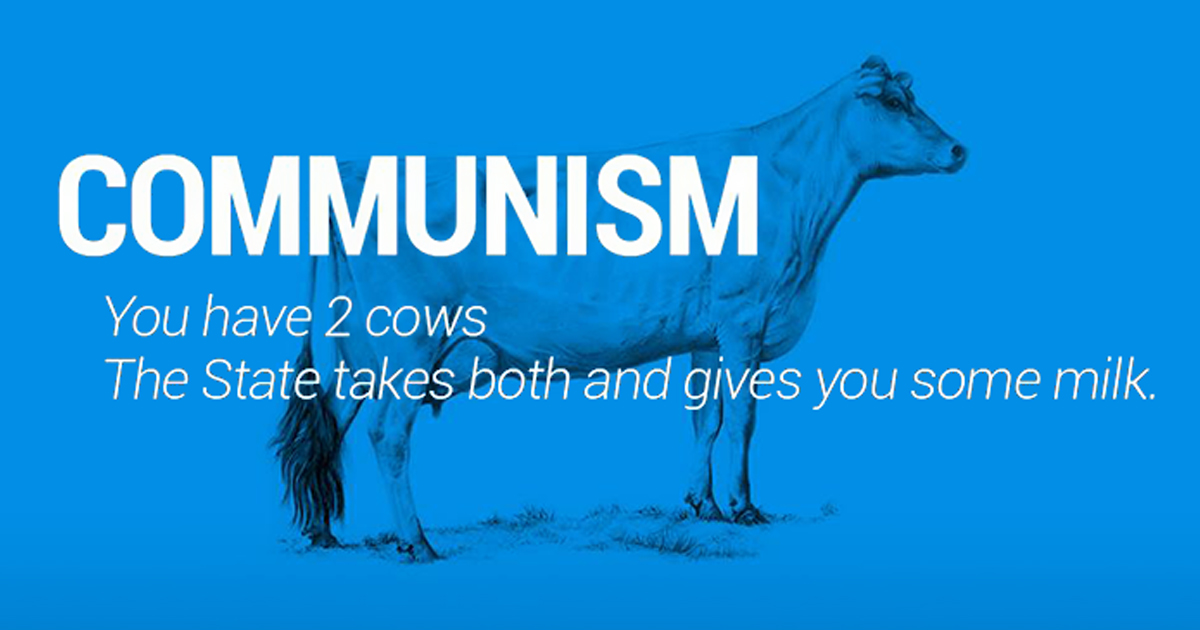
Economics gets a bad reputation. Say the word out loud and half the room pictures charts, acronyms, and one professor who seems emotionally attached to the phrase “all else equal.” But the truth is much simpler: economics is really the study of choices, trade-offs, incentives, and what happens when people want more stuff than the world can easily provide.
That is exactly why the old “two cows” joke has stuck around for so long. It takes giant ideas like capitalism, socialism, monopoly, taxation, and trade, then shrinks them down to one tiny farm and two very confused cows. Somehow, that works. In fact, the joke works so well because economics is not just about Wall Street, central banks, or terrifying graphs in textbooks. It is about everyday life: groceries, rent, jobs, phones, gas, lunch money, and why the price of eggs can make an entire household sound like a political think tank before breakfast.
So let’s do what many classes forget to do. Let’s keep the cows, skip the jargon overload, and use simple examples to explain why economics matters. Because once two cows enter the conversation, economics suddenly stops sounding like punishment and starts sounding like common sense with better branding.
Why the “Two Cows” Method Actually Works
The reason the two-cows framework is so powerful is that it turns abstract economic theory into a story. Stories are easier to remember than formulas, and economics is full of concepts that become instantly clearer when you attach them to something tangible. Two cows are tangible. They eat, they cost money, they produce milk, and they create decisions. Congratulations: you now have an economy.
If you own two cows, you immediately face classic economic questions. How do you use your resources? Do you sell the milk, keep it, or turn it into cheese because your cousin swears artisanal dairy is “where the market is going”? Do you hire help? Do you borrow money to buy a third cow? Do you compete with the farm next door, or do you merge and become the dairy version of a superhero villain?
Economics begins right there, at the point where resources are limited and choices have consequences. That is the whole game.
Two Cows and the First Rule of Economics: Scarcity
Here is the first thing economics wants you to understand: there is never enough of everything for everyone all at once. That is scarcity. It does not mean total absence. It means limits. Your time is limited. Your money is limited. Land, labor, tools, feed, and even patience are limited. Yes, patience counts, especially if one of the cows keeps escaping through the same fence every Tuesday.
With two cows, scarcity shows up immediately. You may want more milk, more land, more feed, more workers, and lower veterinary bills, but you cannot magically have all of it. Because resources are limited, you must choose. That is why economics is not just about money. It is about decision-making under constraint.
In the real world, scarcity explains why families budget, why businesses prioritize, and why governments argue over spending. Every choice uses resources that cannot be used somewhere else at the same time. That is true whether you are running a farm, a company, or a kitchen where three people all want the last slice of pizza and someone is about to discover the law of demand with their feelings.
Opportunity Cost: The Hidden Price Tag
Now we meet the sneakiest idea in economics: opportunity cost. This is the value of what you give up when you choose one option over another. If you use your field to grow feed for the cows, you cannot use that same field for corn. If you spend your savings on a shiny new milking machine, you cannot spend that same money on hiring an extra worker.
Notice something important here: the true cost of a choice is not only the cash you pay. It is also the alternative you lost. That is why opportunity cost is the concept that quietly runs the world while everyone else argues about price tags.
Think about normal life. If you spend three hours scrolling videos instead of studying, the opportunity cost is not “free time.” It might be a better grade. If a business keeps making an old product instead of investing in a better one, the opportunity cost may be future growth. If a government spends more in one area, it may have less room somewhere else. Two cows teach this faster than a semester-long lecture because the trade-off is obvious: you cannot do everything with the same limited resources.
Supply, Demand, and Why Milk Prices Refuse to Be Chill
Let’s say your two cows produce milk and you sell it in town. If many people want milk and only a few farms can supply it, prices tend to rise. If every farm in three counties is suddenly overflowing with milk, prices may fall. That is supply and demand, the celebrity duo of economics.
Demand is how much people want something at different prices. Supply is how much producers are willing and able to sell at different prices. Where they meet, you get the market price. It sounds simple because it is simple. The messy part is that human behavior is involved, and humans are excellent at making simple things dramatic.
Suppose a heat wave hurts pasture quality and raises feed costs. Supply becomes tighter. Milk can become more expensive. Suppose a health trend convinces everyone that homemade yogurt is the personality trait of the summer. Demand rises. Milk can become more expensive again. Suppose both happen at once. Congratulations, your grocery bill now has opinions.
This is one reason two cows explain economics so well. You can see how prices are not random. They are signals. They tell producers what consumers value and tell consumers when goods are scarce, abundant, or suddenly trendy for reasons nobody can fully explain.
Incentives: The Tiny Forces Running Giant Systems
Economics is obsessed with incentives because people respond to them all the time. If milk prices go up, farmers have more reason to produce milk. If taxes rise on a certain activity, people may do less of it, or they may just become impressively creative. If a government offers subsidies for a product, more producers may enter that market. If loans become cheaper, businesses may invest more.
With two cows, incentives show up everywhere. If one buyer offers a better price, you sell there. If better fencing reduces future losses, you install it. If you are penalized for pollution from runoff, you change your methods. Incentives are not magical. They do not force behavior. They nudge it. But enough nudges can reshape an entire market.
This is why good economics asks not only, “What happened?” but also, “What incentives made that result likely?” That question explains business strategy, consumer behavior, public policy, and why “limited-time offer” signs work disturbingly well.
Competition, Monopoly, and the Cow With Too Much Power
Imagine there are ten small dairy farms in your county. They compete on price, quality, delivery, and maybe how photogenic their cows look on social media. That competition tends to help consumers. It keeps pressure on prices, encourages innovation, and rewards efficiency.
Now imagine one giant dairy company buys nearly every farm, controls the trucks, the cold storage, and the local shelf space. Suddenly, competition shrinks. Prices can rise, quality can slip, and choice can disappear faster than free samples at a warehouse store.
This is why economists care about competition and why antitrust policy exists. Markets usually work better when firms have to compete. A monopoly can limit output, charge more, and weaken the normal discipline of the market. In cow language: if one farm owns all the cows, all the feed, and all the roads into town, it is no longer just selling milk. It is basically selling your options back to you.
Banks, Credit, and the Quest for Cow Number Three
Most businesses do not grow using only money stuffed into a coffee can. They borrow, save, invest, and manage risk. That is where banks and credit enter the picture. If your two-cow business is profitable but you want to expand, you might seek a loan to buy more land, equipment, or livestock. Credit lets you use future earnings to finance present growth.
That sounds great until you remember that loans must be repaid. Borrowing can help you grow faster, but it can also make bad decisions bigger and more expensive. Buy a third cow when prices are strong and demand is steady, and maybe you grow. Borrow too aggressively right before a downturn, and now your budget is doing cardio.
Banking matters to the broader economy for the same reason it matters to your little farm: it connects savers, borrowers, and investment. Deposits become part of a larger system that helps finance homes, businesses, and production. When credit flows well, growth can accelerate. When it freezes, expansion becomes harder, spending slows, and the economy can lose momentum.
Inflation: When the Same Money Buys Less Hay
Inflation is one of the most misunderstood topics in economics, partly because people often treat any annoying price increase as proof that civilization is collapsing. In reality, inflation is a broad rise in prices across the economy over time. It is not just one item getting expensive. It is the general purchasing power of money declining.
Back on the farm, inflation means the feed, fuel, equipment, labor, and veterinary services all begin costing more over time. If your milk prices do not rise as fast as your costs, your margins get squeezed. If wages rise but prices rise faster, households feel poorer even when the number on their paycheck looks bigger.
Central banks, including the Federal Reserve, care about inflation because stable prices help households and businesses make better decisions. Interest rates become one of the main tools in that process. When rates rise, borrowing often becomes more expensive, which can cool spending and investment. When rates fall, borrowing can become easier, which may support economic activity. In short: the Fed does not control your cows, but it can influence how expensive it is to finance your barn.
GDP: Measuring the Economy Without Confusing It for Happiness
Gross domestic product, or GDP, measures the value of final goods and services produced in an economy. It is useful because it gives a big-picture view of economic activity. If your two-cow farm sells milk, cheese, or yogurt, that output contributes to economic production. Add together the production of millions of farms, factories, stores, hospitals, software companies, and service providers, and you get a national total.
But GDP is not a perfect scorecard for human well-being. It measures output, not whether life feels fair, affordable, calm, healthy, or meaningful. A country can have growing GDP and still struggle with inequality, weak wages, housing stress, or environmental costs.
This is where economics gets more interesting than the stereotype. It is not only about producing more. It is also about asking who benefits, what trade-offs exist, and whether growth is broad-based, sustainable, and genuinely useful. Two cows can help explain GDP, but they can also remind us that counting output is not the same as measuring a good life.
Trade, Comparative Advantage, and Why You Should Not Make Everything Yourself
Suppose you are excellent at dairy production, but terrible at growing wheat. Your neighbor is the opposite. If each of you specializes where you are relatively better and then trades, both of you can end up better off. That is the logic of comparative advantage. It is one of the least flashy and most powerful ideas in economics.
Trade works not because one side “wins” and the other loses, but because specialization can increase total efficiency. Of course, real-world trade is more complicated. There are transportation costs, job displacement, policy barriers, and national security concerns. Still, the core insight matters: producing everything yourself is rarely the smartest path.
In cow terms, if you insist on producing milk, wheat, steel, smartphone chips, and office chairs all on the same farm, you do not have a diversified economy. You have a cry for help.
So Why Do Two Cows Explain Economics Better Than Any Class?
Because they cut through the fog. Economics can look intimidating when it arrives wrapped in equations and expert vocabulary, but its core ideas are deeply human. Scarcity means we cannot have everything. Opportunity cost means every choice closes another door. Supply and demand shape prices. Incentives change behavior. Competition matters. Credit expands options and risks. Inflation changes purchasing power. GDP measures output, not meaning. Trade can increase prosperity, but not without trade-offs.
Two cows make those ideas visible. They force theory into a picture. And once you can picture an economy, you can start understanding your own world more clearly, from grocery bills and wages to loans, taxes, market power, and policy debates.
That is why the joke endures. It is not just funny. It is efficient. And honestly, economics would probably benefit from more cows and fewer slides.
Field Notes: Everyday Experiences That Prove the Two-Cows Theory
Here is the part no textbook should skip: economics is easiest to understand once you notice it happening around you. You do not need to own livestock. You just need to pay attention.
Take a family grocery trip. One week, the usual snacks seem normal. The next week, the same cart costs more, and suddenly everyone becomes a price analyst. Someone says cereal is ridiculous now. Someone else switches brands. A parent compares store labels, checks sale signs, and decides frozen fruit is a better deal than fresh this week. That is not random household behavior. That is inflation, substitution, and consumer choice unfolding in aisle seven under fluorescent lighting.
Or think about concert tickets. The moment a popular artist announces a show, demand goes through the roof. Prices rise, resale markets appear, and people who were “not that interested” somehow become very interested when they think tickets will sell out. Scarcity creates urgency, and urgency changes behavior. The same logic works for apartments near a good school, limited sneaker drops, and the last table at a trendy brunch spot that has convinced the whole city it invented eggs.
School projects are another economics lab in disguise. Group work sounds equal in theory, but incentives matter. If one student does all the work while everyone gets the same grade, the system quietly encourages freeloading. Change the rules so effort is tracked, and behavior changes fast. That is economics too. People respond to incentives, whether the payment is money, grades, praise, or simply avoiding embarrassment in a group chat.
Even part-time jobs make the lesson obvious. If wages rise, more people may decide a job is worth their time. If scheduling is chaotic or transportation costs are too high, fewer people want the job even if the hourly pay looks decent. Labor markets are still markets. Workers weigh cost, benefit, time, stress, and alternatives. In other words, they do exactly what economists say people do, just with more coffee.
Then there is the used-phone market, a beautiful little chaos machine. A newer model comes out, and suddenly last year’s device loses value. Sellers insist theirs is “basically brand new.” Buyers mysteriously become experts in battery health the moment negotiations begin. Prices settle only when both sides accept a deal. That is supply, demand, information, bargaining, and depreciation in one awkward exchange.
What ties all these experiences together is simple: economics is not trapped in classrooms. It is alive in every choice involving limited resources and competing priorities. The two-cows joke works because it captures that truth in miniature. Give people two cows, and they immediately start facing the same questions that shape households, businesses, and entire countries. What do we have? What do we want? What do we give up? Who has power? What changes behavior? And why does everything get weird the moment prices move?
Once you see those patterns, economics stops being abstract. It becomes a practical way to read the world. And that is why two cows can sometimes teach more than a class: they make the lesson impossible to ignore.













