
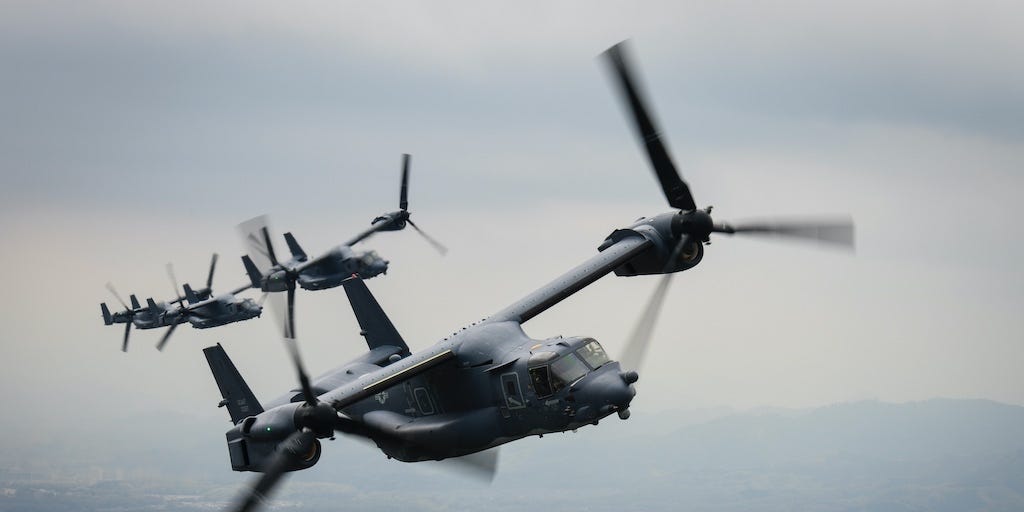
The V-22 Osprey looks like something an engineer sketched after being told to combine a helicopter, a turboprop airplane, and a little bit of science fiction. And somehow, against long odds, that sketch became real. The Osprey can lift off like a helicopter, land in tight spaces, and then rotate its nacelles forward to fly like an airplane. In plain English, it does the job of a rotorcraft when space is tight and the job of a fixed-wing aircraft when distance matters. That unusual mix is exactly why the V-22 has been praised as revolutionary, criticized as complex, and debated almost nonstop since the program began.
For supporters, the Osprey is a mission multiplier. It moves troops, cargo, and special operations teams faster and farther than traditional helicopters, while still operating from ships, austere airfields, and rough landing zones. For critics, it is also a reminder that ambitious aircraft designs can bring equally ambitious maintenance demands, safety concerns, and public scrutiny. Both views can be true at the same time. The V-22 Osprey is not a simple aircraft, and that is exactly what makes it so fascinating.
What Is the V-22 Osprey?
The V-22 Osprey is a tiltrotor, vertical or short takeoff and landing aircraft developed by Bell Boeing for U.S. military missions. Its defining feature is the pair of large proprotors mounted at the wingtips. When those nacelles point upward, the aircraft can take off, hover, and land like a helicopter. When they rotate forward, the V-22 transitions into airplane-style forward flight. That gives it a rare combination of vertical lift, speed, and range.
In other words, the Osprey is the answer to a long-running military wish list: “Can we please have the flexibility of a helicopter without crawling through the sky at helicopter speed?” The V-22’s whole reason for existing is to solve that problem. The Marine Corps wanted a platform that could move assault forces from ships to shore more quickly and from farther away. The Air Force wanted a special operations aircraft capable of long-range infiltration and resupply. The Navy wanted a carrier onboard delivery platform that could move people and priority cargo to the fleet without being tied to conventional runway operations.
How the V-22 Works Without Breaking Physics
The Tiltrotor Trick
The magic of the Osprey is not actually magic, which is probably disappointing if you were hoping for wizardry. It is engineering. Each wingtip carries an engine and rotor assembly inside a rotating nacelle. During takeoff and landing, the nacelles stay upright so the rotors provide vertical lift. Once airborne, the nacelles rotate forward by 90 degrees, turning the aircraft into a fast, fuel-efficient turboprop in level flight.
That arrangement lets the V-22 operate where a normal airplane cannot, then leave the scene much faster than a conventional helicopter. It also folds up for shipboard storage, which matters because naval aviation has never met a space problem it did not dislike intensely.
Performance That Explains the Buzz
On paper, the V-22’s numbers make its appeal obvious. The aircraft uses two Rolls-Royce AE1107C engines, each producing more than 6,000 shaft horsepower. Its maximum vertical takeoff weight is about 52,600 pounds. The Marine Corps has cited troop seating for 24 combat troops, while manufacturer and Navy materials also highlight a 4+24 crew-and-troop configuration. Cruise speed for the MV-22 has been listed around 240 knots, with demonstrated values higher, and Bell markets a top speed in the mid-260-knot range. That places the Osprey in a category where it can outrun the usual helicopter expectations by a wide margin.
Range is another part of the story. Marine Corps materials have long emphasized self-deployment range beyond 2,100 nautical miles with aerial refueling capability, while Bell highlights mission reach that significantly exceeds traditional rotary-wing platforms. The Navy’s CMV-22B variant stretches things further with more internal fuel, allowing it to transport up to 6,000 pounds of cargo and personnel to a 1,150 nautical mile range. That extra reach is a big deal when your workplace is a moving aircraft carrier.
Why the Military Wanted the Osprey So Badly
Marine Corps: Speeding Up Assault Support
For the Marine Corps, the V-22 was designed to replace aging medium-lift helicopters and transform assault support. The MV-22’s main job is transporting troops, equipment, and supplies from amphibious ships and land bases during expeditionary operations. The logic is simple: if you can launch from farther away and arrive faster, you increase survivability, flexibility, and operational tempo. That is not just a tactical advantage. It also changes how commanders think about distance, timing, and force placement.
The Osprey became especially important to the Marine Air-Ground Task Force because it combines shipboard compatibility with aircraft-like speed. It can move Marines from sea bases to inland objectives without requiring the kind of runways fixed-wing transports need. In a world where “close enough” can still mean a very long trip, that matters.
Air Force: The CV-22 and Special Operations
The Air Force version, the CV-22, is tailored for special operations missions. Its role includes long-range infiltration, exfiltration, and resupply in austere environments. That sounds dry until you picture what it means in practice: reaching remote areas at night, flying farther than a conventional helicopter, and delivering people or equipment where a runway is either unavailable or a terrible idea.
The CV-22 gave Air Force Special Operations Command an aircraft that can bridge the gap between fixed-wing reach and rotary-wing access. That is why it has been used in demanding missions where a slower helicopter might struggle to cover the distance or a normal airplane would have nowhere suitable to land.
Navy: The CMV-22B and Carrier Logistics
The Navy’s CMV-22B may be less flashy to the public, but it is quietly one of the most practical Osprey variants. It replaces the C-2A Greyhound for the carrier onboard delivery mission, carrying personnel, mail, supplies, and high-priority cargo between shore bases and aircraft carriers. It is especially relevant in an era of larger, more complex aircraft systems because it can move components needed to keep next-generation jets in the fight.
When the CMV-22B reached initial operational capability, it validated the Navy’s idea that logistics is not glamorous until the part you need is 1,000 miles away and the clock is ticking. During its maiden deployment, Navy officials described it as an operational success, and they specifically highlighted its ability to support the future carrier air wing.
What the Osprey Changed
The V-22 did more than fill a procurement line. It changed expectations. Bell says the fleet has accumulated more than 750,000 flight hours across roughly 450 aircraft, and that large body of operational experience has helped make the Osprey a familiar part of Marine, Air Force, and Navy aviation. As of mid-2025, a GAO testimony cited inventories of 348 Marine Corps Ospreys, 52 Air Force aircraft, and 29 Navy aircraft.
The aircraft has also proven useful outside pure combat scenarios. Marine Corps reporting from 2024 described MV-22B Ospreys supporting foreign disaster relief operations in the Philippines after Typhoon Krathon, with more than 55 flights delivering urgently needed aid and nearly 96,000 pounds of relief supplies to a remote island. That is the kind of mission where the Osprey’s oddball design suddenly looks less odd and more like a very practical tool.
In short, the Osprey helped expand the military’s concept of vertical lift. It showed that the old tradeoff between hovering access and airplane-like reach was not as fixed as it once seemed. That lesson is one reason the aircraft still influences future vertical lift thinking today.
The Controversy: Safety, Maintenance, and Hard Questions
Now for the part of the article where the music gets more serious. The V-22’s history includes fatal accidents, public skepticism, and recurring questions about complexity, reliability, and readiness. The aircraft’s unusual design gives it unique capability, but it also creates technical and maintenance challenges that have followed the program for years.
Those concerns intensified after multiple recent mishaps. Following the November 2023 crash of an Air Force V-22 off the coast of Japan that killed eight airmen, the fleet was grounded on December 6, 2023. In March 2024, the aircraft was cleared to return to flight after maintenance and procedural changes were implemented to address the materiel failure involved in the mishap investigation. Even so, the return to flight did not erase the broader debate.
In late 2025, GAO reported that the Marine Corps and Air Force had higher rates of the most serious Osprey accidents in fiscal years 2023 and 2024 than their average serious accident rates over the previous eight fiscal years. GAO also said program stakeholders had not fully addressed a large number of known system-related risks involving potential failures of airframe and engine components. That is not a minor footnote. It is the kind of oversight finding that forces the program, and the services that operate it, to confront hard truths.
The fairest way to understand the Osprey is to avoid two lazy extremes. It is not a miracle machine unfairly criticized by people who dislike innovation. It is also not a useless aircraft somehow surviving on good public relations. It is a high-value, high-complexity platform that delivers real operational advantages while demanding real engineering discipline, maintenance rigor, and honest safety oversight.
How the V-22 Is Being Improved
One of the most interesting parts of the Osprey story today is modernization. The aircraft is not standing still. Marine aviation planning documents describe efforts such as the Renewed V-22 Aircraft Modernization Plan, or ReVAMP, to keep the platform relevant through the rest of its service life while future assault support aircraft are developed. Other programs, including V-FORCE and cockpit upgrades, are aimed at improving digital interoperability, capability, and sustainment.
The nacelles, one of the aircraft’s most maintenance-intensive areas, are also getting focused attention. Bell’s Nacelle Improvement program is designed to simplify wiring, strengthen structures, and improve maintainer affordability and readiness. NAVAIR has also highlighted clutch instrumentation efforts to better understand critical system behavior during flight and support future safety improvements. In plain terms, the people keeping this aircraft in service are trying to make it smarter, easier to maintain, and less likely to surprise anyone in the worst possible way.
Why the V-22 Osprey Still Matters
The Osprey matters because it sits at the intersection of ambition and utility. It is an aircraft built to solve a genuine operational problem: how to move people and cargo vertically, rapidly, and over longer distances than helicopters usually allow. In many missions, it succeeds brilliantly. In others, it reminds everyone that advanced aviation systems extract a price in maintenance, logistics, and scrutiny.
If you want a simple verdict on the V-22 Osprey, sorry, aviation has once again refused to be simple. The better conclusion is this: the Osprey changed military aviation by proving tiltrotor capability at scale, but its legacy will depend not only on where it can fly, but on how safely and sustainably it can keep flying. That is a tougher standard than speed charts and glossy brochures, and it is the standard that really counts.
Experiences Related to the V-22 Osprey
To understand the V-22 Osprey, it helps to imagine the human experience around it. Not a video-game version. The real one. The kind with rotor wash, headset pressure, cargo straps, ocean spray, and the unmistakable feeling that this machine is doing something just unusual enough to make your brain check twice.
For troops boarding an MV-22, the first impression is often the noise and wind. The proprotors churn the air with serious authority, and the downwash is not subtle. An Osprey arrival is less of a gentle announcement and more of a full-body memo. Loose gear gets a stern talking-to. Dust and debris do not politely step aside. Everyone nearby suddenly remembers why eye protection exists.
Once inside, the experience shifts. The cabin feels more like a military transport than a traditional helicopter ride, but the transition from vertical lift to forward flight is where the aircraft’s personality really shows up. There is a sense that the aircraft is changing modes, almost like it has decided to stop hovering and start covering business-class miles at military tempo. For passengers, that means the trip can feel quicker than expected, especially over water or long coastal routes where a normal helicopter might make the journey feel like a patient test.
For aircrews, the Osprey experience is tied to flexibility. Ship to shore. Shore to ship. Remote landing zone. Humanitarian aid drop. Resupply. Special operations support. Carrier logistics. It is an aircraft that asks crews to be comfortable with a wide range of mission profiles. That versatility is part of the attraction, but it also means aircrews live with the aircraft’s complexity every day, not just during dramatic moments.
For maintainers, the experience is probably the least glamorous and the most important. The public sees the futuristic silhouette. Maintainers see wiring, access panels, inspections, systems behavior, and the endless discipline required to keep a demanding aircraft healthy. If the Osprey has a reputation for being both capable and complicated, maintainers are the people standing squarely in the middle of that truth.
Humanitarian missions reveal another side of the aircraft. In disaster relief operations, the V-22’s experience is not about spectacle. It is about getting aid to places where infrastructure is damaged, roads are unreliable, and time matters more than comfort. In that context, the aircraft’s ability to move quickly, land where a conventional airplane cannot, and keep supplies flowing becomes more than a technical achievement. It becomes a practical relief tool.
Even for spectators, the V-22 tends to leave a strong impression. It does not fly like the aircraft people expect. It hovers like a helicopter, then moves out with airplane energy, which gives it a slightly uncanny quality the first time you see it. The Osprey is one of those machines that makes bystanders stop mid-sentence and say, “Well, that’s different.” Usually louder, because the aircraft has opinions about volume.
In the end, the lived experience of the V-22 Osprey is a blend of awe, utility, and caution. Awe because it really does perform an unusual aviation trick at operational scale. Utility because its missions are real and often urgent. Caution because every flight hours chart and capability slide lives beside the hard lessons learned from accidents, oversight findings, and maintenance realities. That balance is the most honest way to talk about what the Osprey feels like in the real world.
Conclusion
The V-22 Osprey is one of the most distinctive aircraft of the modern era because it refuses to fit neatly into one category. It is part helicopter, part turboprop, part logistics workhorse, part special operations enabler, and part long-running aviation debate. It has proven its value in assault support, carrier logistics, and disaster relief, yet it has also been forced to answer difficult questions about safety and sustainment. That tension is exactly why the Osprey remains such a compelling subject. Love it, criticize it, or do a little of both, but ignoring it is not really an option. The V-22 changed the conversation about vertical lift, and that alone secures its place in aviation history.













