
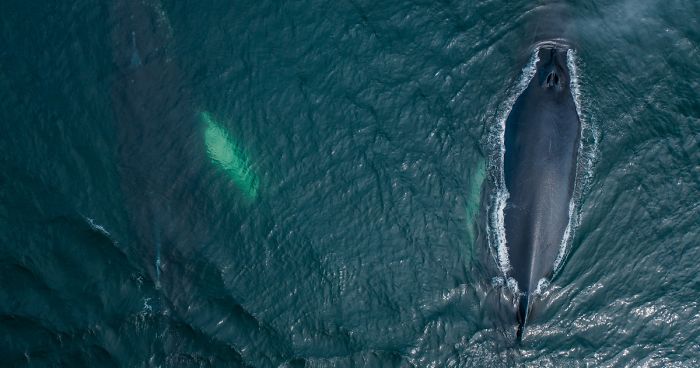
Some days, your town gives you a nice sunset. Other days, it gives you traffic, a windy grocery run, and a parking spot so far away it basically counts as cardio. And then there are the rare, ridiculous, goosebump-inducing days when the ocean decides to show off and sends dozens of whales right up to the edge of your daily life.
That is the magic behind a title like “When Dozens Of Whales Arrived In My Town, I Took Out My Drone To Take These 21 Pics.” It sounds almost too cinematic to be true, but scenes like this do happen in coastal communities when humpback whales and other large baleen whales follow dense schools of forage fish into productive nearshore waters. One minute you are making coffee. The next minute your entire town is standing on the shoreline pointing at the horizon like it just got front-row seats to the greatest wildlife show on Earth.
This article is more than a photo-story headline. It is a closer look at why whales suddenly appear near towns, what makes aerial whale photography so mesmerizing, what responsible drone use around marine wildlife actually looks like, and why moments like these stick with people long after the battery dies and the memory card fills up. Consider it part field note, part coastal love letter, and part respectful reminder that when whales arrive, humans are not the main characters. We are lucky witnesses with cameras.
Why Do Whales Suddenly Show Up Near Towns?
When dozens of whales appear close to shore, it is usually not random. It is dinner.
Humpback whales are famous for following food-rich waters. In many regions, they feed on krill and small schooling fish such as anchovies, sardines, herring, and other forage fish. When those prey species bunch together in dense bait balls, the ocean can turn into a buffet line with no reservations required. Productive coastal conditions, tides, upwelling, current shifts, and concentrated prey can pull whales surprisingly close to towns, harbors, and headlands.
That is one reason scenes like this feel both shocking and strangely organized. The whales are not sightseeing. They are reading the water. Where bait gathers, predators follow. Seabirds join the frenzy. Fish flash silver beneath the surface. Then a dark back rises, a blow hangs in the air, and suddenly your sleepy shoreline feels like the set of a nature documentary with a much better coffee situation.
Humpbacks are especially dramatic visitors because they often feed near the surface. They lunge upward through prey, flash their long pectoral fins, and sometimes work cooperatively. They are among the whales most likely to make humans yell things like, “Did you see that?” five times in a row without adding any new information.
Why Humpback Whales Look So Incredible From Above
If whales were built for publicity, humpbacks would be the marketing department. They are huge, active near the surface, and visually distinctive. Their bodies are mostly dark, but many individuals have striking white markings on their pectoral fins, bellies, and tail flukes. From above, those contrasting patterns can glow beneath clear water like moving brushstrokes.
They also have movement that reads beautifully in photographs. A whale rolling beneath the surface looks less like an animal and more like a weather system with opinions. A fluke lifting before a dive creates a clean silhouette that photographers dream about. A blow catches sunlight. A curved back breaks the water in one smooth line. Even the negative space matters: the dark whale, the bright foam, the glassy sea, the tiny scale of boats or shoreline in the distance. It is visual poetry with a very large lung capacity.
Aerial photography adds another layer. From shore, a whale is an event. From above, it becomes a composition. You can see spacing, direction, water color, bait movement, and the geometry of a feeding group. It reveals patterns that the human eye often misses at sea level. But here is the important part: just because a drone can make the scene look spectacular does not mean it should be flown carelessly. More on that in a minute, because whales deserve awe, not harassment.
What These 21 Pictures Would Really Capture
A title about “21 pics” suggests a gallery, but the best whale photographs do more than show animals. They tell a sequence. They turn one wild afternoon into a layered story of movement, scale, surprise, and emotion. Here is what those 21 photos would likely capture if you were lucky enough to witness a whale-filled day in your town.
- The first blow offshore. Not the whale itself at first, just the misty exhale that makes everyone on land stop mid-sentence.
- A dark back slicing the water. The first clean surfacing shot, calm and massive, like the ocean briefly forgot how to hide things.
- Three whales in one frame. Suddenly the story changes from “a whale is here” to “oh wow, there are a lot of whales here.”
- The shoreline reaction shot. Cars pulled over, neighbors gathering, phones up, people forgetting whatever chores they had ten minutes ago.
- A white pectoral fin glowing under the surface. One of those details that makes humpbacks look almost unreal from above.
- The bait-ball clue. Birds circling low, ripples tightening, fish schooling in a patch that looks ordinary until everything rushes toward it.
- A lunge feed frozen in motion. Water exploding upward, mouth open, chaos for the fish, masterpiece for the camera.
- Two whales surfacing on parallel lines. The kind of frame that makes the ocean look choreographed.
- Foam patterns after the dive. The whale is gone for a moment, but the water keeps talking.
- A perfect fluke-up dive. Tail high, edges crisp, one of the classic images that never gets old no matter how many times you have seen it.
- A juvenile beside a larger whale. Instantly softer, more intimate, and a reminder that not every giant moment needs a splashy entrance.
- Sunlight through clear water. The whale becomes a shadow painting below the surface, half visible, half mystery.
- The town in the background. Houses, docks, or roads tiny beside a marine mammal that can turn an ordinary place into headline material.
- A cluster of blows across the bay. Not one plume, but many, as if the horizon itself were breathing.
- The waiting frame. Empty water where you know a whale will surface any second. Tension is part of wildlife photography too.
- A breach, or almost-breach. Even a partial rise out of the water feels like the ocean overcommitting to drama.
- A calm interval. The kind of shot where the sea smooths out and everyone realizes how quiet awe can be.
- The group pattern. From above, multiple whales reveal spacing and movement you would never understand from shore.
- One whale directly beneath the drone’s perspective. A scale-shifting image that makes the water seem suddenly thin.
- The last good light. Gold on the surface, darker backs below, that end-of-day feeling that says the ocean knows exactly what it is doing.
- The final empty frame. No whale, just open water after they leave, which somehow becomes one of the most emotional pictures in the set.
The Drone Question: Amazing Photos Require Real Responsibility
This part matters. A lot.
Whales may tolerate human presence at times, but that does not mean we should press our luck. In the United States, federal guidance for marine wildlife viewing emphasizes distance, patience, and minimizing disturbance. NOAA advises people on the water to stay well back from whales, avoid cutting through groups, and limit viewing time. The same basic ethic applies to aerial devices. Drones can stress marine mammals through noise, shadow, and proximity, and some regions have specific legal restrictions for certain species.
In practical terms, responsible whale photography is less about “How close can I get?” and more about “How can I avoid changing the animal’s behavior?” That mindset separates respectful observation from pestering a wild animal for content. The goal is never to make the whale react to the drone. The goal is to document what it was already doing.
That may sound less exciting than flying low for a dramatic shot, but honestly, it is better storytelling. Wildlife images mean more when the animal remains wild. The strongest whale photos do not feel invasive. They feel earned through patience, timing, and restraint. In other words, the best tool in wildlife photography is not the drone. It is judgment.
What a Whale Event Like This Says About the Ocean
When a town suddenly finds itself surrounded by whales, the scene feels joyful, but it also hints at larger ecological forces. Whales gather where food gathers. Food gathers where ocean conditions allow it. That means events like this are tied to currents, productivity, seasonal migration, and the shifting behavior of prey species. Coastal communities see the spectacle, but behind the spectacle is an entire food web at work.
That is one reason whale encounters can feel so emotional. They are not just beautiful. They are evidence that the ocean is still functioning in a way we can witness with our own eyes. At the same time, whale populations continue to face real threats, including entanglement in fishing gear, vessel strikes, pollution, habitat disruption, and changes linked to warming oceans. So every thrilling sighting comes with a quiet second thought: enjoy this, respect this, and do not take it for granted.
There is also something powerful about seeing a giant marine mammal near a familiar place. We tend to imagine whales as residents of some distant, cinematic ocean somewhere else. But when they appear near your town, they collapse that distance. Suddenly, marine conservation is not abstract. It is local. It is visible. It is blowing mist into the air while your neighbor stands next to you in flip-flops holding binoculars upside down.
Why Stories Like This Travel So Far Online
The internet loves whale stories for a simple reason: whales make people feel small in the best possible way.
A viral post about dozens of whales near town combines several irresistible ingredients. It has scale. It has surprise. It has beauty. It has the kind of “you had to be there” energy that photographs can only partly contain. It also taps into a very human longing for interruption. We spend so much of life inside routines that when nature barges in with something enormous and impossible-looking, it feels like reality briefly upgraded itself.
There is also a deep emotional honesty in these stories. Nobody watching whales from shore pretends to be in control. A whale does not care about your schedule, your camera settings, or your content strategy. It surfaces when it wants. It disappears when it wants. It turns thousands of people into the same thing for a few minutes: quiet.
That is why the best version of this story is not really about the drone at all. The drone is just how the witness tried to hold onto the moment. The real story is the collision between ordinary human life and extraordinary marine life. The camera records it. The town remembers it. The ocean moves on like it has not just rearranged your entire week.
My Experience Watching the Whales From Shore
I still remember the first second I realized the water in front of town was different. It was not dramatic at first. No movie soundtrack, no instant breach, no slow-motion spray in perfect light. Just a strange feeling that too many birds were circling in one area and too many people were staring at the same patch of ocean. Then the first blow rose into the air, and the whole shoreline changed mood in a heartbeat.
I took out my drone with the kind of shaky excitement that makes you feel both very prepared and absolutely not prepared at all. You check the battery twice. You check the wind. You check your hands, which somehow have become the hands of a person trying to text after three cups of coffee. Even before the drone lifted off, I could hear the whales breathing from shore. That sound carried across the water in a way that felt ancient and mechanical at the same time, like the ocean had suddenly grown lungs.
Once the drone was up, the scene became even more unreal. From above, the whales were not random dark shapes popping up here and there. They were everywhere, moving with purpose, circling, surfacing, diving, and gathering where the fish were concentrated. I could see patterns in the water I never would have noticed from land. A pale flash under the surface. A clean curve of a back. A fluke lifting out of dark blue water. Trails of foam where a feeding rush had just happened. It felt less like photographing wildlife and more like discovering a secret map that had been there all along.
What surprised me most was the emotional part. I expected excitement. I expected adrenaline. I expected the basic photographer’s greed of wanting just one more perfect frame. I did not expect the weird tenderness of it. The whales were huge, but they did not feel monstrous. They felt present. Deliberate. Busy. Alive in a way that made everything on land seem a little sillier and a little smaller. People around me stopped talking in full sentences. They just pointed, laughed, gasped, and repeated each other like that was enough. Honestly, it was.
And then there was the light. Sun on the water can be annoying when you are trying to shoot, but that day it turned every surface into moving glass. At times the whales were visible just beneath the top layer, as if the sea were trying to hide them and failing. When one rolled and showed the pale underside of a fin, it looked almost lit from within. That kind of image stays with you because it feels impossible even while you are looking straight at it.
The strangest moment came after the best photos were already taken. My battery was done. The drone was down. There was nothing left to do but stand there and watch. And that turned out to be the real reward. No framing. No exposure decisions. No trying to catch the next surfacing. Just whales moving through the water in front of town while the rest of us stood still and let the moment happen to us. For a little while, nobody wanted to leave. The town had been handed something rare and wordless, and everybody knew it.
That is the part a gallery can never fully capture. The photos hold shape, color, scale, and drama. They do not quite hold the feeling of hearing a whale exhale across a bay, or the strange lump-in-your-throat reaction that comes from realizing wild beauty has shown up unannounced right outside your regular life. Maybe that is why people keep taking these pictures. Not to prove the whales were there, but to prove we were.
Conclusion
When dozens of whales arrive near town, it creates the kind of memory that instantly divides life into before and after. Before, the shoreline was just the shoreline. After, it becomes the place where the ocean opened a door and let something immense pass through. A drone can document the shapes, the spacing, the white fins, the explosive feeds, and the perfect fluke dives. But the deeper story is still the same: whales remind us that the natural world is not a background image. It is active, powerful, and fully capable of stealing the entire show.
So yes, take the pictures if conditions allow and local rules are respected. Capture the mist, the movement, the scale, the miracle of seeing giants in familiar water. But also put the camera down for a minute. Listen to the blows. Watch the surface settle between dives. Let the awe do its work. Because in the end, the most unforgettable frame may be the one you never post at all.














