
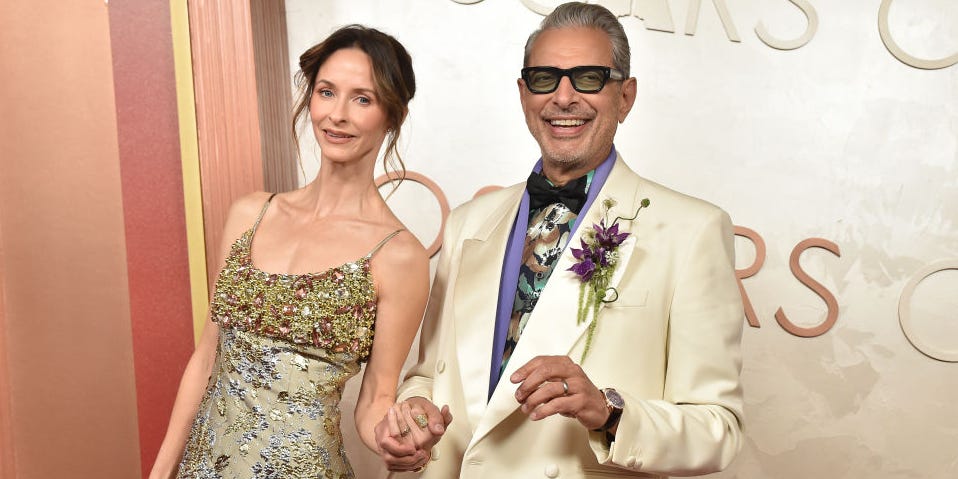
Jeff Goldblum has spent decades making audiences lean forward and ask, “Wait, did he just make chaos theory sound charming?” But away from dinosaurs, jazz pianos, designer suits, and delightfully unpredictable interviews, there is another fascinating figure in his orbit: Emilie Livingston. She is often introduced as “Jeff Goldblum’s wife,” which is technically true, but also wildly incomplete. That is like describing a Cirque du Soleil performer as “someone who stretches sometimes.”
Emilie Livingston is a Canadian former Olympic rhythmic gymnast, dancer, aerialist, contortionist, performance artist, wife, mother, and creative force with a career that has moved from elite international sports to Hollywood sets and red-carpet style moments. She married Jeff Goldblum in 2014, and together they have built a family that includes two sons, Charlie Ocean and River Joe. Their relationship is often covered because Goldblum is a beloved Hollywood original, but Livingston’s own story deserves the spotlight, preferably one bright enough to catch a ribbon toss.
So, who is Emilie Livingston? She is not simply the woman standing beside Jeff Goldblum at premieres. She is a former Olympian who represented Canada, a performer whose body control has translated into film work, and a public figure whose life blends athletic discipline, artistic expression, family, fashion, and a very specific kind of Hollywood magic.
Emilie Livingston at a Glance
Emilie Livingston was born on January 4, 1983, in Etobicoke, Ontario, Canada. Long before she became known to entertainment fans as Jeff Goldblum’s wife, she was already training at a level most people reserve for superhero origin stories. Her background includes ballet, rhythmic gymnastics, aerial performance, contortion, and dance. In other words, while many children were learning how to tie their shoes, Livingston was building the flexibility, precision, and competitive focus that would eventually take her to the Olympic Games.
Her athletic career centered on rhythmic gymnastics, a sport that combines dance, coordination, strength, flexibility, musicality, and apparatus work with ribbons, hoops, balls, clubs, and ropes. It is elegant from the audience’s seat and brutally demanding from the athlete’s side. The smiles may look effortless, but the training is anything but casual. Rhythmic gymnasts must move with grace while handling equipment that seems determined to betray them at the worst possible moment.
Livingston represented Canada at the 2000 Sydney Olympics in the women’s individual all-around event. That achievement alone places her in a rare category. Becoming an Olympian requires more than talent. It takes years of repetition, sacrifice, international competition, coaching, travel, injury management, and a tolerance for pressure that would make most people consider hiding under a weighted blanket.
Her Olympic Gymnastics Career
Before the name Emilie Livingston became linked with Hollywood, it was linked with Canadian rhythmic gymnastics. She competed during an era when the sport was dominated internationally by countries with deep rhythmic gymnastics systems and long-established training pipelines. For a Canadian athlete to reach the Olympic stage in that environment required exceptional persistence.
Livingston’s athletic résumé includes a major highlight at the 1999 Pan American Games, where she won the individual all-around gold medal in rhythmic gymnastics. That victory was a meaningful moment not only for her career but also for Canada’s presence in the sport. The Pan American Games are not a small neighborhood talent show with better snacks; they bring together elite athletes from across the Americas. Winning there meant Livingston had already proven she could handle serious international competition before stepping onto the Olympic floor.
At the 2000 Olympics in Sydney, Livingston competed for Team Canada in rhythmic gymnastics and placed 18th in the individual all-around. The number by itself does not fully explain the achievement. Olympic qualification in rhythmic gymnastics is fiercely competitive, and the sport demands near-impossible consistency. One slight timing error, one dropped apparatus, or one balance issue can affect the entire routine. The athletes make it look fluid, but behind the scenes, every movement is trained until it becomes part choreography, part physics, and part stubborn refusal to quit.
Her gymnastics years also shaped the performer she became later. Rhythmic gymnastics teaches spatial awareness, musical interpretation, body control, resilience, and the ability to perform under bright lights while judges watch every finger angle. Those skills do not disappear after retirement. In Livingston’s case, they transformed into a second career in dance, aerial work, contortion, and film performance.
From Gymnastics to Hollywood Performance
After her competitive gymnastics career, Emilie Livingston moved into the entertainment world. This transition makes sense. Elite rhythmic gymnastics is already a performance art with competitive scoring attached. The athlete must tell a story through movement while making technically difficult skills appear light and natural. Hollywood, especially in dance-heavy or physically stylized films, needs people who can do exactly that.
Livingston has worked as a dancer, aerialist, and contortionist. These are not casual hobbies. Aerial performance requires strength, timing, trust, and a calm relationship with gravity, which is impressive because gravity is famously clingy. Contortion demands flexibility, control, and an understanding of body mechanics that goes far beyond “I did one yoga class and now own a mat.”
She has also worked as a body double in major films. One of her best-known Hollywood credits is as a body double for Emma Stone in La La Land, the Oscar-winning musical that revived old-school Hollywood romance with modern energy. She was also involved as a body double for Rihanna in Valerian and the City of a Thousand Planets, particularly for the physically demanding performance elements of Rihanna’s character, Bubble.
Body-double work often goes underappreciated by casual moviegoers. It requires performers who can match movement, style, physicality, and camera needs while helping create the illusion that a scene belongs seamlessly to the character. In Livingston’s case, her background made her especially suited for sequences requiring elegance, flexibility, athleticism, and precise control. She did not simply “stand in.” She brought a lifetime of training to moments that needed to look magical on screen.
How Did Jeff Goldblum and Emilie Livingston Meet?
Jeff Goldblum and Emilie Livingston reportedly met in 2011 at a gym in California. Given both of their personalities and professions, that setting feels almost too perfect. He was the actor-musician with the jazz rhythm of a man who thinks in delightful tangents. She was the Olympic-trained performer whose physical discipline could probably make a treadmill feel underqualified.
Their relationship became public over time, and they eventually got engaged in 2014. Later that same year, on November 8, 2014, Goldblum and Livingston married in Los Angeles. Their wedding drew attention partly because Goldblum is a famous actor and partly because fans are naturally curious when a beloved celebrity begins a new chapter. But their marriage has lasted well beyond the quick-flash celebrity headline cycle. More than a decade later, they continue to appear together at events, support each other publicly, and raise their children.
The couple’s age difference has often been mentioned in media coverage, but focusing only on that detail misses the broader picture. Their public relationship appears built around shared creativity, performance, humor, family life, and mutual admiration. Goldblum has spoken affectionately about Livingston in interviews, and she has often appeared by his side at red-carpet events, fashion shows, and family outings.
Their Family Life: Charlie Ocean and River Joe
Jeff Goldblum and Emilie Livingston have two sons. Their first son, Charlie Ocean Goldblum, was born in 2015. Their second son, River Joe Goldblum, was born in 2017. The names sound like they could belong to either future artists, adventurous explorers, or extremely stylish jazz musicians. Considering their parents, all three options remain on the table.
Goldblum became a father later in life, and he has spoken publicly about how meaningful fatherhood has been for him. His parenting comments often emphasize presence, values, curiosity, and helping his children grow into independent people. Livingston, meanwhile, shares glimpses of family life through public social media posts, including travel, food, movement, and everyday moments that suggest a warm, creative household.
The family has occasionally appeared together in public, including major events connected to Goldblum’s career and high-profile cultural moments. Still, they seem to maintain a balance between public visibility and privacy. That balance matters. Celebrity families can easily become content machines if boundaries disappear. Goldblum and Livingston appear to give fans enough to appreciate their family story without turning their children’s lives into a permanent reality show.
Why Emilie Livingston Is More Than “Jeff Goldblum’s Wife”
The phrase “Jeff Goldblum’s wife” is useful for search engines, but it should not be the end of the conversation. Emilie Livingston’s identity includes Olympic achievement, artistic performance, motherhood, style, and creative entrepreneurship. She has her own accomplishments, and those accomplishments existed before she married one of Hollywood’s most charismatic eccentrics.
Her story also illustrates a broader point about partners of celebrities. Public curiosity often flattens them into supporting characters. The spouse becomes “the wife of” or “the husband of,” while their own biography gets squeezed into a paragraph. Livingston resists that flattening because her background is too distinctive. She has competed internationally, performed professionally, worked in film, and built a life that crosses several demanding worlds.
She is also part of a modern entertainment ecosystem where movement specialists are finally getting more recognition. Film and television often rely on dancers, stunt performers, body doubles, aerialists, choreographers, and specialty artists to create unforgettable visual moments. Livingston’s work belongs to that hidden architecture of performance. The audience may not always know her name during a scene, but the scene may depend on the kind of skill she spent decades developing.
Her Style and Public Image
Emilie Livingston’s public style has become part of her media presence. She and Goldblum have appeared together at fashion events, premieres, awards-related gatherings, and cultural outings. Goldblum is already known for adventurous fashion choices: patterned shirts, sharp tailoring, eyewear with personality, and the general energy of a man who can make a scarf seem philosophical. Livingston brings her own confidence to those appearances, often choosing looks that reflect her background in performance and movement.
Her red-carpet presence is not accidental. As a dancer and former gymnast, she understands posture, line, silhouette, and how clothing moves on the body. That gives her style a physical intelligence. She does not just wear fashion; she performs it, often with the poise of someone who has spent years making difficult things look easy.
This is one reason she fits naturally beside Goldblum in public. He brings theatrical charm, musical timing, and eccentric elegance. She brings athletic grace, artistic control, and a performer’s confidence. Together, they have become one of those celebrity couples who make photographers very happy and stylists quietly proud.
What Does Emilie Livingston Do Now?
Livingston’s current public life appears to combine family, performance, wellness, creativity, and occasional entertainment-industry work. She has shared cooking content, movement-related posts, family moments, and glimpses of travel. Her background makes her especially interesting to audiences who follow fitness, dance, gymnastics, motherhood, and celebrity culture.
She also represents a type of career that is increasingly common among high-level performers: not one single job title, but a portfolio of abilities. Former Olympian. Dancer. Aerialist. Contortionist. Film performer. Mother. Creative personality. These labels overlap rather than compete. They show how a person can carry elite training into many different forms of work and expression.
For readers wondering whether Livingston still performs, the answer is best understood broadly. She may not be competing in rhythmic gymnastics, but her identity as a performer remains central. Once someone has trained at that level, movement becomes more than a job. It becomes a language.
Jeff Goldblum and Emilie Livingston’s Relationship Dynamic
Goldblum and Livingston’s relationship attracts attention because they seem visually and energetically memorable as a pair. He is famously playful in interviews, with a speaking style that wanders, sparkles, pauses, and then somehow lands exactly where it needs to. Livingston, by contrast, comes from a world where precision is everything. At first glance, they may seem like jazz improvisation married to Olympic discipline. In practice, that may be exactly why the pairing works.
Both understand performance. Both know what it means to live in front of an audience. Both have built careers around timing, expression, and presence. Goldblum’s medium is acting and music; Livingston’s is movement and physical artistry. Their creative languages differ, but they share a respect for craft.
Their public comments and appearances suggest warmth and admiration rather than a relationship built only for celebrity optics. Goldblum has referred to Livingston in affectionate terms, and their family life seems to be a major source of joy for him. Livingston, in turn, has publicly celebrated their children and family milestones. Their marriage has now lasted long enough to move from “celebrity news item” to “steady partnership,” which in Hollywood years is roughly equivalent to a geological era.
Why People Are Searching for Emilie Livingston
Search interest in Emilie Livingston often rises when Jeff Goldblum appears in a major project, attends a big event, or brings his family to a public appearance. His roles in franchises and high-profile films keep him in the spotlight, and fans naturally become curious about the woman beside him. But once readers begin looking into Livingston, they often discover that her biography has more layers than expected.
She appeals to several audiences at once. Celebrity fans want to know about Jeff Goldblum’s wife and family. Sports fans recognize her as a former Olympic rhythmic gymnast. Film lovers may connect her to La La Land or Valerian. Fashion followers notice her red-carpet presence. Parents may relate to her family-centered posts. Fitness and dance fans may admire the training behind her career.
That wide appeal is exactly why her story works as more than a celebrity-spouse profile. Livingston’s life sits at the intersection of sports, entertainment, family, and style. It is a reminder that fame often introduces us to someone, but personal achievement is what keeps the story interesting.
Experiences and Lessons Related to Emilie Livingston’s Story
One of the most useful ways to understand Emilie Livingston’s story is to look at the experiences behind the headline. At first glance, “Who is Jeff Goldblum’s wife?” sounds like a simple celebrity question. But her life offers lessons about discipline, reinvention, partnership, and identity. Those themes are relevant even if your closest brush with Olympic gymnastics was tripping over a yoga mat while trying to find the TV remote.
The first experience that stands out is the power of early commitment. Livingston began developing her movement skills as a child, and by her teenage years she was competing internationally. That level of focus requires support, sacrifice, and unusual maturity. Many people discover their passions later, and that is perfectly valid, but Livingston’s journey shows what can happen when talent meets serious structure early. She did not simply dream about becoming elite; she trained for it day after day.
The second lesson is reinvention. Many athletes face a difficult transition after competition ends. Their identity has often been tied to rankings, routines, coaches, and goals. Livingston managed to carry the skills of gymnastics into a broader creative life. She moved into dance, aerial performance, contortion, and film work. That kind of reinvention is not automatic. It requires seeing old abilities in a new way. A ribbon routine becomes movement intelligence. Competitive flexibility becomes performance range. Stage confidence becomes screen presence.
The third experience is partnership without disappearing. Marrying a globally recognized actor could easily overshadow a person’s own story. Yet Livingston’s biography remains strong because she had already built a meaningful career before becoming widely known to Goldblum’s fans. This matters. Healthy public identity is not about competing with a famous spouse; it is about remaining whole beside them. Livingston’s life shows that being part of a couple does not erase individual accomplishment.
The fourth lesson is that family can become a new creative chapter. For Goldblum and Livingston, parenthood appears to be central to their shared life. Raising two sons while maintaining public careers and creative interests requires flexibility of a different kind. The routines are no longer judged by Olympic panels, but any parent knows that getting children dressed, fed, emotionally regulated, and out the door can feel like its own all-around final.
Finally, Livingston’s story suggests that elegance is often built from effort. Audiences see the polished result: the red-carpet pose, the film movement, the graceful family photo, the calm smile. What they do not always see are the years of training, the injuries avoided or endured, the auditions, the rehearsals, the parenting logistics, and the discipline beneath the glamour. That is the most interesting part of her public image. She brings substance to the sparkle.
Conclusion: Emilie Livingston Has Her Own Spotlight
Emilie Livingston may be widely searched as Jeff Goldblum’s wife, but her life story stands firmly on its own. She is a Canadian former Olympic rhythmic gymnast who represented her country at the 2000 Sydney Games, a Pan American Games gold medalist, a dancer, aerialist, contortionist, Hollywood body double, mother of two, and public figure with a distinctive style presence.
Her marriage to Goldblum is part of the fascination, especially because the couple has built a warm and enduring family life in the public eye. But the real answer to “Who is Emilie Livingston?” is richer than a celebrity relationship label. She is an athlete-artist whose career has required discipline, creativity, resilience, and the ability to keep evolving.
In a culture that often reduces people to one searchable phrase, Livingston is a reminder that the best biographies do not fit neatly into a headline. Yes, she is Jeff Goldblum’s wife. She is also the woman who went from Canadian gymnastics floors to the Olympic stage, from elite sport to Hollywood performance, and from public curiosity to a story worth knowing in its own right.













