
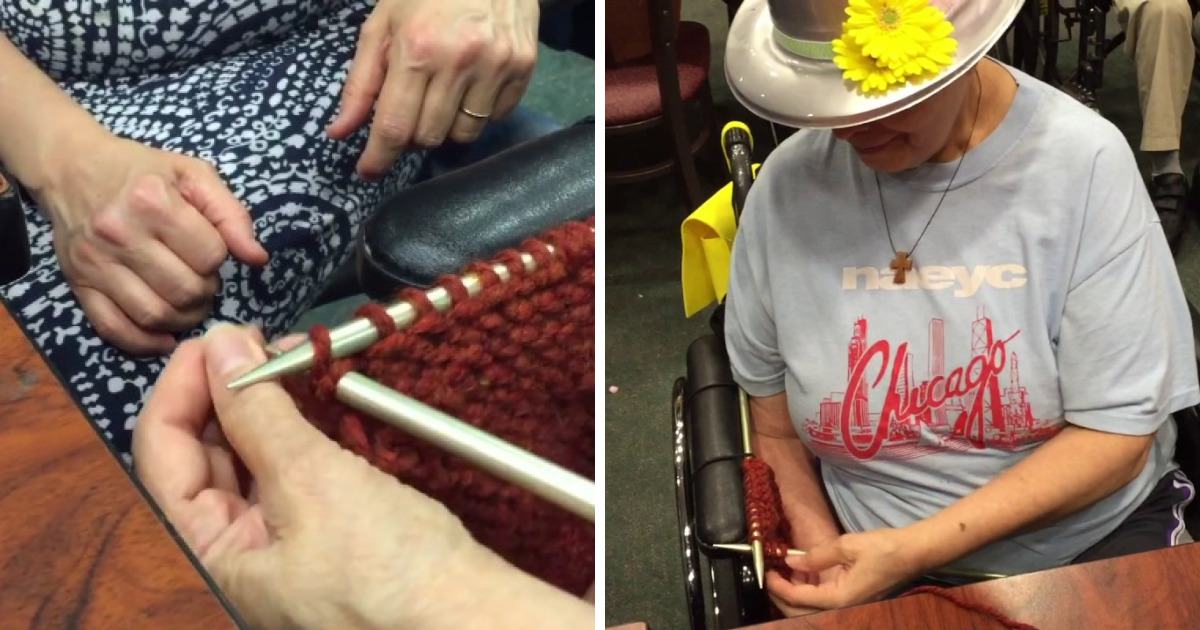
For many people, knitting is more than a hobby. It is a quiet ritual, a creative outlet, a way to make gifts, and occasionally a socially acceptable excuse to buy yarn in seventeen shades of blue.
So when illness, injury, stroke, amputation, arthritis, or limited arm mobility makes traditional knitting difficult, the loss can feel surprisingly personal. Knitting usually asks both hands to cooperate like a tiny orchestra: one hand holds tension, the other moves a needle, and somehow a scarf appears. When only one arm can do most of the work, that familiar rhythm can seem impossible.
But one woman’s adaptive knitting method proves that the craft does not require two fully functioning hands. It requires a little creativity, a stable setup, and a willingness to let the furniture help. The simple trick is to secure one knitting needle in a holder, clamp, or sturdy support so the working hand can manipulate the other needle and yarn.
In other words, the table becomes the second hand. And honestly, tables have been underachieving for years.
The Simple Trick That Makes One-Handed Knitting Possible
The heart of adaptive knitting is simple: instead of holding both needles in the hands, one needle is anchored in place. A clamp, peg, needle holder, modified board, wheelchair tray attachment, lap desk, or homemade support keeps the “resting” needle steady.
The knitter then uses the stronger or more mobile hand to guide the working needle, wrap the yarn, pull loops through, and transfer stitches. The movement may look different from conventional knitting, but the stitch structure remains the same. Knit stitches are still knit stitches. Purl stitches are still purl stitches. The yarn does not care whether your technique looks elegant enough for a historical reenactment.
One-handed knitting aids are designed to hold a needle securely while allowing the user to remove and reposition it when a row is finished. Some commercial devices use clamps, adjustable clips, rubber grips, or flexible arms. Others can be made with basic materials such as a wooden block, a spring clamp, nonslip shelf liner, foam padding, and a stable base.
The goal is not to force the body to imitate a two-handed technique. The goal is to redesign the task so the body can participate comfortably and safely.
Why Adaptive Knitting Matters
Adaptive knitting is not merely about producing a hat, scarf, or blanket. It is about preserving independence, identity, creativity, and connection.
For a lifelong knitter, being unable to use one arm may feel like losing a language. A person may still recognize the weight of wool, remember favorite stitch patterns, and know exactly how many rows are needed before a sleeve starts looking suspiciously like a sock. The knowledge remains. The barrier is physical access.
That is where adaptive tools and occupational therapy strategies can make a difference. Occupational therapists often help people return to meaningful activities after illness, injury, surgery, or disability. Those activities may include dressing, cooking, writing, gardening, working, playing music, or creating with yarn.
Returning to a favorite craft can support routine, confidence, and a sense of control. It may also provide mental stimulation and social connection, especially for people who participate in knitting circles, online crafting groups, or family projects.
How One-Handed Knitting Works Step by Step
1. Secure One Needle
The first step is to create a stable “helper hand.” One knitting needle is placed into a holder, clamp, or support attached to a table, tray, chair arm, lap desk, or other secure surface.
The holder should grip the needle firmly enough that it does not slide or rotate while knitting. A rubber-lined clip or foam-padded clamp can improve stability while protecting the needle. Avoid sharp edges, loose attachments, or setups that require awkward twisting of the wrist.
2. Choose a Comfortable Needle Size
Many beginners find medium or larger needles easier to manage because they are easier to see and grip. Smooth wooden or bamboo needles may offer more traction than very slippery metal needles, although preferences vary.
Shorter straight needles, circular needles, or needles with larger grips may be more manageable depending on the person’s range of motion. Circular needles can be especially useful because the flexible cable helps keep stitches from escaping. Tiny runaway stitches have a mysterious talent for disappearing under furniture at the exact moment someone says, “This should be easy.”
3. Simplify Yarn Tension
Traditional knitting often relies on one hand to control yarn tension. In one-handed knitting, tension can be managed with a yarn guide, tension ring, clip, yarn bowl, wrist loop, or simple routing system attached to the workspace.
Some knitters loop yarn around a finger, while others guide it through a tension device or place the yarn ball in a bowl so it does not roll across the floor like a tiny woolen escape artist.
4. Work Slowly at First
Adaptive knitting may feel awkward in the beginning because the body is learning a new movement pattern. Starting with a simple swatch, garter-stitch scarf, dishcloth, or small rectangular project is often easier than jumping directly into a cable-knit sweater with twelve charts and a mysterious “repeat as established” instruction.
The first goal should be consistency, not speed. A few comfortable rows are better than an hour of painful gripping or frustration.
5. Reposition at the End of Each Row
When the row is complete, the knitter removes the now-empty needle from the holder and replaces it with the needle carrying the stitches. This becomes part of the rhythm of one-handed knitting.
With practice, the transition becomes smoother. Some knitters even develop a method that looks impressively efficient, as though they have been secretly training for the Adaptive Knitting Olympics.
Adaptive Knitting Tools That Can Help
There is no single perfect setup for every person. The best one-handed knitting aid depends on hand strength, shoulder movement, grip, balance, vision, comfort, and the type of project being made.
Needle Holders and Table Clamps
A needle holder is the most direct solution. It anchors one needle in a fixed position and frees the working hand to perform the stitch movements. Some devices are designed specifically for knitting, while others can be adapted from clamps, tool holders, camera mounts, or craft stands.
Nonslip Mats
A nonslip mat placed beneath a lap board, yarn bowl, or adaptive device can prevent the setup from sliding. This small addition can make a surprising difference, especially for people working from a wheelchair, recliner, hospital bed, or sofa.
Large-Grip Needles
Needles with thicker handles or added foam grips may reduce the amount of finger strength needed to hold them. Built-up grips are commonly used in adaptive equipment because a larger surface can be easier to grasp than a thin one.
Yarn Guides and Tension Aids
Yarn tension is one of the trickiest parts of one-handed knitting. A yarn guide, ring, clip, or tensioning attachment can help maintain a more even flow of yarn without requiring constant finger adjustments.
Knitting Looms
For some people, loom knitting may be easier than needle knitting. Looms use pegs instead of two active needles, and stitches are formed with a hook. They can be a good alternative for hats, scarves, blankets, socks, and other simple projects.
That said, loom knitting is not a “lesser” form of knitting. It is simply another route to yarn-based greatness. The scarf does not hold a committee meeting before deciding whether it deserves compliments.
Who May Benefit From One-Handed Knitting?
One-handed knitting techniques can be helpful for people with many different experiences, including:
- Stroke-related weakness or paralysis on one side of the body
- Upper-limb amputation
- Cerebral palsy or congenital limb differences
- Arthritis affecting one hand or wrist
- Temporary injury, surgery, or casting
- Nerve damage or limited grip strength
- Shoulder, elbow, or wrist mobility limitations
- Chronic pain conditions that make two-handed knitting difficult
However, adaptive knitting should be tailored to the individual. Someone recovering from surgery, experiencing hand pain, or dealing with new weakness should speak with a healthcare professional, occupational therapist, certified hand therapist, or rehabilitation specialist before pushing through discomfort.
Pain is not a knitting badge of honor. It is a useful message from the body, not a challenge from a medieval wizard.
Tips for Making Knitting More Comfortable With One Arm
Set Up the Workspace Carefully
Good positioning matters. The work surface should be stable and close enough that the knitter does not have to reach forward or lift the shoulder repeatedly. A chair with arm support, a lap tray, or an adjustable table can reduce strain.
Use Bright Lighting
Clear lighting makes it easier to see stitches, catch mistakes early, and avoid unnecessary squinting. High-contrast yarn can also help beginners follow the loops more easily.
Choose Smooth, Forgiving Yarn
Soft, smooth yarn in a medium weight is often easier to work with than fuzzy, dark, split-prone yarn. Save the mohair cloud yarn for later, when confidence is high and patience has been officially certified.
Take Short Breaks
Frequent breaks can help prevent fatigue, stiffness, and repetitive strain. Stretch the fingers, relax the shoulders, change position, and check whether the setup still feels comfortable.
Start With Small Projects
Dishcloths, scarves, mug cozies, simple squares, headbands, and baby blankets are great practice projects. They allow the knitter to focus on movement without worrying about complex shaping or tiny stitch counts.
The Emotional Side of Returning to a Beloved Craft
When someone loses the use of an arm, people often focus on practical tasks: buttons, zippers, food preparation, driving, bathing, and household chores. Those things matter. But leisure activities matter too.
A favorite craft can represent calm, identity, friendship, memory, and purpose. A grandmother may want to knit blankets for grandchildren. A former teacher may miss creating scarves for coworkers. A person recovering from a stroke may want something that feels familiar in a season when almost everything else feels new.
Adaptive knitting gives people a path back to that part of themselves. It does not erase a disability or make recovery magically simple. It offers something more realistic and more valuable: a way to keep participating.
That participation can be powerful. One stitch becomes ten. Ten become a row. A row becomes a square. Eventually, the project grows into something visible and warm, proof that creativity can adapt even when circumstances are stubborn.
Experiences Related to One-Handed Knitting and Adaptive Crafting
The following examples are composite scenarios based on common experiences shared by adaptive crafters, rehabilitation professionals, and knitting communities. They are not profiles of specific individuals.
One woman began exploring one-handed knitting after a stroke affected movement in her left arm. Before the stroke, she had made baby sweaters for nearly every new child in her family. Afterward, she assumed knitting was over because she could no longer hold both needles in the usual way.
Her first attempts were frustrating. The needle slid off the table. The yarn tangled around the chair. A dropped stitch disappeared into the carpet and apparently began a new life there. But after trying a simple clamp-style holder attached to a lap board, she was able to keep one needle steady.
She started with a small square using only knit stitches. The fabric was uneven, the edges curled, and the first few rows looked like they had survived a minor weather event. Still, it was knitting. A few months later, she was making simple lap blankets for a local nursing home.
Another adaptive crafter had limited use of one arm following a serious shoulder injury. She did not want a complicated device or expensive equipment. Instead, she used a wooden board, a padded clip, and a strip of nonslip material. Her husband helped attach the holder to the board, but she adjusted the angle herself until it felt comfortable.
She discovered that posture mattered as much as the tool. When the board sat too low, her shoulder became sore. When the yarn ball rolled freely, she wasted more time chasing it than knitting. Once she placed the board on a lap tray and kept yarn in a bowl beside her chair, the process became much smoother.
For another woman, the biggest challenge was not holding the needles. It was maintaining yarn tension. She could create the stitches, but the fabric came out loose in some places and tight in others. She experimented with a yarn guide clipped near the edge of the table and found that routing the yarn through the guide gave her more consistent tension.
Her early projects were dishcloths because they were practical, forgiving, and did not require a perfect fit. Eventually, she moved on to scarves. She joked that every scarf was “one part wool, one part determination, and one part refusing to be defeated by a cardigan.”
Adaptive knitting also creates opportunities for community. Some people join online groups where crafters share photos of homemade tools, discuss one-handed casting-on methods, and troubleshoot problems like dropped stitches or aching wrists. These communities can be especially valuable for people who feel isolated after illness or injury.
Many adaptive crafters describe a shift in mindset. At first, they may search for ways to knit exactly as they did before. Over time, they discover that the goal is not to recreate the old method perfectly. The goal is to find a method that works now.
That shift can be deeply freeing. A person may use a clamp instead of a hand, a yarn guide instead of finger tension, a loom instead of needles, or short practice sessions instead of long crafting marathons. None of those choices make the finished work less meaningful.
In fact, the finished piece often carries an extra layer of meaning. A scarf made with one hand may not be flawless. It may have an accidental hole, a row that looks mysteriously larger than the rest, or a color change that happened because the yarn ran out halfway through. But it is still handmade. It still keeps someone warm. And it tells a story about adaptation, persistence, and the surprisingly useful role of a well-placed table clamp.
Conclusion
A woman with use of one arm can knit again with a surprisingly simple adaptation: secure one knitting needle in a stable holder and let the working hand do the remaining stitch work. This approach transforms knitting from an impossible task into a flexible, personalized activity.
Adaptive knitting is not about doing things the “normal” way. It is about creating a workable way. With a needle holder, supportive workspace, tension aid, patient practice, and professional guidance when needed, many people can return to a craft they love.
Sometimes independence begins with a major medical breakthrough. Sometimes it begins with a clamp, a ball of yarn, and a stubborn decision to make one more row.
SEO Tags
Note: This article is for educational and inspirational purposes and is not a substitute for medical, rehabilitation, or occupational therapy advice. Anyone experiencing pain, new weakness, numbness, or limited movement should consult a qualified healthcare professional.













